
June 19, 2026
The Reflexive Machine: How Financial Capital Is Rewriting Copper's Price Discovery
There is a moment in every commodity supercycle when the metal stops being priced on what it is and starts being priced on what it might become. For copper, that moment has arguably already passed. The red metal has crossed a threshold where financial imagination, not physical inventory, is doing the heaviest lifting in price formation. Understanding copper investor speculation is not just an academic exercise. For investors navigating the copper market in 2026, it may be the single most important distinction between capturing structural value and arriving late to a momentum trade.
When big ASX news breaks, our subscribers know first
Copper's Dual Identity: Industrial Workhorse and Strategic Investment Asset
Copper has always served as an economic barometer. Its conductivity makes it irreplaceable across power transmission, electric motors, circuit boards, and plumbing. Yet the demand profile underpinning today's market is qualitatively different from anything experienced in prior decades.
Two structural forces have fundamentally altered how institutional capital frames the copper opportunity:
- Electrification at civilisational scale: Every gigawatt of solar, wind, or offshore energy capacity requires substantially more copper per unit of output than the fossil fuel infrastructure it replaces. Grid modernisation programmes across North America, Europe, and Southeast Asia are copper-intensive by design.
- AI infrastructure density: High-performance computing facilities built to support generative AI workloads require copper-intensive power distribution, liquid cooling loops, and signal interconnects at a scale that was not modelled in demand forecasts written even three years ago.
The combination of these two megatrends has elevated copper from a cyclical industrial input to something closer to a strategic reserve asset in the minds of institutional allocators. When a commodity serves simultaneously as the backbone of the energy transition and the physical substrate of the AI economy, its investment thesis becomes almost self-reinforcing. Furthermore, understanding the copper price growth drivers helps investors contextualise why these narratives carry such weight in current pricing.
Three Forces Driving Copper Investor Speculation in 2026
The current speculative cycle is not driven by a single catalyst. It is the product of at least three converging macro forces, each amplifying the others.
1. Structural Demand Narratives Replacing Cyclical Forecasting
Rather than modelling near-term consumption and production balances, many investors are positioning on decade-long capital deployment trajectories. This forward-looking approach compresses future scarcity into present pricing, creating what economists describe as a speculative premium embedded in spot and futures markets simultaneously.
2. U.S. Tariff Policy as a Speculative Accelerant
The prospect of U.S. import tariffs on refined copper has created a persistent and measurable price wedge between the CME (Chicago Mercantile Exchange) benchmark and the LME (London Metal Exchange) equivalent. This divergence incentivised pre-tariff stockpiling inside the United States, tightening available supply and feeding bullish sentiment independent of any fundamental demand signal. The tariff-driven copper rally has functioned less as policy and more as a speculative multiplier.
3. Supply Disruption Risk Amplifying Perceived Scarcity
Geopolitical fragility at major copper-producing assets periodically injects acute supply anxiety into an already-nervous market. In mid-June 2026, Rio Tinto's Oyu Tolgoi operation in Mongolia briefly halted exports due to a protest-related blockade before shipments resumed within a day. Events like this, even when short-lived, reinforce the narrative that the global copper supply chain is structurally fragile and concentrated in politically sensitive jurisdictions. Consequently, the copper supply crunch remains a persistent concern underpinning speculative positioning.
When speculative buying becomes self-reinforcing, investors price copper on anticipated future scarcity rather than present fundamentals. The market enters a reflexive loop where sufficient capital flowing into a supply-inelastic commodity can create price outcomes disconnected from physical reality, at least temporarily.
How Institutional Investors Are Positioned: CME Copper Data
The rebuilding of institutional long positions after the March 2026 correction is one of the most telling features of the current market structure. Money managers reduced exposure during the pullback but re-entered aggressively as prices recovered. According to CFTC copper speculative positions, tracking this data provides valuable insight into where institutional sentiment stands at any given moment.
| CME Positioning Metric | Data Point |
|---|---|
| Net long contracts at March 2026 low | 35,802 contracts |
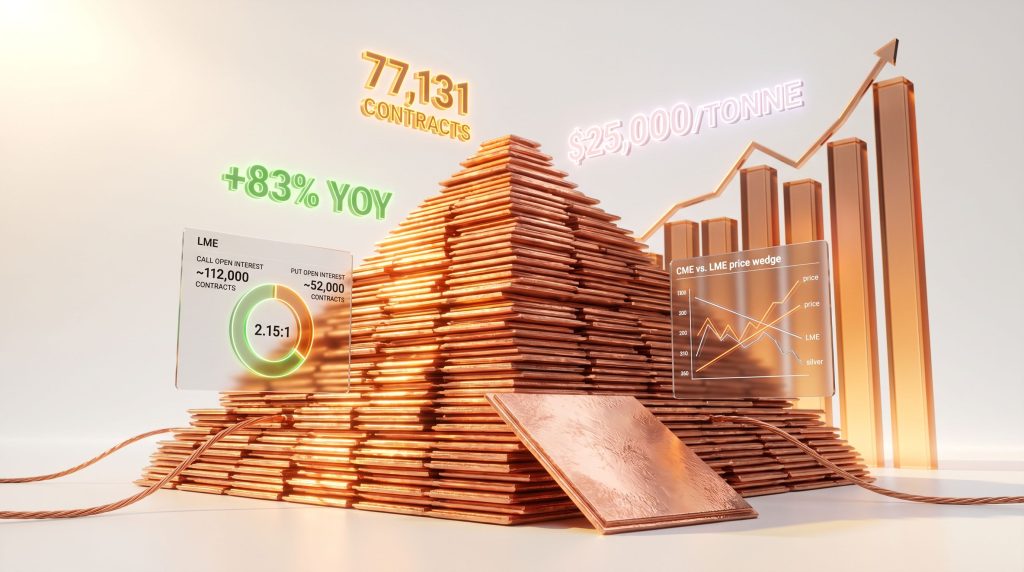
| Net long contracts at early June 2026 peak | 77,131 contracts |
| Net long contracts (current) | ~71,127 contracts |
| Last comparable bull commitment | Early 2021 |
| Fund short positions | Below 20,000 contracts (historically low) |
The near-total absence of short sellers in the CME copper market deserves particular attention. When short positioning falls below 20,000 contracts and holds there for an extended period, it signals that bears have effectively conceded the trade. In a market where algorithmic funds dominate the benchmark contract and feed on momentum signals, the absence of shorts removes a natural stabilising counterweight. If the uptrend holds, systematic funds extend long exposure. If it accelerates, they add more.
The LME Options Market: Where Copper Bulls Reveal Their True Ambitions
Futures positioning on the LME appears relatively measured compared to CME levels. The net investment long of approximately 34,918 contracts sits well below the 60,000-plus contract readings that characterised the second half of 2025. The LME three-month copper price has also been trading roughly $800 below its January 2026 peak of $14,527.50 per tonne, suggesting the London market is not experiencing the same tariff-driven premium as its U.S. counterpart.
However, the LME options market tells a dramatically more aggressive story.
| LME Options Metric | Data Point |
|---|---|
| Call option open interest (through Dec 2026) | ~112,000 contracts |
| Put option open interest (through Dec 2026) | ~52,000 contracts |
| Call-to-put ratio | Approximately 2.15:1 |
| Largest bullish cluster: Sep 2026 strike | $15,500/tonne (17,526 contracts) |
| Second-largest bullish cluster: Sep 2026 | $17,000/tonne (16,773 contracts) |
| Combined tonnage (top two strikes) | Over 850,000 tonnes |
| Most aggressive bullish strike | $25,000/tonne (Dec 2026) |
| Current LME three-month price | ~$13,800/tonne |
The ratio of approximately 2.15 calls for every put through December 2026 is striking in its own right. The concentration of open interest at strikes of $15,500 and $17,000 for September delivery represents a collective bet that the LME price must climb between 12% and 23% from current levels within roughly three months.
Perhaps most remarkable is the presence of a single market participant who has accumulated a strip of call options at a $25,000 per tonne strike, sized at 50 lots per month through December 2026. At current LME prices of around $13,800 per tonne, this position implies a near-doubling of price within six months. This is not a hedging instrument. It is a high-conviction directional bet on speculative momentum compounding into a price spiral that the physical market has never witnessed.
Retail Participation: When Copper Goes Mainstream
Institutional positioning captures the majority of analytical attention, but the structural shift happening at the retail end of the copper market may be equally significant for understanding where this cycle stands.
The CME micro copper contract, sized at one-tenth of the standard contract, has become the access point for retail traders seeking exposure to copper price movements without the capital requirements of the full contract. The growth statistics from the first five months of 2026 are remarkable:
- Volumes in the micro contract registered an 83% year-on-year increase across January through May 2026
- Over 3 million metric tonnes of copper traded through the micro contract in the first five months of 2026
- Open interest at end of May 2026 was three times higher than the equivalent period one year prior
Beyond futures, CME copper event options, which are binary instruments that pay out based on directional price outcomes, recorded 145,478 contracts in April 2026, an all-time record. The May 2026 figure of 58,594 contracts was the second-highest monthly total ever recorded.
What Is the CME Micro Copper Contract?
The CME micro copper contract is a futures instrument sized at one-tenth of the standard CME copper contract, designed to provide retail investors with accessible exposure to copper price movements. It has seen explosive growth in 2026, with volumes up 83% year-on-year and open interest tripling compared to the prior year.
Historically, the mainstream retail entry into a commodity market has been interpreted by experienced traders as a late-cycle signal. When the investment narrative of a commodity reaches widespread public awareness, it often means the institutional early-mover advantage has already been fully captured. This does not mean prices cannot continue rising, but it does imply that the risk-reward profile has shifted. In addition, exploring copper investment strategies remains essential for navigating these conditions effectively.
The next major ASX story will hit our subscribers first
The Money Power Precedent: What 2020 Teaches Us
The capacity of financial capital to override physical fundamentals is not a novel concept in copper markets. Analysts at Citi have estimated that fund buying absorbed approximately 1.5 million tonnes of copper in 2020, easily offsetting a physical surplus of 500,000 tonnes created by COVID-19 production and logistics disruptions, and drove prices materially higher despite the underlying fundamental weakness.
In 2026, a similar dynamic appears to be at work. Investors are pricing copper on its anticipated structural profile rather than on current supply-demand balances. The critical question is whether the structural demand thesis is sufficiently robust and near-term enough to justify the speculative premium already embedded in futures and options markets. Research into how speculators influence copper pricing provides important academic context for understanding these dynamics.
Bull Case vs. Bear Case: A Structured Assessment
| Factor | Bull Signal | Bear Signal |
|---|---|---|
| Fund positioning (CME) | Net long at multi-year highs | Short sellers near historic lows, reversal risk |
| LME options activity | 2.15:1 call-to-put ratio | $25K strikes imply extreme optimism |
| Retail participation | Record micro contract volumes | Retail influx is historically a late-cycle indicator |
| Tariff dynamics | CME premium supports domestic prices | Premium collapses if tariff uncertainty resolves |
| Supply fundamentals | Disruption risk and deficit fears | Goldman Sachs sees surplus potentially re-emerging in H2 2026 |
| LME price action | Rebuilding since March lows | Still ~$800 below January 2026 peak |
Goldman Sachs analysts have flagged that the copper rally may be entering its late stages, with speculative positioning already elevated relative to historical norms. Their base case anticipates price softening in the second half of 2026 as tariff uncertainty resolves and markets refocus on what may be an underlying global supply surplus.
The consistently weaker LME price relative to CME supports this reading. If the tariff premium, rather than fundamental scarcity, is doing the primary heavy lifting in price formation, then resolution of the tariff uncertainty could rapidly deflate a meaningful portion of the current valuation. Furthermore, understanding the broader trade war and copper prices relationship is critical for assessing how quickly this dynamic might shift.
How Speculative Capital Actually Moves Copper Prices
Understanding the mechanics of financial demand in a supply-constrained physical market is essential context for interpreting current copper pricing. Annual refined copper production globally is measured in the low tens of millions of tonnes, making it a relatively finite physical market.
When institutional investors accumulate futures positions at scale, they create synthetic demand that competes directly with physical buyers for price discovery influence. Unlike equities, futures contracts eventually require physical settlement or rollover decisions that have real consequences for spot market dynamics.
Critically, neither copper supply nor consumption responds meaningfully to price signals in the short term:
- Supply inelasticity: Opening a new copper mine or expanding an existing one takes years of permitting, capital deployment, and construction. Higher prices today do not translate into additional physical metal for five to ten years.
- Demand inelasticity: Manufacturers using copper in industrial processes cannot easily substitute alternatives in the short term. Copper's unique conductivity and malleability make it functionally irreplaceable across most applications.
This double inelasticity means speculative capital can move copper prices substantially before fundamentals reassert themselves. It also means that when speculative consensus shifts, there is limited natural cushion on the downside.
Frequently Asked Questions: Copper Investor Speculation
What Is Driving Copper Speculation in 2026?
Copper investor speculation in 2026 is being driven by structural demand narratives linked to energy transition and AI infrastructure, U.S. tariff policy creating a CME-LME price wedge, supply disruption concerns at major producing assets, and momentum-driven algorithmic fund positioning. Retail participation has expanded significantly through smaller futures instruments.
How High Could Copper Prices Go Based on Current Options Positioning?
The LME options market shows the largest concentrations of bullish bets at $15,500 and $17,000 per tonne for September 2026. The most extreme positioning involves call options at a $25,000 per tonne strike for December 2026, nearly double the current LME three-month price of approximately $13,800 per tonne.
Is Copper Speculation a Risk to Investors?
Yes. Goldman Sachs has indicated the speculative rally may be in its late stages, with a global supply surplus potentially re-emerging in the second half of 2026. When speculative consensus shifts in supply-inelastic markets, reversals can be sharp, and the near-total absence of short sellers in the CME market removes a natural stabilising mechanism.
What Is the Difference Between CME and LME Copper Pricing?
The CME prices copper in U.S. dollars per pound and has been trading at a premium to the LME due to U.S. tariff speculation and pre-tariff stockpiling dynamics. The LME is the global benchmark for physical copper pricing, denominated in U.S. dollars per tonne.
Key Data Summary
| Metric | Value |
|---|---|
| CME net long peak (June 2026) | 77,131 contracts |
| CME net long (current) | ~71,127 contracts |
| Micro contract volume growth (YTD) | +83% year-on-year |
| Micro contract open interest vs. prior year | 3x higher |
| LME call option open interest (to Dec 2026) | ~112,000 contracts |
| LME put option open interest (to Dec 2026) | ~52,000 contracts |
| Record CME event options (April 2026) | 145,478 contracts |
| Most aggressive LME bull strike | $25,000/tonne (Dec 2026) |
| Estimated fund copper buying in 2020 (Citi) | ~1.5 million tonnes |
The copper market in 2026 is operating at the intersection of genuine structural transformation and elevated speculative excess. The energy transition and AI infrastructure narratives are real, long-duration demand drivers. However, the speed and magnitude of financial positioning relative to physical fundamentals suggests that a meaningful portion of future value has already been priced into current contracts.
For investors, distinguishing between structural conviction and momentum-chasing is not a stylistic preference. It is the core risk management discipline that will determine outcomes when, not if, the speculative tide eventually turns.
This article contains references to forward-looking market positioning and analyst forecasts. All such information involves inherent uncertainty and should not be interpreted as financial advice. Investors should conduct independent research and seek professional guidance before making investment decisions related to copper or any commodity market.
Want to Catch the Next Major Copper Discovery Before the Market Does?
Discovery Alert's proprietary Discovery IQ model scans ASX announcements in real time, delivering instant alerts on significant mineral discoveries — including copper — so subscribers can act ahead of the broader market rather than reacting to momentum already in motion. Explore historic discovery returns on Discovery Alert's discoveries page and begin a 14-day free trial to position yourself at the front of the next major find.