July 3, 2026
Two Mining Giants, One Portfolio Decision: Understanding the Real Differences Between BHP and Rio Tinto
The global mining sector operates in long, unforgiving cycles. Capital-intensive projects take decades to develop, commodity prices swing violently in response to macroeconomic forces, and the difference between a generational wealth-builder and a value trap often comes down to one word: diversification. For Australian investors navigating the ASX resources sector, few decisions carry more weight than the choice between BHP Group Ltd (ASX: BHP) and Rio Tinto Ltd (ASX: RIO) — making the debate around BHP shares vs Rio Tinto shares one of the most consequential in the market.
Both companies share remarkable structural similarities: world-class low-cost assets, strong free cash flow generation capacity, fully franked dividends, and a combined weighting that makes them near-unavoidable for any serious ASX portfolio. Yet beneath those surface-level similarities lies a meaningful divergence in commodity mix, strategic direction, and long-term earnings trajectory that every investor should understand deeply.
When big ASX news breaks, our subscribers know first
The Commodity Mix Debate: Why What You Mine Matters More Than How Much You Mine
When comparing two mining giants of this scale, the instinct is to evaluate them on production volumes, balance sheet strength, or recent share price performance. However, the more durable analytical lens is commodity exposure. Over a full market cycle, the commodities a miner produces ultimately determine its earnings profile, its sensitivity to macroeconomic conditions, and its alignment with structural demand shifts.
Iron Ore Dependency: A Double-Edged Sword for Both Companies
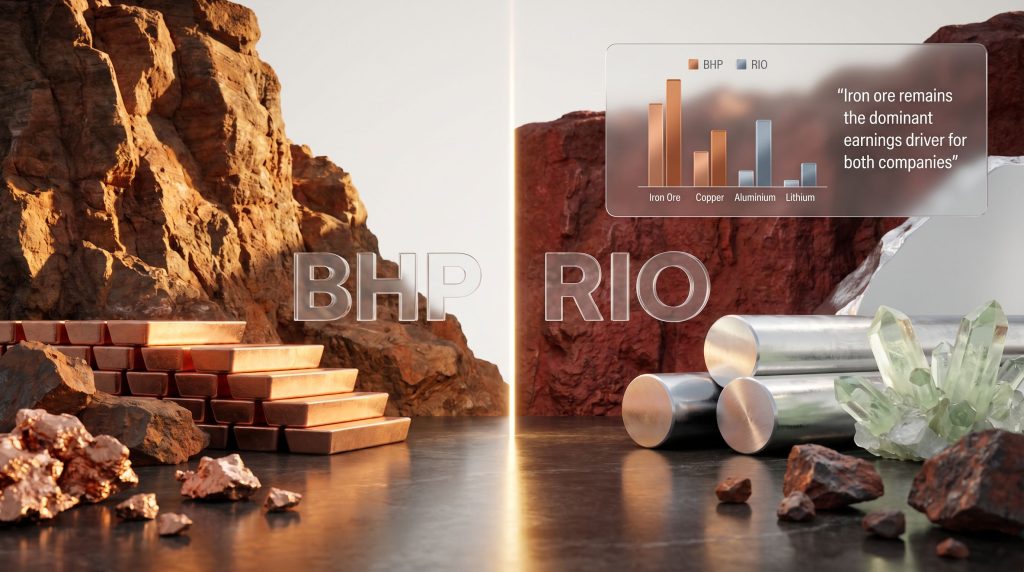
Iron ore remains the dominant earnings engine for both BHP and Rio Tinto. Rio Tinto's Pilbara operations in Western Australia are widely regarded as among the finest large-scale mining assets anywhere in the world, characterised by vast ore bodies, low strip ratios, and highly efficient logistics infrastructure. BHP's own iron ore division is similarly exceptional in terms of scale and cost position.
The challenge is that iron ore is deeply cyclical. Demand is overwhelmingly driven by Chinese construction, infrastructure spending, and steel production. Monitoring iron ore price trends is therefore essential for investors in either company, particularly given how sharply prices can fall when Chinese property sector activity contracts.
Risk Consideration: Investors with meaningful concern about a prolonged structural slowdown in Chinese property and construction activity should carefully evaluate just how much of each company's underlying earnings depends on iron ore price assumptions before committing capital.
Breaking Down the Commodity Portfolios: BHP vs Rio Tinto Side-by-Side
| Commodity Exposure | BHP | Rio Tinto |
|---|---|---|
| Iron Ore | Major | Dominant |
| Copper | Large and Growing | Present but Smaller |
| Aluminium | Minimal | Major |
| Lithium | Minimal | Developing |
| Potash | Jansen Project (Long-Term) | None |
| Coal | Exited | Exited |
What this table reveals is not simply a list of commodities, but a picture of diverging strategic bets about where value will be created over the next decade. Rio Tinto has concentrated more heavily in aluminium and is building out lithium exposure through assets including the Rincon project in Argentina and the Jadar lithium-borates project in Serbia.
BHP, by contrast, has made copper its clear growth priority and is building potash exposure through its massive Jansen project in Saskatchewan, Canada. The BHP strategic pivot away from coal and towards future-facing commodities reflects a deliberate long-term positioning decision.
Why Commodity Mix Determines Earnings Volatility Over Market Cycles
A less commonly understood dynamic in mining investment is the concept of earnings beta relative to individual commodities. Because iron ore prices are highly sensitive to Chinese credit cycles, companies with more concentrated iron ore exposure will experience more pronounced swings in earnings, dividends, and share price during commodity downturns. Diversification across commodities with uncorrelated demand drivers reduces this earnings beta considerably.
Why Copper Could Be the Decisive Factor in This Comparison
No single commodity better illustrates the divergence between BHP shares vs Rio Tinto shares than copper. Understanding why requires moving beyond short-term price movements and examining the structural forces shaping supply and demand over the next ten to fifteen years.
The Structural Demand Case for Copper Over the Next Decade
The copper supply crunch is being driven by multiple simultaneous forces that are reshaping demand forecasts across the industry:
- Electric vehicle manufacturing and charging infrastructure require significantly more copper per unit than conventional vehicles
- Utility-scale solar and wind energy installations are highly copper-intensive relative to thermal power generation
- Data centre construction, particularly facilities supporting artificial intelligence workloads, uses substantial copper in power distribution and cooling systems
- Industrial electrification across emerging markets in Asia, Africa, and Latin America is adding base-level demand independent of the energy transition narrative
- Grid modernisation programmes in developed economies require extensive copper wiring upgrades
Furthermore, the copper growth drivers underpinning long-term demand appear durable rather than cyclical, making copper exposure a structurally different earnings contributor compared to iron ore.
Why New Copper Supply Cannot Easily Meet Projected Demand
The supply response to rising copper demand faces structural constraints that make it fundamentally different from commodities where new production can be brought online quickly:
- Mine development timelines from discovery to first production typically span 10 to 15 years, meaning projects approved today will not meaningfully contribute to supply until well into the 2030s
- Ore grades at many established copper mines have been declining for decades, meaning more rock must be processed to produce the same volume of metal
- Major copper-producing regions including Chile, Peru, and the Democratic Republic of Congo carry varying degrees of geopolitical, regulatory, and social licence risk
- Water scarcity in the Atacama Desert region of Chile is becoming an increasingly material operational constraint
How BHP's Copper Assets Position It Differently to Rio Tinto
BHP's copper portfolio is anchored by Escondida in Chile, the single largest copper mine in the world by production volume, alongside Olympic Dam in South Australia. Olympic Dam contains copper, uranium, gold, and silver, and its underground ore body is among the largest known copper resources globally, though its complex mineralogy makes processing more capital-intensive than simpler porphyry deposits.
BHP has also been actively expanding its copper footprint through the acquisition of OZ Minerals, completed in 2023, which added the Carrapateena and Prominent Hill operations in South Australia to its portfolio. In addition, the Rio Tinto copper expansion through Oyu Tolgoi in Mongolia is finally entering its underground production phase, which will materially grow Rio Tinto's copper output over coming years.
However, BHP's current production scale and near-term growth pipeline in copper is broadly viewed as larger, giving it a more pronounced exposure to the energy transition demand theme.
Market analysis from multiple independent sources has noted that BHP's recent share price performance relative to Rio Tinto has been meaningfully supported by its copper operations, with this contribution representing a structurally different and more durable earnings driver than iron ore's cyclical swings.
The Iron Ore Question: How Exposed Is Each Miner to China's Property Cycle?
Rio Tinto's Pilbara Operations: World-Class but Concentrated
Rio Tinto's iron ore business in the Pilbara is genuinely exceptional. The company operates a network of mines, rail infrastructure, and port facilities that together form one of the most logistically integrated and cost-efficient resource supply chains in existence. The Pilbara's hematite ore is generally of high quality, with iron content levels that are competitive in global seaborne markets.
However, the concentration of Rio Tinto's earnings in this single commodity and single geography creates meaningful cyclical exposure. In years when iron ore trades above USD 100 per tonne, Rio Tinto generates extraordinary profits. In periods of weaker pricing, earnings decline sharply and dividend payments follow accordingly.
Historical Iron Ore Price Volatility and Its Impact on Miner Earnings
Iron ore has historically been one of the most volatile of the major bulk commodities. Prices have ranged from below USD 40 per tonne during oversupply periods to above USD 200 per tonne during the 2021 demand surge. This volatility directly transmits into mining company earnings because iron ore operations have relatively fixed production costs, meaning margins expand and contract dramatically with price movements.
Dividend Analysis: Which Miner Offers Better Income Potential?
How Both Companies Structure Their Dividend Policies
Both BHP and Rio Tinto operate progressive dividend frameworks with the capacity to pay supplementary or special dividends during periods of exceptional profitability. Both companies pay fully franked dividends on their ASX listings, making them particularly attractive for Australian resident investors and self-managed superannuation fund trustees.
| Dividend Factor | BHP | Rio Tinto |
|---|---|---|
| Dividend Policy | Progressive + Special | Progressive + Special |
| Franking Credits | Fully Franked (ASX) | Fully Franked (ASX) |
| Yield Sensitivity | Tied to Copper + Iron Ore | Heavily Tied to Iron Ore |
| Income Consistency | Moderate-High | Moderate-High |
| Appeal to SMSF Investors | Strong | Strong |
When Rio Tinto's Dividend Yield Looks More Attractive Than BHP's
In periods of elevated iron ore pricing and strong Chinese demand, Rio Tinto's more concentrated exposure to that commodity can translate into a higher dividend yield relative to BHP. The company's lower capital reinvestment requirements compared to BHP's major growth projects also means a higher proportion of earnings can be returned to shareholders in the near term.
When BHP's Earnings Quality Supports a More Sustainable Payout
During commodity downturns, particularly those driven by weakness in Chinese property markets, BHP's more diversified earnings base can provide a higher floor for dividends. Copper revenues, which are less correlated with Chinese construction cycles than iron ore, help maintain earnings even when iron ore pricing softens. Consequently, BHP's payout profile is somewhat more resilient across the full commodity cycle.
BHP's Jansen Potash Project: A Long-Term Wildcard Worth Understanding
What Is Potash and Why Does It Matter?
Potassium-based fertilisers, collectively known as potash, are one of three primary macronutrients essential for crop growth. Unlike iron ore or copper, potash demand is driven by agricultural productivity rather than industrial activity or electrification, making it a genuinely non-correlated commodity within BHP's portfolio.
Global potash supply is highly concentrated, with Canada, Russia, and Belarus historically accounting for the majority of world production. Geopolitical disruptions, particularly those affecting Russian and Belarusian exports following 2022, have underscored the strategic importance of securing supply from politically stable jurisdictions.
How the Jansen Project Fits Into BHP's Strategy
The Jansen project in Saskatchewan, Canada, sits within one of the world's largest potash-bearing geological formations. BHP has committed to developing the project in staged phases, with Stage 1 targeting approximately 4.35 million tonnes per annum of muriate of potash production at full capacity. The first stage involves capital expenditure of approximately USD 5.7 billion.
Jansen is not expected to contribute materially to BHP's earnings profile until the second half of the 2020s at the earliest, with full ramp-up extending into the 2030s. However, for investors evaluating a ten-year holding period, it introduces agricultural commodity exposure that is structurally independent of the metals demand cycle.
Strategic Note: Jansen represents a deliberate hedge within BHP's portfolio construction logic, adding a third earnings dimension that is driven by food security and agricultural productivity rather than construction or electrification demand.
The next major ASX story will hit our subscribers first
Scenario Modelling: Which Stock Performs Better Under Different Futures?
Scenario 1: Copper Supercycle Materialises
If electrification demand accelerates faster than new copper supply can respond, BHP's large and growing copper asset base positions it to capture significant margin expansion and earnings upgrades. In this scenario, BHP's share price premium relative to Rio Tinto would likely widen materially.
Scenario 2: Iron Ore Remains Elevated on Chinese Stimulus
If Beijing deploys sustained infrastructure stimulus at scale, Rio Tinto's more concentrated iron ore exposure would likely translate into outsized dividend returns and relative share price strength compared to BHP. For instance, the 2021 iron ore price surge demonstrated exactly this dynamic in real time.
Scenario 3: Commodity Prices Moderate Broadly
In a lower-commodity-price environment, BHP's more diversified earnings base spanning iron ore, copper, and eventually potash may provide a higher earnings floor than Rio Tinto's more concentrated mix, offering relative downside protection.
Scenario 4: Energy Transition Accelerates Faster Than Expected
Rapid global decarbonisation would increase demand for copper simultaneously across multiple applications, directly benefiting BHP's copper-heavy portfolio more than Rio Tinto's. According to investment analysis comparing both miners, this scenario represents one of the most meaningful long-term differentiators between the two companies.
Who Should Buy BHP Shares vs Rio Tinto Shares?
| Investor Type | Recommended Consideration |
|---|---|
| Long-term growth investor (10+ years) | BHP: broader commodity mix, copper upside, potash optionality |
| Income-focused investor | Rio Tinto: historically competitive yield, iron ore leverage |
| Balanced portfolio investor | Either: both offer blue-chip quality and ASX index weight |
| Commodity cycle trader | Rio Tinto: higher iron ore beta for tactical positioning |
| SMSF investor seeking franked income | Both: fully franked dividends on ASX listings |
| ESG-conscious investor | Evaluate both on transition metal exposure and emissions targets |
Frequently Asked Questions: BHP Shares vs Rio Tinto Shares
Is BHP or Rio Tinto the better long-term investment?
For investors with a horizon of ten or more years, BHP's broader commodity mix and deliberate diversification into copper growth and potash gives it an edge from an earnings quality and diversification perspective. Rio Tinto remains an excellent business, but its more concentrated iron ore exposure introduces more cyclical earnings variability over the long run. Furthermore, independent comparisons of both miners consistently highlight this commodity mix distinction as the central consideration.
Which miner has the higher dividend yield?
This varies with commodity cycles. Rio Tinto has historically screened with a marginally higher dividend yield in periods of strong iron ore pricing, while BHP's more diversified earnings base tends to support more consistent payouts when iron ore prices are under pressure. Both pay fully franked dividends on ASX listings.
Can you hold both BHP and Rio Tinto in the same portfolio?
Yes, and many institutional and retail investors do exactly that. Because both companies have significant iron ore exposure, holding both increases concentration in that commodity. However, the diversification between BHP's copper and potash exposure and Rio Tinto's aluminium and lithium holdings does add meaningful portfolio breadth relative to owning just one.
Is Rio Tinto too dependent on iron ore?
Rio Tinto has been actively working to broaden its earnings base through aluminium, copper, and lithium development. However, iron ore continues to represent the dominant share of its earnings in most market conditions, which means the investment thesis remains substantially tied to Chinese steel demand and construction activity.
How does copper exposure affect BHP's investment case?
Copper provides BHP with earnings exposure to the global energy transition and electrification trend that is structurally different from iron ore's dependence on construction cycles. With supply growth constrained by long development timelines and declining ore grades, BHP's existing large-scale copper production capacity is a significant long-term asset for investors considering BHP shares vs Rio Tinto shares.
Key Takeaways: Structuring the BHP vs Rio Tinto Decision
Both companies represent among the highest-quality resource businesses available to ASX investors. The decision between them ultimately reflects individual portfolio priorities, time horizons, and commodity views. Key summary points for investors:
- Both BHP and Rio Tinto operate world-class, low-cost asset bases with strong free cash flow generation capacity across the cycle
- The core differentiator is commodity mix: BHP's copper growth and potash diversification versus Rio Tinto's aluminium scale and more concentrated iron ore earnings
- Income investors may find Rio Tinto's yield profile more attractive during strong iron ore cycles
- Growth and earnings-quality-focused investors are more likely to favour BHP's diversification trajectory and copper exposure
- BHP's Jansen potash project introduces a genuinely non-correlated commodity dimension that adds strategic long-term value beyond metals
- Neither company is a poor investment choice for long-term holders; the decision reflects portfolio construction logic more than fundamental quality differences
This article is general in nature and does not constitute personal financial advice. Past performance is not indicative of future returns. Investors should consider their own financial circumstances and objectives before making investment decisions, and seek professional advice where appropriate.
Want To Know Which ASX Mineral Discoveries Could Deliver the Next Major Return?
Discovery Alert's proprietary Discovery IQ model scans ASX announcements in real time, instantly translating complex mineral data into actionable opportunities across more than 30 commodities — visit the Discovery Alert discoveries page to explore historic examples of extraordinary returns, and begin your 14-day free trial to position yourself ahead of the broader market.