June 18, 2026
When Commodity Windfalls Collide With Geopolitical Fault Lines
Resource-rich nations have always faced a paradox at the heart of their prosperity: the same commodity cycles that fill government coffers can simultaneously destabilise the broader economy through inflation, currency pressures, and trade distortions. Canada is living through exactly this tension in 2026, with the Canada economy oil windfalls and trade wars dynamic navigating a moment where record-level energy export revenues are arriving precisely as bilateral trade relationships with its largest trading partner grow increasingly unpredictable.
Understanding Canada's current economic position requires looking beyond the headline trade numbers. The country sits at the intersection of three powerful forces: a global energy market reshaped by Middle East conflict, a North American trade architecture under its most serious review in decades, and a domestic inflation dynamic that makes monetary policy responses genuinely difficult to calibrate.
When big ASX news breaks, our subscribers know first
Canada's Export Machine: What the March 2026 Numbers Actually Reveal
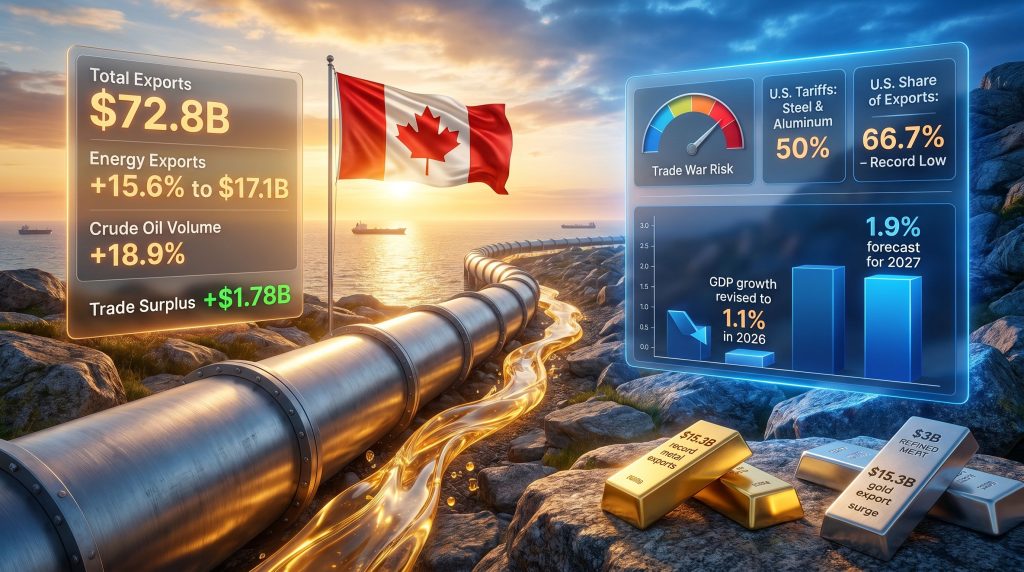
The March 2026 trade data landed with considerable force. Canada's merchandise trade balance swung to a $1.78 billion surplus, a dramatic reversal against market forecasts that had anticipated a deficit of $2.88 billion. Total exports climbed 8.5% to $72.8 billion, reaching the second-highest level ever recorded for a single month.
| Metric | Value | Context |
|---|---|---|
| Merchandise Trade Balance (March 2026) | +$1.78B surplus | vs. forecast deficit of -$2.88B |
| Total Exports | $72.8B | Second-highest level on record |
| Energy Export Growth | +15.6% to $17.1B | Highest since September 2022 |
| Crude Oil Export Growth | +18.9% volume increase | Driven by 33.1% price spike |
| Metal Products Exports | +24.0% to record $15.3B | Led by $3B surge in gold exports |
| Total Imports | -1.6% to $71.0B | Driven by lower consumer goods volumes |
Energy exports were the primary engine, surging 15.6% to $17.1 billion, the strongest monthly reading since September 2022. Furthermore, crude oil volumes rose 18.9%, amplified by a 33.1% price spike that reflected broader disruption across global oil markets. Tracking crude oil price trends helps contextualise just how significant this repricing has been for Canadian exporters. Metal products exports also hit a record $15.3 billion, driven substantially by a $3 billion surge in gold exports as safe-haven demand intensified amid geopolitical uncertainty.
On the import side, total inflows fell 1.6% to $71.0 billion, led by reduced volumes of consumer goods, pharmaceuticals, and aircraft. The combination of surging exports and contracting imports produced a trade surplus that few analysts had anticipated going into the release.
The Trans Mountain Pipeline Factor
One development that deserves specific attention is the role of completed pipeline infrastructure in reshaping where Canadian crude actually flows. The Trans Mountain Expansion Project, which reached full commercial operation in 2024, added approximately 590,000 barrels per day of capacity to the Westridge Marine Terminal in Burnaby, British Columbia. This opened meaningful Pacific Basin access for Alberta crude producers for the first time at scale.
The strategic implication is significant. Before Trans Mountain's expansion, the overwhelming majority of Canadian crude exports moved south through pipelines into the United States, leaving producers with limited pricing alternatives and no real leverage against U.S. market conditions. Pacific access changes that calculus, creating the structural foundation for genuine export diversification toward Asian buyers, particularly refiners in South Korea, Japan, and China.
Key Insight: The Trans Mountain expansion is not merely an infrastructure story. It represents a fundamental shift in Canada's oil export optionality, converting what was previously a captive market relationship with the U.S. into one where alternative destinations are commercially viable at scale.
The Oil Paradox Canada Cannot Escape
High oil prices are delivering clear fiscal benefits. Energy revenues have contributed meaningfully to Canada's improved deficit position in FY 2025/26, with the federal shortfall narrowing by $11.5 billion to $66.9 billion, equivalent to 2.1% of GDP. For a government navigating significant spending commitments, this energy windfall has provided welcome breathing room.
However, the same price environment creates serious complications for monetary policy. Bank of Canada Governor Tiff Macklem has communicated that sustained elevated energy prices increase the difficulty of maintaining the central bank's 2% inflation target, raising the probability that interest rates may need to move higher to contain domestic price pressures. Higher rates, in turn, increase mortgage costs for Canadian households, slow business investment, and risk tipping an already fragile growth trajectory into deeper weakness.
This is the oil paradox in its purest form: the revenue windfall that improves government finances simultaneously creates the conditions that may force the central bank to act against household and business interests. As oilprice.com notes, Canada's economy is genuinely caught between competing pressures that resist simple policy resolution.
The Risk Landscape: What Canada's Market Participants Are Actually Worried About
The Bank of Canada's 2026 Market Participants Survey provides a rare, structured window into professional risk assessment across the financial sector. The results reveal a risk hierarchy that has shifted meaningfully compared to previous survey periods.
Top three downside risks identified:
- Middle East geopolitical tensions, including the Iran conflict, flagged by 82% of respondents
- Escalating global trade tensions, identified by 79% of respondents
- Tightening global financial conditions, cited by 57% of respondents
The elevation of Middle East conflict above trade tensions as the primary downside risk reflects how dramatically the Hormuz disruption has reordered market priorities. The Strait of Hormuz is the world's most critical oil chokepoint, handling roughly 20% of global oil trade at normal operating conditions. Disruptions at this point in the supply chain cascade through oil, gas, and fertilizer markets simultaneously, affecting energy prices, agricultural input costs, and shipping economics across interconnected global supply chains.
For Canada, the connection is indirect but economically meaningful. Higher global oil prices benefit Canadian export revenues, but the same disruption-driven price spike accelerates domestic inflation and complicates the Bank of Canada's rate-setting decisions.
Upside risk factors identified in the same survey:
| Upside Risk Factor | % of Survey Respondents |
|---|---|
| Easing of U.S.-Canada trade tensions | 82% |
| Larger-than-expected fiscal stimulus | 57% |
| Declining geopolitical risks + higher commodity prices | 43% |
The near-perfect symmetry between the top downside risk (geopolitical tensions at 82%) and the top upside risk (trade tension easing at 82%) illustrates how evenly balanced Canada's economic outlook currently is. Resolution of either condition would materially shift the growth trajectory in one direction.
The U.S.-Canada Trade War: Tariff Architecture and Real-World Consequences
The tariff structure already in place between Canada and the United States is more extensive than is commonly appreciated in general coverage. The U.S.-Canada trade war has produced a current tariff regime that includes:
- Steel and aluminum: 50% tariff
- Softwood lumber: 35.2% combined anti-dumping and countervailing duties
- Automobiles: 25% tariff on exports from Canada
- Copper and copper products: 50% tariff
- Canada's retaliatory measures: Targeted levies maintained on U.S. steel, aluminum, and auto products following the removal of the broader $30 billion package in September 2025
What makes these numbers particularly meaningful is the export concentration they affect. Canada's total exports to the U.S. fell to just 66.7% of all merchandise exports in March 2026, the lowest share ever recorded. Even at this reduced proportion, the U.S. remains the destination for two-thirds of everything Canada sells abroad, which means the leverage the U.S. holds through tariff policy remains substantial.
Canada's trade surplus with the United States widened to $7.1 billion in March, driven significantly by an 8.3% increase in passenger car and light truck shipments to $48.51 billion. Meanwhile, imports from the U.S. contracted 1.2% to $41.44 billion. The divergence between rising export values and falling import volumes suggests a structural rebalancing is already underway, though it reflects both tariff diversion effects and the impact of weakening Canadian consumer confidence.
CUSMA at a Crossroads: Three Possible Outcomes
The Canada-United States-Mexico Agreement, known as CUSMA in Canada and USMCA in the United States, entered effect in July 2020 and replaced NAFTA. Its scheduled review process is now one of the most consequential policy events in Canada's near-term economic calendar. Understanding the broader impact of trade wars and supply chains helps frame why the stakes of these negotiations extend well beyond bilateral political posturing.
| Scenario | Description | Probability Assessment | Economic Impact |
|---|---|---|---|
| Base Case | 16-year CUSMA extension with minor modifications | Most likely | Moderate stability, limited disruption |
| Bilateral Split | U.S. restructures into separate Canada and Mexico deals | Moderate risk | Increased complexity, sector-specific volatility |
| Fragmentation Scenario | U.S. imposes up to 35% tariffs on all Canadian exports | Tail risk | Potential Canadian recession |
A key technical element of CUSMA negotiations involves the automobile content rules. The agreement requires that 75% of automobile components be manufactured within North America to qualify for zero-tariff treatment. This provision is central to the automotive sector's current tariff exposure and will be a focal point in any renegotiation.
Negotiations are widely expected to extend into the fall of 2026, partly because U.S. midterm election dynamics create political incentives that complicate deal-making in the near term.
Recession Threshold: Canada faces meaningful recession risk primarily if two conditions occur simultaneously: U.S. tariffs escalate to the 35% across-the-board fragmentation scenario under a CUSMA breakdown, and global oil prices decline materially, removing the energy revenue cushion that is currently offsetting trade-war damage.
Projections suggest a full-scale trade war could reduce Canadian GDP by approximately 1.5% at its 2026 peak, with potential job losses approaching 250,000 positions under a severe escalation scenario. The manufacturing sector carries the highest direct exposure, with consumption and capital expenditure effects spreading outward from there.
Canada's Policy Response: Building Buffers Against Dual Pressures
The Fiscal Position in Context
Finance Minister François-Philippe Champagne's spring economic update delivered a mixed but broadly credible picture. GDP growth is projected to slow to 1.1% in 2026, down from 1.7% in 2025, before recovering to a forecast 1.9% in 2027. The improved deficit outcome for FY 2025/26, narrowed to $66.9 billion or 2.1% of GDP, owes a meaningful portion of its improvement to elevated energy sector revenues.
The 2027 recovery forecast carries real conditions. It assumes trade tensions do not escalate to the fragmentation scenario, that oil prices remain supportive without pushing inflation high enough to require aggressive rate increases, and that business investment recovers as uncertainty around CUSMA resolves. These are not unreasonable assumptions under the base case, but they represent genuine dependencies rather than certainties.
Canada's First Sovereign Wealth Fund
Perhaps the most structurally significant policy development of 2026 has been the establishment of the Canada Strong Fund. Key features include:
- Government seed commitment: $25 billion over three years on a cash basis
- Investment mandate: Market-rate commercial returns alongside private capital co-investment
- Target sectors: Clean energy, fossil fuels, transportation infrastructure, telecommunications, advanced manufacturing, and critical minerals
- Unique feature: A planned retail investment product enabling individual Canadians to co-invest directly in the fund and participate in financial returns
The timing of this launch is deliberate and strategically defensible. Establishing a sovereign wealth fund during a period of elevated energy revenues allows the government to capture windfall receipts before a potential commodity cycle turn, converting temporary income into long-term productive capital. Norway's Government Pension Fund Global, the world's largest sovereign wealth fund, was built on precisely this logic during its North Sea oil expansion period.
The Canada Strong Fund's dual commercial and nation-building mandate distinguishes it from pure return-maximising vehicles. Its critical minerals strategy focus is particularly relevant given the global supply chain realignment underway in battery materials, rare earths, and industrial metals, all of which intersect directly with Canada's existing geological endowments in Ontario, Quebec, and British Columbia.
West Coast Pipeline Infrastructure as a Strategic Hedge
Canada has cleared regulatory pathways for additional West Coast oil pipeline infrastructure, a move that extends the strategic logic established by the Trans Mountain expansion. Every increment of Pacific export capacity that comes online reduces the structural leverage the U.S. holds through tariff threats against Canadian energy exports. Building export optionality during a period of bilateral tension is a sound defensive posture, even if the commercial timelines for new capacity extend beyond the current trade negotiation cycle.
The next major ASX story will hit our subscribers first
Canada's Economic Outlook Through 2027: Navigating the Narrow Path
The 1.1% GDP growth forecast for 2026 is below trend but does not constitute a recessionary outcome under the base case. Canada's economic challenges are well documented, though the resource extraction sector, which posted robust growth through 2024 as documented in the 2025 State of Trade report, continues to provide a partial buffer against weakness in manufacturing and consumer spending.
The critical minerals dimension adds a longer-term investment rationale that extends well beyond current commodity price cycles. Canada holds significant reserves of lithium, cobalt, nickel, and rare earth elements, materials that are central to global clean energy transition supply chains. The Canada Strong Fund's mandate to invest in this sector represents a deliberate attempt to build economic diversification into the country's resource base before fossil fuel dependency becomes a structural liability.
For investors and analysts monitoring Canada economy oil windfalls and trade wars dynamics, the key variables to track through the remainder of 2026 include the trajectory of CUSMA negotiations, the Bank of Canada's rate decisions relative to inflation data, global crude price direction, and any escalation or de-escalation in the Middle East conflict that is currently the dominant risk identified by market participants. Research from institutions examining Canada's economic strategy during trade wars suggests that alternative market development and export diversification remain the most durable long-term responses available to policymakers.
The oil windfall is real, it is measurable in the trade data, and it is buying Canada time. Whether that time is used effectively to build export diversification, capitalise the sovereign wealth fund, and reach a durable trade settlement with Washington will determine whether the 2027 growth recovery becomes a realised outcome or a forecast that circumstances overtook.
This article contains forward-looking projections, scenario analyses, and survey data that reflect conditions and expectations as of the time of writing. Economic forecasts are inherently uncertain and subject to revision. Nothing in this article constitutes financial or investment advice.
Want To Capitalise on the Commodity Trends Shaping Global Markets?
Discovery Alert's proprietary Discovery IQ model delivers real-time alerts on significant ASX mineral discoveries — including gold, copper, and critical minerals central to the supply chain shifts explored in this article — instantly converting complex market data into actionable investment insights for traders and long-term investors alike. Explore historic examples of major mineral discoveries and their market returns, then begin your 14-day free trial to position yourself ahead of the next significant discovery.