May 20, 2026
The Hidden Transmission Belt: How Middle East Conflict Pricing Reaches Latin American Equity Markets
Most investors instinctively track geopolitical risk through the lens of the directly affected region. Yet some of the most consequential market movements triggered by Middle East military tensions occur thousands of kilometres away, in economies that hold no territorial stake in the conflict whatsoever. Mexico's equity markets offer a textbook case of this phenomenon. When Iran-US war talks oil markets Mexico stocks become the subject of global scrutiny, the consequences land with measurable precision on Mexico's benchmark indices, its mining sector, its monetary policy trajectory, and ultimately its broader industrial economy.
Understanding why requires mapping the transmission belt between geopolitical risk and capital markets, a mechanism that operates through energy pricing, inflation dynamics, currency sentiment, and institutional investor behaviour simultaneously.
When big ASX news breaks, our subscribers know first
Oil as the Primary Transmission Channel
The Strait of Hormuz: Where Military Strategy Meets Energy Economics
The Strait of Hormuz is a narrow maritime corridor separating Iran from Oman, and it functions as the single most consequential energy chokepoint on the planet. Approximately 20% of globally traded oil flows through this passage, alongside a substantial portion of liquefied natural gas exports. When military escalation between Washington and Tehran reaches a point where mining operations, drone deployments, or blockade threats become credible, energy markets do not wait for confirmation before repricing risk.
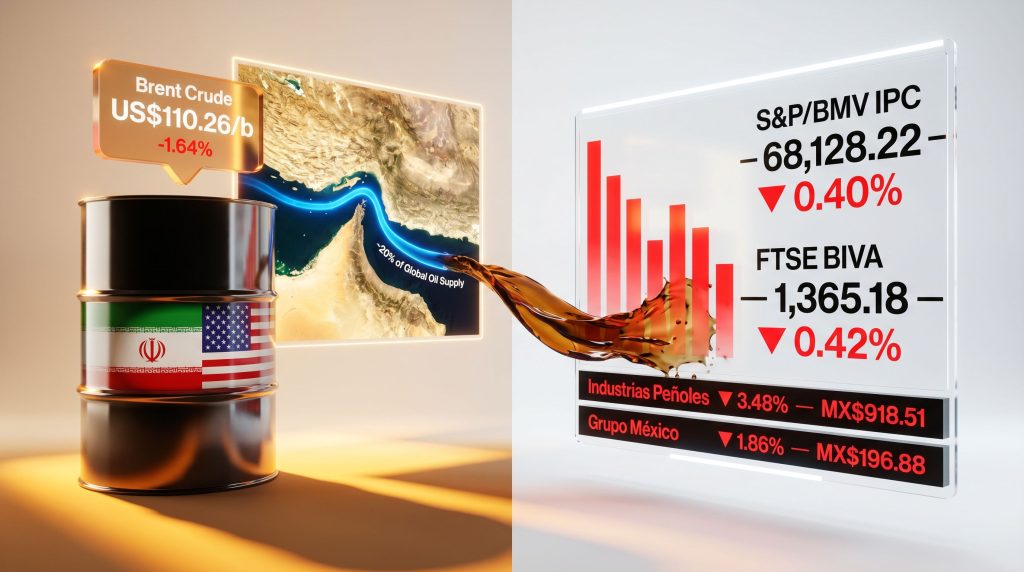
As of May 19, Brent crude was trading at US$110.26 per barrel, reflecting a decline of 1.64% on the day following diplomatic signals from Washington, but still sitting at a level that embeds a substantial geopolitical risk premium relative to pre-conflict baselines. The modest daily decline was itself instructive: markets interpreted the diplomatic language as leaving some space open for negotiation, not as signalling imminent resolution. Monitoring crude oil price trends helps investors understand how quickly these premiums can shift.
The broader vulnerability is illustrated starkly by South Korea's energy exposure. The country sources approximately 70% of its crude oil imports from the Middle East, with 60% of that volume transiting the Strait of Hormuz. A physical disruption to Hormuz transit would not merely affect bilateral US-Iran trade flows. It would cascade across the entirety of Asian manufacturing, supply chain economics, and inflationary dynamics globally, with ripple effects that reach Mexico's peso, its central bank policy rate, and its equity benchmarks.
How Markets Price the Full Spectrum of Diplomatic Outcomes
| Scenario | Oil Price Direction | Equity Market Response | Mexico-Specific Impact |
|---|---|---|---|
| Ceasefire agreement reached | Downward pressure on Brent | Risk-on rally, equities rise | Lower import costs, eased inflation pressure |
| Talks stall, no agreement | Upward spike in crude | Volatility spike, risk-off | Higher fiscal pressure, inflation acceleration |
| Limited military strike | Sharp short-term spike | Sector rotation to energy/defence | Peso depreciation risk, tighter monetary policy |
| Full conflict escalation | Sustained price surge | Broad equity selloff | Severe fiscal and monetary pressure |
Each scenario carries a distinct probability weighting that shifts in real time as diplomatic signals, troop movements, and political statements enter the news cycle. The oil price shock risks are particularly pronounced given the compressed timeline articulated by US President Donald Trump, who publicly stated on May 19 that a military decision could come within "two or three days" if negotiations failed to produce results, injecting acute uncertainty into market pricing that no hedging model can fully neutralise.
Trump also confirmed he had been within an hour of ordering a new strike on Iran before standing down, a disclosure that itself functioned as a volatility catalyst across global risk assets. Analysts have noted that even a ceasefire agreement would not signal a quick return to market normalcy.
Mexico's Structural Vulnerability to Oil Price Shocks
The Energy Paradox at the Heart of Mexico's Industrial Economy
Mexico occupies a structurally paradoxical position in the global energy architecture. As a hydrocarbon producer operating through PEMEX, the country generates crude oil revenues tied to global benchmark pricing. Yet simultaneously, its downstream sector depends heavily on imported refined petroleum products to meet domestic demand, creating a net exposure to crude price elevation that is more complex than either a pure producer or pure importer would face.
When oil prices surge on geopolitical risk, Mexico experiences both a revenue benefit on the upstream side and a cost burden on the downstream side. However, the balance of these effects is heavily influenced by the spread between production economics and refined product import prices. At sustained Brent levels above US$100 per barrel, the cost transmission through Mexico's industrial base typically outweighs the fiscal revenue benefit, particularly when fuel subsidy obligations managed through government energy policy require financing.
The sectors most exposed to a sustained high-oil-price environment include:
- Mining and metals processing: Energy accounts for a significant proportion of total operating costs across extraction, crushing, smelting, and refining operations. Silver and gold mining, as practised by Industrias Peñoles, and copper operations such as those run by Grupo México, are among the most energy-intensive industrial activities in Mexico's economy.
- Chemicals and specialty materials: Companies in petrochemical-adjacent industries face direct feedstock cost inflation when crude benchmarks remain elevated for extended periods.
- Logistics and transportation: Fuel cost escalation flows directly into freight and distribution costs, compressing supply chain economics across manufacturing and retail sectors.
- Export-oriented manufacturing: Mexico's automotive corridor and broader manufacturing base face margin compression when energy and logistics costs rise simultaneously, eroding the cost competitiveness that underpins export economics.
How Mexico's Stock Market Moved on May 19
Benchmark Indices and the Technical Deterioration Signal
Mexico's primary equity benchmark, the S&P/BMV IPC, declined 0.40% to 68,128.22 units on May 19. The parallel FTSE BIVA index on the Institutional Stock Exchange registered a nearly identical 0.42% decline to 1,365.18 units. These moves extended a multi-session period of weakness that had already left both indices below their one-month moving averages, a technical signal that market analysts characterised as broadly negative despite the partial stabilisation seen in the preceding session.
Market commentary from CopKapital noted that while the index had managed to stabilise on May 18 following two consecutive negative sessions, the technical picture remained fragile, with the dividend payment period offering the primary potential source of near-term support. This framing captures the dual dynamic facing Mexican equities precisely: geopolitical headwinds compressing risk appetite on one side, while seasonal dividend flows provide a partial technical cushion on the other.
Sector-Level Breakdown: Mining Stocks at the Epicentre
| Company | Sector | Price Change | Closing Price |
|---|---|---|---|
| Industrias Peñoles | Mining (Silver/Gold) | -3.48% | MX$918.51 |
| Grupo México | Mining (Copper) | -1.86% | MX$196.88 |
| Orbia | Chemicals/Infrastructure | -1.44% | MX$21.85 |
| S&P/BMV IPC (Index) | Broad Market | -0.40% | 68,128.22 units |
| FTSE BIVA (Index) | Broad Market | -0.42% | 1,365.18 units |
Why Mining Stocks Bear a Disproportionate Burden
The counterintuitive aspect of mining equity performance during geopolitical energy shocks is worth examining closely. Conventional market logic suggests that precious metals, particularly gold and silver, should benefit from gold safe-haven demand during periods of conflict-driven uncertainty. Industrias Peñoles, as one of the world's largest silver producers, might theoretically be expected to attract capital during a risk-off episode.
The reality is more nuanced. Mining operations carry an energy cost structure that is far more sensitive to crude price movements than most investors appreciate. Diesel fuel drives haul trucks, crushers, and ore transport. Electricity, often generated from fossil fuels, powers processing plants and ventilation systems. When Brent crude sits above US$110 per barrel for extended periods, energy cost inflation compresses operating margins across the entire extraction and processing value chain, regardless of what commodity is being mined.
Furthermore, for copper-focused operators like Grupo México, the pressure is compounded by a second concern. The relationship between copper market trends and broader economic conditions means that if sustained energy inflation triggers a global growth slowdown, industrial metals demand softens as manufacturing activity contracts. This creates a dual squeeze on revenues and costs simultaneously, a scenario that equity markets price in rapidly when geopolitical escalation looks credible.
The market's treatment of mining equities during oil price shocks reflects a fundamental reality about extraction economics: energy is not merely an input cost, it is the backbone of operational viability at scale.
Consequently, mining equities and gold prices do not always move in the same direction during geopolitical stress events, a distinction that investors tracking Mexico's mining sector must understand clearly.
The Diplomatic Architecture: Where Talks Stand
Key Actors and the Structure of Negotiations
The negotiation framework involves multiple sovereign actors operating across overlapping channels. Pakistan has served as the primary intermediary, having hosted the only confirmed round of direct bilateral talks and continuing to relay proposals between Washington and Tehran. A Pakistani diplomatic source characterised the process by noting that both sides continued to shift their positions, adding that available time for resolution was extremely limited.
The involvement of US Secretary of State Marco Rubio and UN Secretary-General António Guterres in discussions specifically around Hormuz transit security signals that the conflict had moved well beyond the scope of bilateral diplomacy into the territory of multilateral governance. Rubio emphasised the breadth of international support for preventing Iran from mining the waterway or imposing transit tolls, a development that prompted discussion of a potential UN Security Council resolution on the issue.
Iran's Negotiating Framework
According to statements attributed to Iranian Deputy Foreign Minister Kazem Gharibabadi via the IRNA news agency, Tehran's negotiating position encompassed several core demands:
- A full cessation of hostilities across all active fronts, including Lebanon.
- Withdrawal of US military forces from positions in proximity to Iranian territory.
- Reparations for infrastructure and civilian damage caused by US-Israeli strikes.
- Lifting of economic sanctions and release of frozen sovereign assets.
- Termination of the US naval blockade.
These demands were described as broadly similar in structure to a prior Iranian proposal that the Trump administration had rejected in the preceding week, raising questions about how much genuine negotiating space existed between the two sides. Reporting on these stalled negotiations confirms that markets have consistently reacted with renewed volatility whenever diplomatic momentum falters.
US Vice President JD Vance stated publicly that progress had been made in talks and that neither side wanted to see a resumption of full military campaigning, a signal that markets interpreted as leaving some diplomatic resolution pathway intact. However, the gap between stated US strategic objectives and the military outcomes achieved since the campaign began in late February remained substantial. The original declared aims of eliminating Iran's stockpile of near-weapons-grade enriched uranium and neutralising its regional power projection capabilities via missiles, drones, and proxy networks had not been achieved, creating a negotiating environment where neither party could claim decisive leverage.
Scenario Analysis: What Happens If Talks Break Down
Three Pathways and Their Market Consequences
Pathway One: Strait of Hormuz Disruption
If Iran were to mine the Strait or impose transit tolls, the supply shock to global oil markets would be immediate and severe. The cascading effects on Asian manufacturing economies, inflationary dynamics worldwide, and emerging market capital flows would be profound. For Mexico specifically, this scenario would likely produce accelerated Brent crude appreciation, renewed downward pressure on the peso as risk-off capital exits emerging markets, and a potential pause or reversal in Banxico's rate trajectory.
Pathway Two: Contained Military Exchange Without Hormuz Closure
A geographically bounded military strike, without disruption to Hormuz transit, would likely produce a sharp but temporary oil price spike followed by gradual normalisation as markets assessed escalation probabilities. Mexican equities would face volatility but could recover within days if the conflict remained contained. The peso would weaken initially but stabilise as risk appetite returned.
Pathway Three: Negotiated Settlement
A credible ceasefire agreement would likely trigger downward pressure on Brent crude as the geopolitical risk premium partially unwinds. Mexican equities, particularly mining and industrial names, would likely stage a relief rally. Critically, improved conditions would allow Banxico to resume any monetary easing trajectory it had been pursuing, with positive downstream effects on domestic credit growth, consumption, and corporate investment.
The next major ASX story will hit our subscribers first
Monetary Policy in the Crossfire
How Banxico Navigates Oil-Driven Inflation
The relationship between crude oil pricing and Mexican monetary policy is not linear, and this complexity is often underappreciated in market commentary. Banxico's policy calculus requires simultaneously weighing external inflation transmission from energy markets, domestic growth conditions that may warrant lower rates, peso stability considerations that constrain the degree of divergence from Federal Reserve policy, and longer-term inflation expectations that determine credibility.
Sustained Brent crude above US$100 per barrel historically generates second-order inflationary effects that move well beyond petrol pump prices. Energy cost inflation spreads through manufacturing inputs, logistics costs, food production, and ultimately consumer price indices, complicating the central bank's ability to maintain a rate-cutting trajectory that would otherwise support economic expansion.
In an environment where Banxico may have been positioned to continue easing monetary conditions, the persistence of elevated crude prices tied to Iran-US war talks oil markets Mexico stocks introduces upside inflation risks that could force a hold, or in an extreme scenario a reversal, of that trajectory. Both outcomes carry real economic costs: delayed rate cuts suppress credit expansion and investment activity, while rate increases in response to imported inflation risk choking domestic demand at a time when growth may already be under pressure.
Understanding the Geopolitical Risk Premium Lifecycle
How Markets Move Through Conflict Events
Historical analysis of geopolitical shock events reveals a recognisable pattern that experienced investors track closely:
- Initial shock phase: Rapid repricing of risk assets, oil spike, equity selloff, flight to safe-haven instruments including gold, US Treasuries, and the US dollar.
- Assessment phase: Markets evaluate escalation probability, duration of economic impact, and geographic containment. Volatility remains elevated but directional conviction is low.
- Resolution or normalisation phase: If conflict remains contained or resolves diplomatically, risk premiums unwind and equities recover. If escalation continues, a new, higher-risk equilibrium forms.
- Structural repricing: Extended conflicts force permanent adjustments to supply chain architecture, energy sourcing strategies, and geopolitical risk discounts embedded in affected market valuations.
Mexico currently sits at the boundary between the assessment phase and the resolution or normalisation phase, with the outcome depending almost entirely on whether the diplomatic window identified by both sides produces a workable agreement before the military option is reconsidered.
Why Emerging Markets Bear Asymmetric Exposure
Emerging market economies face structurally disproportionate exposure to geopolitical energy shocks compared to developed market peers. Several factors compound this vulnerability:
- Constrained monetary policy buffer: Higher baseline inflation and currency sensitivity limit central bank flexibility to absorb external shocks without domestic consequences.
- Commodity price dependency: Fiscal balances and export revenues are often tightly linked to commodity cycles that amplify rather than dampen the effects of geopolitical shocks.
- Capital flow sensitivity: Risk-off episodes disproportionately trigger capital outflows from emerging markets, creating currency and liquidity pressures that are independent of domestic economic fundamentals.
- Limited institutional hedging capacity: Smaller derivatives markets and less developed institutional investor bases reduce the ability of domestic actors to systematically hedge geopolitical risk exposure.
Key Data Reference: May 19 Market Snapshot
| Metric | Value | Market Significance |
|---|---|---|
| S&P/BMV IPC decline | -0.40% to 68,128.22 units | Below one-month moving average |
| FTSE BIVA decline | -0.42% to 1,365.18 units | Parallel weakness across exchanges |
| Brent crude | US$110.26/b (-1.64% on day) | Elevated geopolitical risk premium |
| Industrias Peñoles decline | -3.48% to MX$918.51 | Steepest single-stock session loss |
| Grupo México decline | -1.86% to MX$196.88 | Copper sector cost inflation pressure |
| Orbia decline | -1.44% to MX$21.85 | Chemicals sector secondary exposure |
| South Korea Hormuz dependency | 60% of Middle East crude via Hormuz | Global supply chain fragility indicator |
Disclaimer: This article is intended for informational purposes only and does not constitute financial or investment advice. All market data, price levels, and scenario projections referenced herein reflect conditions as reported on May 19 and are subject to rapid change. Past market behaviour during geopolitical events does not guarantee future outcomes. Readers should consult qualified financial advisers before making investment decisions.
Want to Stay Ahead of the Next Major Mineral Discovery Before the Market Catches On?
While geopolitical shocks like Iran-US tensions ripple through energy costs and mining equities globally, Discovery Alert's proprietary Discovery IQ model cuts through the noise — delivering real-time alerts on significant ASX mineral discoveries the moment they are announced, so subscribers can identify actionable opportunities ahead of the broader market. Explore Discovery Alert's discoveries page to understand how historic ASX discoveries have generated substantial returns, and start your 14-day free trial today to gain a genuine market-leading edge.