June 6, 2026
Two Giants, One Portfolio Slot: Understanding the Real Trade-Off
The global commodity landscape is undergoing one of its most structurally significant shifts in decades. Electrification is reshaping demand curves across metals markets, energy transition pressures are forcing a reassessment of fossil fuel valuations, and geopolitical volatility is injecting fresh uncertainty into supply chains that once appeared stable. Against this backdrop, Australian investors comparing BHP shares vs Woodside shares are not simply choosing between two large-cap resource stocks. They are making a fundamental decision about which structural forces they believe will dominate the next decade of global growth.
Understanding that distinction is the starting point for a genuinely useful comparison.
When big ASX news breaks, our subscribers know first
How BHP and Woodside Actually Generate Their Revenue
BHP's Multi-Commodity Architecture
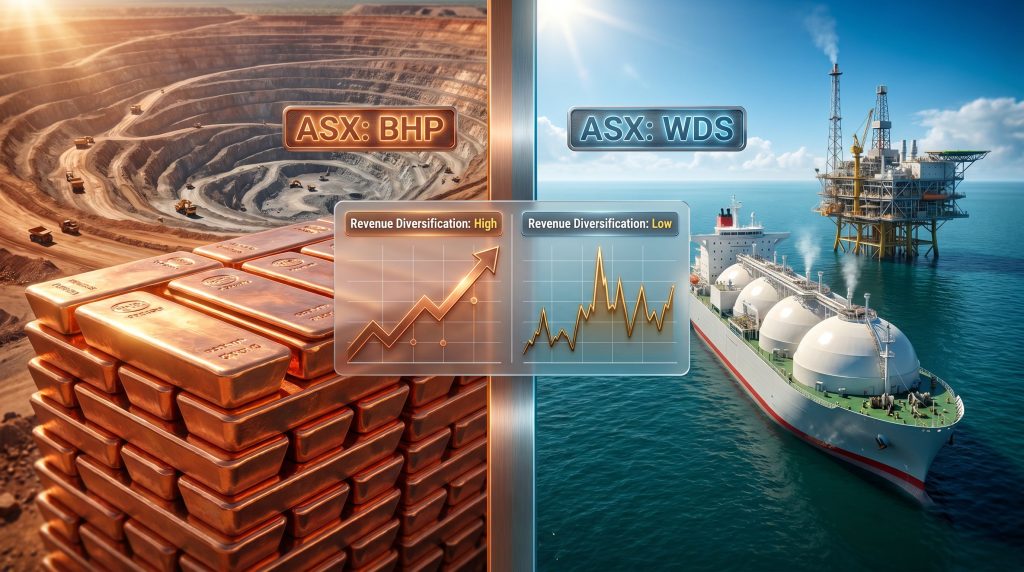
BHP Group (ASX: BHP) operates one of the most diversified commodity portfolios of any publicly listed mining company globally. Its revenue streams span iron ore, copper, metallurgical coal, and nickel, creating a business model where weakness in one commodity complex can be partially offset by strength in another.
Iron ore remains the single largest earnings contributor, with BHP's Pilbara operations consistently delivering among the lowest-cost iron ore globally. However, copper has become the company's strategic growth priority, and for good reason. BHP already holds the position of the world's largest copper producer, giving it unmatched scale in the commodity most closely linked to the electrification transition.
The diversification embedded in BHP's structure is not just a marketing point. It is a genuine risk management mechanism. When Chinese steel demand contracts and iron ore prices fall, copper and energy coal have historically provided earnings support, preventing the catastrophic earnings cliff that pure-play operators experience. Furthermore, BHP's strategic pivot away from fossil fuels and toward future-facing metals underscores this structural repositioning.
Woodside's Concentrated Energy Model
Woodside Energy (ASX: WDS) operates from a fundamentally different position. Its revenue base is almost entirely derived from liquefied natural gas exports and crude oil production, making it one of Australia's most significant energy exporters but also one of the most earnings-volatile large-cap ASX stocks during commodity price cycles.
Woodside's LNG facilities are high-quality assets with long reserve lives, and its position as a major supplier to Asian energy markets provides structural demand support. However, the company's financial performance tracks global oil and LNG benchmark prices with high correlation, meaning that macro energy price movements translate almost directly into earnings outcomes within a single reporting period.
This creates a binary dynamic for investors: elevated energy prices generate exceptional cash flows and dividends, while price normalisation compresses returns quickly and with limited natural hedging from other commodity exposures. For a broader view of what lies ahead, the LNG market outlook for 2025 highlights several key supply and demand dynamics worth considering.
The Structural Forces Reshaping Each Company's Long-Term Thesis
Copper: The Electrification Metal With a Supply Problem
The copper demand outlook is arguably the most compelling structural story in global commodities today. Several converging forces are expected to drive sustained demand growth over the coming decade:
- Electric vehicles require approximately 2.5 to 4 times more copper than equivalent internal combustion engine vehicles, depending on battery size and drivetrain configuration
- Utility-scale wind turbines contain several tonnes of copper each, and offshore wind installations are particularly copper-intensive due to subsea cabling requirements
- Grid-scale battery storage systems, solar farm construction, and transmission infrastructure upgrades all require significant copper input at every stage
- Data centres supporting artificial intelligence workloads are expanding rapidly, with copper wiring, power distribution systems, and liquid cooling infrastructure driving incremental demand
What makes the copper demand story particularly compelling is not just the demand side. It is the structural difficulty of growing supply to meet that demand. Indeed, the worsening copper supply crunch is a central concern for analysts tracking this sector.
| Supply Challenge | Practical Impact |
|---|---|
| Mine development timelines of 10 to 15+ years | Price signals today cannot produce new supply for over a decade |
| Declining ore grades at legacy operations | Higher processing costs per tonne as mines age |
| Permitting complexity in key jurisdictions | Projects cancelled or significantly delayed |
| Capital intensity of greenfield development | Investors require sustained price certainty before committing |
| Geopolitical risk in copper-producing nations | Chile, Peru, and DRC face recurring operational uncertainty |
A frequently overlooked dynamic in copper supply is the grade decline problem. The average copper ore grade processed globally has fallen significantly over the past 30 years, meaning mines must move more rock to produce the same amount of metal. This structural cost inflation makes established, high-grade operations like those within BHP's portfolio increasingly valuable as industry-wide production costs rise.
For BHP, this supply constraint environment is a structural advantage. Its existing copper operations benefit from scale economies, established infrastructure, and proven ore bodies that would cost billions and take well over a decade to replicate.
Woodside's Geopolitical Dependency: Opportunity and Fragility
Woodside's recent earnings performance has been supported by two intersecting forces: strong Asian LNG demand as importing nations prioritise energy security, and elevated oil prices partially driven by Middle Eastern supply disruption risk.
The geopolitical dimension is particularly important to understand. Heightened tensions affecting oil transit routes, particularly through the Strait of Hormuz, have historically sustained a risk premium in Brent crude pricing that directly benefits Woodside's revenue. However, this same dependency is a source of investment fragility.
A diplomatic resolution between the United States and Iran, for example, could meaningfully increase global oil supply availability and compress the risk premium embedded in current energy prices. Consequently, this is not a speculative tail risk — it is a scenario that energy market analysts actively price into forward curves. The potential for an oil price rally to reverse sharply adds another layer of complexity for Woodside investors assessing current valuations.
BHP vs Woodside: A Structured Comparison
| Dimension | BHP (ASX: BHP) | Woodside (ASX: WDS) |
|---|---|---|
| Primary Commodity | Iron ore, copper, coal | LNG, crude oil |
| Revenue Diversification | High | Low |
| Key Demand Driver | Electrification, industrialisation | Global energy demand |
| Supply Constraint | Copper mine scarcity, grade decline | Geopolitically influenced |
| Dividend Franking | Fully franked | Partially or unfranked |
| Long-Term Growth Catalyst | Copper supercycle | Asian LNG demand |
| Primary Downside Risk | China slowdown, iron ore price falls | Oil price collapse, energy transition |
| Investor Profile | Diversified resources exposure | Direct energy leverage |
The 2022 Merger Event and Its Ongoing Portfolio Relevance
What the BHP-Woodside Transaction Actually Did
In 2022, BHP executed a significant corporate restructure by merging its petroleum division with Woodside Energy. The transaction was structured so that eligible BHP shareholders received one Woodside share for every 5.534 BHP shares held at the record date.
This distribution was classified as an in-specie dividend under Australian tax rules, with specific implications for the cost base of both the BHP and Woodside shares held by Australian tax-resident shareholders. The Australian Taxation Office issued guidance on the treatment of this transaction, and affected shareholders were advised to seek personalised tax advice at the time.
The strategic consequence was profound. BHP exited the petroleum sector entirely and repositioned itself as a focused minerals and metals business. Woodside absorbed BHP's petroleum assets, which dramatically expanded its production capacity, extended its reserve base, and materially increased its scale as a global LNG operator.
Investors who held BHP shares through the 2022 corporate action may already hold Woodside shares in their portfolio as a result of the in-specie distribution. For these investors, the question of BHP shares vs Woodside shares is less about making a new choice and more about deciding whether the current weighting between the two positions still reflects their intended commodity exposure.
Dividend Profiles: What Income Investors Need to Know
BHP's Dividend Framework
BHP operates a dividend policy linked to underlying earnings performance, which in practice means payouts fluctuate with commodity price cycles. For Australian resident investors, the fully franked nature of BHP's dividends is a meaningful structural advantage.
Franking credits attached to BHP dividends allow Australian investors to offset their personal tax liability, effectively increasing the after-tax yield relative to an equivalent unfranked dividend. For self-managed superannuation fund investors in particular, franking credits can represent a substantial component of total annual return.
Copper earnings growth offers the potential to partially offset iron ore earnings variability over the medium term, which could provide greater dividend stability than BHP's historical pattern of pronounced payout cyclicality. Furthermore, the evolving dynamics around iron ore and China demand remain a key variable in shaping BHP's overall earnings profile.
Woodside's Dividend Framework
Woodside has delivered substantial dividends during periods of elevated energy prices, and the company has been consistent in returning cash to shareholders when operating cash flows allow. However, Woodside's dividends carry less franking benefit than BHP's, which is a concrete disadvantage for Australian tax-resident investors comparing after-tax income.
More significantly, Woodside's dividend capacity can compress rapidly during energy price downturns. Unlike BHP, where earnings weakness in one commodity segment can be partially offset by strength elsewhere, Woodside has no meaningful hedge within its commodity portfolio.
The next major ASX story will hit our subscribers first
Valuation Considerations and Entry Point Strategy
The Cyclical Timing Problem
Both BHP and Woodside are cyclical businesses, and cyclical stocks carry a specific valuation risk that growth stock investors sometimes underestimate: entering at elevated multiples during commodity price peaks dramatically increases downside risk if prices mean-revert.
BHP shares have seen significant appreciation in recent periods, and Morgan Stanley has published price targets identifying copper as the primary upside catalyst for further share price appreciation beyond current levels. However, even a compelling structural thesis does not eliminate the risk of near-term price corrections in cyclical businesses.
Investors should assess BHP's current valuation relative to its historical cycle-average price-to-earnings ratio, not simply against spot commodity prices. Peak commodity prices tend to produce peak earnings, which can make cyclical stocks appear inexpensive on trailing multiples precisely when they are most exposed to downside.
A Practical Approach to Building a Position
Rather than deploying capital in a single transaction at current market levels, a staged accumulation framework can reduce timing risk in volatile commodity markets:
- Establish an initial partial position at current market prices to gain immediate exposure to the structural copper thesis
- Identify a secondary entry price target based on a meaningful pullback, typically in the range of 10 to 15 percent below current levels
- Set a third tranche trigger linked to a specific macro event, commodity price level, or earnings update that materially changes the investment case
- Regularly review total portfolio weighting to resources and cyclical sectors to ensure position sizing remains appropriate
Matching Each Stock to Investor Objectives
BHP is likely the stronger fit for investors who:
- Want broad commodity diversification within a single large-cap ASX holding
- Seek exposure to the copper electrification demand story over a multi-decade horizon
- Prioritise fully franked dividends and the associated tax efficiency available to Australian residents
- Are comfortable with iron ore price sensitivity but want structural growth optionality through copper
Woodside is likely the stronger fit for investors who:
- Want direct leverage to global energy prices, particularly LNG and crude oil benchmarks
- Hold diversified metals and mining exposure elsewhere in their portfolio
- Believe geopolitical risk premiums in energy markets will remain structurally elevated
- Have a shorter investment horizon aligned with the current energy price cycle
Key Risks Every Investor Should Understand Before Choosing
BHP's Primary Risk Factors
- China demand slowdown: Iron ore prices are directly tied to Chinese steel production. A structural deceleration in Chinese construction activity or manufacturing output would compress BHP's largest earnings segment significantly
- Copper project execution risk: New copper development requires decade-long capital commitments with uncertain regulatory and operational outcomes across multiple jurisdictions
- Grade decline at existing operations: As ore grades at legacy copper mines decline over time, operating costs per tonne increase, compressing margins unless copper prices rise commensurately
- Valuation risk: Entry at elevated multiples following a strong share price run increases capital loss exposure during commodity corrections
Woodside's Primary Risk Factors
- Oil price collapse: A rapid decline in Brent crude, driven by demand destruction, geopolitical resolution, or OPEC+ production increases, would materially reduce earnings and dividend capacity within a single reporting period
- Energy transition acceleration: Long-term structural demand for LNG and oil faces increasing substitution risk as renewable energy penetration rises globally
- Geopolitical premium reversal: The Middle Eastern supply disruption tailwind embedded in current energy prices is inherently unpredictable and cannot be relied upon as a sustainable long-term earnings driver
Frequently Asked Questions
Are BHP and Woodside still connected after the 2022 merger?
The two companies are now completely independent, separately listed ASX entities. BHP transferred its petroleum assets to Woodside in 2022 through a merger transaction, and BHP shareholders received Woodside shares as an in-specie distribution. No ongoing corporate relationship exists between the two businesses.
Which company pays better dividends for Australian investors?
Both have historically delivered competitive dividend yields, but BHP's fully franked dividends provide a meaningful after-tax advantage for Australian resident investors. The franking credit benefit is especially significant for self-managed superannuation fund investors.
Why is copper so central to the BHP investment thesis?
Copper's role in electrification infrastructure, electric vehicles, renewable energy systems, and data centres creates a structural demand growth trajectory that analysts expect to significantly outpace available supply over the coming decade. BHP's position as the world's largest copper producer gives it first-mover scale advantages within this demand environment.
What happens to Woodside if oil prices fall sharply?
Woodside's earnings are highly correlated with crude oil and LNG prices. A sustained decline in energy prices would reduce operating cash flows, compress dividend capacity, and likely place downward pressure on the share price. There is no meaningful commodity diversification within Woodside's portfolio to buffer this effect.
Should I hold both stocks simultaneously?
Holding both provides exposure to metals, mining, and energy sectors simultaneously, offering broader resource sector diversification. Investors should assess their total portfolio weighting to cyclical commodity businesses before adding both positions, particularly if they already hold other ASX resources shares. For a detailed breakdown of both stocks as dividend options, independent research can provide useful context alongside professional financial advice.
The Long-Term Verdict
Both BHP and Woodside represent high-quality, large-cap ASX businesses capable of generating substantial cash flows and meaningful dividends across commodity cycles. The comparison between them is not a question of quality. It is a question of structural positioning across fundamentally different long-term demand trajectories.
Copper's centrality to electrification, grid modernisation, and digital infrastructure creates a demand runway measured in decades, supported by genuine supply-side constraints that established producers cannot easily replicate. Woodside's LNG business carries genuine near-term earnings support, but faces increasing uncertainty as the global energy transition progresses and geopolitical risk premiums fluctuate unpredictably.
For investors with a long-term horizon, BHP's multi-commodity diversification combined with its structural copper positioning represents a more durable growth thesis. Woodside offers meaningful near-term energy price leverage, but with greater sensitivity to variables that lie outside any investor's ability to forecast. Approached with patience on entry timing, BHP shares present a compelling case as the stronger long-term holding in the BHP shares vs Woodside shares comparison.
This article contains general financial information only and does not constitute personalised financial advice. Investors should consider their own circumstances and consult a licensed financial adviser before making investment decisions. Past performance is not indicative of future returns. Investments in commodity-linked businesses carry significant price volatility risk.
For further reading on ASX resource sector analysis and commodity market dynamics, The Motley Fool Australia regularly publishes research and commentary on BHP, Woodside, and the broader ASX resources sector.
Want to Catch the Next Major ASX Mineral Discovery Before the Broader Market Does?
Discovery Alert's proprietary Discovery IQ model delivers real-time alerts on significant ASX mineral discoveries, instantly translating complex geological data into actionable investment insights for both short-term traders and long-term investors. Explore how historic mineral discoveries have generated substantial returns and begin your 14-day free trial today to position yourself ahead of the market.