August 6, 2026
The Infrastructure Constraint That Has Always Held Vaca Muerta Back
For decades, the central paradox of Argentina's energy sector has been straightforward to diagnose but extraordinarily difficult to solve. The country sits atop one of the largest unconventional hydrocarbon resources on the planet, yet chronic underinvestment, regulatory instability, and a near-total absence of export-grade infrastructure have kept that potential locked underground. The story of Vaca Muerta has never really been about geology. The rocks have always been there.
The binding constraint has always been everything else: the pipelines, the port terminals, the fiscal frameworks, and above all, the confidence of international capital that the rules of the game will not change mid-match.
That constraint is now being directly confronted through YPF Rigi incentives for Vaca Muerta project development, a policy architecture that may represent the most consequential structural shift in Argentine energy investment in a generation.
When big ASX news breaks, our subscribers know first
What RIGI Actually Does and Why It Changes the Calculus for Investors
Decoding Argentina's Large Investment Stabilisation Mechanism
RIGI, the Régimen de Incentivo para Grandes Inversiones, is not a subsidy programme or a government co-investment vehicle. It is more precisely described as a contractual stability instrument. Its core function is to remove regulatory time risk from large capital commitments by locking in the fiscal, customs, and foreign exchange conditions that apply to qualifying projects for a period of 30 years from the point of approval.
For investors who have historically applied country risk premiums of 500 to 1,500 basis points above risk-free rates when evaluating Argentine opportunities, this is not a minor administrative detail. It is a fundamental restructuring of the risk-return equation. The 30-year stability clause essentially quarantines project economics from the policy reversals that have periodically devastated foreign investment in Argentina across multiple administrations.
The minimum qualifying investment threshold is US$200 million, and in early 2025, the eligibility criteria were broadened to explicitly include individual shale oil wells as qualifying assets. That seemingly technical amendment had significant downstream consequences: it directly expanded the universe of upstream economics that could be structured under RIGI protections, opening the door to precisely the kind of large-scale unconventional drilling campaigns that Vaca Muerta requires. Furthermore, this broadening of criteria mirrors approaches seen in other ambitious large-scale resource projects around the world, where fiscal stabilisation has been the critical enabler.
How RIGI Compares to Previous Argentine Investment Frameworks
| Feature | Pre-RIGI Regime | RIGI Framework |
|---|---|---|
| Tax stability horizon | Short-term / project-specific | 30 years |
| Customs duty treatment | Standard tariff exposure | Stabilised / reduced |
| FX repatriation rules | Restricted | Structured flexibility |
| Minimum investment | Variable | US$200 million |
| Shale well eligibility | Excluded | Included (post-2025) |
| Export infrastructure | Case-by-case | Explicitly covered |
Critical Context: The inclusion of shale wells as individually qualifying RIGI assets in 2025 is a lesser-known but strategically significant amendment. Prior to this change, unconventional upstream projects could only qualify at the aggregate project level, creating complex structuring requirements. The 2025 expansion simplified the pathway considerably and directly enabled YPF's LLL Oil application.
The $25 Billion LLL Oil Project: Understanding the Scale
Breaking Down YPF's Record RIGI Application
YPF's LLL Oil project represents the largest single RIGI application submitted since the regime's inception. The headline figure of US$25 billion encompasses a fully integrated upstream and midstream development campaign across five production blocks in the Neuquén province's Vaca Muerta formation.
The project's operational parameters are substantial by any global measure:
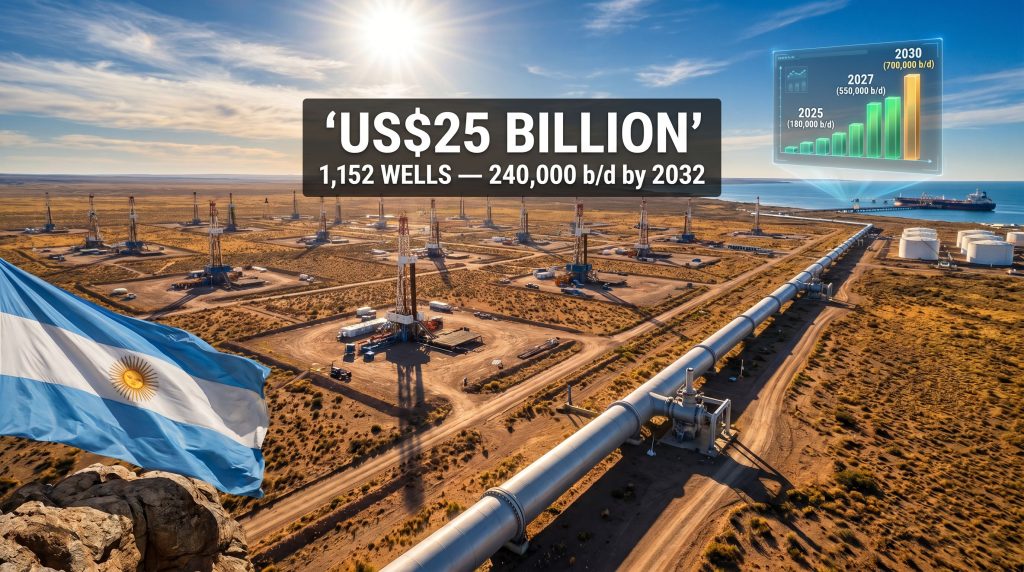
- Wells to be drilled: 1,152 across five Vaca Muerta blocks
- Peak production target: 240,000 barrels per day by 2032
- Export route: Dedicated Vmos pipeline and Atlantic port terminal
- Resource base: Vaca Muerta holds approximately 16 billion barrels of recoverable crude, according to US Energy Information Administration estimates
- Capital requirement: Wood Mackenzie estimates the broader Vaca Muerta basin requires roughly US$22 billion in additional capex and approximately 1,000 new wells to reach full export potential
The fact that YPF's single project application alone exceeds Wood Mackenzie's basin-wide capex estimate underscores just how transformative this commitment is intended to be. This is not incremental development. It is a deliberate attempt to compress what might otherwise be a 15-year development timeline into something closer to a decade.
The Geology Beneath the Numbers
Vaca Muerta's geological characteristics are worth understanding in detail, because they explain both the resource's appeal and the complexity of developing it at scale. The formation is a Late Jurassic to Early Cretaceous-age organic-rich shale deposited in a deep marine environment within the Neuquén Basin. It extends across approximately 30,000 square kilometres, making it one of the largest continuous shale formations outside North America.
The formation's total organic carbon content averages between 2% and 4%, with locally higher concentrations that support both oil and gas windows. Crucially, Vaca Muerta contains both a dry gas window in the deeper, hotter sections of the basin and a prolific oil window at intermediate depths. This geological duality is what makes the formation attractive for a dual oil-and-gas export strategy rather than a single-commodity play.
Well productivity in the oil window has improved dramatically as operators have refined their completion techniques. Initial production rates from the best pads in the Loma Campana and Bajada del Palo Oeste areas have reportedly reached 1,000 to 1,500 barrels per day per well, with decline curve characteristics that are broadly comparable to Tier 1 Permian Basin locations. This level of well performance fundamentally changes the economics of large-scale development, particularly for Argentina copper exploration and broader resource investors already watching the region closely.
The Vmos Export System: Infrastructure as Strategy
Technical Specifications of Argentina's Most Consequential Pipeline
The Vmos pipeline and export project is not simply a piece of infrastructure. It is the enabling condition for everything else. Without a purpose-built export route to the Atlantic coast, even the most productive shale wells in Vaca Muerta would remain commercially constrained by the limited capacity of Argentina's existing domestic pipeline network.
The system's key technical parameters are:
- Pipeline length: 437 kilometres connecting Neuquén production zones to the Atlantic coast
- Terminal location: Punta Colorada, Río Negro province
- Storage infrastructure: Six dedicated tanks, each with a capacity of 120,000 cubic metres
- Phase 1 throughput capacity: 180,000 b/d, targeted for operational commissioning by end of 2025
- Phase 2 throughput capacity: 550,000 b/d, targeted for 2027
- Maximum system capacity: 700,000 b/d by the end of the decade
- Consortium leadership: YPF alongside eight partners including Pan American Energy, Vista Energy, Pluspetrol, Pampa Energía, Chevron, and Shell
Infrastructure Sequencing: A Phased Ramp-Up Model
End-2025    →   180,000 b/d   [Phase 1: Initial pipeline commissioning]
2027        →   550,000 b/d   [Phase 2: Full midstream capacity expansion]
~2029-2030  →   700,000 b/d   [Phase 3: Maximum system throughput]
2032        →   240,000 b/d   [LLL Oil: upstream peak production contribution]
Strategic Insight: The gap between the Vmos system's maximum midstream capacity of 700,000 b/d and YPF's LLL Oil project's upstream contribution of 240,000 b/d reveals an important structural logic. The pipeline was deliberately sized as shared infrastructure capable of aggregating output from multiple upstream operators simultaneously, not as a dedicated YPF facility. This design principle mirrors the role that the Dakota Access Pipeline and Permian Basin's Cactus pipeline systems played in aggregating multiple operators' production to achieve export-scale volumes in the United States.
The Port Infrastructure Dimension: A Rarely Discussed Bottleneck
One aspect of the Vaca Muerta export build-out that receives less attention than the pipeline itself is the port development at Punta Colorada. Atlantic-facing crude export terminals in Argentina's southern provinces are not well-established commercial infrastructure. The construction of a new, purpose-built terminal capable of handling Very Large Crude Carrier class vessels is a prerequisite for accessing the premium Asian and European buyer markets that would make the economics of 700,000 b/d throughput viable at scale.
Developing greenfield port infrastructure alongside 437 kilometres of pipeline construction simultaneously represents a genuine logistical and financial challenge. Cost overruns and schedule delays at the port facility could create a mismatch between pipeline readiness and actual export capacity, which is one of the less-discussed execution risks embedded in the overall programme.
Argentina's Macroeconomic Motivation: The Foreign Currency Imperative
Why Hydrocarbon Exports Are a Sovereign Priority
Argentina's chronic shortage of foreign currency reserves has been one of the defining constraints on its economic policy for the better part of two decades. Hydrocarbon export revenue is not merely an industrial ambition for the Argentine government; it is a balance-of-payments necessity.
At the Vmos system's targeted peak throughput of 700,000 b/d and using a conservative crude price assumption of US$70 per barrel, the export infrastructure alone could generate approximately US$18 billion in annual export revenue at full operational capacity. For context, Argentina's total goods export revenue in recent years has typically ranged between US$60 billion and US$80 billion annually.
A single infrastructure system adding US$18 billion to that figure would represent a structural improvement in the country's external accounts, not a marginal one. This reality explains why the US mining investment framework and other international capital allocation models are increasingly being used as reference points by Argentine policymakers when structuring RIGI's terms.
As of mid-2025, Argentina has approved 13 RIGI projects in total, with 24 additional applications under active evaluation, including YPF's LLL Oil submission. The Vmos pipeline was among the earliest approvals under the regime. The application window remains open until July 2027, creating a defined but time-limited opportunity for capital mobilisation. In addition, Argentina's expanding investment incentives signal the government's sustained commitment to attracting international capital across multiple commodity categories.
Scenario Modelling: Three Pathways to 2032
Base Case: RIGI Execution On Track
Under this scenario, the approval process for YPF's LLL Oil application proceeds without material political disruption. Drilling commences at scale by 2026, the Vmos pipeline reaches its Phase 2 capacity of 550,000 b/d by 2027 as planned, and Argentina's crude export volumes climb toward 400,000 to 500,000 b/d by 2028. Vaca Muerta establishes itself as a globally significant export basin, with a development trajectory broadly comparable to the early growth phase of the Permian Basin between 2012 and 2017.
Delayed Execution: Regulatory or Financing Friction
Political transition, legal challenges to RIGI's contractual guarantees, or oilfield services bottlenecks slow the development pace. The Vmos Phase 2 expansion is delayed to 2028 or 2029. Upstream drilling proceeds below the 1,152-well target pace. Argentina's crude exports reach approximately 250,000 to 350,000 b/d by 2028, delivering material but significantly below-potential results. Investor confidence is partially eroded, making subsequent RIGI applications harder to attract.
Accelerated Development: Multiple RIGI Approvals and International Capital Inflow
Multiple international operators secure RIGI approvals before the July 2027 deadline. LNG feedgas projects advance in parallel, creating a dual oil-and-gas export platform. The Vmos system reaches its 700,000 b/d capacity ahead of schedule. Argentina enters the early 2030s as a credible candidate for top-10 global crude export status, with an emerging LNG export capacity providing a second commodity revenue stream.
The next major ASX story will hit our subscribers first
Who Are the Key Players and What Are the Risks?
Operator and Partner Breakdown
| Entity | Role | RIGI Relevance |
|---|---|---|
| YPF | Project lead, largest stakeholder | Filed US$25bn LLL Oil application |
| Pan American Energy | Vmos consortium partner | Upstream and midstream exposure |
| Vista Energy | Vmos consortium partner | Active Vaca Muerta operator |
| Pluspetrol | Vmos consortium partner | Upstream Vaca Muerta operator |
| Pampa Energía | Vmos consortium partner | Confirmed RIGI interest |
| Chevron | Vmos consortium partner | Long-standing Vaca Muerta JV operator |
| Shell | Vmos consortium partner | International major with upstream Vaca Muerta position |
Risk Matrix: The Four Structural Challenges
1. Political and Regulatory Risk
Argentina's history of policy reversal is well-documented. While RIGI's 30-year stability clause is designed as a contractual ring-fence around project economics, the enforceability of that guarantee across future administrations with different political priorities remains an open question. The July 2027 application deadline creates urgency but also compresses the available window for investor due diligence. The broader mining geopolitical risk landscape is something all capital allocators operating in emerging markets must weigh carefully.
2. Execution and Supply Chain Risk
Drilling 1,152 wells demands oilfield services capacity at a scale that Argentina's domestic services sector may struggle to deliver without significant bottlenecks. Hydraulic fracturing equipment, specialty chemicals, and experienced technical crews are not unlimited resources, and competing demand from other Vaca Muerta operators will intensify procurement competition.
3. Commodity Price Risk
RIGI provides regulatory stability but offers no protection against commodity price volatility. A sustained decline in global crude prices below US$50 to US$55 per barrel would compress returns below hurdle rates even within the RIGI-stabilised fiscal environment, potentially pausing or restructuring investment commitments.
4. Environmental and Social Licence Risk
Large-scale unconventional development across Neuquén and Río Negro provinces will attract scrutiny from environmental groups and Mapuche indigenous communities whose territorial rights overlap with portions of the Vaca Muerta development zone. Water consumption for hydraulic fracturing at 1,152-well scale, seismic activity risks, and land access negotiations represent recurring friction points that have historically added cost and schedule risk to Vaca Muerta development programmes.
How Vaca Muerta Compares to the World's Major Unconventional Basins
Comparative Basin Analysis
| Basin | Country | Est. Recoverable Resources | Current Production | Export Infrastructure |
|---|---|---|---|---|
| Vaca Muerta | Argentina | ~16 billion barrels (crude) | ~600,000 b/d (total basin) | Vmos under construction |
| Permian Basin | USA | ~70+ billion barrels | ~6.5 million b/d | Fully developed; multiple export terminals |
| Montney | Canada | ~400+ trillion cf (gas) | ~2.5 billion cf/d | LNG Canada under construction |
| Eagle Ford | USA | ~10 billion barrels | ~1.2 million b/d | Mature; Gulf Coast export access |
| Vaca Muerta (2030 target) | Argentina | ~16 billion barrels | ~700,000 b/d (Vmos capacity) | Punta Colorada terminal + pipeline |
Industry Perspective: The analogy to the Permian Basin is instructive but requires careful qualification. The Permian's explosive growth between 2015 and 2020 was enabled not just by geology and technology, but by a pre-existing Gulf Coast export infrastructure that could be rapidly expanded. Vaca Muerta is building that equivalent infrastructure largely from scratch, which is simultaneously the basin's greatest near-term challenge and its most important long-term enabler.
The LNG Dimension: A Second RIGI Export Vector
Why Argentina Is Pursuing a Dual-Commodity Export Strategy
A dimension of the YPF Rigi incentives for Vaca Muerta project framework that receives insufficient attention in mainstream coverage is YPF's parallel application for LNG feedgas development. Vaca Muerta's geological duality, encompassing both oil and dry gas windows within the same formation, positions the basin as capable of supporting two distinct export commodity streams simultaneously.
The gas window in the deeper sections of the Neuquén Basin holds resources that several industry estimates suggest could support multiple LNG export trains if the necessary liquefaction and port infrastructure is constructed. Notably, YPF's ambitious LNG feedgas plans underscore how seriously the company is treating this second export vector. If both the crude oil export programme via the Vmos pipeline and an LNG feedgas programme advance under RIGI, Argentina could emerge as a material contributor to global LNG supply by the early 2030s.
This would represent a fundamental transformation in the country's position in global energy markets, from a chronic importer to a multi-commodity exporter, within a single decade. Furthermore, the development of a major Argentina copper system alongside these energy projects reflects how broadly the country's resource investment story is now being written.
Key Takeaways: The RIGI-Vaca Muerta Investment Case in Summary
- US$25 billion in YPF's LLL Oil RIGI application, the largest single filing under the regime to date
- 1,152 wells across five Vaca Muerta blocks, targeting 240,000 b/d of production by 2032
- 437-kilometre Vmos pipeline scaling from 180,000 b/d at end-2025 to a maximum of 700,000 b/d by the end of the decade
- 30-year fiscal, tax, and customs stability under YPF Rigi incentives for Vaca Muerta project qualification, the central mechanism that changes the investment risk calculus for international capital
- 13 RIGI projects approved as of mid-2025, with 24 additional projects under evaluation and the application window open until July 2027
- 16 billion barrels of estimated recoverable crude in Vaca Muerta according to the US Energy Information Administration
- ~US$22 billion in additional basin-wide capex identified as necessary to reach full export targets, per Wood Mackenzie analysis
- A dual export strategy is emerging: crude oil via Vmos combined with LNG feedgas development under separate RIGI applications
This article is intended for informational purposes only and does not constitute financial advice. Projections, scenario modelling, and production forecasts involve inherent uncertainty and should not be relied upon as predictions of future outcomes. Readers should conduct their own due diligence before making any investment decisions related to companies or projects discussed herein.
For additional reporting on Vaca Muerta's development trajectory and Argentina's upstream energy landscape, Argus Media provides ongoing market intelligence coverage at argusmedia.com.
Want to Identify the Next Major Resource Discovery Before the Market Does?
Discovery Alert's proprietary Discovery IQ model delivers real-time alerts on significant ASX mineral discoveries, transforming complex resource data into actionable investment insights — just as large-scale projects like Vaca Muerta demonstrate how transformative the right discovery at the right time can be. Start your 14-day free trial today, or explore Discovery Alert's dedicated discoveries page to understand how historic mineral discoveries have generated substantial returns for early investors.