August 20, 2026
The Blast Furnace Advantage: Why Premium Coking Coal Defies the ESG Exodus
Spend enough time studying global commodity markets and a pattern emerges: assets that carry reputational weight tend to be priced by sentiment rather than structural economics. Thermal coal has dominated the energy transition narrative for good reason, but its story has become so loud that it has drowned out the fundamentally different dynamics governing metallurgical coal. These are two distinct industrial products that happen to share the same four-letter word, and conflating them has created one of the more interesting strategic divergences in large-cap mining.
While most major diversified miners have used ESG tailwinds as justification to accelerate coal asset disposals, BHP has publicly committed to retaining and growing its Queensland steelmaking coal operations. This is not a passive holding decision. It reflects a deliberate thesis about where metallurgical coal sits in the long arc of industrial development, particularly across Asia, where blast furnace steelmaking continues to dominate.
Understanding BHP steelmaking coal BMA returns requires unpacking why the underlying commodity behaves so differently from what the market broadly labels as "coal exposure." Furthermore, BHP's coal strategy has become a focal point for investors trying to separate genuine industrial logic from sentiment-driven narratives.
When big ASX news breaks, our subscribers know first
Hard Coking Coal: The Industrial Irreplaceable
The chemical properties of hard coking coal make it fundamentally different from lower-rank thermal or semi-soft coking coals. When heated in an oxygen-reduced environment, premium hard coking coal transforms into coke, a porous carbon structure with the mechanical strength to support the weight of iron ore and limestone inside a blast furnace while simultaneously acting as a reducing agent. This dual role cannot currently be replicated at industrial scale without major process redesign.
Approximately 70% of global steel production still relies on this blast furnace and basic oxygen furnace (BOF) pathway. Electric arc furnace (EAF) technology, which can use scrap steel and direct-reduced iron, is growing in market share, but it cannot fully substitute for the BOF route in producing high-specification flat steel products required for automotive, shipbuilding, and heavy infrastructure applications.
What Makes Premium Hard Coking Coal Distinctive?
Several factors distinguish premium hard coking coal from lower-grade alternatives:
- Coke Strength after Reaction (CSR): A key metallurgical quality metric measuring how coke behaves inside a blast furnace under thermal and chemical stress. Premium Bowen Basin coals routinely achieve CSR ratings above 60, placing them at the top of the global quality spectrum.
- Volatile Matter (VM) content: Optimal coking coals typically carry VM content in the 18-26% range, which governs the swelling and bonding behaviour during carbonisation. Coals outside this window require blending to achieve acceptable coke quality.
- Ash and sulphur content: BMA's Bowen Basin assets consistently deliver low-ash, low-sulphur products, reducing impurity loads in downstream steel production and commanding a persistent quality premium in seaborne markets.
As geologically accessible deposits of premium hard coking coal become progressively exhausted globally, the scarcity premium attached to high-CSR material from established provinces like the Bowen Basin is structurally supported.
BMA's Financial Arc: Cyclicality, Collapse, and Recovery
The BHP Mitsubishi Alliance, a 50-50 joint venture between BHP and Mitsubishi Development that has operated continuously for decades, represents one of the largest and most enduring partnerships in global mining. BMA controls multiple operating mines across Queensland's Bowen Basin and is a dominant force in seaborne hard coking coal supply.
The financial trajectory of BHP steelmaking coal BMA returns over the past three fiscal years captures the extreme cyclicality inherent in this market with unusual clarity:
| Period | BMA Production (BHP 50% share) | Underlying EBITDA | Key Dynamic |
|---|---|---|---|
| FY2024 | ~18.0 Mt (est.) | Materially higher | Elevated benchmark pricing |
| FY2025 | 18.0 Mt | US$0.6 billion | 69% EBITDA decline; price collapse |
| H1 FY2026 | 9.2 Mt | US$0.3 billion | Early price stabilisation |
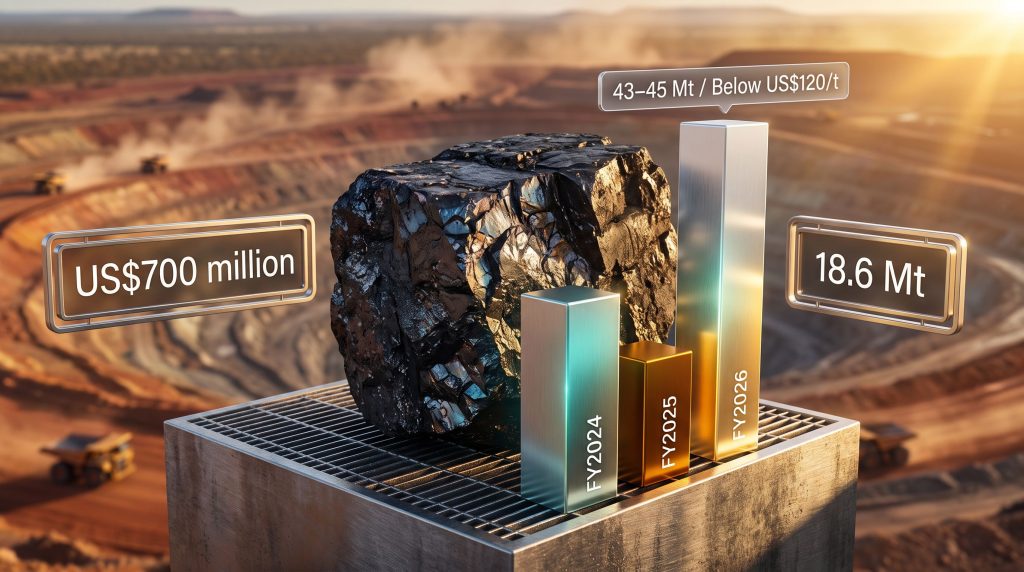
| FY2026 Full Year | 18.6 Mt | US$0.7 billion | 19% EBITDA recovery |
The FY2025 result was among the most challenging periods in BMA's recent history. Benchmark hard coking coal prices declined sharply through the 2024-2025 period as China's steel market softened under ongoing property sector stress, while seaborne supply from Australia and North America remained elevated. BMA's average realised price for FY2025 came in at US$193.82 per tonne, a significant compression from earlier cycle peaks.
What Does the FY2026 Recovery Signal?
The FY2026 recovery tells a more constructive story. A 3% increase in production volumes to 18.6 Mt on a BHP 50% share basis, combined with firmer realised prices, drove EBITDA up 19% to US$700 million. The operating leverage this demonstrates is significant: a relatively modest volume gain amplified considerably by price recovery, highlighting the sensitivity of BMA's earnings profile to even incremental price improvements.
A 3% rise in production volumes generating a 19% EBITDA improvement illustrates the powerful operating leverage embedded in BMA's cost structure. As realised prices recover toward long-run averages, this leverage becomes an increasingly compelling feature of the investment case.
Cost Architecture and the Path Below US$120 Per Tonne
One of the most closely watched dimensions of BHP steelmaking coal BMA returns is the unit cost trajectory. Unit costs rose 5% to US$134.05 per tonne in FY2026, a move partially attributable to labour, diesel, and consumables inflation common across Australian mining operations. However, BHP's medium-term target of driving costs below US$120 per tonne represents a reduction of more than 10% from current levels.
BHP has outlined four operational levers designed to deliver this cost reduction:
- BHP Operating System deployment across BMA mine sites, introducing standardised workflows, performance management disciplines, and continuous improvement frameworks drawn from BHP's broader operational playbook.
- Advanced technology integration, including real-time data analytics for mine planning, predictive maintenance systems, and ore-to-product tracking that reduces variability and waste across the processing chain.
- Automation initiatives, with progressive deployment of autonomous haulage systems and autonomous drilling platforms that reduce labour intensity while improving consistency and equipment utilisation rates.
- Targeted cost reduction programs focused on contractor spend, energy consumption, and consumables procurement across multiple mine sites simultaneously.
Production Growth Roadmap
The production growth roadmap accompanying these cost initiatives is equally ambitious:
| Timeframe | Production Target (100% JV basis) | Approximate BHP 50% Share |
|---|---|---|
| FY2026 Actual | ~37.2 Mt | 18.6 Mt |
| FY2027 Guidance | 37-41 Mt | ~18.5-20.5 Mt |
| Medium-Term Target | 43-45 Mt | ~21.5-22.5 Mt |
Achieving the upper end of the medium-term volume target alongside the sub-US$120/t cost goal would represent a structurally different earnings profile for BMA, one that becomes materially more powerful as coking coal pricing normalises above current levels. In addition, current metallurgical coal prices suggest there is room for meaningful upside as market conditions stabilise.
The Queensland Royalty Problem: Fiscal Drag on Capital Commitment
No analysis of BHP steelmaking coal BMA returns is complete without addressing Queensland's coal royalty framework. In recent years, Queensland introduced additional royalty tiers triggered at higher coal price thresholds. While these tiers were designed to capture windfall revenues during price spikes, they created a structural problem: the same price environment that makes steelmaking coal investment most attractive is precisely when the royalty burden becomes most punishing.
BHP's position is that the current royalty regime is inconsistent with long-term capital investment in Queensland's steelmaking coal sector. This is not merely a negotiating posture. It reflects a genuine capital allocation consideration: at sufficiently high royalty rates, the post-royalty return on incremental investment may fall below BHP's internal hurdle rates, even when pre-royalty economics appear attractive.
The Royalty Strategic Paradox
The royalty dilemma creates a strategic paradox for Queensland's fiscal planners:
- Near-term: Higher royalty tiers extract maximum revenue during price upswings, generating significant state revenue.
- Medium-term: The same rate structure deters the capital reinvestment needed to sustain and expand production, progressively eroding the royalty base itself.
- Long-term: As global hard coking coal reserves deplete and Bowen Basin's quality premium expands, under-investment now could permanently reduce Queensland's share of a tightening global supply picture.
BHP has indicated active engagement with Queensland authorities toward a framework that both parties can sustain over the long term. The miner has acknowledged that returning to historical royalty structures is not its goal, but rather achieving a rate setting that preserves the incentive to reinvest. No timeline for resolution has been established, and consequently this remains a material constraint on the pace of BMA's capital deployment.
Until Queensland's royalty framework is resolved, the scale of incremental capital BHP is willing to commit to BMA expansion will remain constrained, even as the operational and geological case for investment continues to strengthen.
The Scarcity Thesis: Why Premium Coal's Best Years May Be Ahead
BHP's incoming CEO Brandon Craig articulated a view during the FY2026 results analyst session that positions steelmaking coal not as a legacy asset in managed decline, but as a commodity whose most commercially significant period may not yet have arrived. This forward-looking stance rests on several supply and demand dynamics that receive less mainstream attention than the energy transition narrative.
On the supply side:
- Premium hard coking coal deposits of the quality and scale found in Queensland's Bowen Basin are geographically concentrated in a small number of global locations, primarily Australia, Canada, and parts of the United States.
- Many of these reserves are being mined progressively deeper, driving higher unit costs and greater geological complexity over time.
- New large-scale greenfield hard coking coal development is increasingly rare, given a combination of capital costs, regulatory complexity, and financing constraints imposed by ESG-focused institutional lenders.
- As lower-quality coking coals become relatively more available and high-CSR premium material becomes scarcer, the quality differential in pricing should structurally widen.
On the demand side:
- The India steel demand outlook remains compelling, with Indian crude steel production exceeding 140 million tonnes in 2023 and projected to grow substantially through 2030 and beyond. Blast furnace technology is expected to remain dominant given India's scrap steel deficit.
- Southeast Asian economies including Vietnam, Indonesia, and the Philippines are in earlier stages of steel-intensive infrastructure build-out, providing an additional demand layer beneath China.
- BHP itself projects global copper demand to rise from approximately 34 Mt annually today to more than 50 Mt by 2050. Building out the copper mines, transmission infrastructure, and energy systems required to deliver this copper expansion will itself require enormous volumes of steel, and therefore coking coal.
However, it is worth noting that the rise of green steel economics introduces a longer-term variable into the demand equation, as hydrogen-based and EAF routes mature and scale up across key markets.
The next major ASX story will hit our subscribers first
BMA Within BHP's Dual-Engine Portfolio Strategy
BHP's portfolio construction is increasingly legible as a two-speed architecture. Copper represents the high-growth, capital-intensive primary engine, accounting for 54% of group underlying EBITDA in FY2026 after copper EBITDA rose 48% to a record US$18.2 billion, generating US$6.9 billion in free cash flow. BHP's copper project pipeline targets approximately a 40% increase in attributable copper production to around 2 Mt per annum by FY2035.
Funding this copper growth ambition without excessive leverage or dilutive equity issuance requires cash-generative assets elsewhere in the portfolio. BMA fills precisely this role. Its improving earnings trajectory and the structural quality of its resource base make it a credible internal capital provider for BHP's copper development pipeline.
| Portfolio Element | FY2026 Metric | Strategic Role |
|---|---|---|
| Copper | US$18.2bn EBITDA; 54% of group | Primary growth engine |
| BMA Steelmaking Coal | US$700m EBITDA; ~2% of group | Cash contributor; durable earner |
| BHP FY2035 Copper Target | ~2 Mt per annum (+40%) | Requires sustained capital |
This portfolio logic explains why BHP's new CEO has simultaneously elevated copper as BHP's biggest growth opportunity while also committing to steelmaking coal retention. Furthermore, analysts monitoring BHP's asset disposal options suggest these are not contradictory positions but complementary roles within a carefully constructed capital allocation framework.
Resource base replenishment has also been flagged as a top-tier priority under new leadership, with increased exploration activity, adjacent acquisition opportunities, and partnership structures all forming part of the strategic toolkit for both copper and coal.
Key Metrics Snapshot: BHP BMA Performance and Targets
| Metric | FY2025 | FY2026 | Medium-Term Target |
|---|---|---|---|
| BMA Production (BHP 50% share) | 18.0 Mt | 18.6 Mt | ~21.5-22.5 Mt |
| BMA Underlying EBITDA | US$0.6bn | US$0.7bn | Materially higher |
| BMA Unit Costs | N/A at target level | US$134.05/t | Below US$120/t |
| Avg. Realised Price | US$193.82/t | Higher than FY2025 | Market dependent |
| BMA Production (100% JV basis) | ~36 Mt | ~37.2 Mt | 43-45 Mt |
Frequently Asked Questions: BHP Steelmaking Coal BMA Returns
What drove the 19% improvement in BMA's underlying EBITDA in FY2026?
BMA's underlying EBITDA increased from US$0.6 billion in FY2025 to US$700 million in FY2026, driven by a combination of higher realised steelmaking coal prices compared to the prior year and a modest 3% increase in production volumes to 18.6 Mt on a BHP 50% share basis. The result demonstrated the significant operating leverage embedded in BMA's cost structure.
What is BHP's production target for BMA over the medium term?
BHP has guided BMA production of 37-41 Mt on a 100% joint venture basis for FY2027, rising to an annual target of 43-45 Mt over the medium term. This represents approximately 15-20% growth from current production run-rates, expected to be achieved primarily through brownfield optimisation at existing operations.
Why is BHP not selling its steelmaking coal business?
BHP's leadership has stated that it has no current plans to separate its metallurgical coal operations, viewing steelmaking coal's most commercially rewarding period as potentially still ahead. This reflects BHP's distinction between thermal coal and metallurgical coal, with the latter remaining essential to blast furnace steelmaking, which accounts for approximately 70% of global steel output. Moreover, independent research from the IEEFA on BHP's coal capital dynamics highlights the ongoing debate around long-term capital commitment in this sector.
What is the Queensland royalty issue and how does it affect BMA?
Queensland's coal royalty regime applies additional tiered rates at higher coal price thresholds. BHP has stated this structure is not supportive of long-term capital investment in steelmaking coal assets. The miner is actively engaging with the Queensland government to seek a revised framework, though no agreement timeline has been established. This uncertainty consequently constrains BHP's willingness to accelerate incremental capital deployment at BMA.
How does BMA fit within BHP's broader portfolio strategy?
BMA serves as a durable cash-generating contributor within BHP's portfolio, supporting the company's ability to fund its capital-intensive copper growth pipeline without excessive balance sheet leverage. While copper generates the dominant share of group earnings, BMA's improving trajectory and high-quality resource base give it continued strategic relevance as both a cash engine and a long-duration asset with scarcity-driven upside.
Disclaimer: This article contains forward-looking statements, forecasts, and financial projections based on publicly available information and analyst commentary. These do not constitute financial advice. Commodity markets are subject to significant price volatility, and actual outcomes may differ materially from projections. Investors should conduct independent due diligence before making any investment decisions.
Want to Track the Next Major ASX Mining Discovery Before the Market Does?
Discovery Alert's proprietary Discovery IQ model delivers real-time alerts on significant ASX mineral discoveries — cutting through complex geological and commodity data to surface actionable investment opportunities the moment they are announced. Explore historic examples of exceptional discovery-driven returns and begin your 14-day free trial today to position yourself ahead of the broader market.