August 20, 2026
Why Copper Project Financing Timelines Matter More Than Most Investors Realise
Across the commodity cycle, the single most transformative event in a junior mining developer's lifecycle is not a drill result or a resource upgrade. It is the moment a credible, structured financing package lands on the table. Until that moment arrives, even the most technically sound copper project trades at a layered discount that no amount of permitting progress or drilling success can fully eliminate. Understanding why that discount exists, and which conditions genuinely resolve it, is foundational to evaluating any developer approaching a financing decision.
For investors tracking Marimaca Copper financing before the end of 2026, the company's current position represents one of the more instructive case studies in how junior copper developers transition from deep discount territory toward fair value recognition.
When big ASX news breaks, our subscribers know first
Decoding the Junior Developer Discount in Copper Markets
The valuation gap between a junior developer's market capitalisation and the intrinsic net present value of its asset is not arbitrary. It reflects a structured series of risk premiums, each of which can be mapped to a specific category of uncertainty. The important distinction for investors is that some of these discount drivers are resolvable through project-level work, while others operate entirely outside a company's control.
| Discount Driver | Category | Resolvable Through Project Work? |
|---|---|---|
| Study stage (DFS completion) | Technical | Yes |
| Environmental permitting | Regulatory | Yes |
| Resource growth potential | Geological | Yes |
| Execution risk | Operational | Partially |
| Funding structure | Financial | Yes |
| Jurisdiction risk | Geopolitical | Partially |
| Board and management credibility | Governance | Subjective |
| Market sentiment | Macro | No |
| Share trading liquidity | Market structure | No |
Most of the entries on this list respond directly to investment and technical effort. A completed definitive feasibility study resolves study-stage uncertainty. Environmental approval eliminates permitting risk. Active drilling addresses resource growth questions. Two conditions, however, sit outside the reach of any project-level action: macro-driven market sentiment and the structural constraints of share trading liquidity.
The Conditions That Actually Move the Valuation Needle
For a developer to compress the discount applied to its assets, it must work through the resolvable conditions systematically. Each milestone retired narrows the gap between market price and intrinsic value. The sequence matters because institutional capital operates on a threshold basis: lenders and equity partners typically require all material technical and regulatory conditions to be resolved before committing to a project financing structure.
This is precisely why a DFS combined with environmental approval represents such a commercially significant pairing. Together, they signal to the financing market that a project is technically sound and legally clearable, which are the two most fundamental requirements for project debt to be underwritten.
Marimaca Oxide Deposit: What the DFS Numbers Actually Show
The 2025 Definitive Feasibility Study completed on the Marimaca Oxide Deposit (MOD) establishes a set of project economics that can be evaluated against copper development benchmarks with reasonable precision.
| Metric | Value |
|---|---|
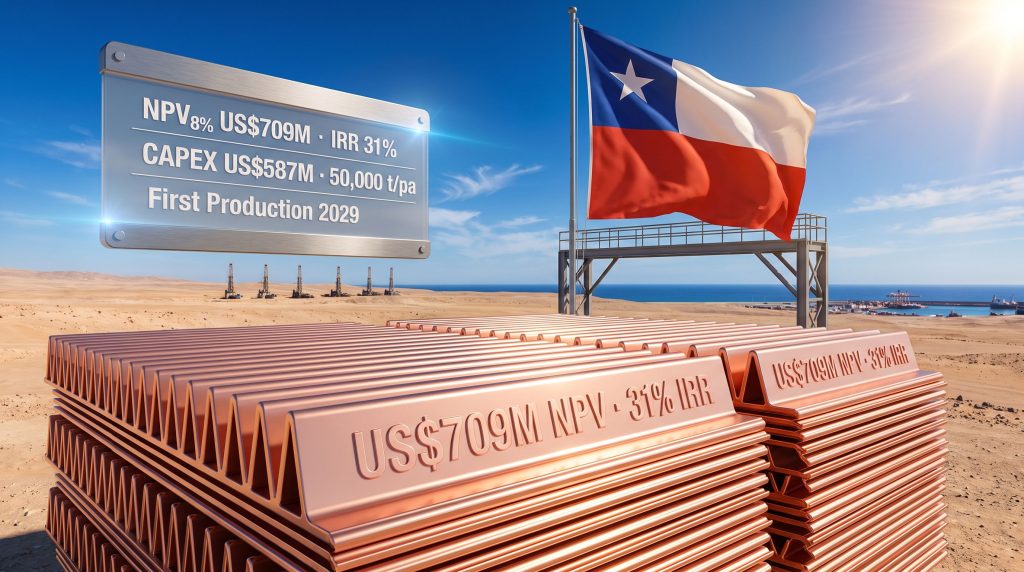
| Post-Tax NPV (8% discount rate) | US$709 million |
| Internal Rate of Return (IRR) | 31% |
| Payback Period | 2.5 years |
| Long-Term Copper Price Assumption | US$4.30/lb |
| Initial Capital Expenditure | US$587 million |
| Capital Intensity | US$11,700/t of annual copper cathode |
| Steady-State Annual Output (Years 2-8) | 50,000 tonnes of copper cathode |
| Life-of-Mine Average Annual Output | 43,000 tonnes |
| Mine Life | 13 years |
A 31% IRR at US$4.30 per pound copper is a figure worth contextualising carefully. Copper project hurdle rates for major miners typically sit in the 15-20% range for greenfield development, and project finance lenders generally require demonstrated IRRs comfortably above the cost of debt before underwriting. A 31% IRR provides meaningful buffer above both thresholds, which matters for the bankability assessment.
Capital Intensity as a Financing Signal
Capital intensity, measured in dollars of upfront capital per tonne of annual production capacity, is one of the most closely watched metrics by project finance lenders assessing copper development. The MOD's figure of US$11,700 per tonne of annual copper cathode capacity sits materially below the threshold of US$15,000 per tonne that is broadly considered competitive for heap leach oxide projects across Latin America.
Capital intensity below US$15,000 per tonne of annual copper cathode capacity is broadly considered competitive for heap leach oxide projects in Latin America. The MOD's figure of US$11,700 per tonne places it in the lower-cost development tier, which carries direct implications for debt serviceability and financing attractiveness.
Lower capital intensity improves debt serviceability ratios, widens the margin of safety on copper price sensitivity analysis, and generally improves the terms available in a competitive project financing process. Furthermore, for lenders stress-testing a project at lower copper price assumptions, a capital-efficient operation provides greater downside protection.
The Heap Leach Oxide Process: Why Metallurgy Matters for Financing
The MOD's processing route deserves specific attention because it directly influences both capital efficiency and lender confidence. Heap leach solvent extraction electrowinning (SX-EW) technology, the method used to produce copper cathode from oxide deposits, is one of the most well-understood and commercially proven processing routes in the copper industry. Unlike sulphide concentrator projects, which require smelting and refining infrastructure and introduce additional counterparty dependencies, SX-EW heap leach operations produce a refined, London Metal Exchange (LME) grade copper cathode directly on site.
This has two practical implications for financing. First, the offtake structure is simpler, because cathode is a standardised, immediately tradeable product that does not require a tolling or smelting agreement. Second, the technology risk premium applied by lenders is lower for proven heap leach operations compared to novel or first-of-kind processing configurations.
Chile's Antofagasta Region: Infrastructure as a Financing Accelerant
Project location is not merely a geological consideration. For lenders and equity partners evaluating a financing package, infrastructure readiness functions as a direct input into capital efficiency calculations and construction timeline credibility. The Chile copper outlook remains broadly constructive, and the MOD's location in Chile's Antofagasta Region offers a combination of attributes that is genuinely difficult to replicate:
- Altitude: 1,100 metres above sea level, well below the operational challenges facing high-altitude Andean projects that routinely sit above 4,000 metres
- Port proximity: 25 kilometres from the Port of Mejillones, reducing concentrate and reagent logistics costs
- Urban access: 40 kilometres from Antofagasta city and its international airport, supporting workforce mobilisation and skilled labour availability
- Road connectivity: Direct access via Route 1, Chile's national coastal highway
- Power infrastructure: A dedicated power spur and transmission line confirmed in the DFS layout, removing grid connection as a development risk
- Country context: Chile accounts for approximately 27% of global mined copper production, making it the world's largest copper-producing nation by volume, according to the US Geological Survey
Low altitude is a frequently underappreciated operational advantage. High-altitude projects face equipment efficiency losses, higher labour turnover from altitude sickness, increased fuel consumption, and compressed construction windows. None of those cost pressures apply at 1,100 metres.
Acid Supply: The Input Cost Variable That Markets Are Watching
Heap leach copper operations depend on sulfuric acid as the primary lixiviant, the chemical agent that dissolves copper from oxide ore. Acid pricing is linked to sulfur availability, which in turn is influenced by oil refining activity and smelter output. Geopolitical instability affecting Middle Eastern oil supply chains, including Iranian production dynamics, introduces indirect cost volatility into the operating cost structure of any heap leach copper operation.
This is one of the two macro variables that management at Marimaca Copper acknowledges sits outside project-level control. The DFS operating cost assumptions incorporate acid pricing, but sustained disruptions to global acid supply markets can move realised operating costs in ways that no amount of permitting or drilling can mitigate.
The Peer Comparison Problem in Copper Development
One of the more analytically challenging aspects of valuing Marimaca Copper is the genuine absence of a comparable listed copper junior at the same development stage and production scale. The copper market trends shaping the broader sector tend to bifurcate the development universe in ways that leave mid-scale developers without a direct peer group:
- Projects producing fewer than 20,000 tonnes of copper per annum lack the scale to attract major project finance interest or significant offtake attention from trading houses and smelters
- Projects targeting more than 100,000 tonnes per annum typically require multi-billion dollar capital structures that exceed the risk capacity of junior-focused institutional investors
The MOD's steady-state output of 50,000 tonnes per annum occupies an intermediate position. It is large enough to attract serious project finance interest and meaningful offtake discussions, but small enough to be financeable within a structure that does not require sovereign wealth fund participation or major miner co-investment as a prerequisite.
Cross-Commodity NAV Multiples: The Gold Developer Proxy
When direct sector peers are unavailable, mining analysts typically look across commodity boundaries for valuation references. Construction-ready gold developers with completed feasibility studies and environmental approvals have historically traded at NAV multiples at or above 1.0x during periods of positive gold price sentiment. Management applies a 0.8x NAV multiple as the reference point for a permitted, financeable copper developer approaching construction, a figure that reflects a modest discount to fully construction-ready gold precedents.
| Scenario | Long-Term Copper Price | Implied Valuation Basis |
|---|---|---|
| DFS Base Case | US$4.30/lb | NPV8% of US$709 million |
| Consensus Long-Term Price | ~US$5.00/lb | Higher implied NAV |
| 0.8x NAV Applied | ~US$5.00/lb | Shares at or near slight discount to MOD standalone value |
At a share price of C$7.12 as of July 31, 2026, against a market capitalisation of C$962 million and a balance sheet holding US$147.2 million in cash with zero debt, the arithmetic suggests the market is currently pricing the shares close to the MOD standalone value at consensus copper prices, with the Pampa Medina district growth optionality assigned negligible value.
Disclaimer: The NAV multiple framework described above is based on management's internal analytical approach and cross-commodity precedent analysis. It does not represent a guaranteed valuation outcome. Investors should conduct independent due diligence and recognise that junior mining valuations are subject to significant volatility driven by commodity prices, financing outcomes, and broader market conditions.
Marimaca Copper Financing Before End of 2026: The Formal Process
A structured project financing process is actively underway, led by Endeavour Financial, with a broad pool of potential financing counterparties engaged across debt, equity, and hybrid structures. According to recent reporting on Marimaca's build readiness, this is a mandate-driven process rather than a preliminary market sounding, which is a meaningful distinction for investors assessing execution risk.
The strategic milestone sequence leading to and beyond a financing announcement:
- 2025: DFS completed; environmental approval for the MOD granted
- 2026 (active): Formal financing process underway; Pampa Medina drilling program running with 6 rigs across a 30,000-metre program
- Q4 2026 (target): Financing package announcement, as publicly guided by management on July 17, 2026
- 2027 (target): Construction commencement
- 2029 (target): First copper cathode production from a 24-month build program
- Early 2027 (target): Maiden mineral resource estimate for Pampa Medina oxides and sulfides
Management's illustrative funding model assumes an equity component matched by an equivalent debt tranche, a structure internally characterised as conservative relative to what the final financing may actually require. Under this structure, full project financing would increase the implied per-share value of the MOD beyond its current standalone NAV calculation.
Investor Caution: The Q4 2026 financing announcement is a management target formally communicated to the market, not a completed transaction. The financing structure has not been publicly committed. Investors should treat this as an indicative timeline subject to market conditions, lender due diligence timelines, and commodity price dynamics. A financing target is materially different from a finalised funding package.
Balance Sheet Runway: What US$147 Million Buys
The balance sheet position as of March 31, 2026, consisting of US$147.2 million in cash and zero debt, provides a meaningful runway for ongoing development activity. Management has confirmed this is sufficient for at least 12 months of operations, covering the financing process costs, drilling programs at Pampa Medina, and progression of auxiliary permits.
It is critical to note, however, that this cash position is not sufficient to fund full project construction if a Final Investment Decision is made. External project financing remains an absolute requirement for the MOD to advance to production. The balance sheet provides operating security through the financing decision point, not construction capital.
The next major ASX story will hit our subscribers first
Pampa Medina: District Growth Optionality and Its Financing Role
The active 30,000-metre drilling campaign at Pampa Medina, running with six drill rigs as of July 2026, serves a dual purpose within the overall investment thesis. On one level, it is a conventional resource delineation program targeting a maiden mineral resource estimate for both oxide and sulfide mineralisation in early 2027. On another level, it functions as a value demonstration tool for prospective financing counterparties.
Demonstrating district-scale growth potential adjacent to an already permitted, DFS-complete deposit strengthens the equity story and potentially improves debt financing terms by widening the asset base available as collateral or as a future production upside narrative. The copper project partnerships landscape suggests that compelling district optionality can also attract strategic equity participants, further diversifying the financing mix. If the Pampa Medina maiden resource delivers meaningful tonnage at economically relevant grades, it would add a layer of value to the investment thesis that sits entirely outside the US$709 million NPV already established for the MOD alone.
The Two Discount Drivers That Remain Beyond Management's Reach
Even with a completed DFS, environmental approval, a strong balance sheet, and a formal financing process underway, two valuation discount conditions remain structurally unresolvable through project work.
Market sentiment operates on copper price dynamics and macroeconomic inputs that have no connection to Marimaca's project progress. Copper trading near historical highs provides a constructive backdrop, but price volatility driven by global demand forecasts, Chinese industrial output data, or geopolitical disruptions to supply chains can compress or expand developer valuations independently of any project milestone.
Share trading liquidity operates at the register level rather than the asset level. The concentration of ownership among strategic and institutional holders, including Assore at 18.7%, Ithaki Limited at 14.9%, Greenstone at 6.4%, and Mitsubishi Corp. at 3.4% as at February 26, 2026, compresses the freely tradeable float. With 135,156,927 shares outstanding as at July 27, 2026, and significant portions locked into strategic positions, institutional investors wanting to build meaningful stakes face practical constraints on position sizing that no amount of project de-risking can address.
Research coverage from nine analyst houses provides information flow, but does not itself solve the float constraint that prevents new large-scale institutional entry. Investors considering their broader copper investment strategies should weigh these structural liquidity dynamics carefully alongside the project fundamentals. Consequently, the formalised financing process represents the most significant near-term catalyst available to close the valuation gap.
Financing Readiness: A Scorecard Approach
| Readiness Dimension | Status |
|---|---|
| Definitive Feasibility Study | Completed (2025) |
| Environmental Approval | Granted (2025) |
| Balance Sheet Strength | US$147.2M cash, zero debt |
| Formal Financing Process | Underway (Endeavour Financial) |
| Financing Announcement Target | Before end of 2026 |
| Growth Drilling Active | 6 rigs at Pampa Medina, 30,000m program |
| Construction Start | Targeted 2027 |
| First Production | Targeted 2029 |
| Peer Benchmark Available | No direct copper junior peer identified |
| Market Sentiment Control | External variable, not manageable |
| Liquidity Constraint | Register concentration limits free float |
The scorecard illustrates a developer that has systematically retired the project-level discount conditions while two structural variables remain outside its control. The Marimaca Copper financing before the end of 2026 announcement, if delivered as targeted, would represent the final major project-level catalyst available to close the remaining valuation gap between the MOD's standalone NPV and the company's current market capitalisation.
This article is for informational purposes only and does not constitute financial advice. Junior mining investments carry significant risks including commodity price volatility, financing uncertainty, construction execution risk, and illiquidity. Readers should seek independent financial advice before making any investment decisions.
Want to Track the Next Major Copper Discovery Before the Market Moves?
Discovery Alert's proprietary Discovery IQ model scans ASX announcements in real time, instantly identifying significant mineral discoveries across copper and 30+ other commodities — turning complex data into actionable opportunities for investors at every experience level. Explore historic discoveries and their remarkable returns on Discovery Alert's dedicated discoveries page, then begin your 14-day free trial at discoveryalert.com.au to position yourself ahead of the broader market.