
August 20, 2026
Offshore Lease Sales and the Long Game: How Programmatic Leasing Reshapes U.S. Energy Capital
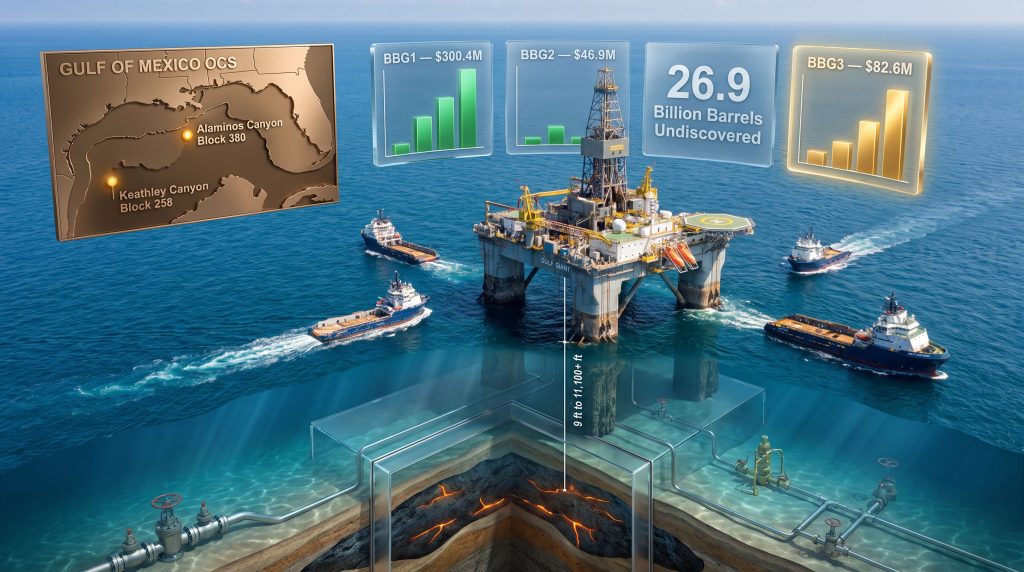
Long before a single barrel of oil reaches the surface from deepwater Gulf waters, the investment decisions that make it possible have already been locked in for years, sometimes decades. Offshore energy is fundamentally a long-cycle industry, where the gap between lease acquisition and first production can span ten to twenty years. Understanding this reality is essential context for evaluating the Big Beautiful Gulf 3 lease sale high bids, which totalled $82.6 million across 59 blocks awarded in federal Gulf of America waters in August 2026.
The number itself is only part of the story. The more significant signal lies in what the BBG3 result reveals about operator confidence, capital allocation strategy, and the structural mechanics of a mandated 30-sale leasing programme that is reshaping the long-term investment calculus for U.S. offshore energy.
When big ASX news breaks, our subscribers know first
What the BBG3 Result Actually Represents
The Marine Minerals Administration administered the Big Beautiful Gulf 3 lease sale as the third instalment in a series of thirty Gulf of America offshore lease sales mandated under the One Big Beautiful Bill Act. The MMA offered approximately 15,100 unleased blocks spanning roughly 80.4 million acres across the Western, Central, and portions of the Eastern Gulf Planning Areas, with water depths ranging from as shallow as 9 feet to beyond 11,100 feet, and distances from shore extending out to 231 miles.
Sixteen companies participated, submitting 69 total bids with a combined value of $99.5 million, of which $82.6 million represented the final high-bid awards across 59 blocks covering approximately 330,150 acres.
| Metric | BBG3 Result |
|---|---|
| Total High Bids Value | $82,689,756 |
| Blocks Awarded (High Bids) | 59 blocks |
| Total Acreage (High Bids) | ~330,150 acres |
| Companies Participating | 16 |
| Total Bids Submitted | 69 |
| Total Value of All Bids | $99,476,285 |
| Royalty Rate Applied | 12.5% (all water depths) |
| Total Blocks Offered | ~15,100 unleased blocks |
| Total Acreage Offered | ~80.4 million acres |
| Water Depth Range | 9 feet to 11,100+ feet |
All awarded blocks carry a 12.5% royalty rate, consistent with the minimum threshold established under the Working Families Tax Cut Act, applying uniformly across all water depths.
Who Dominated the Bidding Competition
Not all participants in BBG3 competed on equal terms. The acreage that attracted the most intense bidding was concentrated in deepwater geology, where reservoir quality and per-well production potential justify far higher upfront lease costs.
Murphy E&P submitted the single highest individual bid of the entire sale at $7.7 million for Alaminos Canyon Block 380, a deepwater location in the western Gulf. Murphy also led all participating companies in aggregate high-bid expenditure, committing $21.4 million in total across its awarded blocks.
Chevron took a different competitive posture, focusing on volume over concentration, and consequently secured the greatest number of individual blocks awarded to any single company in BBG3.
The most geologically contested tract was Keathley Canyon Block 258, which attracted four competing bids — an unusually high level of competition for a single block that signals strong operator conviction about the subsurface prospectivity of that specific location.
The concentration of high-value bids in Alaminos Canyon and Keathley Canyon reflects a broader industry pattern: deepwater tracts command premium valuations because their reservoir structures tend to be larger, more continuous, and capable of sustaining higher production rates over longer plateau periods compared to shallower equivalents.
Three Sales In: Reading the Trajectory
The BBG3 result cannot be understood in isolation. Positioned within the arc of the first three sales, it reveals a market dynamic that is more nuanced than simple growth or decline.
| Sale | High Bids Total | Blocks Awarded | Companies | Total Bids | Total Bid Value |
|---|---|---|---|---|---|
| BBG1 (Dec 2025) | $300.4 million | 181 blocks | 30 | 219 | $371.8 million |
| BBG2 (Mar 2026) | $46.9 million | 25 blocks | 13 | 38 | $69.8 million |
| BBG3 (Aug 2026) | $82.6 million | 59 blocks | 16 | 69 | $99.5 million |
BBG1's $300.4 million result was a pent-up demand event. Years of constrained leasing access had accumulated unmet appetite for Gulf acreage among operators who had already conducted geological work and were ready to move quickly once access was restored. It was not a sustainable baseline.
BBG2's contraction to $46.9 million reflected a natural recalibration. After the BBG1 land rush, companies evaluated what acreage they had won, reassessed capital priorities in the context of prevailing oil prices, and approached the second sale with greater selectivity.
BBG3's partial recovery is the most strategically meaningful data point of the three. Participation rose from 13 to 16 companies. Blocks awarded more than doubled from 25 to 59. Total bids jumped from 38 to 69. These are not the metrics of a market losing interest; they are the metrics of a market finding its equilibrium. Furthermore, the oil price rally observed earlier in 2025 has contributed to renewed operator appetite for long-cycle offshore commitments.
If the trajectory from BBG2 to BBG3 continues, the programme may establish a sustainable mid-range cadence in the $70 million to $120 million per sale range, which would be sufficient to sustain workforce capacity and supply chain activity without triggering the volatility associated with boom-bust leasing cycles.
Note: This projection is speculative and dependent on oil price conditions, operator capital budgets, and acreage quality in subsequent offerings. It should not be treated as a forecast.
Why Regulatory Predictability Drives Offshore Capital Decisions
One of the least-discussed but most consequential aspects of the One Big Beautiful Bill Act's mandated 30-sale schedule is what it does to investment planning horizons inside energy companies and their service sector supply chains.
Offshore projects require capital commitments years before any revenue is generated. A company bidding on deepwater acreage in BBG3 is making decisions today that will shape its exploration programme through the early 2030s and its production profile potentially into the 2040s. For that kind of long-cycle capital to be deployed, boards and investors need confidence that leasing access will remain available.
The Trump policy impact on energy investment has been particularly notable here, with the American Petroleum Institute emphasising that the third Gulf of America lease sale represents a further demonstration of investor confidence in American energy — attributing this in part to the long-term investment certainty that a structured, mandated leasing schedule provides. The National Ocean Industries Association reinforced this perspective, noting that a predictable leasing programme gives companies the confidence to commit capital to projects that will sustain domestic production and strengthen supply chains over time.
The practical downstream effects of leasing predictability include:
- Workforce retention in specialised trades such as subsea engineering, deepwater drilling, and offshore logistics
- Long-term contracts between operators and drilling contractors, enabling rig fleet maintenance and upgrades
- Supply chain investment by fabricators, pipeline contractors, and subsea technology providers who need multi-year demand visibility to justify capital expenditure
- Exploration spending approvals within corporate budgeting cycles that require regulatory certainty as a prerequisite
The Gulf's Structural Advantages: Why This Basin Remains Central
The Gulf of America Outer Continental Shelf spans approximately 160 million acres and is estimated to hold 26.90 billion barrels of undiscovered technically recoverable oil and 45.59 trillion cubic feet of natural gas. The Gulf currently accounts for 14% of total U.S. crude oil production and 2% of domestic natural gas output, while representing 97% of all U.S. offshore oil and gas production.
These numbers explain why the Gulf commands sustained operator interest even in periods of modest individual lease sale results. The basin's combination of resource scale, infrastructure maturity, workforce depth, and proximity to Gulf Coast refining capacity creates competitive advantages that newer offshore frontiers cannot replicate quickly. In addition, the natural gas price outlook for 2025 and beyond adds further weight to the investment case for accessing Gulf reserves.
Key structural advantages of the Gulf of America as an offshore basin include:
- Subsea infrastructure density: Decades of development have produced an extensive network of pipelines, platforms, and processing facilities that reduce the incremental cost of bringing new discoveries to production
- Workforce expertise: The Gulf Coast region hosts one of the world's deepest concentrations of offshore energy specialists, from reservoir engineers to ROV pilots
- Geological knowledge base: Decades of seismic acquisition and well data have produced an unusually detailed picture of Gulf subsurface geology, reducing exploration risk relative to frontier basins
- Refinery proximity: Gulf Coast refining capacity is among the largest and most sophisticated in the world, minimising transportation and logistics costs from offshore production
The next major ASX story will hit our subscribers first
Deepwater Geology: Why Alaminos Canyon and Keathley Canyon Attract Premium Bids
The geographic concentration of high-value bids in BBG3 reflects specific geological characteristics of the deeper Gulf of Mexico basin. Alaminos Canyon, located in the western Gulf's ultra-deepwater province, is associated with large subsalt structures that have historically yielded significant discoveries. Keathley Canyon, situated in the central deepwater Gulf, sits within a corridor known for prolific carbonate and clastic reservoirs at depths where reservoir quality can support high-rate production wells.
What distinguishes deepwater Gulf reservoirs from shallower alternatives:
- Reservoir pressure: Higher formation pressures at depth often correlate with higher initial production rates and more sustained flow performance
- Reservoir continuity: Deepwater turbidite and slope fan systems tend to produce laterally extensive, well-connected reservoir bodies that support large drainage areas per well
- Subsalt prospectivity: The Gulf's salt canopy geology creates structural traps beneath thick salt sheets, which have historically been among the most prolific exploration targets in the basin
- Temperature and fluid quality: Deeper reservoirs in the Gulf often contain lighter, more valuable crude grades with favourable viscosity characteristics
Murphy E&P's willingness to bid $7.7 million for a single Alaminos Canyon block reflects the company's geological conviction about the subsurface potential of that specific tract — a conviction that is only economically rational if the company's internal resource estimates support it.
Fiscal Architecture: Where Lease Revenue Flows
Beyond their direct investment implications, Gulf of America lease sales generate revenue streams that flow through multiple fiscal channels simultaneously.
Revenues from Outer Continental Shelf oil and gas activities are distributed across four primary destinations:
- U.S. Treasury — federal general fund contributions supporting broad national programmes
- Gulf Coast States — direct revenue-sharing allocations for state budgets and infrastructure
- Land and Water Conservation Fund — conservation and recreation programme funding
- Historic Preservation Fund — cultural heritage preservation support
Beyond the initial lease bonus payments recorded at the time of the sale, the 12.5% royalty rate applied to all BBG3 blocks will generate ongoing revenue as production commences from awarded acreage, potentially years after the lease sale itself. Coastal restoration programmes and hurricane protection infrastructure along the Gulf Coast also draw partial funding from these offshore revenue streams, creating a direct link between offshore leasing activity and coastal community resilience.
Environmental Considerations and the Stewardship Framework
The expansion of Gulf leasing activity is not without contested dimensions. The Natural Resources Defense Council has raised concerns that drilling activities associated with BBG3 awards could harm marine species and Gulf ecosystems, citing potential impacts on acoustically sensitive species, marine mammal migration corridors, and habitat disruption from subsea infrastructure.
The DOI has framed its offshore leasing programme within a responsible stewardship mandate, acknowledging obligations under the Outer Continental Shelf Lands Act to balance resource development against environmental protection. These competing considerations shape the regulatory environment within which companies must conduct their exploration and development activities on awarded acreage.
Scenario Projections: Three Pathways for the Remaining 27 Sales
With 27 mandatory sales remaining under the One Big Beautiful Bill Act, the programme's ultimate fiscal and strategic impact depends heavily on which macro scenario materialises.
Scenario A: Sustained High Oil Prices
Operators accelerate exploration programmes on newly awarded acreage, deepwater development timelines compress, and participation in subsequent sales broadens. The programme's cumulative high-bid total may exceed projections, with royalty income from production adding substantially over the following decades.
Scenario B: Accelerated Energy Transition
Companies become highly selective, concentrating capital on only the highest-return deepwater blocks. Marginal shallow-water acreage may sit dormant through lease terms. Participation stabilises but narrows to a smaller pool of majors and well-capitalised independents.
Scenario C: Geopolitical Supply Disruption
Geopolitical supply disruption would, in this scenario, drive Gulf of America production — already supplying 14% of U.S. crude — to become a critical buffer against import dependency. The strategic value of every awarded lease block would increase, potentially drawing new participants into subsequent sales and elevating bid premiums on high-quality acreage.
These scenarios are analytical frameworks rather than predictions. Actual outcomes will depend on oil price trajectories, global demand patterns, regulatory developments, and company-specific capital allocation decisions. Investors should not rely on scenario projections as investment guidance.
Key Metrics to Track Across the BBG Sale Series
For analysts and investors monitoring the 30-sale programme, the following indicators provide the most meaningful signals of programme health and market sentiment:
- Participation breadth (number of companies per sale) as a leading indicator of sector confidence and competitive dynamics
- Deepwater vs. shallow-water bid allocation as a proxy for operator risk appetite and geological conviction
- Bid-to-high-bid ratios as a measure of competitive intensity and whether tracts are being awarded at or near competitive market value
- Average bonus per acre as a valuation benchmark that enables comparison across sales with different acreage offerings
- Geographic concentration of winning bids as an indicator of which geological sub-basins operators find most prospective
Furthermore, U.S. oil production trends will remain a key contextual factor in determining how aggressively operators pursue new Gulf acreage. If the programme maintains an average result in the $80 million to $150 million range per sale across the remaining 27 instalments, cumulative lease bonus revenue could reach between $2.4 billion and $4.5 billion, before royalty income from production is factored in. That projection excludes the BBG1 opening surge and should be treated as an illustrative range rather than a firm forecast.
Frequently Asked Questions: Big Beautiful Gulf 3 Lease Sale
What is the Big Beautiful Gulf 3 lease sale?
BBG3 is the third of thirty Gulf of America offshore oil and gas lease sales mandated under the One Big Beautiful Bill Act. Administered by the Marine Minerals Administration, it generated $82.6 million in high bids across 59 blocks, with 16 companies submitting 69 total bids valued at $99.5 million. According to reporting from Offshore Magazine, the sale reinforced sustained operator interest in Gulf of America acreage.
Which company submitted the highest single bid in BBG3?
Murphy E&P submitted the highest individual bid of $7.7 million for Alaminos Canyon Block 380. Murphy also led all participants in total high-bid expenditure at $21.4 million.
Which company won the most blocks in BBG3?
Chevron secured the greatest number of individual blocks among all participating companies in the sale.
What royalty rate applies to BBG3 leases?
All blocks carry a 12.5% royalty rate, consistent with the minimum threshold under the Working Families Tax Cut Act, applying uniformly across all water depths.
How does BBG3 compare to earlier sales?
BBG1 generated $300.4 million (December 2025), BBG2 generated $46.9 million (March 2026), and the Big Beautiful Gulf 3 lease sale high bids totalled $82.6 million (August 2026). The trend from BBG2 to BBG3 suggests stabilising rather than declining market participation. The DOI press release confirmed these figures and framed the result within the broader American energy dominance agenda.
How many sales remain in the mandated programme?
With BBG3 completed, 27 additional sales remain under the One Big Beautiful Bill Act's mandated schedule of 30 total Gulf of America offshore lease sales.
Want to Stay Ahead of the Next Major Resource Discovery?
While offshore lease sales shape the long-cycle future of U.S. energy capital, Discovery Alert's proprietary Discovery IQ model delivers real-time alerts on significant ASX mineral discoveries — instantly translating complex resource data into actionable investment insights for both short-term traders and long-term investors. Explore how historic mineral discoveries have generated extraordinary returns and begin your 14-day free trial today to secure a market-leading edge.