June 20, 2026
The Geology Beneath the Geopolitics: Why Canada's Oil Sands Are Built for This Moment
Energy markets have a long memory, but energy geology is longer still. Beneath the boreal forests of Alberta lies one of the most consequential hydrocarbon accumulations on earth: bituminous oil sands deposits estimated to contain over 165 billion barrels of proved reserves, ranking Canada third globally behind only Venezuela and Saudi Arabia. For most of the past decade, that geological endowment was treated as a liability rather than an asset by global capital markets. Today, with the Middle East in active conflict and liquefied natural gas supply chains severed by Iranian strikes on Qatari infrastructure, the calculus has inverted completely.
The big oil return to Canada is not simply a story about one blockbuster acquisition. It is a story about how geopolitical stress tests the assumptions that have governed energy investment for a generation, and what happens when those assumptions fail simultaneously.
When big ASX news breaks, our subscribers know first
From ESG Liability to Strategic Asset: Understanding the Decade-Long Arc
The retreat of supermajors from Canadian oil sands beginning around 2015 and accelerating through 2019 was driven by a specific combination of pressures that seemed, at the time, likely to persist indefinitely. Institutional investors were embedding emissions restrictions into their mandates with increasing rigidity. The oil sands, which require significantly more energy to produce a barrel of bitumen than conventional light crude, sat at the top of every carbon intensity ranking.
Furthermore, a structural pipeline shortage was forcing Canadian producers to route crude to U.S. refineries by rail, a method that added roughly $15 to $20 per barrel in transport costs compared to pipeline delivery and constrained production growth.
The result was a prolonged period of capital withdrawal. Supermajors that had paid premium prices for oil sands acreage in the mid-2000s commodity boom wrote down billions in asset values and redirected capital toward U.S. shale, deepwater Africa, and low-cost Middle Eastern partnerships. The conventional wisdom became entrenched: Canadian oil sands were too expensive, too carbon-intensive, and too regulatory-burdened to compete.
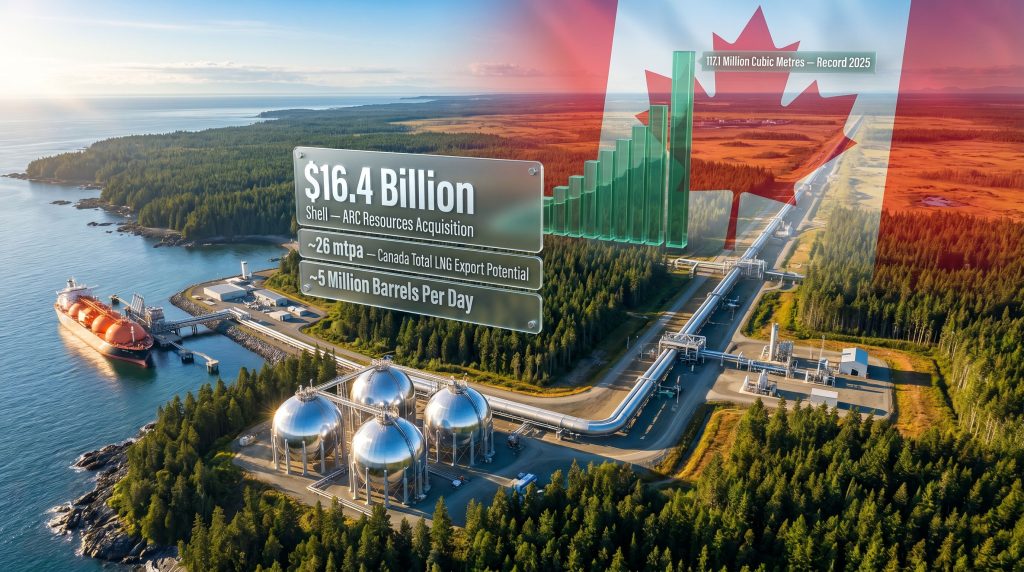
What that conventional wisdom failed to account for was the resilience of Canadian production itself. Even as supermajors departed, Canadian oil sands output continued to climb. Production approached 5 million barrels per day by 2025, driven by integrated oil sands operators who had invested in upgrader technology and process efficiency improvements. Refined petroleum output reached a record 117.1 million cubic metres in 2025, the highest ever recorded and the third consecutive annual record.
The industry proved it could grow without supermajor capital. The question was always whether supermajor capital would eventually return, and on what terms. Canada's energy transition challenges have, however, added additional layers of complexity to this longer-term investment picture.
The Supply Shock That Changed Everything
QatarEnergy's Force Majeure and the LNG Supply Void
The triggering event for the current supermajor reassessment of Canada was not a gradual policy shift or a slow-moving price signal. It was sudden and structural. Iranian strikes on Qatari LNG infrastructure in March 2026 forced QatarEnergy to declare force majeure on export commitments, removing one of the world's largest LNG suppliers from operational status at a moment of elevated global demand.
The cascading effects were immediate and severe:
- Japan's JERA, the country's largest gas buyer, had recently concluded a 3 million tonne per annum (tpa) supply agreement with QatarEnergy, now rendered inoperative
- Asian LNG spot prices spiked sharply as buyers scrambled for replacement cargoes
- IEA member nations, including Canada, coordinated the release of 400 million barrels from strategic petroleum reserves to stabilise crude markets
- The Iran conflict contributed to the effective destruction of an estimated 1.6 million barrels per day in oil demand through price-driven suppression, according to analysis published by OilPrice.com
The EU has publicly warned that the energy crisis stemming from Middle East disruption could persist for years, sharpening the urgency of securing long-term supply contracts from non-Gulf sources.
For Asian buyers already managing exposure to Strait of Hormuz transit risk, the QatarEnergy force majeure crystallised a supply diversification imperative that had previously existed in theory. It now existed in practice, with urgent commercial consequences. Consequently, the LNG supply outlook has shifted dramatically, with Canada emerging as a primary beneficiary of this structural realignment.
The Hormuz Chokepoint Problem
What makes Canada structurally distinct from virtually every competing hydrocarbon jurisdiction is the absence of a geographic chokepoint in its export chain. Approximately 20% of global oil and liquefied gas trade transits the Strait of Hormuz, a 33-kilometre-wide passage between Iran and Oman that represents the single most consequential maritime bottleneck in the global energy system.
Canadian crude exported via the Trans Mountain pipeline system reaches the Pacific coast without passing through any comparable chokepoint. Canadian LNG exported from the BC coast transits the North Pacific, entirely outside conflict-exposed zones.
Asian buyers are now demonstrably willing to pay a geographic security premium for supply that avoids this vulnerability. Western Canadian Select crude, historically discounted relative to WTI due to quality and transport differentials, has seen that discount compress as Pacific-facing export capacity through Trans Mountain has expanded access to Asian refiners who value supply chain certainty over marginal cost optimisation.
Shell's $16.4 Billion Bet: Anatomy of the ARC Resources Deal
Shell's acquisition of ARC Resources represents the most significant single validation of Canada's re-emergent strategic value, and understanding the transaction's architecture reveals how precisely it was constructed around the LNG Canada supply chain. Indeed, big oil's return to Canada has been broadly covered, with Reuters noting that oil majors are eyeing resurgent Canadian energy in the wake of Middle East upheaval.
| Deal Metric | Detail |
|---|---|
| Acquirer | Shell plc |
| Target | ARC Resources Ltd. |
| Deal Value | ~$16.4 billion USD |
| Production Added | ~370,000 boe/d |
| Reserves Acquired | ~2 billion barrels |
| Shell's LNG Canada Stake | 40% operating interest |
| Strategic Rationale | LNG Canada feedstock security + reserve replenishment |
ARC Resources is not a generic Canadian upstream acquisition. Its assets are geographically contiguous with Shell's existing Canadian operations that feed LNG Canada, the flagship export terminal on the BC coast. This means the acquired production does not require new pipeline interconnection, processing infrastructure buildout, or gas routing negotiations with third-party operators. The molecules flow directly into an established supply chain that Shell already operates and controls.
The reserve acquisition also addresses a structural challenge common to all supermajors operating in a period of capital discipline: reserve replacement. At approximately $8.20 per barrel of reserves acquired, the transaction compares favourably to recent deepwater and international upstream acquisitions, particularly given the low geopolitical risk attached to Canadian assets. For investors tracking Shell's reserve life index, the addition of 2 billion barrels provides a meaningful extension of production longevity.
The Simultaneous Capital Recycling Strategy
In a move that reflects sophisticated balance sheet management, Shell simultaneously announced exploration of a partial divestment of its LNG Canada stake, with the interest estimated to be worth between $10 billion and $15 billion. Three of the world's largest alternative asset managers — KKR, Apollo Global Management, and Blackstone — are reportedly competing for the position, according to Reuters.
This structure is worth examining carefully, as it reveals how supermajors are engineering exposure to Canadian energy assets in the current environment:
- Shell acquires upstream gas reserves through the ARC deal, strengthening feedstock control
- Shell simultaneously monetises a partial interest in the downstream LNG infrastructure to institutional capital hungry for long-duration energy assets
- The net effect is that Shell recycles acquisition capital while retaining operational control and commercial exposure across the entire value chain
- Institutional investors gain access to a premium energy infrastructure asset without the operational complexity of managing upstream production
This is not capital withdrawal. It is capital restructuring, and the distinction matters enormously for interpreting what the big oil return to Canada actually signals about long-term strategic conviction.
LNG Canada: The Export Infrastructure Underpinning Everything
Current Capacity and the Growth Runway
LNG Canada, located in Kitimat, British Columbia, represents Canada's first operational LNG export terminal and the infrastructure centrepiece of the country's Pacific-facing energy strategy. Its first train carries a nameplate capacity of 6.5 million tonnes per annum (mtpa), though the facility was operating at below nameplate capacity as of early 2026 while optimisation and ramp-up work continued.
The potential scale of Canadian LNG exports is significant when viewed against the current supply disruption:
| LNG Project | Capacity (mtpa) | Status |
|---|---|---|
| LNG Canada Train 1 | 6.5 | Operational (ramping) |
| LNG Canada Train 2 | 7.5 | Planned (full build-out = 14 mtpa total) |
| Ksi Lisims LNG | 12.0 | Proposed |
| Combined Potential | ~26.0 | Subject to FID and permitting |
Combined potential capacity of approximately 26 million tonnes per annum would position Canada as a meaningful competitor to Australian and U.S. Gulf Coast LNG suppliers in Asian markets. In addition, Australia's resource and energy exports currently sit at approximately 80–85 mtpa, and the United States has been growing its Gulf Coast LNG capacity aggressively since 2022. Canada at 26 mtpa would represent a structurally important incremental source for Asian buyers seeking geographic diversification of supply.
One technical aspect that is less widely understood outside the industry is the significance of LNG Canada's location relative to competing export points. Kitimat sits approximately 4,000 nautical miles closer to major Northeast Asian demand centres than U.S. Gulf Coast terminals. At current LNG shipping costs, this translates into a meaningful per-cargo freight advantage for Canadian exports delivered to Japanese, Korean, and Chinese buyers — a cost differential that compounds across the multi-decade duration of typical LNG offtake contracts.
The Acquisition Queue: Four More Supermajors Circling Canadian Assets
Shell is not operating alone. Reuters reported in late April 2026 that TotalEnergies, Equinor, ConocoPhillips, and BP had each engaged investment banks to compile lists of suitable acquisition targets within Canada's oil and gas sector. The specific characterisation of this activity is important: commissioning target lists represents early-stage strategic assessment, not binding intent. However, in the M&A cycle of large-scale energy transactions, engagement with investment banks on target identification typically precedes formal approach by six to eighteen months.
What this pipeline of interest suggests is that the big oil return to Canada is unlikely to resolve as a single transaction event. Instead, it may represent the early phase of a sustained M&A wave across Canadian upstream and midstream assets, potentially spanning several years and multiple deal structures.
The factors that would accelerate or constrain this wave are worth mapping explicitly:
Factors that could accelerate the M&A cycle:
- Sustained Middle East supply disruption maintaining elevated global crude and LNG prices
- Regulatory approvals for Trans Mountain capacity expansions and new pipeline corridors
- Final investment decisions on LNG Canada Train 2 and the Ksi Lisims project
- Long-term Asian LNG offtake agreements providing revenue certainty for project financing
- Continued institutional investor reorientation toward energy security over decarbonisation timelines
Risk factors that could constrain or reverse the trend:
- A rapid de-escalation of Iran-related conflict restoring alternative Middle Eastern supply
- Renewed regulatory tightening under future Canadian government administrations
- Capital cost inflation in oil sands development compressing return profiles below hurdle rates
- U.S. shale supply response to elevated prices increasing Atlantic Basin supply availability
- Currency and commodity price volatility affecting acquisition economics
Furthermore, the commodity price impacts on individual producers in this environment remain highly variable, with integrated operators generally better positioned than pure-play upstream players to manage margin compression.
The next major ASX story will hit our subscribers first
Trans Mountain and the Infrastructure Foundation
The Pacific Gateway Effect
The Trans Mountain Expansion (TMX) effectively doubled the pipeline system's capacity and is already operating near full utilisation, ahead of original schedule projections. This is a more consequential infrastructure development than its modest media coverage would suggest. Before TMX, Canadian crude was almost entirely landlocked into the U.S. refining system, which made Canadian producers price-takers in a market dominated by U.S. Gulf Coast refinery demand and WCS-WTI differential dynamics.
Canada previously supplied 4.4 million barrels per day to U.S. refiners, representing 63% of total U.S. crude imports. While that relationship remains commercially important, TMX has meaningfully shifted the structural dependency. Canadian producers can now direct incremental barrels to Pacific coast tanker terminals and sell into Asian markets at prices that reflect global demand rather than U.S. domestic refinery gate netbacks.
For producers, this is a fundamental improvement in pricing optionality. For Asian buyers, it is the supply chain access point that makes Canadian crude a credible alternative to Middle Eastern barrels. The Prairie Connector pipeline project, carrying approximately 450,000 barrels per day of capacity, adds further midstream infrastructure depth to the system, while discussions around a second LNG export facility on Canada's Pacific coast reflect producer and investor confidence that the demand pull for Canadian hydrocarbons is durable rather than cyclical.
What the Policy Environment Actually Means for Investors
Reading the Carney Government's Signals Carefully
The current federal government under Prime Minister Carney has signalled a more commercially constructive orientation toward the energy sector compared to its predecessors. Industry observers, including legal and financial advisors active in Canadian energy transactions, have noted that this directional shift carries weight for long-duration investment decisions even where it has not yet translated into specific legislative changes. Carney's energy superpower vision has, in particular, become a focal point for international investors assessing Canada's long-term strategic positioning.
One energy sector attorney at Mayer Brown characterised Canada's current positioning in terms of the country's advantages relative to a world of escalating supply risks, noting that Canada presents a compelling combination of resource quality, institutional stability, and commercial accessibility that is difficult to replicate elsewhere in the global energy landscape. (Reuters, April 2026.)
However, investors should be precise about what the policy environment does and does not currently represent:
- It does not constitute confirmed government funding, designated strategic project status, or formally accelerated permitting for specific developments
- It does represent a shift in regulatory philosophy that reduces the probability of further restrictive measures in the near term
- It signals that the federal government views energy development as compatible with its economic agenda, which reduces political risk premiums on long-duration investment decisions
- It remains more rhetorical than legislative, meaning that a change in government could reverse this orientation
For institutional investors evaluating Canadian energy exposure, the policy environment functions as a risk-reduction factor in scenario modelling rather than a confirmed return-enhancement mechanism. The distinction matters for investment analysis.
Canada vs. the World: A Risk-Adjusted Supply Comparison
| Attribute | Canada | Middle East (Gulf) | U.S. Gulf Coast LNG |
|---|---|---|---|
| Geopolitical Risk | Low | Elevated (active conflict) | Low |
| Export Route Chokepoint | Minimal | High (Strait of Hormuz) | Low (Atlantic/Gulf) |
| Proximity to Asian Markets | Advantaged (Pacific coast) | Disrupted | Disadvantaged (longer transit) |
| Regulatory Predictability | High | Variable | High |
| LNG Export Capacity Growth | Expanding | Constrained | Expanding |
| Institutional Investment Framework | Transparent, treaty-based | Varied | Transparent |
| Production Growth Trajectory | Strong | Disrupted | Strong |
The comparison above illustrates why the big oil return to Canada is not purely reactive to the current crisis. Even in a scenario where Middle East supply disruption eases, Canada retains structural advantages in proximity to Asian markets, institutional investment certainty, and production growth capacity that make it a durable component of any globally diversified energy portfolio. For instance, Shell's acquisition of ARC Resources demonstrates precisely the kind of long-horizon conviction that transcends short-term commodity price cycles.
Disclaimer: This article is intended for informational purposes only and does not constitute financial, investment, or legal advice. Statements regarding acquisition activity, production figures, and deal valuations are based on publicly available reporting as of May 2026. Forward-looking statements involve risks and uncertainties, and actual outcomes may differ materially from projections discussed herein. Readers should conduct independent due diligence before making investment decisions.
Want to Capitalise on the Next Major Resource Discovery Before the Market Moves?
Discovery Alert's proprietary Discovery IQ model delivers real-time alerts on significant ASX mineral discoveries, transforming complex geological data into actionable investment insights for both short-term traders and long-term investors — explore historic examples of major discovery returns to understand the scale of opportunity, and begin your 14-day free trial at Discovery Alert to position yourself ahead of the broader market.