June 8, 2026
Understanding the Convergence of Biological and Digital Mining Technologies
The global mining landscape stands at a technological crossroads where biomining and AI in minerals extraction are fundamentally reshaping how minerals are extracted from the Earth. This convergence represents more than incremental improvement – it signals a paradigmatic shift toward intelligent, sustainable extraction methodologies that could redefine the economics of resource recovery.
The mining equipment, technology and services (METS) vertical, valued at approximately US$200 billion annually, is witnessing unprecedented capital flows into biotechnology and AI-driven solutions. French biotechnology firm Genomines has raised more than $60 million to date, while US-based companies Endolith and Alta Resource Technologies have secured $16.5 million and $10 million respectively, demonstrating investor confidence in bio-AI mining integration.
Defining Biomining in Modern Extraction Operations
Biomining encompasses sophisticated microbial-mediated processes that utilize naturally occurring or engineered microorganisms to extract metals from ore matrices. Unlike conventional chemical leaching, these biological systems leverage metabolic pathways of specialized bacteria to solubilize target metals through controlled biochemical reactions.
The technology operates through two primary mechanisms: bioleaching, where microorganisms directly attack sulfide minerals, and biooxidation, where bacteria oxidize sulfur compounds to create acidic conditions that facilitate metal dissolution. These processes occur under carefully controlled temperature, pH, and nutrient conditions optimized for specific microbial communities.
Thermophilic bacterial applications, operating at temperatures between 65-80°C, offer enhanced reaction kinetics for certain ore types, while mesophilic systems function effectively at 25-40°C ranges. The selection between these approaches depends on ore mineralogy, processing economics, and environmental considerations specific to each operation.
AI Integration Points in Minerals Processing
Modern biomining operations integrate artificial intelligence across multiple operational layers to optimize biological performance and predict extraction outcomes. Machine learning algorithms analyze geological datasets to identify prospective mineral deposits and predict ore behavior under various processing conditions.
Real-time sensor networks continuously monitor critical parameters including pH levels, dissolved oxygen concentrations, bacterial population dynamics, and metal recovery rates. This data feeds into AI-driven control systems that automatically adjust operating conditions to maintain optimal biological performance.
Industry experts emphasize that computational power, AI, and robotics have positioned the sector at what one experienced mining leader characterized as the "next portal of development and discovery." Furthermore, AI transformation in mining and robotics are fundamentally changing operational frameworks, with potential scientific breakthroughs affecting future resource extraction methodologies.
When big ASX news breaks, our subscribers know first
Core Biomining Technologies Transforming Metal Recovery
The technical foundations of commercial biomining rest on sophisticated understanding of microbial communities and their interactions with mineral matrices. Recent collaborative research by biochemists from Columbia University, Lawrence Livermore National Laboratory, and Idaho National Laboratory, sponsored by the US Department of Energy, indicates that while bio-hydrometallurgical metal extraction demonstrates inherent advantages compared to conventional pyrometallurgical and hydrometallurgical methods, many fundamental questions related to microbe-metal interactions remain unexplored.
Microbial Engineering for Enhanced Extraction
Contemporary biomining operations employ both naturally occurring and genetically optimized microorganisms selected for specific metallurgical applications. The most promising commercial applications involve bacterial strains capable of processing complex sulfide ores under varying environmental conditions.
Endolith's operational framework exemplifies advanced microbial engineering, where microorganisms are cultivated on-site using continuous low-dose inoculation methodologies. The company's approach integrates real-time genomic monitoring with proprietary microbial adaptation techniques, creating biological communities specifically tailored to local ore compositions.
The platform enables conversion of traditionally passive heap leaching operations into actively monitored systems where every operational parameter contributes to algorithmic learning. As Endolith's founder and CEO, American astrobiologist Liz Dennett, explains, their approach fundamentally transforms biomining from a biological service into a comprehensive platform solution.
Heap Leaching Operations and Scalability
Commercial heap leaching operations require precise engineering of ore stacking geometries, irrigation distribution systems, and leachate collection networks. Modern installations incorporate automated monitoring capabilities that track biological activity throughout the heap structure using embedded sensor arrays.
Site preparation involves creating engineered foundations with appropriate drainage characteristics and chemical containment systems. Ore stacking follows specific protocols that ensure adequate porosity for air and liquid circulation while maintaining structural stability under varying weather conditions.
Irrigation systems must deliver precise volumes of process solutions containing nutrients and microbial inoculants while maintaining uniform distribution across heap surfaces. Advanced systems integrate weather monitoring and predictive algorithms to adjust irrigation schedules based on environmental conditions and biological requirements.
In-Situ Biomining Applications
In-situ biomining represents the most technically challenging application of biological extraction technologies, requiring injection of microbial solutions directly into ore bodies through carefully designed well systems. These operations demand sophisticated monitoring technologies to track bacterial propagation and metabolic activity within subsurface environments.
Underground microbial injection techniques utilize horizontal drilling and hydraulic stimulation methods adapted from petroleum industry applications. Monitoring systems employ geochemical sensors, downhole instrumentation, and surface analysis equipment to assess biological performance and environmental impacts.
Environmental containment protocols for in-situ operations include groundwater monitoring, geological barrier assessment, and microbial population control measures designed to prevent uncontrolled bacterial migration beyond target zones.
How AI Accelerates Geological Discovery and Processing Optimization
Artificial intelligence is revolutionising geological exploration by processing vast datasets that traditional analytical methods cannot efficiently handle. Industry commentators at the Future Minerals Forum in Riyadh emphasised that the subsurface of the Earth represents the potential foundation for humanity's largest AI modelling endeavour, highlighting the scale of data integration opportunities in geological applications.
Predictive Modeling for Deposit Identification
Modern exploration companies utilise machine learning algorithms to analyse multispectral satellite imagery, geophysical survey data, and geological mapping information to identify prospective mineral deposits. These systems can process decades of historical data to recognise subtle patterns indicative of mineralisation.
Geospatial data integration platforms combine information from diverse sources including airborne magnetic surveys, gravity measurements, geochemical sampling results, and structural geology interpretations. AI-powered mineral targeting algorithms identify correlations between these datasets that human analysts might miss, potentially reducing exploration timelines significantly.
Advanced pattern recognition capabilities enable automated prospectivity mapping that continuously updates as new data becomes available, providing exploration teams with dynamic targeting information.
Real-Time Process Control Systems
Contemporary mining operations deploy extensive sensor networks that monitor equipment performance, ore grades, and processing efficiency in real-time. These systems generate massive amounts of operational data that AI algorithms analyse to optimise production parameters continuously.
Glenn Wylde, Chief Technology Officer at Deswik, emphasises that simulation technologies have tremendous potential for reducing operational options and providing real-time decision support. He notes that while enormous amounts of data are available, very little typically reaches decision-makers in actionable form.
Automated grade control systems use computer vision and spectroscopic analysis to sort ore based on metal content, waste rock composition, and mineralogical characteristics. In addition, these systems can make thousands of classification decisions per hour with accuracy levels exceeding human operators.
Underground Visibility and Monitoring Technologies
Underground mining operations face unique challenges related to limited visibility within complex subsurface environments. Traditional modelling techniques provide theoretical frameworks, but lack real-time verification of actual conditions within mining areas.
Tony Diering, who has specialised in modelling software and underground mine design for over three decades, advocates for advanced subsurface visualisation technologies. His experience developing software at SRK Consulting, Gemcom, and Dassault Systèmes provides perspective on the evolution from theoretical models to real-time underground intelligence.
Muon tomography technology, utilising cosmic ray detection, provides three-dimensional subsurface imaging capabilities similar to medical CT scanning. Ideon Technologies, which has raised $17 million in private funding since 2020, recently secured a global partnership with Rio Tinto, demonstrating industry recognition of this technology's importance.
Calliope Lalousis, Chief Operating Officer at Deswik, notes that surface mineral deposits are declining while ore grades continue falling. Underground innovation is transforming access to deep reserves through advanced simulation systems that optimise sequencing and ventilation, making digital mine planning essential rather than optional.
What Are the Economic Advantages of Bio-AI Mining Integration?
The economic advantages of integrating biomining with AI systems extend beyond simple cost reduction to encompass fundamental changes in mining project economics, resource recovery rates, and operational risk profiles.
Cost Reduction Mechanisms
Primary economic benefits of bio-AI mining integration include:
-
Energy consumption reduction: Processing minerals at coarser particle sizes (0.5mm or 500 micron) utilises approximately 25-30% of the energy required for conventional 70-micron grind sizes
-
Capital expenditure optimisation: Elimination of traditional smelting infrastructure and simplified processing facilities
-
Chemical reagent cost reduction: Biological processes minimise requirements for toxic chemicals like cyanide and mercury
-
Waste management efficiency: Conversion from wet tailings storage to surface stacking systems reduces long-term environmental liabilities
Mike Hourn, Director of Strategy and Innovation at Glencore Technology, explains that processing at coarser particle sizes delivers more than 50% reduction in energy use while simultaneously addressing water recovery challenges. This approach eliminates wet tailings storage requirements, which represent major operational risks for modern mining operations.
Resource Recovery Enhancement
Bio-AI mining systems enable processing of previously uneconomical low-grade ores through enhanced selectivity and improved recovery rates. BHP Chief Development Officer Catherine Raw noted that the average grade for copper deposits has declined to approximately 0.4% copper, requiring movement of enormous amounts of earth for relatively small copper recovery.
Processing marginal ores and bringing them into production within five-year timeframes could deliver substantial incremental increases to global metal supply. This capability transforms the economic viability of existing mining properties while extending operational lifespans of producing mines.
Secondary recovery from tailings and waste dumps represents significant value creation opportunities. Historical mining operations often left substantial metal content in waste streams due to technological limitations or economic constraints that modern bio-AI systems can overcome.
Operational Efficiency Metrics
Comparative Performance Analysis:
| Metric | Traditional Methods | Bio-AI Integration | Improvement |
|---|---|---|---|
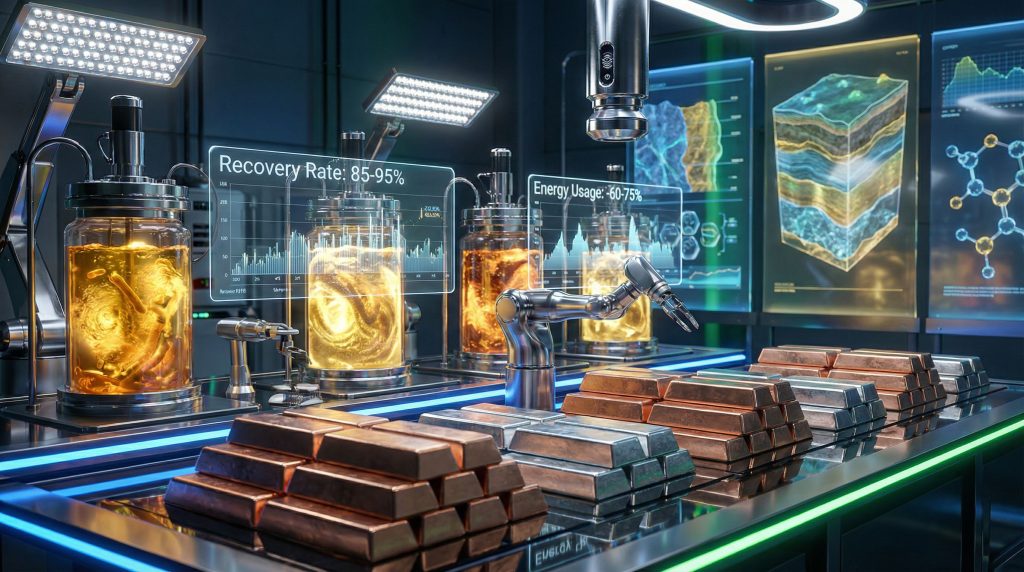
| Recovery Rate | 65-80% | 85-95% | +20-30% |
| Processing Time | 6-12 months | 3-8 months | -50% |
| Energy Usage | 100% baseline | 25-40% baseline | -60-75% |
These performance improvements reflect integrated benefits of biological selectivity, AI-driven optimisation, and advanced process control systems working in coordination to maximise metal recovery while minimising resource consumption.
Which Critical Minerals Benefit Most from Biomining Applications?
Biomining and AI in minerals extraction technologies demonstrate varying effectiveness across different mineral types, with certain metals showing particular promise for commercial-scale biological extraction processes.
Copper Extraction Through Bioleaching
Copper represents the most commercially advanced application of biomining technology, with multiple companies deploying engineered microorganisms in partnership with major mining operations. Endolith collaborates with Rio Tinto, BHP, and South32 for copper recovery applications, demonstrating industry confidence in biological extraction methods.
Glencore Technology's development work focuses specifically on addressing declining copper ore grades in large porphyry systems throughout Chile and Peru. Their technology portfolio emphasises capability to achieve high performance with coarser particle sizes while operating in hypersaline water conditions common in these regions.
Industrial-scale heap leaching operations utilising biological agents can process chalcopyrite and other complex copper sulfides that resist conventional processing methods. However, these systems integrate AI-driven monitoring to optimise bacterial performance throughout extended processing cycles.
Rare Earth Elements and Biorecovery
Rare earth element extraction presents unique opportunities for biological processing due to the complex chemistry involved in separating individual lanthanide elements from mixed ore concentrates. Engineered microorganisms can provide selective extraction capabilities that conventional chemical processes struggle to achieve economically.
Biological systems offer environmental advantages compared to traditional acid leaching methods used for rare earth processing, which typically require harsh chemical conditions and generate significant waste streams. Microbial processes can operate under milder conditions while achieving comparable or superior separation efficiency.
Research initiatives focus on developing bacterial strains capable of selective lanthanide extraction from complex matrices containing multiple rare earth elements, potentially simplifying downstream purification requirements.
Lithium Recovery from Brines and Clays
Lithium extraction from brine resources and clay deposits represents an emerging application area for biomining technologies, particularly relevant given escalating battery supply chain demands. Biological concentration mechanisms could complement direct lithium extraction (DLE) technologies by pre-concentrating lithium from dilute sources.
Genomines is pioneering plant-based metal farming approaches in South Africa using hyperaccumulator plant species. CEO and cofounder Fabien Koutchekian, a former mining engineer, positions this methodology as an alternative to capital-intensive traditional mining that typically requires deployment of one-to-five billion euros for mine development.
Plant-based extraction systems could potentially transition the industry toward smaller-scale operations with reduced capital requirements while maintaining competitive production economics for battery-grade lithium compounds.
Advanced AI Applications in Biomining Process Optimization
Artificial intelligence applications in biomining extend beyond basic monitoring to encompass predictive modelling, adaptive control systems, and autonomous optimisation capabilities that continuously improve processing performance.
Machine Learning for Microbial Performance Prediction
Advanced AI systems analyse historical performance data, environmental conditions, and ore composition variables to predict optimal microbial community configurations for specific processing applications. These algorithms consider complex interactions between bacterial species, nutrient availability, and metallurgical conditions.
Genetic algorithm optimisation techniques guide selection and development of bacterial strains with enhanced metal recovery capabilities. These systems can simulate thousands of potential genetic modifications to identify promising candidates for laboratory validation and field testing.
Environmental parameter modelling enables real-time adaptation to changing ore compositions, weather conditions, and operational requirements. Machine learning algorithms continuously update processing parameters based on sensor feedback and performance outcomes.
Computer Vision in Ore Characterisation
Automated mineralogy analysis using computer vision systems provides detailed characterisation of ore samples at microscopic scales. These systems identify mineral phases, grain sizes, and liberation characteristics that influence biological processing effectiveness.
Particle size distribution monitoring throughout processing operations ensures optimal conditions for microbial access to mineral surfaces. Computer vision systems track particle breakage patterns and surface area evolution during biological treatment cycles.
Quality control applications utilise visual inspection systems to detect contamination, monitor bacterial growth patterns, and identify operational anomalies that could affect metal recovery rates. These systems operate continuously without human intervention while maintaining high accuracy levels.
Digital Twin Technology for Biomining Operations
Digital twin platforms create virtual representations of biomining operations that enable simulation-based optimisation without disrupting actual production processes. Furthermore, these systems integrate real-time operational data with predictive models to forecast performance under various scenarios.
Virtual modelling capabilities allow operators to test different processing strategies, evaluate equipment modifications, and assess environmental impact scenarios before implementing changes in physical operations. This approach minimises operational risks while maximising optimisation opportunities.
Predictive analytics applications forecast production rates, equipment maintenance requirements, and resource consumption patterns based on current operational trends and historical performance data. These insights enable proactive management decisions that improve overall operational efficiency.
The next major ASX story will hit our subscribers first
Environmental and Sustainability Benefits of Bio-AI Mining
The environmental advantages of bio-AI mining integration extend beyond reduced chemical usage to encompass fundamental improvements in mining's ecological footprint and resource utilisation efficiency.
Reduced Chemical Footprint
Biological extraction processes eliminate requirements for many toxic reagents commonly used in conventional mineral processing. Traditional cyanide-based gold extraction, mercury amalgamation, and strong acid leaching systems can be replaced with biological alternatives that operate under near-neutral pH conditions.
Lower acid consumption in biomining operations reduces both environmental risks and operational costs associated with chemical transportation, storage, and waste neutralisation. Biological processes generate acids through microbial metabolism rather than requiring external chemical addition.
Groundwater contamination risks decrease significantly when biological systems replace chemical leaching operations. Microbial processes can be designed with natural containment mechanisms that prevent environmental migration of processing solutions.
Carbon Emission Reductions
Biomining operations typically generate 70-80% fewer CO2 emissions compared to conventional pyrometallurgical processes, primarily due to eliminated requirements for high-temperature smelting and reduced energy consumption throughout processing operations.
Energy intensity reductions from coarser grinding requirements directly translate to lower carbon emissions from power generation. Processing at 500-micron particle sizes instead of 70-micron conventional standards delivers more than 50% energy reduction with proportional emission benefits.
Transportation-related emissions decrease through reduced chemical reagent requirements and simplified infrastructure needs. Consequently, sustainable mining transformation requires fewer material inputs and generates less waste requiring off-site disposal compared to traditional operations.
Waste Stream Minimisation
Biological treatment systems can process mining effluents to remove dissolved metals and neutralise acidic conditions using natural biological processes. These approaches integrate waste treatment with resource recovery, creating circular economy benefits within mining operations.
Conversion of waste rock into productive resources through biological processing enables mining companies to extract value from previously uneconomical materials. This approach extends mine life while reducing surface footprints of waste storage areas.
Tailings management benefits significantly from biological processing capabilities that enable coarser particle discharge and surface stacking instead of wet tailings storage. This transformation reduces long-term environmental liabilities while improving water recovery rates.
Technical Challenges and Implementation Barriers
Despite promising technological advances, biomining and AI in minerals extraction face significant technical challenges that must be addressed for widespread commercial deployment.
Microbial Stability and Control
Maintaining stable bacterial communities under varying operational conditions requires sophisticated understanding of microbial ecology and environmental control systems. Temperature and pH fluctuations can rapidly destabilise bacterial populations, leading to processing interruptions and reduced metal recovery.
Contamination prevention protocols must address both biological and chemical threats to microbial communities. Foreign bacteria, chemical inhibitors, and equipment cleaning residues can severely impact biological performance if not properly managed.
Bacterial culture maintenance systems require continuous monitoring and periodic inoculation to maintain optimal population densities and metabolic activity levels. These requirements add operational complexity compared to conventional chemical processing systems.
Scale-Up Engineering Considerations
Transitioning from laboratory-scale biological processes to commercial operations involves complex engineering challenges related to mass transfer, heat management, and process control at industrial scales. Many biological systems that perform well in controlled laboratory conditions struggle with the variable conditions present in large-scale operations.
Bioreactor design for large-scale operations must balance biological requirements with engineering constraints including structural integrity, maintenance accessibility, and operational flexibility. These systems often require custom engineering solutions for specific applications.
Integration with existing mining infrastructure presents logistical challenges, particularly for retrofit applications where biological systems must interface with conventional processing equipment. These installations require careful planning to minimise production disruptions during implementation phases.
AI System Integration Complexities
Data standardisation across mining operations remains a significant challenge for AI system deployment. Different equipment manufacturers, operational protocols, and legacy systems create data compatibility issues that complicate AI algorithm development and deployment.
Cybersecurity considerations for connected mining systems require robust protection against both external threats and internal vulnerabilities. Mining operations increasingly rely on network-connected sensors and control systems that create potential attack vectors for malicious actors.
Training requirements for operational personnel must address both biological and digital technology components. However, data-driven mining operations need workforce development programmes that prepare employees for hybrid bio-AI operational environments significantly different from traditional mining practices.
Future Technological Developments and Market Projections
The convergence of biotechnology and artificial intelligence in mining applications is accelerating, with emerging technologies promising even more sophisticated capabilities for mineral extraction and processing.
Synthetic Biology Applications
Genetically modified organisms designed specifically for mineral extraction applications represent the next frontier in biomining technology. These engineered systems could provide enhanced metal selectivity, improved environmental tolerance, and faster processing kinetics compared to naturally occurring microorganisms.
Engineered metabolic pathways enable bacteria to target specific metals while ignoring others, potentially simplifying separation processes for complex ore matrices. Research initiatives focus on developing organisms capable of processing rare earth elements, platinum group metals, and other high-value materials.
Biosafety protocols for modified microorganisms require comprehensive environmental risk assessment and containment strategies. Regulatory frameworks for genetically engineered mining applications are still developing, creating uncertainty for commercial deployment timelines.
Quantum Computing in Geological Modelling
Quantum computing technologies promise revolutionary advances in geological modelling capabilities by enabling simulation of complex molecular interactions within mineral matrices. These systems could model microbial behaviour at unprecedented scales and accuracy levels.
Advanced simulation capabilities for complex ore bodies would enable mining companies to optimise extraction strategies before beginning operations. Quantum algorithms could solve optimisation problems involving thousands of variables that overwhelm conventional computing systems.
Molecular-level modelling of biological processes could accelerate development of engineered microorganisms by predicting performance characteristics before laboratory validation. This capability would significantly reduce development timelines and costs for new biomining applications.
Investment Landscape and Capital Flows
Mark Frayman, Managing Partner at Orion Industrial Ventures, emphasises that the minerals sector sits at the forefront of global geopolitical discussions, with technology access becoming increasingly strategic. Government funding for leading startups is expected to accelerate as technology and technology access mirror patterns observed in semiconductor industries.
Market Growth Projections 2026-2035:
| Year | Market Value (USD Billion) | Growth Rate | Key Drivers |
|---|---|---|---|
| 2026 | 2.8 | 12% | Copper demand growth |
| 2030 | 4.9 | 15% | ESG compliance requirements |
| 2035 | 8.7 | 18% | Critical mineral security concerns |
Orion Industrial Ventures believes that emerging companies developing these technologies today will scale into the leading mining and service companies of tomorrow. Furthermore, mining industry evolution will be critical to identifying, developing and operating natural resource assets at viable economics in sustainable ways.
Regulatory Framework Development
Environmental approval processes for biomining operations require new regulatory approaches that address both biological and technological components. Traditional mining regulations may not adequately cover microbial applications and AI-controlled systems.
Safety standards for AI-controlled mining systems must balance automation benefits with operational safety requirements. Regulatory agencies are developing guidelines for autonomous mining equipment and AI-driven decision-making systems.
International trade implications for bio-processed metals may create new classification categories and quality standards. In addition, green transition mining developments could affect global supply chains and pricing mechanisms for metals produced through biological extraction methods.
The mining industry stands at the threshold of a technological revolution where biological intelligence and artificial intelligence converge to create entirely new paradigms for mineral extraction. While significant technical challenges remain, the economic incentives, environmental benefits, and strategic importance of critical minerals are driving unprecedented investment in biomining and AI in minerals extraction technologies.
Disclaimer: This analysis contains forward-looking projections and market estimates based on current industry trends and expert opinions. Actual market developments, technological advancement timelines, and investment outcomes may differ significantly from these projections. Readers should conduct independent research and consult qualified professionals before making investment decisions related to biomining or AI technologies in the mining sector.
Ready to Discover the Future of Mining Technology?
The convergence of biomining and AI represents a transformative shift in mineral extraction, creating exceptional investment opportunities for forward-thinking investors. Discovery Alert's proprietary Discovery IQ model delivers real-time alerts on significant ASX mineral discoveries, empowering subscribers to identify actionable opportunities in this rapidly evolving sector. Begin your 14-day free trial today and position yourself at the forefront of mining's technological revolution.