Bison Resources Ltd
- ASX Code: BSR
- Market Cap: $13,125,765
Bison Resources Uncovers Classic Carlin-Type Pathfinders at Bald Peaks as Nevada Fieldwork Advances
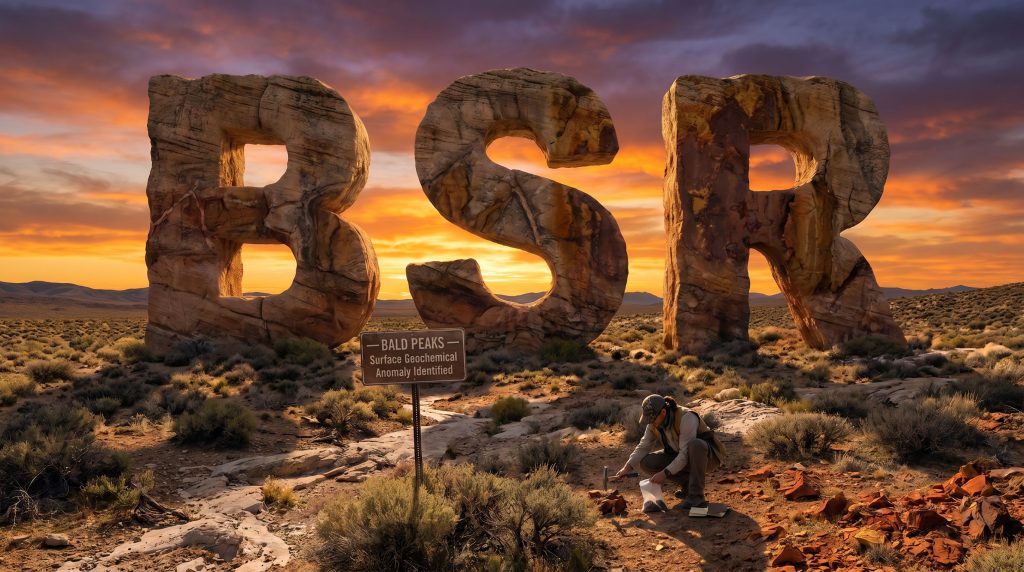
Bison Resources Bald Peaks Carlin-type gold pathfinder results in Nevada represent one of the more compelling early-stage exploration stories to emerge from the region in recent months. Bison Resources Ltd (ASX: BSR) has reported early surface results from its Bald Peaks Project in Nevada, identifying a more than 1.5 km arsenic-antimony (As-Sb) surface geochemical anomaly coincident with gossanous breccias, jasperoid alteration and decalcified carbonate rocks.
According to the 10 July 2026 ASX announcement, these findings from the first 66 rock chip and float samples of the maiden reconnaissance programme are considered by the company to be consistent with the pathfinder element halo of a Carlin-type hydrothermal system.
Mapping, rock chip and soil sampling are ongoing, with Bison Resources Ltd aiming to define anomalies for drill testing for gold mineralisation later in the year.
"The Bison team are extremely encouraged by the strong geochemical anomalism returned from the first reconnaissance sampling programme at the Bald Peaks Project. Surface arsenic-antimony anomalism, coupled with strong iron-silica alteration and decalcification are precisely the ingredients we were hoping to find to indicate the presence of a Carlin-type mineral system. The field crews will now progress with detailed mapping and surface sampling to define high-tenor targets that will be drill tested for gold mineralisation later in the year," said Tim Mackellar, Chief Executive Officer of Bison Resources Ltd.
When big ASX news breaks, our subscribers know first
What Was Found at Bald Peaks?
The initial programme at Bald Peaks focused on testing previously defined spectral (hyperspectral) anomalies for alteration related to hydrothermal activity.
A total of 66 samples were collected, comprising both:
- Rock chip samples from in-situ outcrop, and
- Float samples from loose material where outcrop was absent.
Assays from this first pass confirm:
- A >1.5 km strike length As-Sb anomaly,
- Coincident mercury (Hg), sulphur (S), lead (Pb) and zinc (Zn) anomalism, and
- Strong spatial association with mapped alteration and interpreted structures.
The anomaly is furthermore associated with:
- Decalcification of host carbonate rocks,
- Silicification and jasperoidal alteration, and
- Gossanous breccias mapped along the same trend as the geochemical anomalism, closely aligned with a major interpreted brittle structural corridor.
Field observations recorded that gossanous material is traceable along ridgelines in both outcrop and float, and float is interpreted to be close to its source due to steep topography and the lack of active alluvial systems.
For investors, the key point is that these pathfinder and alteration patterns are widely regarded in Nevada as typical surface expressions that can sit above or adjacent to concealed Carlin-type gold systems, even when gold itself is not yet evident at surface.
Understanding Carlin-Type Systems and Pathfinder Elements
What Is a Carlin-Type Gold Deposit?
Carlin-type deposits are a style of gold mineralisation that is especially well known in Nevada. They are characterised by:
- Gold hosted in fine-grained sedimentary rocks, especially limestones and other carbonate units.
- Gold occurring as microscopic particles, often locked in iron sulphide minerals such as pyrite, rather than as visible nuggets or veins.
- Large, often district-scale systems, where mineralising fluids have moved considerable distances through the rock.
These deposits form when:
- Hot, metal-bearing fluids move through faults and fractures.
- The fluids react chemically with carbonate-rich rocks, changing their composition and dissolving calcium carbonate (decalcification).
- This reaction creates porosity and prepares the rock to host sulphides and gold at depth.
Because the gold is very fine and often not visible, early exploration rarely sees strong gold grades at surface. Instead, geologists track "pathfinder" elements that travel with, or slightly ahead of, the gold-bearing fluids.
Why Do Pathfinder Elements Matter?
In Carlin-type systems, a characteristic suite of elements is commonly associated with gold:
| Pathfinder element | Typical role in Carlin-type systems |
|---|---|
| Arsenic (As) | Close to gold-bearing zones; often one of the strongest indicators near the orebody |
| Antimony (Sb) | Also proximal; supports the presence of hydrothermal fluid pathways |
| Mercury (Hg) | More distal; indicates the broader hydrothermal system footprint |
| Thallium (Tl) | Distal halo element; helps confirm Carlin-type fluid chemistry |
| Tungsten (W) | Can be associated with Carlin-style hydrothermal systems in certain settings |
According to Bison Resources Ltd, the strong As-Sb association with supporting Hg, Tl and W at Bald Peaks suggests that the current sampling is intersecting a proximal halo to a Carlin-type hydrothermal system, and that the core of the system is yet to be located.
From an investment perspective, this means the current work is about system discovery and vectoring, rather than immediate resource definition. The key question now is where, within or adjacent to this halo, any gold-bearing core might sit.
Key Geological Features at Bald Peaks Explained
The announcement references several technical terms that are important in the Bald Peaks context:
-
Decalcification
This is the removal of calcium carbonate from rocks by acidic fluids. It can create spaces within the rock that later fill with sulphides and, potentially, gold. -
Silicification and jasperoidal alteration
Silicification is the addition or replacement of silica (quartz) in the rock. Jasperoid often refers to a dense, silica-rich replacement of carbonate rocks, frequently linked with Carlin-style systems. -
Gossanous breccias
Breccias are rocks made up of broken fragments cemented together. When these are heavily stained with iron oxides at surface, they are described as gossanous and can indicate the weathered remains of sulphide mineralisation at depth. -
Float samples
Float refers to loose rock fragments found on the surface that have moved slightly from their original position. At Bald Peaks, float is interpreted to be close to its original source due to the steep terrain and limited transport.
These features together provide context for the pathfinder geochemistry and improve confidence that the anomaly is structurally controlled rather than random.
Sample Highlights and Geochemical Pattern
The full dataset of 66 samples is presented in Appendix A of the ASX announcement. Several samples illustrate the intensity of the pathfinder response at Bald Peaks:
| Sample ID | Type | Sb (ppm) | As (ppm) | Hg (ppm) | Description |
|---|---|---|---|---|---|
| BPR0050 | Rock | 238.8 | 3,366 | 1.00 | Gossanous carbonate |
| BPR0030 | Float | 592.1 | 1,990 | 0.67 | Carbonate |
| BPR0015 | Float | 242.2 | 2,667 | 0.83 | Gossanous |
| BPR0016 | Float | 371.1 | 1,907 | 0.60 | Gossanous |
| BPR0058 | Rock | 72.91 | 455.9 | 0.50 | Carbonate |
| BPR0059 | Float | 284.3 | 917.6 | 0.45 | Gossanous |
| BPR0061 | Float | 128.7 | 991.5 | 0.20 | Gossanous |
| BPR0026 | Float | 158.4 | 413.4 | 0.24 | Carbonate |
| BPR0053 | Rock | 90.99 | 972.5 | 0.43 | Carbonate |
| BPR0018 | Float | 171.9 | 717.4 | 0.60 | Carbonate |
The highest arsenic value of 3,366 ppm As in sample BPR0050, taken from in-situ gossanous carbonate, stands out as a particularly strong pathfinder response.
Across the anomaly:
- Many samples show Sb values above 100 ppm and As values ranging from several hundred to several thousand ppm.
- Mercury values are generally low to moderate but consistent with a broader hydrothermal halo.
Gold (Au) values in this initial dataset are largely below detection limit, with only a few very low-level results — for example, 0.014 ppm Au in sample BPR0019. This pattern is in line with early-stage sampling in Carlin-style systems, where gold is commonly better developed at depth within sulphide zones, rather than at the oxidised surface.
For investors, the main takeaway is that the geochemical footprint is large and coherent, providing a logical base for follow-up soil sampling, mapping and ultimately drilling.
Project Context: Bison Resources' Position in the Carlin Trend
Bison Resources Ltd holds four projects in northeast Nevada:
- Ruby Lake
- Cherry Springs
- Bald Peaks
- Medicine Range
Collectively, these comprise 312 unpatented lode mining claims covering approximately 26.1 km², located around 80 km southeast of Elko within the Carlin Trend, one of the world's best-known gold districts.
The Bald Peaks Project specifically:
- Consists of 40 unpatented lode mining claims over approximately 3.3 km².
- Is held 100% by Bison Nevada LLC, a wholly owned subsidiary of Bison Resources Ltd.
- Has no known joint ventures, royalties or third-party encumbrances, according to the ASX announcement.
Regionally, Bald Peaks sits:
- Directly adjacent to Torex Gold Resources Inc.'s Medicine Springs high-grade silver project.
- Proximal to Sun Silver's Maverick Silver Project, which the announcement states has a reported 539 Moz AgEq resource.
- In a geological and structural setting described by the company as similar to Maverick Silver.
The project area lies within the broader Mud Springs Historic Mining District, although Bison Resources Ltd notes that no known historic exploration has taken place within the Bald Peaks lease boundaries.
For investors, this combination of a recognised gold district, proximity to advanced silver projects, and an underexplored land position with 100% ownership provides a clear context for the current early-stage work.
How the Current Results Support the Targeting Model
Prior to fieldwork, Bison Resources Ltd utilised hyperspectral mapping to define two primary targets at Bald Peaks:
- An 800 m-long kaolinite-jarosite anomaly in the northeast.
- A 1 km-long iron-rich anomaly in the south.
These features were interpreted as indicators of hydrothermal alteration potentially linked to Carlin-type systems.
According to the ASX announcement, the initial rock chip and float sampling:
- Confirms a >1.5 km As-Sb anomaly closely aligned with these spectral anomalies.
- Shows that pathfinder element anomalism is spatially consistent with mapped zones of decalcification, jasperoid, and gossanous breccias.
- Indicates that the geochemical response correlates well with the original remote-sensing based predictions.
This alignment between pre-field modelling and on-ground data is important for investors assessing technical capability, as it suggests that the exploration team's targeting methods are performing as planned.
Next Steps: From Surface Anomaly to Drill Targets
According to Bison Resources Ltd, work at Bald Peaks is continuing and is planned to progress through several stages designed to move from broad anomaly definition to prioritised drill targets.
Planned activities include:
| Activity | Objective |
|---|---|
| Systematic soil sampling with multi-element analysis | Extend and refine the surface footprint of pathfinder element anomalies across the project area |
| Additional rock chip sampling | Improve definition of the >1.5 km As-Sb trend and test additional alteration zones |
| Detailed geological mapping | Clarify alteration zonation, structural controls and relationships between lithology, structure and geochemistry |
| Airborne magnetic survey | Map structural architecture at depth, including potential faults and folds that may control fluid flow |
| Ground gravity survey | Identify density contrasts that may relate to lithological boundaries or intrusions associated with mineralising systems |
| Drill targeting and future drilling | Use the integrated dataset to select and prioritise targets for future drill testing of gold potential |
The company states it is aiming to define anomalies suitable for drill testing for gold mineralisation later in the year, subject to the successful completion of these surface programmes and other typical exploration considerations.
The next major ASX story will hit our subscribers first
Investment Considerations: Early-Stage Carlin Trend Exposure
For investors assessing Bison Resources Ltd at this stage, several factors from the announcement are relevant:
Is the Geochemical Signal Meaningful?
The As-Sb-Hg pathfinder association, plus decalcification, silicification and gossanous breccias, matches widely recognised Carlin-style criteria. However, no economic gold mineralisation has been reported, and all conclusions about system type remain interpretive at this stage.
What Does the Land Position Offer?
The company reports no known prior exploration within the Bald Peaks claims, which means the current results represent the first systematic dataset for this ground. Furthermore, Bison Resources Ltd controls multiple projects within the Carlin Trend, providing several potential discovery opportunities rather than a single asset focus.
How Is the Exploration Being Managed?
The announced next steps follow a standard, staged exploration approach: geochemistry, mapping, geophysics, then drilling. This can help manage risk by ensuring that any drilling is guided by as much supporting data as possible.
Investors tracking the Bison Resources Bald Peaks Carlin-type gold pathfinder results in Nevada may consequently view Bald Peaks as an early-stage Carlin-style exploration opportunity where the immediate focus is on defining and refining targets, with future drilling planned to test whether the identified hydrothermal system hosts economically meaningful gold mineralisation.
Ready to Explore What Bison Resources Is Building in Nevada?
Bison Resources Ltd (ASX: BSR) is advancing a compelling early-stage gold exploration portfolio across four projects in one of the world's most celebrated gold districts — the Carlin Trend. With a maiden reconnaissance programme at Bald Peaks already confirming a classic Carlin-type pathfinder signature across more than 1.5 km of strike, and drilling planned for later in the year, investors seeking exposure to a 100%-owned, underexplored Nevada land position may want to stay close to developments. To learn more about Bison Resources and its projects, visit www.bisonresources.com.au.