August 7, 2026
The Hidden Cost Equation Behind Large-Scale PGM Mine Restarts
Commissioning a mothballed platinum mine is rarely a straightforward capital decision. In the world of South African underground mining, the complexity compounds quickly: steep-dipping orebodies resist mechanisation, fixed costs accumulate before the first ounce ships, and commodity price cycles operate on timelines that rarely align with construction schedules. When a diversified mining company commits R15.2 billion to a single asset that has already been written down once, the investment community pays close attention. The Bokoni Platinum reboot could knock ARM's cash flow in ways that extend well beyond the project announcement itself, and understanding why requires a closer look at the geology, the capital structure, and the market dynamics simultaneously in play.
When big ASX news breaks, our subscribers know first
Bokoni's Geological Identity: High Grade, High Complexity
Not all platinum group metals deposits are created equal, and Bokoni's geological profile captures this tension better than most. The mine operates on the UG2 chromitite layer, a reef formation that sits beneath the better-known Merensky reef in the Bushveld Igneous Complex stratigraphy. Approximately 80% of Bokoni's total resource base sits within this UG2 horizon, which carries an ore grade of 6.43 grams per tonne (g/t) of platinum group metals.
By South African industry standards, that grade is genuinely exceptional. The South African PGM sector average for underground operations typically ranges between 3.5 g/t and 5 g/t across the Bushveld Complex, meaning Bokoni's UG2 resource is meaningfully above the peer group median. However, grade alone does not determine mine economics. The ore body's steep-dipping geometry is the critical complicating factor.
Why Steep-Dip Geometry Matters to Mine Economics
In underground hard-rock mining, the dip angle of an orebody determines how efficiently ore can be extracted, how easily infrastructure can be installed, and ultimately how much it costs to move each tonne of rock to the surface. Flat to gently dipping reefs, like portions of the Merensky reef mined by major producers, are more amenable to trackless mechanised mining methods that reduce labour intensity and improve productivity rates.
Steep-dipping reefs require fundamentally different approaches. Conventional stoping methods with scraper winches and hand-held drilling equipment remain the most viable extraction technique in many steep-dip scenarios, but they are inherently labour-intensive and slow. Consequently, unit costs per ounce tend to migrate toward the upper end of the industry cost curve, limiting margin even when the in-situ grade is excellent. This is the exact dynamic that prevented previous operators from making Bokoni work financially across more than two decades of stewardship.
Furthermore, cut-off grade economics become particularly significant in steep-dip scenarios, where the boundary between ore and waste is not merely a geological question but a commercial one that shifts with metal prices and operating costs.
Geological Note: The UG2 reef is chromite-rich and carries a different PGM basket ratio compared to the Merensky reef. UG2 material is typically richer in palladium and rhodium relative to platinum, meaning its basket value is sensitive to palladium and rhodium price movements. This is worth noting when evaluating the project's long-term revenue assumptions.
ARM's Capital Allocation History: Context Is Everything
Any serious evaluation of ARM's Bokoni commitment must be filtered through the company's broader track record of project decisions, which includes both disciplined exits and costly miscalculations. The ARM platinum investment outlook has evolved considerably over recent years, shaped by these historical lessons.
-
Lubambe Copper (Zambia): ARM divested its 40% stake in 2017 following a R1.4 billion impairment. The subsequent Chinese owner committed approximately $300 million in pre-revenue capital expenditure, suggesting ARM's exit, while painful, may have avoided a deeper capital trap.
-
Otjikoto Gold (Namibia): ARM divested the greenfield asset in 2010, classifying it as below investment threshold. The Canadian acquirer, B2Gold, developed Otjikoto into Namibia's largest gold producer, with the operation contributing more than $19 billion to the Namibian economy between 2015 and 2022. This exit is widely considered one of the most consequential missed opportunities in ARM's history.
-
Bokoni Platinum (initial cycle): Acquired for R3.5 billion in 2021 from the Amplats-Atlatsa Resources joint venture, suspended within three years as the operating configuration failed to generate sufficient revenue to cover fixed costs, then written down by R2.2 billion in ARM's 2025 financial year. Now entering a second capital cycle at R15.2 billion.
Pattern Recognition: The Otjikoto divestment illustrates the risk of abandoning assets too early. The Lubambe exit suggests ARM can also make structurally correct decisions despite the financial pain of write-downs. Bokoni sits at the intersection of both lessons: ARM chose to re-engage, but at a cost that dwarfs its original acquisition price.
The Feasibility Plan: What ARM Is Actually Committing To
The revised definitive feasibility study that underpins the Bokoni restart represents a fundamental redesign of the operating configuration, not a simple recommissioning of what existed before. The capital commitment and production targets are summarised below.
| Parameter | Detail |
|---|---|
| Total approved capital expenditure | R15.2 billion |
| Capital intensity per ounce | ~R40,500/oz |
| Target annual PGM production | Up to 400,000 oz |
| Target production commencement | First half of FY2028 |
| Full ramp-up target | Approximately 2030 |
| Investment horizon | Seven years |
| Mining methodology | Phased, hybrid approach |
| Processing infrastructure | New concentrator included |
The phased, hybrid mining approach is designed to manage the challenge that has historically defeated Bokoni's economics: balancing the steep-dip orebody geometry against the need to keep unit costs in the lower half of the industry cost curve. The inclusion of a new concentrator signals that ARM is investing in the full processing chain, not just the extraction infrastructure.
At full production, Bokoni's targeted 400,000 oz per year would represent approximately two-thirds of ARM's current attributable PGM output of 615,719 oz annually, making it a transformative production addition for the group if the ramp-up succeeds. For context, according to Mining Weekly, Bokoni's capital intensity of R40,500 per ounce sits broadly in line with Sibanye-Stillwater's approximately R30 billion brownfield PGM project portfolio disclosed in June 2026, suggesting the project's economics are not an outlier within the current South African PGM development landscape.
Cash Flow Risk: The Two Rivers Compounding Factor
The question of whether the Bokoni Platinum reboot could knock ARM's cash flow cannot be answered by looking at Bokoni alone. The more serious analytical concern sits at the intersection of Bokoni and a second project: the Two Rivers Merensky expansion, held in joint venture with Impala Platinum.
If Two Rivers receives formal approval while Bokoni is in active capital deployment, the concurrent funding requirements of both projects could push ARM into negative free cash flow for a period of two to three years, according to analysis from RMB Morgan Stanley's Brian Morgan. This scenario assumes current PGM basket prices hold through the deployment phase. Any meaningful price deterioration would amplify the deficit.
ARM's Balance Sheet: Genuine Buffer or False Reassurance?
ARM reported a net cash position of R9.5 billion at end-June 2026, which represents a meaningful liquidity foundation entering the investment cycle. However, the arithmetic is sobering:
- Bokoni's total capex of R15.2 billion exceeds ARM's current net cash position by approximately R5.7 billion
- The net cash buffer covers roughly 62% of Bokoni's total capital requirement on a standalone basis
- Adding Two Rivers approval would extend the funding gap considerably further
Citi analyst Shashi Shekhar provides a more constructive counterpoint, noting that ARM's PGM segment is generating substantial cash at prevailing metal prices, meaning the company has operational cash flow working in its favour alongside the balance sheet buffer. The critical variable is whether PGM basket prices remain at or near current levels through the multi-year capital deployment window.
Market Reaction and Investor Sentiment: What the Share Price Reveals
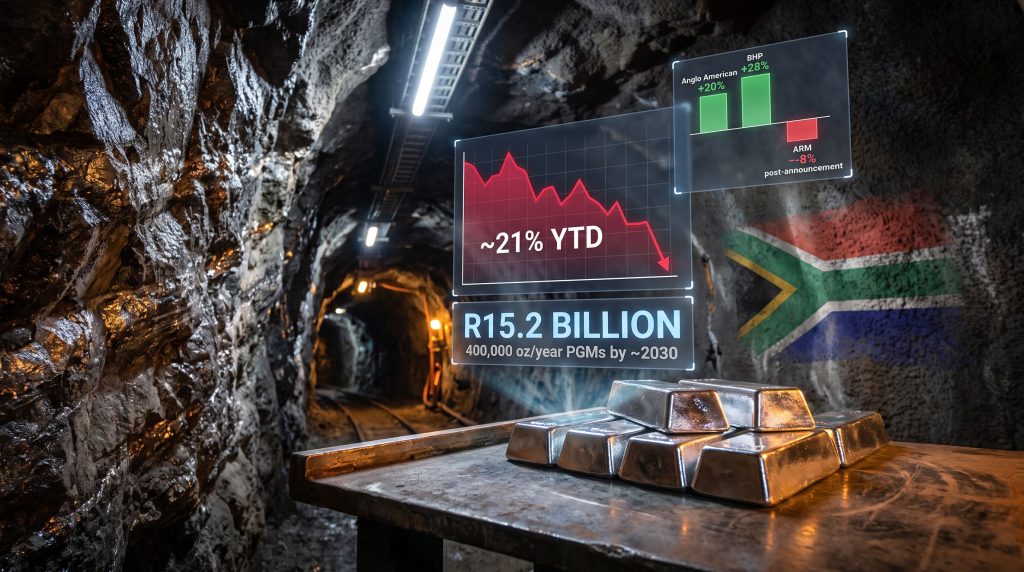
The market's response to the Bokoni announcement delivered an unambiguous signal. ARM shares fell approximately 8% in the seven days following the July 23 announcement, extending a year-to-date decline of approximately 21% by early August 2026. This performance stands in sharp contrast to diversified JSE-listed peers over the same period:
| Company | 2026 YTD Share Price Performance |
|---|---|
| ARM | Approximately -21% |
| Anglo American | Approximately +20% |
| BHP | Approximately +28% |
UBS analyst Steve Friedman noted that the approval was expected in principle but had not been forecast for this specific timing, indicating the market was caught off-guard by the announcement's swiftness rather than its ultimate direction. RMB Morgan Stanley characterised investor sentiment toward the project as broadly negative, flagging that the quantum of capital committed is likely to weigh on the share price.
Investor Psychology Insight: The gap between ARM's share price trajectory and those of its diversified peers reflects more than PGM price sensitivity. It captures the market's pricing of execution risk, capital drag, and the historical precedent of Bokoni's underperformance across every previous ownership structure.
The next major ASX story will hit our subscribers first
The PGM Market Backdrop: Supply Contraction Meets Demand Recalibration
The strategic case for restarting Bokoni rests on two intersecting market arguments that have gained credibility over the past 12 to 18 months. In addition, understanding the broader platinum and palladium market dynamics is essential context for evaluating why ARM moved now rather than waiting.
Supply-side: South African PGM production is in structural decline. Ongoing operational restructuring across major producers, including shaft closures and workforce reductions, is reducing aggregate refined supply. In a market where South Africa accounts for approximately 70% of global platinum output and over 35% of palladium supply, domestic production contractions have outsized global pricing implications. Indeed, PGM supply constraints across the Bushveld Complex are increasingly shaping long-term price forecasts.
Demand-side: The electric vehicle adoption rate, which was the primary bearish argument for long-term platinum and palladium demand through 2021 to 2023, has slowed materially relative to earlier projections. Automotive catalytic converter demand remains the dominant use case for the PGM basket, and the moderation in EV penetration forecasts has partially restored the long-term demand outlook for these metals.
The combination of declining supply and a recalibrated demand profile creates a more supportive pricing environment for new production capacity. However, the Bokoni investment horizon of seven years means the project carries exposure to multiple commodity price cycles before reaching full production in approximately 2030.
The Nkomati Nickel Restart: Secondary Risk, Different Dynamics
On the same date as the Bokoni announcement, ARM confirmed it would also restart the Nkomati nickel mine in Mpumalanga province, representing a combined capital commitment exceeding R16 billion across both projects in a single announcement. Reuters reported that the simultaneous nature of these approvals underscored the scale of ARM's strategic shift.
- Nkomati's capital expenditure: R750 million, substantially smaller than Bokoni
- An offtake agreement with Swedish mining group Boliden, secured in April 2026, underpins commercial confidence
- The nickel market has experienced significant volatility but showed improvement through 2026
- While Nkomati adds to the aggregate capital deployment burden, its scale is unlikely to independently threaten ARM's free cash flow position
The Nkomati commitment is best understood as a lower-stakes, commercially anchored restart, where the Boliden offtake agreement provides revenue certainty that the Bokoni project cannot yet offer.
Bull Case vs. Bear Case: The Investor Decision Framework
The Bull Case in Three Points
-
South African PGM supply is structurally declining, creating a medium-term pricing floor that supports investment in new capacity.
-
Bokoni's 6.43 g/t UG2 grade positions it as a high-quality asset if the new phased mining methodology can genuinely resolve the steep-dip cost challenge that defeated previous operators.
-
ARM's R9.5 billion net cash position and operational PGM cash generation provide a genuine liquidity buffer through the early capital deployment phase.
The Bear Case in Three Points
-
No previous operator has achieved sustained low-cost production at Bokoni across more than two decades of attempts, including Amplats, now trading as Valterra Platinum.
-
Concurrent funding of Bokoni and Two Rivers Merensky could push ARM into negative free cash flow for two to three years, creating a sustained dividend and balance sheet risk.
-
The seven-year capital deployment horizon exposes the project to multiple PGM price cycles before meaningful production revenues materialise, and a 15% to 20% decline in basket prices during this window would materially impair project economics.
Key Conditions for a Positive Outcome
For the Bokoni restart to deliver on its potential, a specific set of conditions would need to hold simultaneously:
- PGM basket prices must remain at or near current levels through approximately 2026 to 2030
- The hybrid mining methodology must demonstrably reduce unit costs relative to the historical operating configuration
- Two Rivers approval timing must be managed carefully to avoid peak simultaneous capital outflows
- ARM's operational execution would need to improve meaningfully on Valterra Platinum's two-decade cost record at the same asset
Disclaimer: This analysis is based on publicly available information and analyst commentary as reported by MiningMX and associated industry sources as of August 2026. It does not constitute financial advice. Forward-looking statements regarding production targets, cash flow projections, and commodity prices involve material uncertainty. Investors should conduct independent due diligence before making any investment decisions.
Bokoni Platinum Restart: Key Metrics at a Glance
| Dimension | Assessment |
|---|---|
| Asset grade | 6.43 g/t UG2, high-quality but steep-dipping |
| Total capital commitment | R15.2 billion over seven years |
| Capital intensity | ~R40,500 per ounce |
| Production target | Up to 400,000 oz PGMs per year by ~2030 |
| Net cash buffer | R9.5 billion at end-June 2026 |
| Free cash flow risk | Potentially negative for 2–3 years if Two Rivers also proceeds |
| YTD share price performance | Approximately -21% (vs Anglo American +20%, BHP +28%) |
| Operational execution risk | High, given two decades of above-industry-average costs under prior owners |
| PGM market backdrop | Supportive, but price-sensitive over the long deployment horizon |
| Analyst consensus | Mixed, cautious on execution, conditionally positive on market timing |
The central question the Bokoni Platinum reboot poses for ARM's cash flow is not whether the asset has geological merit — it clearly does. The question is whether the company's redesigned operating approach, combined with a more favourable PGM market structure, can finally solve the cost problem that has made Bokoni one of South Africa's most technically challenging platinum operations for a generation of mining engineers and capital allocators alike.
Want to Know When the Next Major Mineral Discovery Hits the ASX?
Discovery Alert's proprietary Discovery IQ model delivers real-time alerts on significant ASX mineral discoveries — instantly transforming complex data into actionable insights for both short-term traders and long-term investors. Explore why historic discoveries generate substantial returns on Discovery Alert's dedicated discoveries page, and begin your 14-day free trial today to position yourself ahead of the market.