August 7, 2026
The TRL Valley of Death: Why Bridging the Commercialisation Gap Is Now a National Priority
Across the global minerals industry, one of the most persistent structural failures is not the absence of innovation — it is the inability to move proven technologies from the laboratory bench to commercial-scale operations. Projects that have survived years of exploration, metallurgical testing, and pilot-scale trials routinely stall at the precise moment they need the most capital. Private financiers demand production history. Early-stage grant programmes have already exited. The result is a financing vacuum that quietly buries dozens of viable projects each decade.
This is the problem the UK critical minerals accelerator has been specifically designed to address, and understanding that context is essential to appreciating why this programme carries genuine strategic weight beyond its headline funding figure.
When big ASX news breaks, our subscribers know first
What Is the UK Critical Minerals Accelerator?
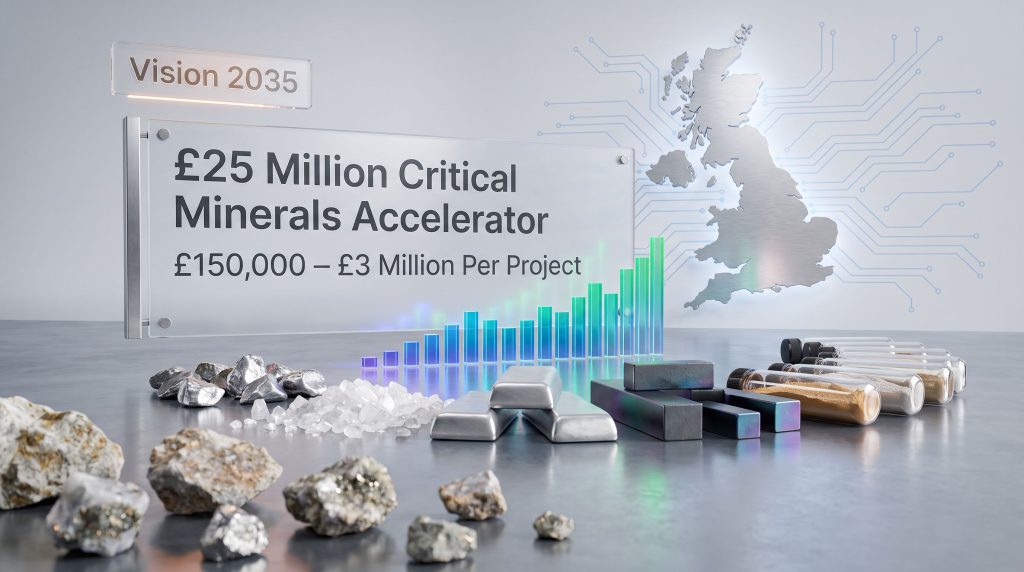
Announced in August 2026, the UK critical minerals accelerator is a £25 million grant scheme targeting domestic extraction, processing, and recycling projects that are close to commercial readiness but cannot yet attract conventional institutional financing. It forms one component of a broader £50 million UK Critical Minerals Programme, which also includes the Magnet Hub and a Demand Aggregation Platform, each targeting a different structural weakness in the UK's domestic supply chain architecture.
The three pillars underpinning the accelerator's design reflect both industrial and geopolitical logic:
- Driving economic growth through domestic job creation and value-added processing capability
- Strengthening economic security by reducing dependence on concentrated foreign supply chains
- Building domestic resilience against commodity shocks, trade disruptions, and geopolitical instability
The accelerator is explicitly linked to Vision 2035, the UK Government's ten-year strategic framework for securing critical mineral supply chains, announced in 2025. The accelerator functions as one of Vision 2035's primary near-term delivery instruments, translating long-range strategic ambition into funded, operational projects before the end of the decade.
The £50M Programme Architecture: Three Workstreams, One Strategic Goal
The parent programme distributes its £50 million across three distinct components, each targeting a different segment of the supply chain problem.
| Programme Component | Primary Function | Strategic Focus |
|---|---|---|
| Critical Minerals Accelerator | Grant funding for near-commercial projects | Extraction, processing, recycling |
| Magnet Hub | Permanent magnet supply chain development | Manufacturing capability |
| Demand Aggregation Platform | Coordinating buyer-side demand signals | Market development |
This architecture reflects a sophisticated understanding of where the UK's supply chain vulnerabilities actually lie. The country is not simply short of raw materials in the ground; it lacks the processing infrastructure, manufacturing capability, and coordinated demand signals to build a functioning domestic supply chain from end to end. Each workstream targets one layer of that structural deficit.
How the Accelerator Works: Eligibility, Funding, and Timeline
Eligibility Criteria
Not every minerals project qualifies. The accelerator has defined a precise target profile:
- Operations must be UK-based, with no provision for overseas project funding
- Projects must target minerals included on the 2024 UK Critical Minerals List, which also encompasses associated growth minerals
- Technology Readiness Levels must fall between TRL 6 and TRL 8, covering pilot-demonstrated technologies through to fully qualified pre-commercial systems
- All funded activity must be completed and delivered by 31 March 2030
Grant Funding Parameters
| Funding Parameter | Detail |
|---|---|
| Total Accelerator Pot | £25 million |
| Minimum Individual Grant | £150,000 |
| Maximum Individual Grant | £3 million |
| Delivery Deadline | 31 March 2030 |
The grant range reflects a deliberate design choice. By setting a relatively modest floor of £150,000 and a ceiling of £3 million, the programme can support a diversified portfolio of projects across extraction, processing, and recycling subsectors, rather than concentrating capital in one or two large bets.
Application Timeline
- Applications opened: 5 August 2026
- Application window closes: 30 September 2026
- Grant decisions expected: By end of 2026
- Delivery period: Early 2027 through to 31 March 2030
The two-stage process moves from an Expression of Interest to a full application and formal assessment. This phased approach allows applicants to gauge eligibility before committing to a comprehensive submission, and allows assessors to prioritise projects with the strongest strategic alignment and commercial readiness.
Understanding Technology Readiness Levels 6 to 8
The TRL framework, originally developed by NASA and now widely adopted across defence, energy, and industrial innovation, provides a standardised vocabulary for describing how mature a technology is relative to commercial deployment.
Projects operating between TRL 6 and TRL 8 occupy one of the most underfunded segments of the entire innovation pipeline. They are too advanced for early-stage research grants, yet too unproven for institutional project finance. This is the commercialisation gap the accelerator is designed to bridge.
To be specific about what these levels mean in practice:
- TRL 6: Technology has been demonstrated at pilot scale in a relevant operational environment
- TRL 7: A full prototype has been demonstrated in an operational environment, with performance data available
- TRL 8: The system is complete, integrated, and qualified for deployment, pending commercial scale-up
A UK-based lithium recycling operation that has completed hydrometallurgical recovery trials at pilot scale and is seeking capital to build a multi-hundred-tonne-per-year demonstrator plant would represent a textbook TRL 6 to 7 transition — precisely the profile this accelerator targets. Direct lithium extraction technology exemplifies the type of innovation that sits squarely within this funding gap. The private financing gap at this stage is well-documented: early-stage venture funds have typically exited, and project finance lenders require operational cash flows that do not yet exist.
The 2024 UK Critical Minerals List and Eligible Mineral Categories
The UK uses a formal criticality assessment methodology to classify minerals based on two axes: supply risk (considering geographic concentration, geopolitical stability, and market liquidity) and economic importance (measured by the mineral's role in key industrial and defence value chains).
The 2024 list draws a distinction between core critical minerals, where supply disruption poses an acute national security risk, and growth minerals, where strategic demand is expected to accelerate significantly over the coming decade driven by the energy transition and defence modernisation. Both categories are eligible under the accelerator, which broadens the potential applicant pool considerably beyond a narrow rare earths focus. Furthermore, the critical minerals demand surge driven by the energy transition continues to place upward pressure on the urgency of domestic supply chain development.
Minerals with applications across the following sectors typically feature prominently on criticality assessments:
- Defence systems: Guidance electronics, radar hardware, secure communications infrastructure
- Renewable energy: Permanent magnets for wind turbines, grid-scale battery storage, power conversion systems
- Consumer and industrial technology: Electric vehicle drivetrains, semiconductors, smartphone components
The next major ASX story will hit our subscribers first
Why Supply Chain Concentration Represents a Structural Risk
The strategic rationale behind the accelerator becomes sharper when viewed against the current global supply landscape. According to the Centre for Strategic and International Studies, China accounts for more than 70% of global rare earth mining and approximately 93% of global magnet manufacturing. These rare earth supply chain importance figures represent a degree of market concentration that is unusual even by historical commodity standards.
| Metric | Current Global Reality |
|---|---|
| China's share of global rare earth mining | More than 70% |
| China's share of global magnet manufacturing | Approximately 93% |
| UK domestic critical mineral production | Largely pre-commercial |
This concentration means that supply disruptions — whether driven by trade policy shifts, export controls, environmental regulation, or geopolitical events — have an outsized impact on downstream manufacturers in countries that have not developed domestic alternatives. The UK's current position, with a nascent domestic production base, leaves its advanced manufacturing and defence industrial sectors exposed to exactly this type of systemic shock.
How the UK's Strategy Compares to Allied Nation Approaches
Contextualising the UK's investment within the broader allied response to mineral supply chain risk reveals both the ambition and the relative scale of the domestic programme.
| Country/Bloc | Primary Policy Tool | Scale of Commitment |
|---|---|---|
| United Kingdom | Grant accelerator and programme funding | £50 million programme |
| United States | Direct equity, loans, and production grants | US$400 million+ to MP Materials alone |
| European Union | Regulatory benchmarks and strategic project status | Critical Raw Materials Act |
| Australia | Export partnerships and processing investment | Multi-billion AUD pipeline |
The United States has pursued a high-conviction, high-concentration model, committing over US$400 million to MP Materials, which is the only fully integrated rare earth producer in the US, managing mining, refining, separation, and magnet manufacturing within a single domestic value chain. The US also invested more than US$4 million in the Madagascar Ampasindava project in July 2026, extending its supply chain anchoring strategy offshore.
The UK's approach distributes risk across a portfolio of near-commercial projects rather than consolidating capital behind a single integrated producer. This reflects the different industrial base the UK is working with — one that possesses significant processing, recycling, and advanced manufacturing expertise, but lacks the large-scale resource endowment available to the US or Australia.
The EU's Critical Raw Materials Act takes yet another approach, using regulatory mandates and strategic project designations to shape private investment flows, rather than direct grant disbursement. European critical raw materials funding illustrates how this regulatory-led model differs structurally from the UK's direct grant mechanism. Each model carries distinct trade-offs between deployment speed, leverage of private capital, and tolerance for concentration risk.
What Projects Are Most Likely to Qualify?
Given the eligibility parameters, three project archetypes emerge as the most likely candidates for accelerator funding:
1. Domestic extraction operations targeting listed critical minerals at the pre-commercial stage, including hard rock and secondary resource projects where pilot-scale ore processing data is available.
2. Processing and refining facilities seeking to build mid-stream capability within the UK, particularly where imported concentrates can be processed domestically to reduce dependence on overseas refining capacity.
3. Recycling and secondary supply operations targeting end-of-life recovery of critical minerals from consumer electronics, industrial equipment, and defence hardware, closing the loop on mineral flows that currently exit the UK as waste.
The recycling segment deserves particular attention from an investor and policy perspective. The urban mining potential of recovering critical minerals from manufactured goods, rather than geological sources, has historically been underinvested relative to its strategic value. For minerals like cobalt, lithium, and rare earth elements, secondary supply through recycling can meaningfully reduce primary extraction requirements over time, while also building domestic processing expertise applicable across both primary and secondary feedstocks.
Economic Impact: Beyond the Grant Cheque
The direct value of individual grants — ranging from £150,000 to £3 million — understates the programme's potential economic impact when the leverage effect of public capital on private investment is considered. Grant funding at the TRL 6 to 8 stage serves primarily as a de-risking mechanism, not a full financing solution. By demonstrating government confidence in a project's technical and commercial viability, accelerator awards can significantly improve a company's ability to raise follow-on private capital.
This multiplier dynamic is well-understood in innovation policy literature: public grants at the pre-commercial stage consistently generate private investment multiples well in excess of the original public outlay. For the £25 million accelerator, the real economic test will be how much additional private capital is mobilised alongside and following grant awards by the end of 2026. For further detail on the full programme funding structure, the UK Government's official collections page outlines all related critical minerals initiatives.
From a regional economic perspective, the programme has the potential to distribute industrial activity across UK geographies with underlying mineral endowments or established processing clusters, supporting job creation in sectors where the UK has genuine comparative advantage in technical expertise. Notably, the broader programme investment of £50 million signals the government's commitment to strengthening supply chains at multiple levels simultaneously.
Frequently Asked Questions: UK Critical Minerals Accelerator
Who Can Apply for the UK Critical Minerals Accelerator?
UK-based companies and project entities working on extraction, processing, or recycling of minerals on the 2024 UK Critical Minerals List, operating at Technology Readiness Levels 6 to 8.
How Much Funding Is Available Per Project?
Individual grants range from £150,000 to £3 million, drawn from a total £25 million accelerator pool.
When Does the Application Window Close?
Applications opened on 5 August 2026 and close on 30 September 2026. Grant decisions are expected before the end of 2026.
Does the Accelerator Fund Overseas Projects?
No. Funding is restricted to UK-based projects and operations.
What Is the Relationship Between the Accelerator and Vision 2035?
Vision 2035 is the UK Government's ten-year strategic framework for critical mineral supply chain security. The accelerator is one of its primary near-term delivery mechanisms.
What Happens After Grant Decisions in Late 2026?
Approved projects begin delivery, with all funded activity required to conclude by 31 March 2030.
Key Takeaways: UK Critical Minerals Accelerator at a Glance
| Element | Detail |
|---|---|
| Total Grant Funding | £25 million |
| Parent Programme | £50 million UK Critical Minerals Programme |
| Target TRL Range | 6 to 8 |
| Grant Range Per Project | £150,000 to £3 million |
| Application Open | 5 August 2026 |
| Application Close | 30 September 2026 |
| Project Delivery Deadline | 31 March 2030 |
| Strategic Framework | Vision 2035 |
| Eligible Sectors | Extraction, processing, recycling |
| Geographic Restriction | UK-based projects only |
Disclaimer: This article contains forward-looking statements and references to government policy frameworks that are subject to change. Information regarding programme parameters, timelines, and funding allocations is based on publicly available sources current at the time of writing. Readers should verify all details directly with the relevant government departments before making investment or business decisions. Nothing in this article constitutes financial advice.
Want to Know Which ASX Discoveries Could Deliver Transformative Returns?
As critical minerals move to the centre of global industrial and defence strategy, Discovery Alert's proprietary Discovery IQ model scans ASX announcements in real time, instantly identifying significant mineral discoveries across more than 30 commodities and translating complex data into clear, actionable insights — explore historic discovery outcomes to understand the scale of opportunity, then begin your 14-day free trial at Discovery Alert to position yourself ahead of the market.