August 7, 2026
The Infrastructure Gap That Determines Whether Critical Mineral Projects Actually Get Built
Every mining project that looks compelling on paper eventually collides with the same set of problems: power delivery, road access, and the logistics that connect a resource in the ground to a customer on the other side of the world. These are not glamorous problems. They rarely make headlines. However, they are the problems that kill projects, stretch timelines by years, and quietly erode the returns that investors were promised at the outset.
What makes a project genuinely de-risked is not just the grade of the deposit or the quality of the offtake agreement. It is whether the foundational infrastructure challenges have been acknowledged, funded, and placed on a defined engineering pathway. That distinction matters enormously, and it is precisely why First Phosphate Canada funding for Quebec phosphate mine development has attracted sustained attention from institutional observers and individual investors alike.
When big ASX news breaks, our subscribers know first
First Phosphate and the Two-Stage Federal Funding Story
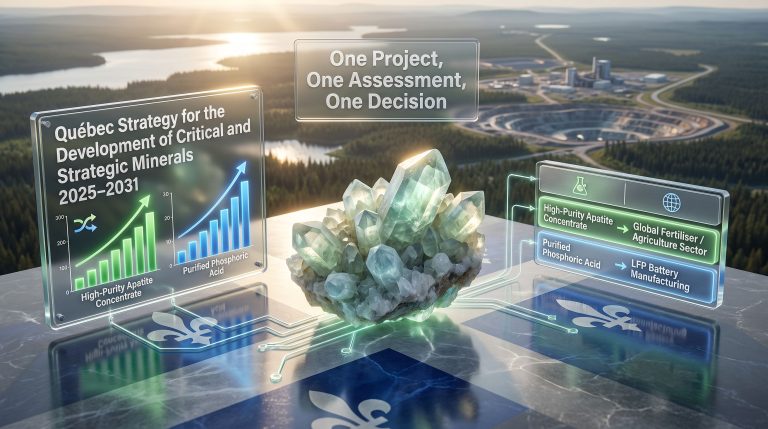
First Phosphate (CSE: PHOS | OTC QX: FRSPF) is developing an igneous phosphate deposit in Quebec's Saguenay-Lac-Saint-Jean region with the stated objective of achieving first production by 2029. The company is targeting a vertically integrated system that processes phosphate rock into high-purity product suitable for Lithium Iron Phosphate (LFP) battery cathode manufacturing, directly addressing growing critical minerals demand from allied nations.
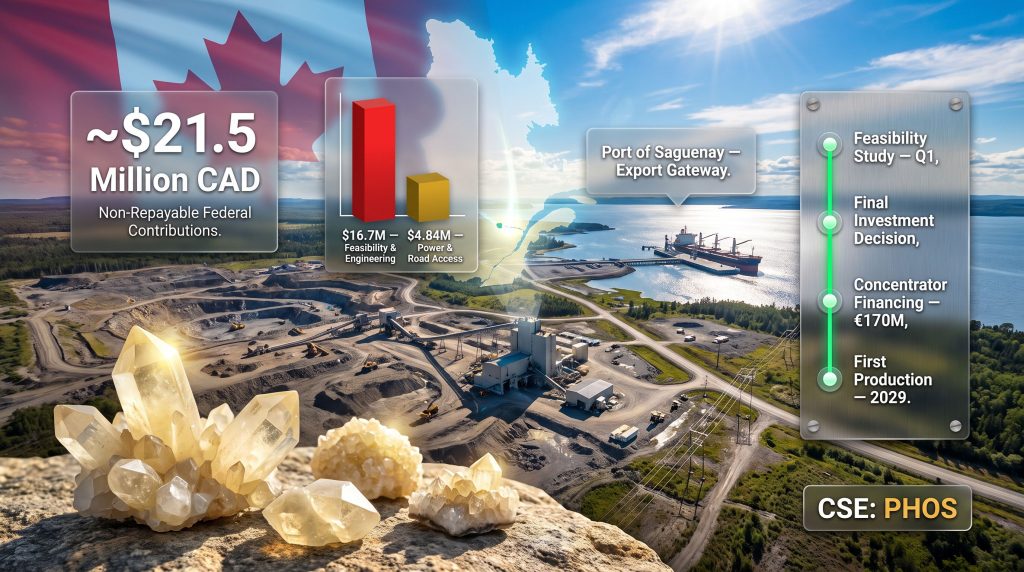
Two separate funding announcements from Natural Resources Canada (NRCan) in 2026 represent a combined federal contribution of approximately $21.5 million CAD, both on a non-repayable basis. Understanding what each tranche is actually doing and why infrastructure was the focus of the second announcement reveals a great deal about where the project currently sits in its development arc.
Funding Stream 1: Engineering and Feasibility ($16.7 Million CAD)
The first contribution, announced in March 2026, was directed toward completing the integrated engineering study and feasibility work required to finalise plans for the mine-and-concentrator system. Administered through NRCan's Global Partnerships Initiative, this grant addressed the technical development phase of the project. A definitive feasibility study of this scope is a foundational step before any major capital deployment.
This type of funding is structurally significant in junior mining for a specific reason: it is non-repayable and non-dilutive. Unlike equity raises that increase the share count, or project debt that creates future cash flow obligations, a non-repayable grant delivers capital without any mechanism for value extraction from existing shareholders.
Funding Stream 2: Power and Road Infrastructure ($4.84 Million CAD)
The second contribution, announced in August 2026, was directed toward infrastructure studies covering the electrical line connection between the mine site and the concentrator facility, as well as road access corridor planning. This funding came through NRCan's First and Last Mile Fund, a programme specifically designed to address the logistical gap between where a mineral resource sits and where it needs to go for processing and export.
The road and power connection between the mine and concentrator is not a minor operational detail. It is a prerequisite for production. Without a defined power supply and physical access corridor, no concentrator can operate. Funding studies that establish the engineering pathway for these assets is a meaningful milestone.
Federal Funding Summary
| Funding Program | Amount (CAD) | Purpose | Repayable? |
|---|---|---|---|
| Global Partnerships Initiative | $16.7 million | Feasibility study and engineering | No |
| First and Last Mile Fund | $4.84 million | Power transmission and road access | No |
| Total Federal Contributions | ~$21.5 million | Infrastructure and development | No |
The Four-Layer Support Structure: Local to International
What distinguishes this project within the junior mining landscape is not any single approval or funding event but rather the accumulation of support across four distinct governance levels. Each layer represents a different form of validation, and together they create a project profile that is uncommon among companies at this stage of development.
-
Municipal and local endorsement – Chambers of commerce, suppliers, local indigenous groups, and regional community organisations in the Saguenay-Lac-Saint-Jean area have expressed support for the project.
-
Quebec provincial government – First Phosphate was selected as one of only three companies for Quebec's fast-track environmental approval programme. This programme consolidates all provincial ministry interactions, including natural resources, mines, financing, and energy departments, into a centralised coordination pathway. The practical effect is that bureaucratic fragmentation is reduced and permitting timelines are compressed.
-
Federal Government of Canada – NRCan contribution programmes totalling approximately $21.5 million CAD, across two separate funding programmes and two separate grant cycles. In addition, junior explorers funding frameworks globally are increasingly mirroring this non-dilutive model.
-
G7 international recognition – The project has been designated as a strategic asset under the Critical Minerals Resilience and Production Alliance, an allied-nation framework that coordinates supply chain priorities across G7 member countries.
Being selected for Quebec's fast-track programme alongside only two other companies is a competitive distinction worth examining closely. Provincial governments do not design streamlined permitting systems and then apply them broadly. Selection for such programmes typically follows rigorous technical and policy screening.
What Is Igneous Phosphate and Why Does the Deposit Type Matter?
Most of the world's phosphate comes from sedimentary deposits, particularly from Morocco and Western Sahara, which together account for an estimated 70% or more of global phosphate reserves. Sedimentary phosphate has different mineralogical characteristics than igneous-hosted deposits, and those differences affect processing pathways and the purity profile of the final product.
Igneous phosphate deposits, by contrast, are geologically distinct. They are typically found in alkaline intrusive rock complexes and are often associated with higher concentrations of specific trace elements. The processing characteristics of igneous phosphate can yield a product with a purity profile that aligns more closely with the specifications required for battery-grade phosphoric acid and lithium iron phosphate cathode precursors.
This matters for market positioning. The LFP battery sector is not buying commodity-grade phosphate. It requires a highly purified input, and the ability to process from mine to high-purity product within an integrated domestic system addresses a supply chain vulnerability that Canada, the United States, and other allied nations have explicitly identified as a strategic priority. Advanced lithium extraction technology developments are similarly reshaping how allied nations approach upstream mineral processing.
The LFP Battery Market Context
Lithium Iron Phosphate battery chemistry has been gaining market share against Nickel Manganese Cobalt (NMC) formulations for several converging reasons:
-
LFP batteries have a lower cost per kilowatt-hour, making them increasingly competitive for stationary energy storage and entry-level electric vehicles.
-
They offer superior thermal stability, which reduces fire risk and extends cycle life in demanding applications.
-
They contain no cobalt, which removes one of the most geopolitically and ethically complex materials from the supply chain.
-
Chinese manufacturers, who currently dominate global LFP production, have invested heavily in scaling this chemistry, which has validated the technology's commercial viability at scale.
High-purity phosphate is a fundamental input for LFP cathode production. Furthermore, battery storage expansion across allied markets is accelerating demand for exactly the type of domestically sourced, high-purity phosphate that First Phosphate Canada funding for Quebec phosphate mine development is designed to deliver.
The Capital Stack: What $50 Million in Available Funding Looks Like
One of the more striking aspects of First Phosphate's current position is the combination of treasury cash and grant access that has accumulated heading into the feasibility study completion window.
| Capital Component | Amount |
|---|---|
| Cash on hand | ~$30 million CAD |
| Total grant access | ~$20 million CAD |
| Combined capital access | ~$50 million CAD |
For a junior mining company at the feasibility stage, this is a substantial non-dilutive runway. The key structural point is that the grant component does not require repayment, does not trigger any royalty mechanisms, and does not dilute the existing shareholder base.
The Danish Export Credit Facility: $170 Million Euros Under Discussion
Beyond the current treasury position, First Phosphate has disclosed that Denmark's export credit agency is at the table for a potential facility of approximately 170 million euros, specifically intended to fund concentrator construction at the Final Investment Decision stage.
It is important to be precise about the status of this arrangement. Based on publicly available information, this facility is under discussion and has not been reported as a fully executed agreement. It represents a potential financing commitment that would be confirmed at the FID stage. However, the identity of the counterparty and the scale of the potential facility, if confirmed, would represent one of the largest single non-dilutive financing lines disclosed by a company in the junior phosphate development space.
Export credit agency financing is a category that many retail investors are unfamiliar with. These institutions exist to support the export industries of their home countries. When Denmark's export credit body engages with a mining project, the likely rationale involves Danish industrial or engineering contractors who would participate in constructing the facility. Consequently, the financing is tied to economic activity that benefits the lending country, which means the underwriting framework is fundamentally different from traditional project finance.
Port Infrastructure and the Saguenay Export Gateway
The Port of Saguenay sits approximately 70 kilometres from the mine site and serves as the deep-sea export gateway for committed offtake agreements. According to company disclosures, the port is currently operational, with commercial shipments already moving through it. No logistical bottlenecks at the port level have been identified that would impede initial production shipments.
The federal government has separately committed over $50 million CAD toward expanding the Port of Saguenay, including a second wharf designed to accommodate increased critical mineral export volumes. This expansion is not a prerequisite for First Phosphate's initial production but represents an additive capacity enhancement that would support longer-term scaling.
The next major ASX story will hit our subscribers first
Development Timeline: The 2029 Target and Concurrent Workstreams
| Milestone | Target Timing |
|---|---|
| Feasibility study completion | No later than Q1 next year |
| Final Investment Decision | Following feasibility study release |
| Infrastructure studies (power and road) | Underway, funded by August 2026 grant |
| Concentrator financing (€170M facility) | Under discussion |
| First production | Target: 2029 |
A 2029 production target is, by conventional mining development standards, an aggressive schedule. The typical timeline from feasibility completion to first production for comparable integrated mining and processing projects ranges from five to eight years. Compressing that window requires parallel execution across permitting, engineering, financing, and offtake workstreams simultaneously rather than in sequence.
The tradeoff is coordination complexity. Running multiple technical and regulatory processes concurrently increases near-term resource demands and raises the risk that a delay in one workstream creates cascading pressure on others. However, provincial fast-track permitting and federal infrastructure funding are key inputs that support the compressed schedule.
Shareholder Growth and Market Liquidity
First Phosphate has reported shareholder growth from approximately 500 investors to over 5,000 over the past 12 to 18 months. The company trades on the Canadian Securities Exchange under the ticker PHOS and is accessible to U.S. investors via the OTC QX markets under the ticker FRSPF, with an ADR available under FPHY for institutional participants.
A bid-ask spread of approximately one cent on both exchanges has been reported by company management, which indicates functional liquidity for a junior mining issuer at this stage of development. Spread tightening is generally a lagging indicator of market depth and increasing institutional interest.
Risk Factors That Investors Should Weigh Carefully
This section contains forward-looking considerations and should not be interpreted as financial advice. Investors should conduct independent due diligence before making any investment decisions.
-
The 2029 production target is contingent on feasibility study outcomes, permitting timeline adherence, and successful financing close. Any one of these variables could extend the schedule.
-
The 170 million euro export credit facility has not been publicly confirmed as an executed agreement. It remains a potential commitment subject to Final Investment Decision conditions.
-
Commodity price assumptions embedded in the feasibility study will drive the project economics that underpin the FID. Phosphate pricing dynamics, particularly in the battery-grade segment, will influence the attractiveness of the project to lenders and offtake partners.
-
Concurrent workstream execution reduces timeline risk but increases operational and financial management complexity during the pre-production period.
What Sequential Federal Funding Approvals Signal to the Market
Government agencies that administer contribution programmes, particularly non-repayable grants, do not deploy capital without conducting substantial technical and economic due diligence. The fact that NRCan has approved two separate funding allocations to First Phosphate Canada funding for Quebec phosphate mine development across two distinct programmes in the same calendar year is a data point worth examining independently of the company's own communications.
Federal funding bodies assess project feasibility, management capability, economic merit, and alignment with policy objectives before committing non-repayable funds. Sequential approvals suggest that the project has met the substantive criteria applied by federal evaluators at two separate points in time, which is a form of third-party technical validation that is structurally different from self-reported corporate milestones.
Disclaimer: This article is intended for informational purposes only and does not constitute financial, investment, or legal advice. All forward-looking statements involve risk and uncertainty. Readers should seek independent professional advice before making any investment decisions.
Want to Spot the Next Major Mineral Discovery Before the Market Does?
Discovery Alert's proprietary Discovery IQ model scans ASX announcements in real time, delivering instant alerts on significant mineral discoveries across 30+ commodities — so subscribers can act on actionable opportunities ahead of the broader market. Explore historic discoveries and their returns to understand what early positioning can mean, then begin your 14-day free trial at Discovery Alert to secure your market-leading edge.