August 14, 2026
The Lithium Triangle's Sleeping Giant: Why Bolivia's Vast Reserves Remain Locked Underground
The global race to secure battery-grade lithium has exposed a striking paradox sitting at the heart of South America's Altiplano plateau. While automakers, grid operators, and battery manufacturers scramble to diversify upstream supply chains, one country simultaneously holds the world's largest identified lithium resource base and contributes almost nothing to global supply. Understanding why this structural anomaly persists, and whether it can be resolved, has become one of the most consequential questions in critical mineral strategy.
For investors and policymakers navigating Bolivia lithium investments, the story is not primarily about geology. The reserves are there. The challenge lies at the intersection of brine chemistry, constitutional architecture, and an investment framework that has repeatedly struggled to bridge the gap between resource potential and commercial production.
When big ASX news breaks, our subscribers know first
Bolivia's Reserve-to-Production Gap: A Number That Demands Explanation
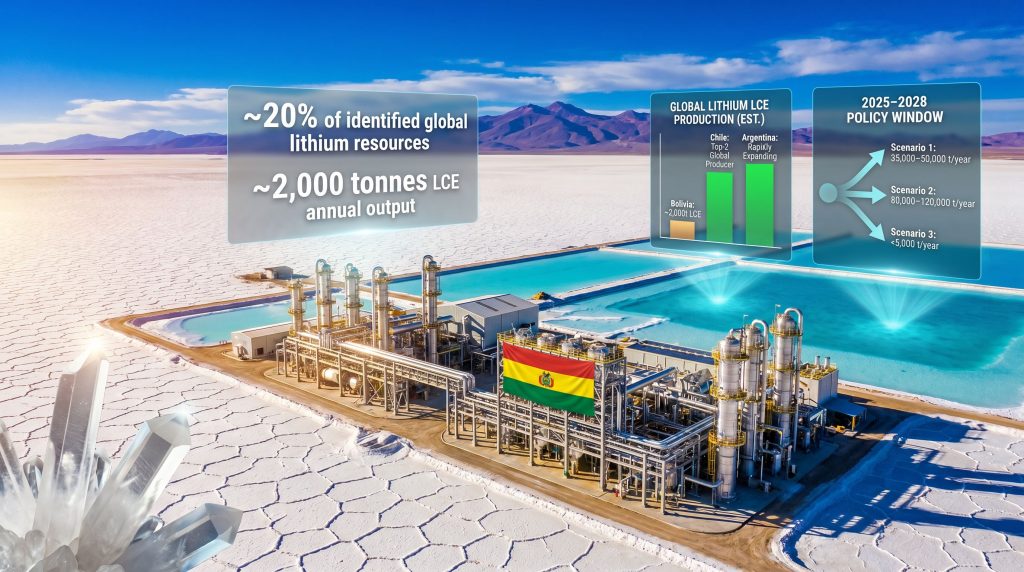
Bolivia holds an estimated 21 million tonnes of identified lithium resources according to the U.S. Geological Survey's 2025 Mineral Commodity Summaries, representing approximately 20% of the world's total identified lithium resources, concentrated overwhelmingly within the Salar de Uyuni, the world's largest salt flat at roughly 10,582 square kilometres.
Against that geological abundance, Bolivia's actual production output is strikingly modest. Current annual output sits at approximately 2,000 tonnes of lithium carbonate equivalent (LCE), a figure that represents less than 0.1% of global production.
To put that in competitive context:
| Country | Estimated Lithium Resources (tonnes) | 2024 Estimated LCE Output |
|---|---|---|
| Bolivia | ~21 million | ~2,000 tonnes |
| Chile | ~9.3 million | ~410,000 tonnes |
| Argentina | ~3.6 million | ~120,000 tonnes |
| Australia | ~7.9 million | ~86,000 tonnes (spodumene basis) |
Sources: USGS Mineral Commodity Summaries 2025; IEA Global Critical Minerals Outlook 2024
Chile operates at roughly 205 times Bolivia's output despite holding less than half the identified resource base. Furthermore, among the largest lithium reserves countries, Argentina produces 60 times more lithium annually despite a resource endowment less than one-fifth the size of Bolivia's. The reserve-to-production ratio gap is not incremental; it is structural.
Bolivia's lithium situation is not a geology problem. It is a convergence of political architecture, brine chemistry complexity, and investment framework design that has compounded over decades of unrealised development.
The global lithium market is projected to expand at a compound annual growth rate of approximately 18% through 2030, reaching an estimated 3.5 million tonnes of LCE annually according to the IEA's 2025 Global EV Outlook. With Chile, Australia, and China collectively accounting for roughly 85% of current global production, the concentration risk embedded in today's supply chains creates genuine strategic urgency around unlocking alternative sources, including Bolivia's dormant capacity.
What Makes Bolivia's Lithium So Difficult to Extract?
The Magnesium Problem: Why Conventional Methods Fail at Uyuni
The primary technical barrier to large-scale Bolivia lithium investments is chemical, not geological. The brines within the Salar de Uyuni contain a magnesium-to-lithium ratio typically ranging from 10:1 to as high as 20:1, depending on location within the flat. For comparison, Chile's Atacama brines average approximately 6:1, while Argentina's Fenix operations in the Puna region achieve ratios closer to 4:1.
This distinction matters enormously in practice. Conventional evaporation pond extraction, the dominant commercial method in Chile, relies on progressively concentrating brine in open-air ponds over 12 to 24 months, allowing lithium to separate from other elements as they precipitate out at different concentrations. When magnesium is present at elevated ratios, it co-precipitates with lithium at similar concentration thresholds, contaminating the product stream and dramatically reducing recovery efficiency.
The practical consequences of this chemistry include:
- Significantly higher water consumption per tonne of lithium carbonate produced
- Extended processing cycles that increase working capital requirements
- Greater reagent costs to chemically separate magnesium from lithium concentrate
- Lower product purity in initial output, requiring additional downstream refining
- Increased waste volumes requiring environmentally sensitive disposal in a fragile ecosystem
Bolivia's brine chemistry also contains elevated concentrations of potassium and boron relative to Atacama-sourced brines, adding further separation steps before battery-grade lithium carbonate specifications can be achieved. Major EV manufacturers including Tesla and BYD impose strict limits on impurity levels in battery-grade lithium carbonate, including iron, calcium, and magnesium content, meaning that Bolivian output requires more intensive processing to qualify for premium market segments.
Direct Lithium Extraction: The Technology That Changes the Calculation
Direct lithium extraction (DLE) represents a fundamentally different approach to the separation problem. Rather than relying on passive evaporation and gradual concentration, DLE uses selective adsorption materials or ion exchange membranes to isolate lithium ions directly from brine, irrespective of the surrounding chemical matrix.
The key technical advantage for Bolivian applications is that DLE's selectivity is largely independent of the magnesium-to-lithium ratio, meaning the high-magnesium interference that undermines evaporation ponds does not apply to the core extraction step. This makes DLE specifically suited to the geochemical conditions at Uyuni in a way that no prior technology has been.
DLE technology has also followed a meaningful cost reduction curve. Benchmark Mineral Intelligence has tracked DLE processing costs declining from approximately $8,000 per tonne of LCE in 2020 to an estimated $4,500 per tonne in 2025, reflecting improvements in membrane durability, process engineering, and scale. This trajectory meaningfully improves the economic case for deployment in technically challenging environments like Bolivia.
The operational structure and timelines across extraction methods differ substantially:
| Extraction Method | Suitability for Bolivia Brines | Capex Profile | Typical Timeline to Production |
|---|---|---|---|
| Traditional Evaporation Ponds | Low (high Mg interference) | Lower capex, elevated opex | 18-24 months (limited output) |
| Direct Lithium Extraction (DLE) | High (selective ion capture) | Higher capex, lower opex | 3-5 years to full scale |
| Hybrid Evaporation + DLE | Moderate | Medium | 4-6 years |
Who Is Currently Investing in Bolivia's Lithium Sector?
China's $1 Billion Commitment: The CBC-YLB Joint Venture
The most significant active Bolivia lithium investment is the $1 billion agreement between China's CBC Investments and Bolivia's state lithium company, Yacimientos de Litio Bolivianos (YLB), signed in late 2024. The structure involves constructing two lithium carbonate processing plants at the Salar de Uyuni using DLE technology, with a combined target capacity of 35,000 metric tonnes of LCE per year.
Under Bolivia's constitutional framework, YLB retains a 51% ownership stake in the joint venture, with CBC Investments holding the remaining 49%. This majority state ownership requirement is a non-negotiable condition of Bolivian law, applicable to all foreign investment in the lithium sector.
The strategic rationale from the Chinese side is straightforward. China currently controls approximately 65% of global lithium conversion capacity, giving it dominant midstream positioning. Securing upstream carbonate supply from Bolivia would extend that integration further back in the value chain, reducing dependency on Chilean and Australian supply and providing leverage in battery material pricing dynamics.
The CBC-YLB project also functions as the first large-scale commercial proof-of-concept for DLE at Uyuni. If the plants achieve design capacity with battery-grade output specifications, they will validate the technical pathway for Bolivia's broader industrialisation ambitions far more powerfully than any pilot study could.
Russia's Uranium One: A Stalled Strategic Partnership
Earlier agreements between Bolivia and Uranium One, the Russian state-controlled mining company, preceded the CBC commitment but have faced persistent delays. Congressional approval has proven elusive, and the broader geopolitical environment surrounding Russian-linked investments has compounded the friction. International financing partners and downstream customers increasingly apply scrutiny to supply chains with Russian-state exposure. The current status of those agreements reflects Bolivia's broader challenge of managing multiple bilateral investment relationships within a shifting geopolitical landscape.
The Western Capital Question
Bolivia's political leadership has, as of 2025–2026, signalled growing interest in broadening its investor base beyond China and Russia. This represents a meaningful shift in tone, though the structural requirement for majority YLB ownership remains firmly in place and no major Western mining contracts have yet been formally executed.
For Western institutional investors and mining majors, the phrase "more bankable" has specific meaning. It implies the presence of stabilisation clauses that prevent retrospective legislative changes from altering agreed fiscal terms, access to international arbitration under recognised frameworks such as ICSID rather than purely domestic courts, and transparent revenue-sharing arrangements that allow independent financial modelling. Bolivia currently offers none of these features in codified form, which explains why the rhetorical openness to Western capital has not yet translated into binding agreements.
The shift from a purely state-controlled model toward hybrid investment frameworks represents the single most consequential policy variable for Bolivia lithium investments between 2025 and 2030.
The Obstacles That Have Blocked Development for Decades
Legislative Architecture as a Structural Veto Point
Bolivia's Congress holds formal approval authority over major foreign mining contracts, creating a legislative chokepoint that has repeatedly delayed or blocked project timelines regardless of executive-branch intent. This is not incidental friction; it is embedded in the constitutional framework that declares lithium a strategic national resource. Resource nationalism, institutionalised at the constitutional level, sets a ceiling on private sector participation that cannot be lifted by executive decree alone.
The resulting tension is between two legitimate but conflicting objectives: maximising state revenue from a finite natural resource, and attracting the capital and technical expertise necessary to develop that resource at commercial scale. Bolivia has historically prioritised the former in ways that have undermined the latter.
Environmental, Community, and Governance Dimensions
The Salar de Uyuni sits within the territory of multiple indigenous communities whose land rights and consultation processes carry legal weight under both Bolivian domestic law and international frameworks including ILO Convention 169. Community opposition to large-scale extraction has been a recurring feature of development attempts, particularly given concerns about water usage in one of the world's most water-stressed high-altitude ecosystems.
The World Resources Institute's Aqueduct Water Risk Atlas classifies the Altiplano region as facing extremely high baseline water stress. Any extraction method, including DLE, requires water inputs for processing and reagent preparation, making water governance a material project risk rather than a peripheral concern.
Institutional governance perceptions add a further dimension. Bolivia's rankings on transparency and corruption indices affect not only institutional investor appetite but also the cost of capital, insurance premiums, and the willingness of international banks to provide project financing, creating compounding financial barriers even where political will may exist.
| Risk Category | Bolivia | Chile | Argentina |
|---|---|---|---|
| Political and Legislative Risk | High | Low-Medium | Medium |
| Technical Extraction Complexity | High | Low-Medium | Medium |
| Environmental and Community Risk | High | Medium | Medium-High |
| Foreign Ownership Flexibility | Very Limited (51% state minimum) | Moderate | High (post-RIGI) |
| Contract Enforceability | Uncertain | Strong | Improving |
How Bolivia Compares to Chile and Argentina in the Lithium Race
The Lithium Triangle: Why Two Countries Run While One Walks
Chile, Bolivia, and Argentina collectively host the world's most concentrated zone of lithium brine resources, a region commonly described as the Lithium Triangle. Yet the three countries have followed fundamentally different development trajectories, with outcomes diverging sharply over the past two decades.
Chile built its lithium industry on a foundation of stable regulatory infrastructure, long-term contracts with major operators including SQM and Albemarle, and consistent policy frameworks that allowed operators to plan capital expenditure over multi-decade horizons. The result is a production base operating at multi-hundred-thousand-tonne annual scale, generating substantial royalty and tax revenues that fund social programmes across the country.
Argentina's recent trajectory is instructive for Bolivia. The RIGI incentive regime, introduced in 2023, offered investors tax stability guarantees, streamlined permitting pathways, and reduced royalty rates in exchange for capital deployment commitments. Within 18 months of the regime's introduction, Argentina attracted over $2.3 billion in new lithium investment commitments, with multiple projects entering construction phases in 2024–2026. The Argentina lithium brine market demonstrates the competitive pressure this creates for Bolivia acutely: every year of Bolivian policy inaction is a year in which Argentine capacity expansion reduces Bolivia's relative strategic value to supply chain planners.
The production reality makes the competitive positioning stark:
- Bolivia: approximately 2,000 tonnes LCE annually, minimal foreign investment
- Chile: approximately 410,000 tonnes LCE annually, established global supply relationships
- Argentina: approximately 120,000 tonnes and rapidly expanding, multiple projects in construction
The Critical Distinction Between Resources and Reserves
A technically important nuance often lost in popular coverage of Bolivia lithium investments is the distinction between resources and reserves as defined by international reporting standards such as the JORC Code or NI 43-101. Resources represent geological occurrences that may be economically extractable under some future set of conditions. Reserves represent the subset of resources demonstrated to be economically extractable under current market prices and existing technology.
Bolivia's figures largely reflect resource-level estimates rather than fully defined, economically extractable reserves. Until DLE technology is demonstrated at commercial scale at Uyuni, a meaningful portion of Bolivia's identified resources cannot be reclassified as reserves under rigorous technical standards. This distinction has significant implications for how mining analysts and institutional investors value Bolivia's lithium endowment relative to Chile's and Argentina's more developed project pipelines.
Moreover, lithium brine extraction processes at Uyuni must be validated at nameplate capacity before resource classifications can be meaningfully upgraded, adding further timeline risk for investors modelling production ramp scenarios.
The next major ASX story will hit our subscribers first
Scenario Analysis: What Bolivia's Lithium Future Could Look Like
Scenario 1: State-Led DLE Industrialisation (Current Trajectory)
Under this pathway, YLB retains majority control across all projects and the CBC-YLB joint venture proceeds toward construction. Success depends entirely on DLE technology performing at nameplate capacity under Uyuni's specific geochemical conditions, and on sustained Chinese capital commitment through potential regulatory and political headwinds.
The output ceiling under this model is estimated at 35,000 to 50,000 tonnes LCE per year by 2030 under an optimistic case, representing a meaningful step-change from current production but still a fraction of Bolivia's theoretical potential. The primary vulnerability is single-partner dependency and the continued absence of diversified foreign capital.
Scenario 2: Hybrid Public-Private Reform Model
Bolivia introduces stabilisation clauses, access to international arbitration, and ownership flexibility pathways that attract three to five additional major project commitments within a five-year window. Western and Asian investors enter a more competitive bidding environment, bringing diversified technology platforms and capital structures.
Projected output upside under accelerated development: 80,000 to 120,000 tonnes LCE per year by 2032. This scenario also positions Bolivia to capture premium pricing for battery-grade lithium hydroxide, which commands a meaningful price premium over carbonate, rather than remaining solely in the lower-value carbonate segment.
Scenario 3: Structural Stagnation
Congressional gridlock, community opposition, and DLE underperformance combine to delay all major projects. Bolivia remains below 5,000 tonnes LCE per year through 2030, while Chile and Argentina consolidate their advantages in customer relationships, offtake agreements, and supply chain integration. Bolivia's window to become a tier-one supplier narrows significantly, potentially closing before a reform cycle can restart momentum.
Scenario 1 is the most probable near-term trajectory. Scenario 2 represents the highest-value outcome for both Bolivia and global supply chains. Scenario 3 remains a credible downside risk given the pattern of legislative delays established over the past two decades.
Four Indicators Every Bolivia Lithium Investor Should Monitor
For investors seeking exposure to or intelligence on Bolivia's lithium trajectory, the following indicators provide the most actionable signal quality:
- Congressional Ratification Status – Whether Bolivia's legislature formally approves the CBC-YLB and Uranium One contracts, the conditions attached, and the timeline from signing to ratification
- Legal Framework Reform Signals – Any executive or legislative movement toward stabilisation clauses, international arbitration access, or expanded foreign ownership thresholds that would signal genuine opening to broader capital
- DLE Technology Performance Data – Early operational metrics from the CBC-YLB plants, specifically recovery rates, product purity specifications, and throughput against design capacity, as the first real proof-of-concept validation for Bolivia's broader DLE strategy
- Competitive Timeline Pressure – Whether Argentina's RIGI-accelerated projects and Chile's expansion programmes move faster than Bolivia's reform cycle, reducing Bolivia's relative attractiveness to supply chain planners operating on defined capital deployment windows
Investment Readiness Checklist for Bolivia Lithium Exposure
- Monitor YLB project milestone announcements and government communications quarterly
- Track congressional session outcomes specifically related to mining contract ratifications
- Assess DLE technology vendor performance data from comparable global deployments, including projects in Argentina's high-magnesium Puna region brines
- Evaluate Bolivia's sovereign credit ratings and governance indices for institutional risk threshold alignment
- Compare Bolivia project internal rate of return estimates against Argentina and Chile equivalents under current and projected frameworks
Frequently Asked Questions: Bolivia Lithium Investments
Does Bolivia Have the World's Largest Lithium Reserves?
Bolivia holds approximately 21 million tonnes of identified lithium resources according to the USGS, representing roughly 20% of the global total. However, the critical distinction between resources and reserves matters here. Bolivia's figures reflect geological resource estimates, not fully defined economically extractable reserves under current conditions. Until DLE technology is proven at commercial scale at Uyuni, a significant portion of that resource base cannot be classified as reserve-grade under rigorous reporting standards.
Why Has Bolivia Historically Struggled to Attract Major Lithium Investment?
The combination of a mandatory minimum 51% YLB ownership requirement, congressional approval hurdles for major contracts, the high-magnesium brine chemistry that undermines conventional extraction methods, community and environmental opposition, and the absence of stabilisation clauses or international arbitration access creates a multi-layered barrier. Consequently, this has deterred Western institutional investors and many mining majors despite the scale of the resource base.
What Is the CBC-YLB Lithium Project?
A joint venture between China's CBC Investments and Bolivia's state lithium company YLB, structured around a $1 billion capital commitment to construct two lithium carbonate processing plants at the Salar de Uyuni using direct lithium extraction technology, targeting 35,000 metric tonnes per year of combined output capacity.
How Does DLE Technology Address Bolivia's Specific Extraction Challenges?
DLE uses selective adsorption or ion exchange processes that isolate lithium ions directly from brine without relying on passive evaporation concentration. Because the selectivity mechanism targets lithium ions specifically, the high magnesium-to-lithium ratio that undermines evaporation pond methods does not directly impair DLE's core extraction step, making it technically better suited to Uyuni's brine chemistry than any previously deployed commercial method.
When Could Bolivia Realistically Become a Significant Lithium Producer?
Under the most optimistic scenario involving successful DLE deployment at nameplate capacity and meaningful regulatory reform attracting additional foreign capital, Bolivia could reach 50,000 tonnes or more of LCE annually by the early 2030s. Under the current trajectory without significant reform, meaningful production scale remains several years away, with output likely remaining below 10,000 tonnes through 2030.
Bolivia's Lithium at a Structural Inflection Point: The Strategic Verdict
The decisions Bolivia makes within the next two to three years will carry consequences that extend well beyond any single project approval. If the CBC-YLB DLE plants perform at design capacity and the political environment evolves toward broader investment frameworks, Bolivia could credibly emerge as a meaningful contributor to the global lithium supply chain before the end of the decade. If, however, legislative friction, community opposition, or technical underperformance derail the current trajectory, Chile and Argentina will have absorbed the market relationships and customer commitments that Bolivia could have secured.
The competitive clock is running. Argentina's RIGI-driven capital acceleration is not theoretical; it is materialising in signed contracts, construction starts, and offtake agreements with major battery manufacturers. Every delayed reform cycle in Bolivia is a compounding competitive disadvantage against neighbours who are actively converting policy frameworks into production tonnes.
| Dimension | Current Status | 2030 Outlook (Reform Path) | 2030 Outlook (Status Quo) |
|---|---|---|---|
| Annual LCE Output | ~2,000 tonnes | 50,000-80,000 tonnes | Under 10,000 tonnes |
| Foreign Investment Climate | Restricted | Moderately open | Unchanged |
| DLE Technology Deployment | Early-stage | Operational at scale | Partial or delayed |
| Global Supply Contribution | Negligible | Emerging | Marginal |
| Competitive Position vs. Chile and Argentina | Distant third | Narrowing gap | Widening gap |
Bolivia's lithium paradox, vast geological wealth sitting alongside minimal commercial output, is ultimately a solvable problem. The technology exists in DLE. The capital exists in both Chinese and potentially Western sources. The market demand exists and is growing at a rate that renders Bolivia's resource base strategically significant rather than merely geologically interesting. What remains unresolved is whether the institutional architecture can evolve quickly enough to allow those three elements to converge before the window closes.
Disclaimer: This article is intended for informational purposes only and does not constitute financial, investment, or legal advice. Projections and scenario analyses referenced herein involve significant uncertainty and should not be relied upon as forecasts of future outcomes. Investors considering exposure to Bolivia's lithium sector or related securities should conduct their own due diligence and consult qualified professional advisers before making any investment decisions.
Want To Stay Ahead of the Next Major Mineral Discovery on the ASX?
Discovery Alert's proprietary Discovery IQ model delivers real-time alerts the moment significant mineral discoveries — including critical minerals like lithium — are announced on the ASX, turning complex data into clear, actionable investment insights for both short-term traders and long-term investors. Explore how major discoveries have historically generated substantial returns on Discovery Alert's dedicated discoveries page, and start your 14-day free trial today to position yourself ahead of the market.