July 23, 2026
When Waste Becomes a Strategic Resource: The Lithium Hidden in Chile's Industrial Past
For decades, the global lithium industry measured its potential almost exclusively by what lay beneath pristine salt flats and brine aquifers. The prevailing logic was simple: find the deposit, secure the concession, build the evaporation ponds. Yet this extractive orthodoxy is now being quietly challenged by a different kind of resource accounting — one that asks a more provocative question: how much critical mineral wealth has already been pulled from the earth, processed, and discarded into tailings piles never intended to yield a second harvest?
Chile's recent regulatory move involving Quiborax CEOL litio desde residuos mineros en Arica suggests the answer may be substantial enough to warrant an entirely new governance framework. The country's Ministry of Mining published a decree in May 2026 establishing the formal conditions under which Quiborax S.A. will enter into a Contrato Especial de Operación de Litio, or CEOL, to recover lithium from historical mining residues at its El Águila plant in the Arica and Parinacota region. The implications extend far beyond a single industrial facility.
When big ASX news breaks, our subscribers know first
Understanding the CEOL Framework: Why Lithium Operates Outside Normal Mining Law
The Legal Architecture Behind Chile's Lithium Regime
Chile's relationship with lithium is legally unusual by global standards. Unlike copper, gold, or iron ore, lithium was designated a mineral reserved to the Chilean state under Decree Law 2,886 of 1979, a classification rooted in strategic and geopolitical considerations of that era rather than pure economic calculus. This reservation means that no private company can acquire a standard mining concession over lithium-bearing deposits.
The CEOL mechanism exists precisely to bridge this legal gap. Under this contractual structure, the Ministry of Mining negotiates directly with private operators and establishes specific conditions, timelines, royalty obligations, and environmental standards that govern the extraction and commercialisation of lithium. The contract replaces the concession system entirely, and the state retains ultimate ownership of the resource while allowing private capital and technical expertise to bring it into production under tightly defined parameters.
Chile's lithium strategy has historically applied this architecture to brine extraction from the country's famous salt flats, primarily the Salar de Atacama, which hosts two of the world's largest lithium operations. The extension of the CEOL framework to secondary sources — specifically to lithium contained within historical mining residues — marks a substantive evolution in how Chile defines the boundaries of its National Lithium Strategy.
What Companies Must Demonstrate to Secure a CEOL
The threshold for obtaining a CEOL is deliberately high. The Ministry's evaluation of the Quiborax application reveals the type of evidence required across multiple domains:
- Technical credibility: Verifiable resource estimates, operationally feasible extraction methodologies, and demonstrated understanding of the target material's characteristics
- Financial resilience: Audited financial statements prepared under IFRS standards, with sufficient balance sheet strength to absorb project contingencies without compromising delivery
- Environmental seriousness: A credible plan for managing sectoral permits, minimising ecological footprint, and adopting cleaner production technologies
- Fiscal contribution: Acceptance of a progressive royalty structure linked directly to international lithium prices, ensuring the Chilean state captures proportionally more value during commodity price peaks
In Quiborax's case, the Ministry assessed the company's financial position as demonstrably solid. Audited figures showed a patrimony of US$112 million in 2023 rising to US$114 million in 2024, producing a two-year average of approximately US$113 million. Crucially, the debt-to-equity ratio averaged just 0.18 across that period — a figure the Ministry characterised as low and indicative of reduced financial risk exposure. This low leverage profile matters enormously in project finance terms, as a company carrying minimal debt has considerably more capacity to absorb cost overruns or commodity price weakness during construction.
The El Águila Project: What Makes Lithium From Tailings Fundamentally Different
From Operating Liability to Strategic Asset
The El Águila plant sits at the heart of an operational logic that most traditional mining analysts would have overlooked entirely until recently. Quiborax has operated for decades in northern Chile, primarily extracting ulexite and other industrial boron minerals from the Salar de Surire. Over the course of those operations, substantial quantities of processed material — known as ripios in Chilean mining terminology — accumulated at the El Águila facility. These tailings were never considered a resource; they were managed as waste.
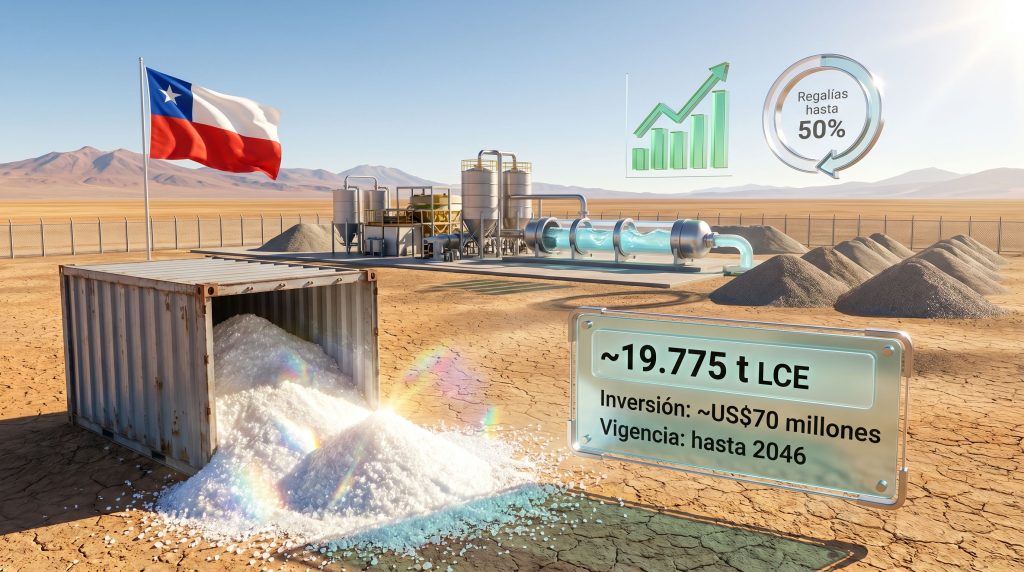
The critical insight embedded in the Quiborax CEOL application is that lithium was present in those ripios all along, simply unrecoverable or uneconomic under older processing paradigms. The Ministry's evaluation determined that the accumulated historical residues at El Águila contain an estimated 19,775 tonnes of lithium carbonate equivalent (LCE) — a figure substantial enough to justify investment in a dedicated recovery operation.
Furthermore, what distinguishes this project from every conventional lithium development in the country is not merely the source material but what that source material eliminates from the risk register:
- No new surface disturbance of sensitive ecosystems
- No intervention in active salar hydrology
- No requirement to develop remote greenfield infrastructure from scratch
- No need to establish water access rights in one of the world's most arid regions
The material already exists, in a fixed location, on property controlled by the company. This pre-extracted status compresses both the environmental complexity and the capital intensity of early-stage project development in ways that conventional lithium projects simply cannot replicate.
Key Project Parameters at a Glance
| Parameter | Detail |
|---|---|
| Location | El Águila Plant, Arica and Parinacota Region |
| Resource type | Historical ripios from Salar de Surire operations |
| Estimated resource | ~19,775 tonnes LCE |
| Estimated capital investment | ~US$70 million |
| Contract duration | Until 31 December 2046, or 20,000 t LCE produced |
| Quiborax patrimony (2024) | US$114 million |
| Average debt/equity ratio | 0.18 (2023–2024) |
| Extraction technology | Direct Lithium Extraction (DLE) |
It is worth noting that the contract imposes a hard ceiling on production: the CEOL authorises processing only the lithium present in residues accumulated before the contract's commencement date. Any waste generated after signing is explicitly excluded from the scope of the agreement, which eliminates the possibility of the project growing beyond its intended circular economy mandate.
The Four-Phase Roadmap and What Each Stage Demands
The Ministry structured the contract around four sequential development phases, each carrying its own duration limits, obligations, and extension provisions.
- Evaluation Phase: A maximum of two years, extendable by one additional year. During this period, Quiborax must complete reserve quantification, confirm technical and economic feasibility, and navigate the environmental and sectoral permitting landscape.
- Construction Phase: Up to three years, with provision for extension. This covers the development of all processing infrastructure required to treat the lithium-bearing ripios and produce marketable lithium products.
- Processing and Beneficiation Phase: The active operational period during which lithium is extracted, refined, and commercialised. Revenue generation, royalty obligations, and environmental performance reporting all become active during this stage.
- Site Closure Phase: Conducted in accordance with Chile's current mining closure regulations, including applicable environmental rehabilitation standards.
The Royalty Architecture: Progressive Rates Up to 50%
The fiscal structure embedded in the CEOL is designed to behave asymmetrically with lithium price cycles. When international prices for lithium carbonate or lithium hydroxide are low, royalty rates are modest, protecting project economics during downturns. As prices climb into upper market tiers, the state's take increases progressively, reaching rates of up to 50% of the commercial value of lithium products sold in the highest price brackets.
This progressive design reflects a broader lesson learned from resource booms globally: fixed royalty regimes that looked generous to governments during price troughs often delivered spectacularly insufficient returns during commodity supercycles. Chile's CEOL framework attempts to internalise that lesson structurally, ensuring that extraordinary price windfalls are shared rather than captured entirely by the private operator.
Direct Lithium Extraction: The Technology That Makes This Possible
Why DLE Is Particularly Well-Suited to Processing Residues
Direct lithium extraction refers to a family of technologies — including ion exchange, solvent extraction, and adsorption-based systems — that selectively isolate lithium from aqueous solutions without the prolonged evaporation cycles associated with conventional brine processing. Rather than concentrating brine in enormous solar evaporation ponds over 12 to 18 months, DLE systems can produce lithium-rich product streams within days or weeks.
For a project targeting lithium dissolved or leached from historical tailings, DLE's characteristics are almost ideally aligned:
- The feed material can be prepared as a leach solution or lixiviate, directly compatible with most DLE process configurations
- Water consumption is substantially lower than evaporation-based alternatives, critical in northern Chile's hyper-arid environment
- The physical footprint of a DLE facility is dramatically smaller than equivalent-capacity evaporation pond infrastructure
- Selectivity for lithium over competing ions such as sodium, potassium, and magnesium reduces downstream purification complexity
Comparative Extraction Method Performance
| Method | Water Intensity | Environmental Footprint | Production Timeline | Suitability for Residues |
|---|---|---|---|---|
| Solar evaporation (brine) | High | High | 12–18 months | Low |
| Direct Lithium Extraction (DLE) | Low | Low | Weeks | High |
| Acid leaching (spodumene) | Moderate | Moderate | Months | Moderate |
| DLE applied to tailings leachate | Low | Very low | Weeks | Very high |
One dimension of DLE that receives insufficient attention in mainstream coverage is the technology's current maturity gradient. Not all DLE processes are equally proven at commercial scale. The Quiborax CEOL's evaluation phase will be partly devoted to confirming which specific DLE configuration is best suited to the chemical characteristics of the El Águila ripios, since lithium concentration, pH, competing ion ratios, and physical matrix all influence process selection and recovery rates. Innovative lithium extraction projects elsewhere are confronting similar questions around technology selection and scalability.
Circular Economy Principles Applied to Critical Minerals
The Conceptual Shift From Linear Extraction to Resource Recovery
Circular economy thinking in mining is often discussed in abstract terms, but the Quiborax model provides a concrete operational expression of its principles. In a linear extraction model, ore is mined, processed for its target mineral, and the residue is deposited permanently as a liability. In the circular model that this CEOL embodies, that residue is reconsidered as a secondary resource inventory waiting for the right technology and economic conditions to unlock its value.
International precedents for this type of thinking exist across several jurisdictions. European countries, particularly Finland and Sweden, have invested significantly in characterising and potentially reprocessing historical mine tailings for critical minerals including cobalt, nickel, and rare earth elements. The United States has similarly explored critical mineral recovery from coal mine drainage and legacy copper tailings. In addition, a growing lithium recycling network model is emerging globally, reinforcing the principle that lithium value chains need not begin and end with primary extraction.
What distinguishes the Chilean case, however, is the regulatory formalisation of this approach within a strategic minerals framework. The Quiborax CEOL represents one of the first instances globally where a national government has created a specific contractual instrument authorising lithium brine extraction and secondary source recovery together, establishing royalty obligations, environmental standards, and production ceilings tailored explicitly to non-conventional source types.
The Larger Question: How Much Lithium Exists in Chilean Mining Waste?
"The El Águila project's approximately 19,775 tonnes of estimated LCE represents only one facility associated with one company's historical operations. Chile's northern regions host numerous mining operations with decades of accumulated residues whose lithium content has never been systematically catalogued."
No national inventory of lithium present in Chilean industrial tailings currently exists. This knowledge gap is itself a strategic issue: without systematic characterisation of what historical residues contain, the full scale of Chile's secondary lithium resource base remains unknown. The Quiborax project, if it successfully completes its evaluation phase and confirms its resource estimate, will generate a body of geological, chemical, and engineering knowledge applicable to evaluating analogous deposits elsewhere in the country. Notably, Contraloria has already approved the project's legal framework, an important regulatory milestone validating this secondary source approach.
The next major ASX story will hit our subscribers first
Quiborax as a Multi-Vector Lithium Participant
Two Fronts, Two Very Different Risk Profiles
Quiborax occupies an unusual strategic position in Chile's evolving lithium landscape because it is simultaneously pursuing lithium development from both secondary and primary sources through distinct regulatory pathways.
| Project | Source | Resource Type | Regulatory Status | Partner |
|---|---|---|---|---|
| El Águila (Arica) | Historical Salar de Surire ripios | Secondary (residues) | CEOL conditions established by Ministry | Independent |
| Salar de Ascotán | Brine aquifer | Primary (conventional) | CEOL under development | Codelco via Minera Ascotán SpA |
The Ascotán joint venture with Codelco, Chile's state copper giant, connects Quiborax to a fundamentally different type of lithium resource: primary brine in a conventional salar. Codelco's institutional weight brings advantages in regulatory navigation and financing capacity, but primary salar development carries its own environmental complexities, particularly around water use and ecosystem impacts in high-altitude wetland systems.
The El Águila project, by contrast, operates with a smaller capital requirement, a constrained and fully defined resource base, and a technology pathway through DLE that sidesteps many of the environmental friction points associated with conventional salar extraction. These two projects collectively position Quiborax across the full spectrum of Quiborax CEOL litio desde residuos mineros en Arica activity — from circular economy recovery at one end to conventional primary extraction at the other.
It should also be noted that Quiborax's operations at the Salar de Surire remain subject to an active precautionary measure — a legal restraint arising from ongoing environmental proceedings related to those operations. The El Águila CEOL, focused on already-extracted residues rather than active salar intervention, is legally separate from that litigation context.
Market Positioning and the Signals This Contract Sends Globally
Dimensioning the Project's Contribution to Global Lithium Supply
With a contractual ceiling of 20,000 tonnes of LCE and a maximum operational horizon extending to December 2046, the El Águila project is not positioned to reshape global lithium supply balances on its own. Global lithium demand projections for the battery transition period through 2030 are measured in millions of tonnes of LCE annually, driven primarily by electric vehicle penetration and grid-scale energy storage deployment.
What the project contributes is not volume but validation. It demonstrates operationally that:
- Secondary lithium sources can be economically viable under the right technological and contractual conditions
- DLE is mature enough to anchor commercial-scale investment proposals reviewed by national regulators
- Circular economy approaches to critical minerals can attract formal regulatory architecture rather than remaining theoretical policy aspirations
- A capital investment of approximately US$70 million is sufficient to develop a meaningful secondary lithium recovery operation — a threshold accessible to mid-sized operators rather than only tier-one mining giants
For investors and industry observers tracking the evolution of lithium project economics, this last point carries particular weight. The conventional wisdom in lithium development has tended toward large-scale greenfield projects requiring hundreds of millions or billions of dollars in capital expenditure. The El Águila model suggests a parallel development pathway characterised by smaller capital commitments, defined resource boundaries, and lower environmental risk premiums.
Frequently Asked Questions About the Quiborax CEOL
What does CEOL mean in Chile's mining law context?
CEOL stands for Contrato Especial de Operación de Litio — the special operating contract mechanism that allows private companies to commercially exploit lithium in Chile. Because lithium is a state-reserved mineral under Chilean law, it cannot be accessed through standard mining concessions, making the CEOL the only legal instrument through which private operators can participate in lithium production.
How much lithium could the El Águila project actually produce?
The Ministry's evaluation identified approximately 19,775 tonnes of LCE in the historical residues at the El Águila plant. The contract sets a production ceiling of 20,000 tonnes of LCE, meaning the project is sized to process essentially the totality of the identified resource base during its operational life. The broader significance of Quiborax CEOL litio desde residuos mineros en Arica lies in what this model demonstrates for other legacy mining sites across Chile's northern regions.
Why does recovering lithium from tailings matter environmentally?
Conventional lithium extraction from salars requires long-duration brine pumping, large evaporation pond systems, and careful management of highly sensitive high-altitude aquatic ecosystems. Recovery from pre-existing industrial residues avoids all of these interventions. The material is already concentrated at surface level in a defined industrial zone, making the environmental footprint of the extraction operation fundamentally different in character from greenfield salar development.
Is Direct Lithium Extraction proven technology?
DLE encompasses multiple process variants at different stages of commercial maturity. Some configurations have operated at industrial scale for years; others are earlier in their deployment journey. The Quiborax evaluation phase will be partly used to confirm which DLE approach is best matched to the specific chemical and physical characteristics of the El Águila ripios, since feed chemistry significantly influences technology selection and recovery efficiency.
What are the next key milestones for the project?
- Commencement of the formal evaluation phase, during which reserves are confirmed and permitting processes advance
- Completion of feasibility studies, including technical and economic validation of the DLE processing route
- Progression to a final investment decision, anticipated to involve approximately US$70 million in capital commitment
- Construction phase execution, followed by first production of lithium carbonate or equivalent commercial product
Disclaimer: This article is intended for informational purposes only and does not constitute financial, investment, or legal advice. Forward-looking statements regarding project timelines, resource estimates, production volumes, and market conditions involve inherent uncertainty and should not be relied upon as guarantees of future outcomes. Resource estimates referenced herein are derived from the Ministry of Mining's published evaluation and have not been independently verified by the author. Readers should conduct their own due diligence before making any investment decisions related to companies or projects discussed in this article.
Want to Track the Next Major Mineral Discovery Before the Market Does?
Discovery Alert's proprietary Discovery IQ model delivers real-time alerts on significant ASX mineral discoveries — turning complex geological and commodity data into actionable investment insights the moment announcements hit the exchange. Explore historic examples of exceptional discovery returns and begin your 14-day free trial today to position yourself ahead of the broader market.