May 15, 2026
The Supply Chain Battleground Reshaping America's Lithium Ambitions
Few industries expose the fault lines of global trade policy as clearly as large-scale mining construction. When a project requires steel from the Middle East, processing components from Asia, and engineering inputs from Europe, all while operating under an increasingly protectionist domestic trade framework, the intersection of geopolitics and project economics becomes impossible to ignore. That tension sits at the centre of one of America's most consequential resource development efforts, where Lithium Americas Thacker Pass tariffs and construction milestones are now advancing in parallel.
Thacker Pass, located in Humboldt County, Nevada, is the most advanced domestic lithium project currently under active construction in the United States. For investors, policymakers, and battery supply chain strategists, understanding the project's cost structure, risk profile, and financing architecture is essential context for evaluating where North American lithium production actually stands in 2026.
When big ASX news breaks, our subscribers know first
Why Domestic Lithium Production Has Become a National Priority
The strategic case for building domestic lithium capacity is rooted in a structural vulnerability that has taken years to fully surface. The United States currently relies on imported lithium compounds for the vast majority of its battery manufacturing inputs, with the dominant share of global lithium processing capacity concentrated in China. For an economy increasingly dependent on electrification across transportation, grid storage, and defence applications, that dependency represents a long-term supply chain risk that trade policy alone cannot resolve.
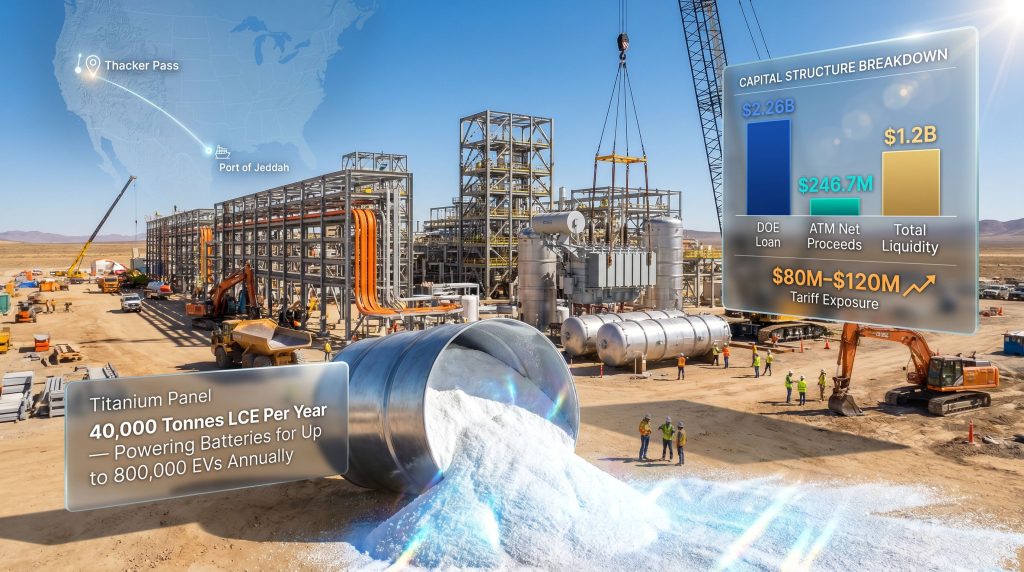
Lithium's designation as a critical mineral under U.S. national security frameworks reflects this concern. The classification is not merely symbolic. It shapes procurement priorities, financing eligibility, and the broader regulatory environment within which projects like Thacker Pass are developed. Furthermore, the practical implication is that a producing domestic lithium operation capable of delivering 40,000 tonnes of battery-quality lithium carbonate annually carries significance well beyond its commercial economics.
To contextualise that output figure: the Thacker Pass facility is designed to supply lithium sufficient to support battery production for an estimated 800,000 electric vehicles per year. That scale positions the project as infrastructure-grade in its national relevance, not merely a mining venture. The Thacker Pass production outlook reinforces why this project commands such significant attention from policymakers and investors alike.
Where the Project Stands as of Mid-2026
Thacker Pass has crossed a threshold that separates speculative resource projects from operational realities. As of mid-May 2026, the site hosts more than 1,300 workers, with peak workforce projections exceeding 2,000 personnel as construction intensity increases. Detailed engineering has surpassed 95% completion, and procurement is more than 70% complete, including the arrival of major plant materials and long-lead equipment at either the project site or the Winnemucca fabrication yard.
Mechanical completion is targeted for late 2027. The project's risk profile has fundamentally shifted from the permitting and financing uncertainties that characterised its earlier development phases. Execution risk, cost management, and supply chain coordination now define the primary challenges ahead.
Breaking Down the $2.93 Billion Capital Commitment
The Phase 1 capital estimate for Thacker Pass sits at $2.93 billion, representing one of the largest single capital deployments in the U.S. domestic critical minerals sector. As of March 31, 2026, $1.3 billion in construction capital and project-related costs had been capitalised, of which $1.1 billion forms part of that total capex estimate. The fiscal year 2026 capital expenditure target range spans $1.3 billion to $1.6 billion, signalling the construction programme's heaviest spending period.
The capital structure supporting this deployment is layered across multiple sources:
| Funding Source | Amount | Status |
|---|---|---|
| U.S. DOE Loan (Loan Programs Office) | $2.26 billion | Committed; October 2024 |
| Second DOE Loan Advance | $432 million | Received February 24, 2026 |
| ATM Equity Programme (November 2025) | $246.7 million net | Completed January 26, 2026 |
| ATM Equity Programme (March 2026) | Up to $250 million | Established March 19, 2026 |
| Total Cash and Restricted Cash (March 31, 2026) | ~$1.2 billion | Including $529M at JV level |
A critical detail for investors to understand: the original $2.93 billion figure from the project's technical report was developed without incorporating tariff impacts, Middle East conflict-related supply chain disruptions, fuel price escalation, or recent inflationary pressures. These variables are expected to be captured in a definitive capital estimate due in the second half of 2026, which will use advanced engineering data and current procurement intelligence to produce materially higher-confidence cost projections than were possible at the technical report stage.
The Capital Intensity Lens
At $2.93 billion against a designed annual capacity of 40,000 tonnes of lithium carbonate equivalent, Thacker Pass carries an implied capital intensity of approximately $73,250 per tonne of annual production capacity. This figure provides a useful reference point for comparing project economics against other lithium development initiatives, though investors should note that capital intensity varies significantly depending on ore type, processing chemistry, and infrastructure requirements. Hard rock lithium projects and brine extraction operations carry fundamentally different cost profiles, and direct comparison requires careful contextualisation.
How Lithium Americas Thacker Pass Tariffs Are Reshaping the Budget
The central cost management challenge facing Thacker Pass in 2026 is the exposure of imported construction materials to U.S. tariff policy. Lithium Americas has quantified the total potential tariff exposure for Phase 1 construction at between $80 million and $120 million, with the majority of that burden expected to materialise during the current fiscal year. Source countries subject to tariff risk include Canada, China, India, the UAE, Turkey, and the European Union, spanning a wide geographic spread that reflects the global nature of modern capital equipment supply chains.
The broader context of US critical minerals tariffs has placed additional pressure on project budgets across the sector, making Thacker Pass's mitigation strategy particularly instructive for the industry. In addition, US lithium policy shifts continue to introduce both challenges and opportunities for domestic producers navigating this environment.
"Tariff and trade-restriction policies can change with minimal advance notice, creating an ongoing variable cost risk that is difficult to hedge at the project level. Lithium Americas has explicitly flagged this as a material uncertainty within its guidance." (Lithium Americas Q1 2026 filing, via Mining Weekly, May 15, 2026)
The $80 to $120 million tariff exposure range represents approximately 2.7% to 4.1% of the total $2.93 billion capex estimate. At current levels, this is manageable within the project's liquidity buffer. However, the dynamic nature of trade policy under the current administration means that escalation risk is real and cannot be dismissed as negligible.
The 75% Domestic Cost Insulation Factor
One of the less frequently examined structural characteristics of Thacker Pass is how much of its total capital cost is naturally shielded from tariff exposure. Approximately 75% of total project capital costs are attributable to domestic labour, contractor services, and locally sourced inputs. This creates a substantial natural hedge against trade policy changes, concentrating the tariff burden within the remaining 25% of costs covering imported equipment, structural steel, and processing components.
For investors benchmarking Lithium Americas Thacker Pass tariff exposure against comparable infrastructure projects, this domestic cost composition is an important mitigant. The absolute dollar figure of $80 to $120 million becomes more meaningful when understood as a charge against only the internationally sourced portion of a project where three-quarters of spending stays within the domestic economy.
Steel, the Strait of Hormuz, and Port of Jeddah Rerouting
The structural steel supply chain for Thacker Pass offers a detailed case study in geopolitical risk management. More than 75% of the project's structural steel is sourced from the United Arab Emirates, with shipments moving toward the U.S. West Coast. When escalating Middle East conflict introduced a credible risk of Strait of Hormuz disruption, Lithium Americas and its lead engineering, procurement, and construction management contractor Bechtel worked directly with the steel supplier to implement an alternative routing strategy.
Steel shipments were successfully redirected through the Port of Jeddah, preserving delivery timelines and avoiding what could have been a project-critical delay on a construction path where structural steel installation is a sequencing prerequisite. As of the Q1 2026 reporting date, over 75% of the required structural steel had either arrived at the Thacker Pass site or reached the Winnemucca laydown yard. Outstanding deliveries were tracking to schedule across the remainder of 2026.
Long-Lead Equipment: What Has Arrived and What Remains
The delivery status of long-lead equipment is one of the most reliable leading indicators of construction progress in large-scale mineral processing facilities. Equipment with six-to-twenty-four-month manufacturing lead times represents the critical path of any project build, and Thacker Pass has been systematically receiving these items throughout early 2026.
Delivered or in transit as of Q1 2026:
- 115 kV main transformer
- Auxiliary boiler
- Air-cooled heat exchangers and fin fan cooler
- Duplex stack and bicarbonate reactors
- Thickener steel and shell plates
- Filter presses
- Steam turbine generator
- SS Converter
The diversity of this equipment list reflects the complexity of Thacker Pass as a processing facility. Unlike conventional open-pit mining operations, Thacker Pass is designed to produce battery-quality lithium carbonate, which requires multi-stage chemical processing involving carbonation, purification, and crystallisation. The presence of items such as bicarbonate reactors, filter presses, and a steam turbine generator on the delivered equipment list confirms that the facility is being built to produce a finished battery-grade product, not merely a raw intermediate material.
Construction Milestones Completed Through Q1 2026
Beyond equipment deliveries, several structural and civil milestones were reached during the first quarter:
- First cable pulls on module pipe racks commenced in March 2026, marking the transition to electrical and instrumentation installation phases
- Second floor structural steel installation progressing at the filter building
- Key equipment installation initiated across multiple facility areas
- Grid power reliability upgrades completed in March 2026, ahead of schedule, involving the upgrading of six regional substations and switching stations
The ahead-of-schedule completion of the grid power upgrade is a noteworthy operational detail. Reliable grid connection is a prerequisite for commissioning a processing facility of this scale, and early delivery of this infrastructure provides scheduling flexibility for subsequent construction phases.
The Winnemucca Transload Terminal: Infrastructure for Long-Term Operations
Construction of the Transload Terminal (TLT) began in March 2026, adding an important logistical layer to the Thacker Pass operational model. Located approximately 60 miles west of Thacker Pass and adjacent to the regional rail network, the TLT is designed to function as the primary reagent logistics hub for the facility during operations.
Reagent management is a dimension of lithium carbonate processing that receives comparatively little attention in investor communications but carries significant operational cost implications. Processing lithium-bearing ore into battery-grade carbonate requires substantial volumes of chemical reagents, including soda ash and other alkaline compounds, delivered reliably and cost-effectively at scale. A dedicated rail-linked transload facility eliminates dependence on direct road transport for bulk reagent inputs, reducing trucking costs, managing road wear in the remote Nevada desert environment, and improving supply reliability.
The TLT is targeted for completion in 2027, timed to align with Thacker Pass startup. This synchronisation ensures that the logistics infrastructure is operational before the facility requires full reagent supply volumes. Consequently, the Thacker Pass battery supply chain is being built with long-term operational resilience as a central design principle.
The next major ASX story will hit our subscribers first
Financing Architecture: How Capital Is Being Managed
The financing strategy employed at Thacker Pass combines large-scale government-backed debt with flexible equity capital tools, creating a structure designed to accommodate cost variability without triggering liquidity stress.
ATM Programme Mechanics and Strategic Rationale
At-the-Market equity programmes allow a company to sell shares into the open market at prevailing prices over a defined period, without the discount and commitment requirements of traditional block offerings. This structure offers flexibility that is particularly valuable during active construction phases, where capital needs are continuous but lumpy, and where management seeks to avoid locking in equity terms at potentially unfavourable moments in the project cycle.
The November 2025 ATM programme generated $246.7 million in net proceeds from 43.3 million shares before its completion on January 26, 2026. Of this total, $189.7 million from 32.5 million shares was raised specifically during Q1 2026. A second ATM programme authorising up to $250 million was established on March 19, 2026, with post-quarter activity yielding $11.2 million from 2.3 million shares in initial trading.
Permitted Uses of ATM Proceeds
- General corporate and project overhead funding
- Capital expenditure financing
- Debt repayment
- Working capital additions
Liquidity Position as of March 31, 2026
With approximately $1.2 billion in total cash and restricted cash as of March 31, including $529 million at the joint venture level, the project maintains a meaningful buffer against tariff-driven cost escalation and supply chain disruption. This liquidity position, combined with the remaining availability under the March 2026 ATM programme and ongoing DOE loan advances tied to construction milestones, provides multiple capital access pathways.
The Competitive Landscape for U.S. Domestic Lithium
Thacker Pass does not exist in isolation. A small number of other domestic lithium projects are in various stages of development, but the gap in advancement is substantial. Furthermore, innovations such as direct lithium extraction are emerging as potentially transformative technologies for the broader sector, though Thacker Pass relies on conventional processing methods suited to its unique clay-hosted deposit.
| Project | Developer | Stage | Annual Capacity Target |
|---|---|---|---|
| Thacker Pass, Nevada | Lithium Americas | Active construction | 40,000 t LCE |
| Piedmont Lithium, North Carolina | Piedmont Lithium | Permitting/development | ~30,000 t LCE |
| Standard Lithium, Arkansas | Standard Lithium | Pilot/development | TBD |
Thacker Pass is the only large-scale domestic lithium project currently in active full-scale construction in the United States. This first-mover position carries tangible advantages: early offtake relationship development, workforce recruitment priority, contractor and equipment availability, and the ability to establish operational credibility before competing domestic supply comes online.
"For investors evaluating exposure to domestic battery supply chain development, the stage-of-development distinction between projects is arguably more material than reserve size or resource grade. A project in production is categorically different from one in permitting, regardless of how the underlying geology compares."
Political Engagement as a Signal of Strategic Priority
Separate from regulatory frameworks and policy classifications, the pattern of political site visits to Thacker Pass is noteworthy. Visits by Nevada Senators Catherine Cortez Masto and Jacky Rosen, Nevada Governor Joe Lombardo, and representatives from the U.S. Department of Energy reflect cross-party engagement with the project at a level typically reserved for infrastructure deemed critical to regional employment and national energy strategy. The bipartisan character of this engagement is particularly significant given the polarised political environment surrounding energy and mining policy in the current period. Lithium Americas' latest project update provides further detail on how the company is navigating these dynamics heading into the second half of 2026.
Key Risk and Cost Summary
| Risk Factor | Estimated Impact | Mitigation Status |
|---|---|---|
| Tariff exposure (all sources) | $80M to $120M | Actively managed; majority in FY2026 |
| Strait of Hormuz / steel rerouting | Potential delay risk | Resolved via Port of Jeddah |
| Fuel price inflation | Embedded in revised estimate | Captured in H2 2026 definitive estimate |
| Domestic labour and contractor costs | ~75% of capex; tariff-insulated | Natural hedge via domestic sourcing |
| Total capex vs. original estimate | $2.93B baseline (pre-tariff) | Revised estimate due H2 2026 |
Disclaimer: This article is intended for informational purposes only and does not constitute financial advice. All forward-looking statements regarding construction timelines, capital estimates, tariff exposure, and production targets are subject to material uncertainty and may differ from actual outcomes. Investors should conduct independent research and seek qualified financial advice before making investment decisions. References to Lithium Americas financial data are drawn from publicly available Q1 2026 reporting as cited via Mining Weekly (Bulbulia, T., May 15, 2026).
Want to Stay Ahead of the Next Major Mineral Discovery?
Discovery Alert's proprietary Discovery IQ model scans ASX announcements in real time, instantly identifying significant mineral discoveries and turning complex data into actionable investment insights — explore Discovery Alert's discoveries page to see the historic returns major discoveries have delivered, and begin your 14-day free trial to position yourself ahead of the broader market.