June 9, 2026
The Silent Bottleneck Blocking America's Battery Future
For decades, the United States has possessed one of the most geologically diverse critical mineral endowments on the planet, yet has remained structurally dependent on foreign supply chains for the battery materials powering its own technological and industrial ambitions. The disconnect is not primarily geological. It is bureaucratic. Federal permitting timelines for major mineral and infrastructure projects have historically stretched across multiple years, sometimes exceeding a decade, creating a risk environment that deters capital deployment and cedes strategic ground to faster-moving competitors, particularly China.
Understanding this structural barrier is essential context for appreciating what the completion of federal permitting for the FAST-41 Arkansas lithium project actually represents. This is not simply a project-level milestone. It is evidence that a coordinated federal permitting architecture, purpose-built to compress review timelines for strategically significant resource developments, can deliver measurable outcomes at scale.
When big ASX news breaks, our subscribers know first
What FAST-41 Actually Does, and Why the Distinction Matters
The Fixing America's Surface Transportation Act of 2015 introduced FAST-41 as a procedural framework to improve transparency, accountability, and coordination in federal reviews for major infrastructure projects. Subsequent executive action, including the critical minerals executive order 14241, extended and reinforced the program's application to critical minerals and mining projects, designating the Federal Permitting Improvement Steering Council as the coordinating authority.
The mechanics of FAST-41 are worth understanding clearly, because misconceptions are common. The framework does not reduce or bypass substantive environmental review standards. What it does is:
- Assign a single federal point of contact to eliminate inter-agency confusion and duplicated requests
- Establish publicly-tracked target timelines for each stage of the review process
- Create accountability mechanisms ensuring agencies adhere to agreed schedules
- Publish active project progress on a public-facing federal tracking dashboard at permits.performance.gov
This transparency infrastructure addresses a specific failure mode in traditional permitting: indefinite review periods caused not by environmental complexity, but by procedural ambiguity, inter-agency handoffs, and absent coordination. FAST-41 does not lower the bar for approval. It removes the fog around the bar's location.
The South West Arkansas project became the 17th critical minerals and mining project to complete federal permitting under the current administration, according to Federal Permitting Improvement Steering Council Executive Director Emily Domenech. Domenech framed the outcome as both a programmatic validation and a signal of the administration's broader commitment to domestic critical minerals demand as a pillar of its energy dominance policy framework.
The South West Arkansas Project: Core Metrics and Strategic Context
The project is a joint venture between Standard Lithium Ltd. and Equinor ASA, combining a lithium-focused development company with one of the world's major energy companies, a pairing that reflects both the capital intensity of large-scale lithium production and the strategic interest energy majors are taking in battery supply chains.
| Metric | Detail |
|---|---|
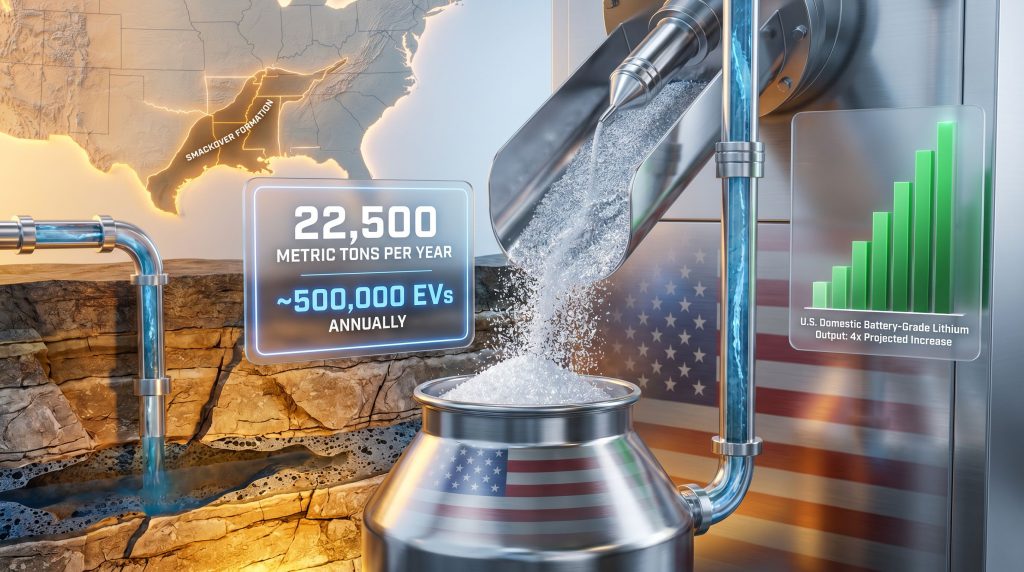
| Annual Production Target | 22,500 metric tons of battery-grade lithium carbonate |
| EV Supply Equivalent | ~500,000 average-sized EVs per year |
| Lithium Source | Smackover Formation brines, southern Arkansas |
| Joint Venture Partners | Standard Lithium Ltd. and Equinor ASA |
| Federal Permitting Program | FAST-41 (Executive Order 14241) |
| DOE Financial Support | $225 million grant (awarded January 2025) |
| Target First Production | 2029 |
| NEPA Environmental Outcome | Finding of No Significant Impact (FONSI) |
The production target of 22,500 metric tons of battery-grade lithium carbonate per year is significant at a systems level. Standard Lithium CEO David Park has stated publicly that the U.S. currently accounts for roughly 1% of global lithium production, and that the South West Arkansas project alone is positioned to increase domestic battery-grade lithium chemical output by approximately four times current levels. That is not an incremental improvement. It represents one of the largest single-step changes in U.S. critical mineral self-sufficiency that has been proposed and now permitted in recent history.
"The U.S. produces just 1% of the world's lithium, and the South West Arkansas Project is poised to increase domestic production of battery-grade lithium chemicals by 4x," according to Standard Lithium CEO David Park, as reported by Metal Tech News (May 2026).
Park also connected the project's permitting progress to broader competitive positioning, noting that the U.S. cannot maintain global relevance in energy and manufacturing unless nationally important resource projects are able to move forward in a timely manner. The implication is direct: permitting speed is now a component of national industrial strategy, not merely a bureaucratic process.
The Smackover Formation: Understanding What Makes This Resource Unique
Most discussions of domestic lithium focus on hard-rock spodumene deposits in the Mountain West or the nascent brine operations of the Great Basin. The Smackover Formation occupies a fundamentally different geological category, and understanding its characteristics helps explain why the South West Arkansas project carries a distinct risk and production profile compared to its peers.
The Smackover is a Jurassic-age limestone carbonate reservoir system extending in a broad arc from Florida through Alabama, Mississippi, Arkansas, and into Texas. It was historically known to the petroleum industry, which has drilled into its formations extensively over decades, generating an unusually detailed subsurface data record. This pre-existing geological intelligence represents a meaningful advantage for lithium development: formation depths, brine chemistry, permeability, and pressure characteristics are far better understood here than in frontier exploration targets.
The lithium within the Smackover occurs as dissolved ions in naturally occurring deep saline brines, not as hard mineral phases requiring crushing and roasting. This distinction has major implications for how the resource is extracted, processed, and managed environmentally. Furthermore, the lithium brine extraction approach used here is fundamentally different from hard-rock methods, offering a lower-impact development pathway.
Why the Petroleum Legacy of the Smackover Is a Lithium Advantage
The petroleum industry's extensive history with Smackover brines created an inadvertent knowledge base for lithium developers. Decades of oilfield operations produced detailed records of brine flow rates, chemical compositions, and aquifer behaviour across the formation. For lithium developers, this translates to reduced geological uncertainty, faster feasibility assessment, and lower pre-production exploration costs compared to greenfield geological settings with no prior subsurface data.
This is a lesser-known but structurally important insight: the Smackover's lithium potential was essentially mapped by proxy through oilfield activity. Some industry observers have noted that certain oil and gas operators in the region had been aware of elevated lithium concentrations in their produced brines for years before lithium's strategic importance drove dedicated exploration.
Direct Lithium Extraction: The Technology Separating This Project From Global Incumbents
The South West Arkansas project's technical architecture centres on direct lithium extraction (DLE), a processing approach that departs fundamentally from the two dominant methods that define most of the world's current lithium supply.
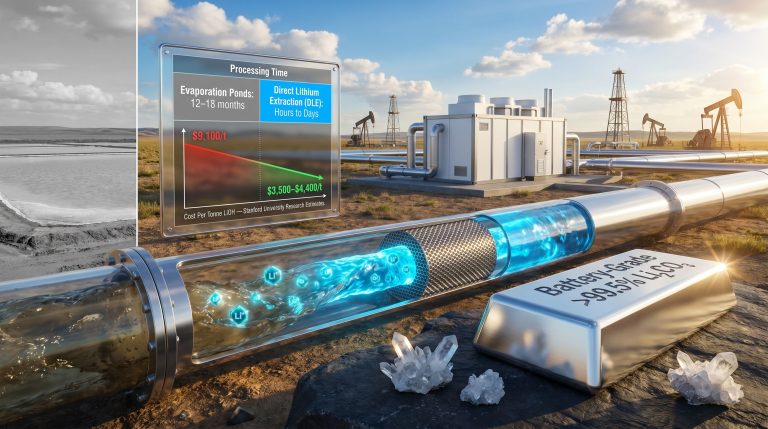
| Production Method | Water Use | Surface Footprint | Processing Time | Environmental Risk |
|---|---|---|---|---|
| Hard-Rock Mining (Spodumene) | Moderate | High | Weeks | Moderate to High |
| Evaporation Ponds (Brine) | Very High | Very High | 12 to 18 months | High |
| Direct Lithium Extraction (DLE) | Low | Low | Hours to Days | Low |
In conventional South American brine operations, lithium-enriched water is pumped to the surface and left in vast shallow ponds to evaporate under the sun, a process that can take between 12 and 18 months and consumes enormous quantities of water in some of the world's most arid and ecologically sensitive environments. Hard-rock spodumene mining, dominant in Australia, requires blasting, crushing, and high-temperature processing, with a significant surface and carbon footprint.
DLE takes a structurally different path:
- Lithium-enriched brine is drawn from deep underground limestone aquifers through production wells
- The brine passes through a selective extraction media, capturing lithium ions while allowing other dissolved minerals to pass through
- The recovered lithium is processed into battery-grade lithium carbonate or hydroxide
- The stripped brine is reinjected into the subsurface formation
This closed-loop architecture dramatically reduces both surface footprint and freshwater consumption relative to evaporation pond operations. The processing timeframe compresses from months to hours or days, which has compounding benefits for capital efficiency and working capital management.
"Unlike hard-rock spodumene mines or South American evaporation pond operations, the South West Arkansas project uses DLE technology to draw lithium-enriched brine from deep limestone aquifers, recover the lithium, and reinject the processed water, significantly reducing surface footprint and water consumption compared to incumbent production methods."
The Environmental Significance of Brine Reinjection
One aspect of DLE that receives insufficient attention in mainstream coverage is the environmental significance of subsurface brine reinjection. By returning processed water to its original formation, the DLE approach avoids the evaporation pond model's two most significant environmental liabilities: massive water consumption and the creation of large surface impoundments containing concentrated salt and chemical residuals.
The U.S. Department of Energy's issuance of a Finding of No Significant Impact (FONSI) under the National Environmental Policy Act confirms that federal reviewers assessed the project's environmental footprint and determined it does not require a full Environmental Impact Statement, a meaningful regulatory signal about the technology's risk profile. Smackover Lithium's NEPA conclusion further validates the environmental credentials of this approach.
America's 1% Problem: The Supply Chain Arithmetic Behind This Project's Importance
The geopolitical dimensions of lithium supply have shifted from niche industry concern to mainstream strategic priority with remarkable speed. According to USGS Mineral Commodity Summaries, global lithium production is dominated by Australia, Chile, China, and Argentina, with the U.S. contributing a marginal share of global output. Meanwhile, China has consolidated its position not just in raw lithium production but across the entire downstream value chain: refining, chemical processing, cathode material manufacturing, and battery cell production.
This creates a structural vulnerability that is qualitatively different from ordinary commodity import dependence. When a single nation controls not just the raw material but every processing and conversion step, supply chain disruption can manifest at multiple points simultaneously.
The South West Arkansas project addresses this vulnerability at the production and chemical processing stages. By targeting battery-grade lithium carbonate as its output rather than raw brine or spodumene concentrate, the project is designed to deliver a product ready for direct use in cathode manufacturing, bypassing the refining steps where China's processing dominance is most pronounced.
The Smackover's Broader Potential Beyond South West Arkansas
An important dimension of the South West Arkansas milestone that extends beyond the single project is what it signals about the Smackover Formation's broader development potential. The formation extends across multiple states, and the geological and regulatory precedents established at South West Arkansas create a template that other developers in the same formation can reference.
A recent USGS assessment of Appalachian lithium potential, reported by Metal Tech News in May 2026, suggests that unconventional lithium sources across the southern and eastern United States may collectively represent a material expansion of America's domestic lithium resource base, of which the Smackover represents one of the most technically accessible components. However, projects such as the Thacker Pass lithium mine in Nevada demonstrate that multiple distinct geological settings are simultaneously advancing, further diversifying the domestic supply pipeline.
The next major ASX story will hit our subscribers first
The NEPA Process and What FONSI Means in Practice
For readers unfamiliar with U.S. environmental review frameworks, the significance of a FONSI determination deserves specific explanation. The National Environmental Policy Act requires federal agencies to assess the environmental consequences of major federal actions. This review follows a tiered structure:
- Categorical Exclusion: Minor actions with no significant environmental effects, exempt from detailed review
- Environmental Assessment (EA): Moderate-complexity review that evaluates whether significant impacts are likely
- Environmental Impact Statement (EIS): Full-scale, often multi-year review for projects with potentially significant environmental consequences
A FONSI, issued at the conclusion of an EA, means the reviewing agency concluded that the proposed project does not have the potential to cause significant environmental impacts, and therefore does not require escalation to a full EIS. For a project of South West Arkansas's scale, this outcome reflects both the environmental characteristics of DLE technology and the thoroughness of the environmental assessment process itself.
The three federal permitting processes for the project, as they stand following the FONSI issuance, can be summarised as:
- Process 1: Environmental Assessment completed; FONSI issued by the U.S. Department of Energy
- Process 2: Construction and operational permitting advancing in the post-FONSI phase
- Process 3: Final financing structure and offtake infrastructure continuing to be developed
The Road to 2029: Construction, Financing, and Market Timing
With federal permits secured, the project's development pathway shifts from regulatory to commercial and engineering execution. Several interdependent milestones will determine whether the 2029 first production target is achievable:
- Final Investment Decision (FID): The formal commitment by Standard Lithium and Equinor to proceed with full-scale construction, contingent on financing structure, offtake agreements, and engineering readiness
- EPCC/EPCM Contract Award: Engagement of engineering, procurement, construction, and commissioning or management contractors to execute the build
- Offtake Agreements: Securing committed purchase agreements from battery manufacturers or EV producers to underwrite revenue certainty during the financing period
- Capital Stack Completion: The $225 million DOE grant awarded in January 2025 provides a meaningful anchor to the project's early-stage capital structure, but large-scale lithium facilities at this production target require substantially larger total capital commitments
The timing dimension of the 2029 target deserves attention from an industry structure perspective. Multiple North American EV manufacturers and battery cell producers have publicly announced capacity expansions with timelines converging on the 2027 to 2032 window. A domestic, battery-grade lithium carbonate producer coming online in 2029 would consequently enter a market in which North American cathode and cell manufacturing capacity is simultaneously scaling, creating a potential structural alignment between supply availability and regional demand growth.
"If Standard Lithium and Equinor achieve first production by 2029 as targeted, the South West Arkansas project would come online during a period when multiple EV manufacturers are projected to be scaling North American battery cell production, creating a well-timed domestic supply intersection that could reduce dependence on imported lithium carbonate from Chile, Argentina, and China."
Where South West Arkansas Sits Within the U.S. Critical Minerals Pipeline
The FAST-41 Arkansas lithium project is best understood not in isolation but as one component of a broader domestic critical minerals development pipeline that is gaining structural momentum. The 17 projects that have now cleared federal permitting under the current administration span a range of mineral types and geographies, reflecting a deliberate policy effort to diversify the domestic critical minerals base across multiple commodity categories.
Within lithium specifically, the U.S. development landscape encompasses both brine-based and hard-rock projects:
- Brine-based projects in the Smackover Formation and Great Basin regions leverage DLE technology and existing subsurface infrastructure knowledge
- Hard-rock projects in Nevada, North Carolina, and the Mountain West are advancing through various permitting stages with spodumene or clay-hosted lithium resources
- Unconventional sources, including lithium recovery from geothermal brines and oilfield produced water, represent an emerging category with significant long-term potential
The USGS's recent mapping of substantial lithium potential across the Appalachian region, reported by Metal Tech News in May 2026, adds another layer to this diversification picture. America's lithium resource endowment is considerably larger and more geographically varied than conventional industry narratives have suggested, and the FAST-41 Arkansas lithium project is helping establish the technical and regulatory frameworks through which that endowment can be accessed.
Frequently Asked Questions: FAST-41 Arkansas Lithium Project
What is the FAST-41 program?
FAST-41 is a federal permitting framework that assigns coordinated review timelines, single agency contacts, and public tracking dashboards to major infrastructure and critical mineral projects. It operates under the oversight of the Federal Permitting Improvement Steering Council and is designed to improve transparency and reduce unnecessary delays without altering substantive environmental review standards.
What is the South West Arkansas lithium project?
A joint venture between Standard Lithium Ltd. and Equinor ASA targeting the production of battery-grade lithium carbonate from brine extracted from the Smackover Formation in southern Arkansas, using direct lithium extraction technology.
How much lithium will the project produce?
The project is designed to produce up to 22,500 metric tons of battery-grade lithium carbonate annually, sufficient to supply battery materials for approximately 500,000 EVs per year.
What federal funding has the project received?
The U.S. Department of Energy awarded the project a $225 million grant in January 2025 through its critical minerals programme, providing an important anchor to the project's capital structure ahead of the Final Investment Decision.
When will the project begin production?
Standard Lithium and Equinor are targeting first commercial production in 2029, following FID and construction commencement expected in 2026.
What is a FONSI in the context of NEPA review?
A Finding of No Significant Impact is a formal determination by a federal agency that a proposed project does not require a full Environmental Impact Statement, having completed an Environmental Assessment without identifying impacts that would trigger that more extensive review process.
Why is the Smackover Formation significant for lithium?
It is a large Jurassic-age limestone aquifer system with naturally occurring lithium-enriched brines, extensive prior geological characterisation from the oil and gas industry, and geographic accessibility across the southern United States, making it one of the most technically and environmentally favourable lithium resource settings in North America.
Key Takeaways
- The FAST-41 Arkansas lithium project represents a potential four-fold increase in U.S. domestic battery-grade lithium chemical production capacity
- FAST-41 is demonstrating measurable effectiveness as a permitting coordination tool, with 17 critical minerals projects now cleared under the current administration
- The Smackover Formation's geological heritage from petroleum industry activity provides a significant knowledge and cost advantage for DLE-based lithium development
- DLE technology's closed-loop brine reinjection architecture positions South West Arkansas as a structurally lower-impact alternative to incumbent global lithium supply methods
- The $225 million DOE grant and FONSI issuance collectively address the two most significant early-stage risk categories: regulatory uncertainty and capital access
- First production targeted for 2029 aligns with accelerating North American EV manufacturing scale-up timelines, creating a potential domestic supply and demand convergence
This article is based on publicly available information and reporting by Metal Tech News (May 2026). References to production targets, financial figures, and development timelines reflect disclosed project plans and are subject to change. Nothing in this article constitutes financial or investment advice. Readers should conduct their own due diligence before making investment decisions related to any company or project referenced herein.
Want to Track the Next Major Mineral Discovery Before the Broader Market Does?
Discovery Alert's proprietary Discovery IQ model delivers real-time alerts the moment significant ASX mineral discoveries are announced, transforming complex resource data into clear, actionable investment insights for traders and long-term investors alike — explore the historic returns major discoveries have generated and begin your 14-day free trial at Discovery Alert to position yourself ahead of the market.