May 14, 2026
Underground Lithium Mining Is Entering a New Strategic Phase
For most of the past decade, lithium production growth across Australia was synonymous with open-pit operations. The economics were straightforward: shallow, high-grade pegmatite outcrops could be stripped and processed rapidly, delivering concentrate to market with relatively modest capital requirements. That model served the industry well during the initial demand surge for battery-grade lithium. But as the most accessible surface mineralisation is progressively depleted, the industry is confronting an inflection point that was always coming, just perhaps sooner than anticipated.
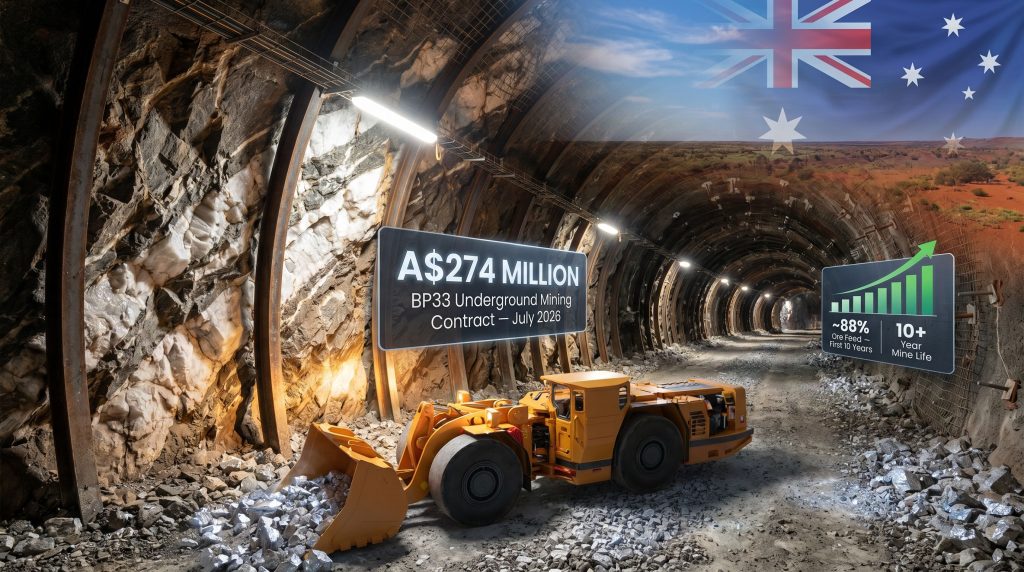
The transition to underground lithium mining represents more than a technical evolution. It signals a maturation of the sector, where operators must now commit to larger upfront contracts, longer development timelines, and more sophisticated extraction methods to sustain production over multi-decade asset lives. Against that backdrop, the Core Lithium BP33 mining contract awarded in May 2026 is a meaningful marker of where Australian hard-rock lithium is heading.
When big ASX news breaks, our subscribers know first
What Is the BP33 Deposit and Why Does It Define the Finniss Operation's Future?
The BP33 deposit sits at the operational heart of Core Lithium's Finniss Lithium Operation in the Northern Territory, located approximately five kilometres from the Finniss processing plant. While the Grants open-pit deposit provides near-term ore feed and early cash flow, it is BP33 that determines whether Finniss becomes a short-cycle project or a long-duration asset with genuine strategic value.
Understanding the Geological Foundation at BP33
The deposit's mineralisation is hosted within a substantial sub-vertical pegmatite structure. The geometry of this body is what makes BP33 both technically and economically distinctive. Its key physical characteristics include:
| Geological Feature | Specification |
|---|---|
| Pegmatite Structure Orientation | Sub-vertical |
| Strike Length | ~290 metres |
| Maximum Width | Up to 30 metres |
| Depth Extent (Plunge) | Greater than 800 metres |
| Plunge Direction | Steep southerly |
Source: Mining Technology, May 14, 2026
The sub-vertical orientation is not incidental. In underground mining, orebody geometry directly determines which extraction method can be deployed cost-effectively. A steeply dipping, narrow-to-moderate width pegmatite like BP33 is precisely the geometry that suits long-hole open stoping, the method selected for the project. This technique involves drilling long blast holes downward through ore blocks, blasting the ore in sequence, and allowing fragmented material to flow gravitationally to collection points below. The mechanics rely on the orebody standing sub-vertically so that stope walls remain stable and drill patterns can be efficiently applied across the full strike length.
Why Depth Extension Matters for Long-Term Valuation
The greater-than-800-metre depth extent is a critical but underappreciated detail. Many Australian pegmatite deposits demonstrate diminishing grade or structural complexity at depth, which compresses their underground mining potential. A deposit that maintains consistent orientation and width beyond 800 metres provides genuine optionality for resource extension drilling, potentially adding years to the already projected ten-plus-year mine life. This exploration upside is an embedded but unquantified value component in the current contract framework. Furthermore, understanding how lithium mining works at this scale helps contextualise why depth continuity carries such significant weight in long-term asset valuations.
Breaking Down the A$274 Million Underground Mining Contract
Contract Structure and Key Terms at a Glance
Contract Snapshot
Contract Value: A$274 million (~USD $198.5 million)
Primary Term: 3 years
Extension Option: Up to 2 additional years by mutual agreement
Contractor: Dev Mining Services Pty Ltd (subsidiary of Develop Global Limited)
Selection Method: Competitive tendering process
Mobilisation Start: June 2026
Underground Operations Launch: July 2026
The contract was awarded following a competitive tendering process, with Core Lithium identifying three primary selection criteria: alignment in operational methodology, commercial structure compatibility, and the depth and experience of the proposed project team. This multi-factor evaluation framework is notable because it explicitly de-prioritises cost as the sole determinant, suggesting Core Lithium was willing to accept a premium for a contractor whose approach to underground execution closely matched its own operational philosophy.
What the Scope of Work Actually Covers
The Core Lithium BP33 mining contract encompasses the complete underground mining cycle. The defined work categories include:
- Decline development (establishing the access infrastructure through which all personnel, equipment, and ore will move)
- Drill and blast operations (fragmentation of in-situ ore using percussive drilling and controlled blasting)
- Load and haul activities (moving broken ore from stopes to the surface or ore handling points)
- Production mining (systematic extraction of ore within defined stope sequences)
- Ground support and geotechnical management (installation of rock bolts, mesh, shotcrete, and monitoring systems to maintain excavation stability)
- Lithium ore handling and feed preparation (conditioning broken ore for delivery to the Finniss processing plant)
The structured financial schedule embedded within the contract aligns payment obligations with physical progress milestones, a common mechanism in large-scale underground contracts that protects the mine operator's cash flow against schedule slippage.
The Logic Behind the Three-Year Primary Term With Extension Option
The decision to structure the contract with a three-year base term and a mutual two-year extension option reflects prudent risk allocation from both parties' perspectives. For Core Lithium, it ensures contractor accountability through a defined performance window without locking in costs over a period where commodity price volatility could necessitate operational adjustments. For Develop Global, the extension option provides revenue visibility and workforce continuity planning beyond the initial term, incentivising strong execution during the first three years to secure renewal.
Who Is Develop Global and Why Were They Selected?
A Track Record Built on Hard-Rock Underground Complexity
Develop Global is an ASX-listed mining services company that operates through its subsidiary Dev Mining Services Pty Ltd for contract execution. The company's selection for BP33 is grounded in a demonstrated history of managing large-scale underground operations. Its prior portfolio includes an underground gold mining contract in Western Australia valued at approximately A$400 million over four years, which provided the selection committee with a substantive reference point for assessing Develop Global's capacity to mobilise, manage, and sustain complex underground programmes at financial scale comparable to BP33.
From Gold to Lithium: The Technical Transferability Argument
A nuanced but important aspect of this contractor selection is what it reveals about underground mining methodology. The evaluation process treated hard-rock underground mining expertise as transferable regardless of the host mineral. The drill-and-blast techniques, decline management disciplines, ground support protocols, and load-and-haul logistics that define an underground gold operation are mechanically identical to those required at an underground lithium pegmatite mine. The mineralogy differs but the execution framework does not.
This cross-commodity competency recognition is increasingly how major Australian mining operators approach contractor selection, particularly as lithium-specialist underground contractors remain relatively scarce compared to gold-sector operators. In addition, spodumene extraction demands consistent technical discipline that experienced hard-rock contractors are well-positioned to deliver, regardless of their primary commodity background.
The Dual-Track Production Strategy: BP33 Plus Grants
How the Two-Deposit Model Balances Risk and Revenue
Core Lithium's production strategy at Finniss is structured around simultaneous operation of two mining fronts with fundamentally different roles:
| Feature | BP33 Underground | Grants Open-Pit |
|---|---|---|
| Mining Method | Long-hole open stoping | Open-cut / open-pit |
| Strategic Role | Primary long-term ore feed source | Early cash flow generation |
| Ore Feed Contribution (First 10 Years) | ~88% of total | ~12% supplementary |
| Contractor | Dev Mining Services (Develop Global) | NRW Holdings |
| Contract Value | A$274 million | ~A$50 million |
| Operational Status | Commencing July 2026 | Already progressing |
Source: Mining Technology, May 14, 2026
The 88% ore feed dependency on BP33 over the first decade of production is simultaneously the operation's greatest strength and its most concentrated risk. On the upside, it means the long-duration underground asset drives the bulk of processing plant throughput, supporting sustained concentrate output and revenue predictability. The risk dimension is that any extended disruption to underground development progress, whether geotechnical, mechanical, or logistical, would disproportionately affect Finniss's production capacity. The Grants open-pit contribution, while supplementary, provides a meaningful buffer during the BP33 ramp-up phase.
What Decline Development Actually Involves
The decline is the access tunnel that spirals or ramps downward from surface into the ore body, typically at a gradient of around 1-in-7 to 1-in-8 in large operations. It serves as the operational spine of the underground mine, accommodating diesel-powered mining equipment, ventilation infrastructure, services reticulation, and ore transport. At BP33, the design incorporates dual-level access to the ore body, which is a more sophisticated arrangement than single-level access.
This configuration allows mining crews to extract ore simultaneously from two elevation intervals within the pegmatite, reducing bottlenecks in stope sequencing and providing operational flexibility to manage ground conditions or equipment availability without halting overall production. Australia's first underground lithium mine pioneered many of these dual-access principles that BP33 is now building upon.
Production Timeline: From Contract Award to Nameplate Capacity
Key Milestones in Sequential Order
- March 2026 – Dewatering of the BP33 site completed, clearing groundwater that had accumulated during the care-and-maintenance period
- May 2026 – Underground mining contract formally awarded to Dev Mining Services following competitive tender evaluation
- June 2026 – Contractor mobilisation commences alongside completion of long-lead procurement items
- July 2026 – Underground decline works begin as all contractual conditions are met
- Q4 2026 – First spodumene concentrate targeted from the Finniss processing plant
- Mid-2027 – First ore from BP33 underground workings targeted
- Mid-2028 – Ramp-up to nameplate production capacity anticipated
What Preparatory Work Is Already Complete
The sequential completion of pre-development activities is a meaningful risk-reduction signal. Work already executed or in progress includes:
- Dewatering concluded in March 2026, confirming groundwater has been managed to safe working levels
- Box cut remediation completed, establishing the surface entry point for the decline portal
- Site civil works progressed to support June 2026 mobilisation readiness
- Long-lead procurement items initiated, addressing equipment items with extended delivery timelines that could otherwise delay July 2026 operational commencement
- Parallel advancement of box cut infrastructure alongside active open-pit work at Grants, demonstrating simultaneous execution capability
The dewatering milestone deserves particular attention. Underground mines in the Northern Territory can encounter significant groundwater ingress, particularly where pegmatite bodies intersect fractured country rock. The confirmation that dewatering was completed in March 2026 prior to contract award suggests the hydrogeological conditions have been assessed and managed to a point where underground access is considered operationally feasible.
The next major ASX story will hit our subscribers first
How BP33 Fits Into Australia's Critical Minerals Supply Framework
The Northern Territory as a Hard-Rock Lithium Province
The Northern Territory occupies a distinctive position within Australia's lithium landscape. While Western Australia dominates global hard-rock spodumene production through operations like Pilgangoora, Greenbushes, and Mount Marion, the NT offers a geologically prospective pegmatite belt that remains relatively underexplored by comparison. Finniss represents one of the more advanced development-stage operations in the territory, and BP33's long mine life projection positions it as a potentially durable supply contributor within Australia's broader critical minerals production base.
Spodumene's Role in Battery Supply Chain Architecture
Hard-rock spodumene concentrate, the likely primary product from Finniss, serves as a feedstock for lithium hydroxide and lithium carbonate conversion facilities. These compounds are the functional materials incorporated into lithium-ion battery cathodes. Australian spodumene operations are regarded by battery manufacturers and downstream chemical processors as geopolitically stable supply sources, a characteristic that carries commercial value in an environment where supply chain diversification has become a procurement priority for major battery and electric vehicle manufacturers across Asia, Europe, and North America.
However, it is worth noting that direct lithium extraction technologies are emerging as complementary pathways in the broader supply chain, though hard-rock pegmatite operations like BP33 remain foundational to near-term battery-grade supply.
Market Context: Australian hard-rock spodumene is widely recognised within battery supply chain procurement discussions as offering supply reliability characteristics distinct from brine-sourced lithium production in other jurisdictions. The geological consistency of pegmatite-hosted mineralisation typically translates to more predictable concentrate specifications, which matters for downstream chemical conversion processes that require consistent feedstock quality.
What This Contract Signals for Core Lithium's Recovery Trajectory
Transitioning From Care-and-Maintenance to Full Production
Core Lithium's path to this contract award traversed a care-and-maintenance period that temporarily suspended operations at Finniss. The decision to place a project in care and maintenance is never taken lightly, as it involves maintaining infrastructure, retaining key technical personnel, and sustaining community relationships during a period of zero revenue. The fact that Core Lithium is now executing two major mining contracts simultaneously — A$274 million for BP33 underground and approximately A$50 million for Grants open-pit — represents a substantive operational recommitment.
Locking in two separate contractors across the open-pit and underground mining fronts serves an important risk management function. It prevents single-contractor dependency, maintains competitive accountability between operational programmes, and provides Core Lithium with comparative performance data across both mining approaches. The alignment of NRW Holdings on Grants and Develop Global on BP33 creates parallel execution tracks that the project team can manage independently while coordinating ore delivery to a shared processing plant.
Core Lithium's managing director characterised the Core Lithium BP33 mining contract as "a major milestone and a strong endorsement of the project's quality", reflecting the view that attracting a credible contractor through a competitive process validates both the deposit's technical credentials and the company's operational recovery plan. According to Australian Mining, this contract is widely seen as the central pillar of Finniss's restart strategy. Furthermore, analysts tracking the sector noted that Core Lithium shares jumped following the announcement, signalling positive market reception to the operational recommitment.
Key Metrics Summary
| Metric | Value |
|---|---|
| Contract Value | A$274 million (~USD $198.5 million) |
| Contract Term | 3 years + 2-year extension option |
| Ore Feed Contribution (First 10 Years) | ~88% of Finniss total |
| Projected Mine Life | 10+ years |
| Pegmatite Depth Extent | 800+ metres |
| Pegmatite Strike Length | ~290 metres |
| Maximum Pegmatite Width | Up to 30 metres |
| Mobilisation Date | June 2026 |
| Underground Operations Start | July 2026 |
| First Ore from BP33 | Targeted mid-2027 |
| Nameplate Production Target | Mid-2028 |
Frequently Asked Questions
What is the BP33 deposit?
BP33 is an underground lithium deposit located approximately five kilometres from the Finniss processing plant in the Northern Territory, Australia. It is the primary long-term ore source for the Finniss Lithium Operation, projected to supply approximately 88% of total ore feed during the first decade of production. The mineralisation is hosted within a sub-vertical pegmatite structure extending more than 800 metres at depth.
Who was awarded the BP33 underground mining contract?
Dev Mining Services Pty Ltd, the operational subsidiary of ASX-listed Develop Global Limited, was awarded the contract following a competitive tendering evaluation process.
How much is the Core Lithium BP33 mining contract worth?
The contract is valued at A$274 million (approximately USD $198.5 million), structured across a three-year primary term with a mutual option to extend by two additional years.
When will underground mining begin at BP33?
Underground decline development is scheduled to begin in July 2026, following contractor mobilisation in June 2026. First ore from BP33 is targeted for mid-2027, with nameplate processing capacity anticipated by mid-2028.
What mining method will be used at BP33?
Long-hole open stoping is the primary extraction method. This approach was selected based on the deposit's sub-vertical pegmatite geometry — approximately 290 metres in strike length, up to 30 metres wide, and extending more than 800 metres at depth — all of which are characteristics well-suited to this extraction technique.
What is the expected mine life at BP33?
Current projections indicate a mine life exceeding ten years, with additional exploration potential at depth that could extend the operational horizon further beyond current resource estimates.
Disclaimer: This article is intended for informational purposes only and does not constitute financial advice. Statements regarding production timelines, mine life projections, and ore feed contributions are forward-looking and subject to geological, operational, commodity price, and market risks. Investors should conduct independent due diligence before making investment decisions. Further reporting on the Core Lithium BP33 mining contract is available via Mining Technology.
Want to Spot the Next Major ASX Mineral Discovery Before the Broader Market Does?
Discovery Alert's proprietary Discovery IQ model delivers real-time alerts on significant ASX mineral discoveries — instantly translating complex geological data into actionable investment insights for both short-term traders and long-term investors. Explore historic examples of exceptional discovery returns and start your 14-day free trial at Discovery Alert to position yourself ahead of the market.