
May 14, 2026
When Mining Scale Collides With Residential Life
The global race to secure battery-grade lithium has accelerated the expansion of mining operations across Western Australia's southwest, creating a collision between industrial ambition and the lived reality of the communities sitting nearest to the ore bodies. In towns where hard-rock lithium sits directly beneath residential streets, the social licence to operate has become as consequential as the mining licence itself. Nowhere is that tension more sharply drawn than in Greenbushes, where the world's largest hard-rock lithium mine shares a boundary fence with a historic township of a few hundred residents.
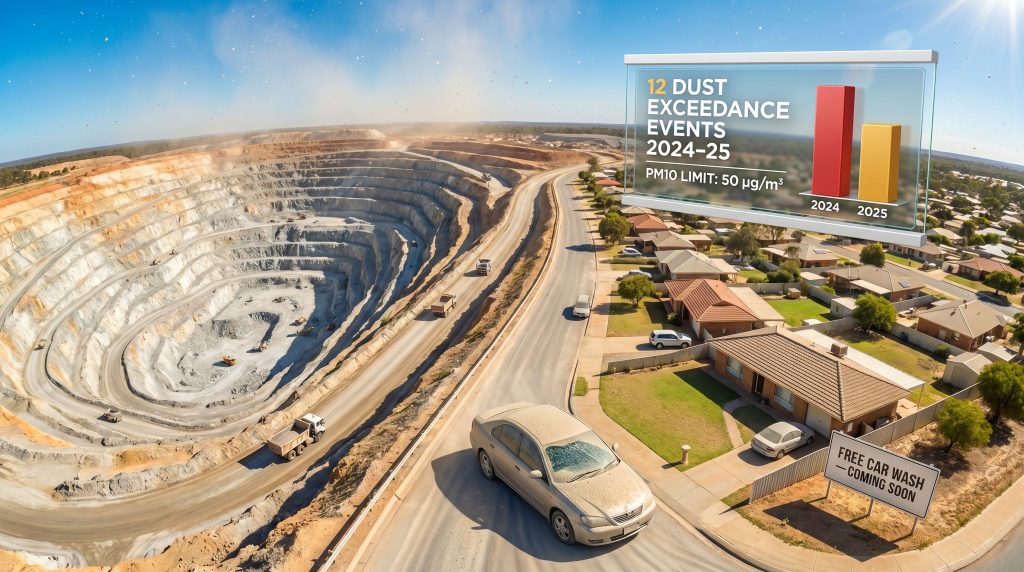
The Talison Lithium Greenbushes dust car wash plan, confirmed to be in its planning stages as of May 2026, has crystallised a debate that extends far beyond vehicle cleanliness. It raises fundamental questions about what genuine community impact management looks like when a mine of global significance operates within metres of people's front doors.
When big ASX news breaks, our subscribers know first
What the Greenbushes Mine Actually Represents
Before examining the car wash proposal in isolation, it helps to understand the extraordinary scale of what sits at the edge of this small Western Australian town, located approximately 240 kilometres south of Perth.
The Greenbushes operation holds the distinction of being both Australia's oldest active lithium mine and the world's single largest hard-rock lithium deposit currently in production. Owned by Sino-American joint venture Talison Lithium, the operation contributes roughly 20 per cent of global hard-rock lithium supply, making it an irreplaceable node in the international battery supply chain.
The mineral being extracted is spodumene, a lithium-bearing pyroxene mineral that is crushed, processed, and concentrated into a chemical-grade or technical-grade product before being shipped to battery manufacturers across Asia and beyond. Furthermore, spodumene processing involves significant crushing, grinding, and flotation stages, each of which generates fine particulate matter that requires active dust management.
Why Proximity Matters at This Scale
What makes Greenbushes unusual in a global mining context is the physical proximity of the mine pit and processing infrastructure to the residential township. Most world-scale open-cut operations maintain substantial buffer zones between their operational footprint and the nearest residential areas. At Greenbushes, that buffer is minimal, making every operational decision about blasting schedules, haulage routes, and dust management one with direct daily consequences for residents.
This proximity is not accidental. The township predates the modern scale of mining activity, having grown around earlier, smaller mining operations over many decades. The current expansion of the mine to meet global lithium demand has fundamentally altered the relationship between the operation and the community it surrounds.
The Dust Problem: What the Numbers Reveal
The regulatory framework governing dust emissions at Greenbushes is administered by the Department of Water and Environmental Regulation (DWER), which sets operational licence conditions including maximum permissible dust concentrations.
| Metric | Detail |
|---|---|
| Regulatory dust limit | 24-hour PM10 threshold of 50 µg/m³ |
| Reporting obligation | Exceedances must be notified to DWER within 1 business day |
| Recorded exceedances (2024-25) | 12 documented breaches of the exceedance limit |
| Year-on-year change | Company states exceedances attributable to operations were halved in 2025 vs 2024 |
| Current claim | No further exceedances recorded since the most recent reporting period |
PM10 refers to particulate matter with a diameter of 10 micrometres or less, small enough to be inhaled into the respiratory tract. The 50 µg/m³ limit represents an averaging period of 24 hours, meaning short-duration peak concentrations during blasting or high-wind events may temporarily far exceed the threshold even when daily averages appear compliant.
The Compliance Gap That Residents Experience
Talison has acknowledged something significant in its public statements: compliance with DWER monitoring thresholds does not necessarily mean residents experience a dust-free environment. The company has conceded that felt impacts can still occur even when monitoring registers within permitted limits. This is a technically honest but troubling admission, because it confirms that the regulatory standard and the community amenity standard are not the same thing.
The implications of this gap are substantial. A mine can be technically compliant with every monitoring station reading while individual residents experience daily dust accumulation on vehicles, outdoor furniture, and building surfaces. The monitoring network's spatial coverage, the location of monitoring stations relative to residential zones, and the averaging methodology all influence what the data shows versus what residents breathe.
The Haul Road: A New and Distinct Dust Source
While the mine's own blasting and processing operations have historically been the primary dust source, residents now identify a newly constructed haul road running through the centre of town as the most significant current contributor to dust accumulation. This distinction matters enormously for understanding why Talison's reported improvement in mine-based dust exceedances has not translated into reduced dust on cars and properties.
Resident Rick Fryer, who lives on Stanifer Street, has described a daily procession of heavy haulage vehicles passing his home around the clock. He has reported observing approximately 200 truck movements per day past his front door, a figure that represents a substantial and sustained source of road dust, tyre wear particles, and diesel particulate that operates entirely independently of the mine's dust management controls.
Fryer has noted the apparent paradox directly: while the company reports reducing mine-sourced dust from one year to the next, residents report that vehicles and properties are carrying more dust than ever before, consistent with the haul road becoming the dominant exposure pathway.
The lived experience documented by residents includes:
- Dust accumulation on outdoor surfaces reaching millimetre-scale thickness between cleaning cycles
- The requirement to clean windscreens each morning to maintain adequate driving visibility
- Dust particles visible in air illuminated at night, described as resembling falling glitter or snow
- Garden beds and outdoor furniture requiring regular cleaning to remain usable
- Reported respiratory symptoms including persistent coughs and eye irritation
The Talison Lithium Greenbushes Dust Car Wash Plan: Origins and Details
The Talison Lithium Greenbushes dust car wash plan has attracted significant attention, but its origins reveal something important about the dynamic between the company and the community. The proposal was not developed internally by Talison as a proactive community benefit initiative. It was first raised by residents themselves as a practical workaround for a problem they were already experiencing daily.
As of mid-May 2026, Talison has confirmed it is in the planning stages for the facility, with no confirmed location, no confirmed opening date, and no disclosed specifications regarding water sourcing, wastewater management, or operational hours. The company has described the initiative as part of its commitment to capacity expansion and being better neighbours to the surrounding community.
When a mining company adopts a community-proposed vehicle cleaning facility as evidence of its community commitment, the framing reveals more than the content. It suggests the company believes the gap between its operational performance and community expectation can be bridged with a service amenity rather than a fundamental operational change.
Why Residents Say the Car Wash Does Not Solve the Problem
The community response to the Talison Lithium Greenbushes dust car wash plan has been consistent in its logic: a car wash treats the evidence of a problem, not the problem itself.
Resident Grant McDonald articulated this directly. He acknowledged the practical value of a car wash while identifying it as simultaneously an admission of failure. His reasoning was straightforward: the existence of a car wash implies the company knows vehicles are being covered in dust, and if the company knows that, then it knows the dust problem has not been resolved.
Rick Fryer echoed this perspective, noting that the world's largest and most productive lithium operation should be capable of constructing a dedicated haul road that bypasses residential streets entirely. His concern extends beyond daily inconvenience. He noted that community members have been told current dust levels pose no immediate health risk, but expressed scepticism about the basis for that assurance, observing that some health consequences from long-term particulate exposure may not become apparent for decades.
Kellie Gillies, a resident of Bridgetown located 7 kilometres from the mine, framed the issue in terms of air quality rather than vehicle cleanliness. Her observation was pointed: if vehicles need constant rinsing because of dust exposure, the facility confirms the scale of the underlying problem rather than resolving it. A car wash does nothing for the air that residents and their families breathe between washes.
The Corporate-Community Expectation Divide
| Corporate Position | Community Expectation |
|---|---|
| Car wash as community commitment | Reduction or elimination of dust at its source |
| Compliance with DWER PM10 thresholds | Lived experience free from visible daily dust accumulation |
| Year-on-year reduction in mine-based exceedances | No exceedances and no property accumulation |
| Haul road as necessary operational infrastructure | Purpose-built corridor that routes heavy vehicles away from homes |
| Stakeholder Reference Committee as engagement mechanism | Binding operational changes with enforceable community standards |
Current Dust Control Measures and Their Limitations
Talison operates under a formal Dust Management Plan and a Dust Trigger Action Response Plan (TARP), a structured framework that defines the specific interventions required when monitoring data reaches defined trigger thresholds. The company's current operational toolkit includes:
- Water carts deployed to dampen unsealed roads and active working areas
- Non-hazardous chemical suppressants applied to roads and exposed surfaces to bind particulate material
- Dust extraction systems integrated into crushing and processing circuits
- Vehicle and equipment wash-down bays to prevent tracked dust from spreading beyond operational areas
- Sealed permanent roads and carparks to reduce dust lift-off from vehicle movement
- Permanent and mobile monitoring stations with real-time data collection
- Weather forecasting integration to enable proactive responses during high-wind or low-humidity conditions
Recent additions to this framework include expanded live monitoring coverage across additional points around the mine boundary and the establishment of a Stakeholder Reference Committee designed to formalise community input into operational decisions.
What the Current Framework Does Not Address
The Dust Management Plan and TARP were designed primarily around the mine's own operational dust sources: blasting, crushing, ore processing, and materials handling. The haul road through the town centre represents a categorically different dust source, one that operates through sustained high-frequency vehicle movements across roads that may or may not have adequate dust suppression applied to them. Whether the haul road is subject to the same TARP trigger thresholds and response protocols as mine-site operations is not publicly documented.
The TARP framework is also reactive by design: it specifies what actions must be taken once monitoring data reaches a trigger level. In residential amenity terms, the damage to daily quality of life occurs continuously between trigger events, particularly from the haul road, which generates dust independently of weather conditions or blasting schedules.
The next major ASX story will hit our subscribers first
Expansion, Regulatory Scrutiny, and the Stakes for Approval
The Greenbushes dust issue does not exist in a static operational context. Talison's proposed Greenbushes Capacity Expansion is currently under active review by Western Australia's Environmental Protection Authority (EPA), a process that has generated hundreds of public submissions. The proposed expansion encompasses new waste rock landforms, modified dam infrastructure, additional road infrastructure, and expanded laydown and processing areas.
Each element of the expansion carries measurable dust-generation implications. New waste rock landforms increase the exposed surface area subject to wind erosion. Additional road infrastructure creates new vehicle movement pathways. Expanded processing areas extend the operational footprint and associated particulate emissions.
The dust, noise, light, and vibration impacts on the residential community of Greenbushes are among the primary concerns formally identified in the EPA review process. The community's current dissatisfaction with dust management under existing operational conditions is directly relevant to whether the EPA can be satisfied that expansion will be managed to an acceptable standard.
The Rail Line Question
One structural intervention that has been raised repeatedly by residents and community advocates is the revival of a historical rail connection linking the Greenbushes mine to the regional freight network. Reinstating rail freight capacity would, in principle, substantially reduce the volume of heavy vehicle movements required through and around the township, addressing the haul road dust problem at its source.
Talison has declined to pursue rail reinstatement, describing it as not commercially viable. Critics argue this position prioritises short-term operational cost management over long-term community impact reduction, particularly given the scale of the mine's global commercial significance. The rail question is also relevant to the EPA expansion review: approving additional capacity without resolving transport infrastructure impacts on the community could set a problematic precedent.
Home Buyback Demands: The Most Significant Community Signal
A segment of the Greenbushes community has escalated beyond requests for operational improvements to demand a formal home buyback scheme. The existence of buyback demands is a critical indicator of the depth of community dissatisfaction. When residents reach the point of seeking exit rather than improvement, it signals that confidence in the company's willingness or ability to achieve acceptable operational standards has been exhausted.
This is particularly significant in a regulatory context. EPA and DWER assessments of social licence typically consider community sentiment as a factor in approvals and conditions. The emergence of buyback demands substantially changes the character of the community relations challenge from a dust management problem to a fundamental question about whether compatible land use between the mine and the township is achievable. In addition, Australia's first underground lithium mine developments elsewhere in the region demonstrate that alternative operational models do exist, raising further questions about what is genuinely achievable.
What a Genuine Response Would Look Like
The gap between what Talison has proposed and what communities in Greenbushes and Bridgetown are requesting can be mapped across three timeframes.
Immediate priorities would centre on the haul road. An independent investigation into feasible rerouting options, even partial rerouting away from the highest-density residential streets, would demonstrate operational commitment beyond monitoring. Real-time, community-accessible dust monitoring dashboards, rather than data held internally by the company, would close the transparency deficit that is currently compounding community distrust.
Medium-term structural reforms would include binding dust reduction targets incorporated as enforceable conditions in any EPA expansion approval, rather than voluntary commitments. A structured community benefit fund tied to production volumes would provide ongoing financial recognition of the amenity burden carried by residents. An independent longitudinal health study, conducted by researchers without financial ties to the company, would address the uncertainty about long-term exposure effects that residents have consistently raised.
Long-term planning would require reassessing whether a purpose-built haul road corridor bypassing the residential township is achievable within the expansion infrastructure envelope. It would also require honest engagement with property value support mechanisms for residents whose assets have been materially affected by changed amenity conditions. Furthermore, emerging technologies such as direct lithium extraction methods being trialled elsewhere may offer insights into how extraction processes can be modified to reduce surface-level impacts.
| Practice Area | Current Approach | Community-Requested Standard |
|---|---|---|
| Dust monitoring | Permanent and mobile stations, PM10 threshold | Real-time publicly accessible dashboards, residential-zone specific limits |
| Haulage routing | Through residential streets | Dedicated bypass corridor away from populated areas |
| Community support | Free car wash (proposed) | Structured benefit funds, property support mechanisms |
| Health assessment | Regulatory compliance-based reassurance | Independent longitudinal health research |
| Engagement governance | Stakeholder Reference Committee | Co-design of operational parameters with binding outcomes |
The Broader Lesson for Mining Community Relations
The Talison Lithium Greenbushes dust car wash plan, whatever its practical utility, illustrates a recurring pattern in mining community relations: the tendency to manage the visible, measurable symptoms of community impact rather than restructuring operations to reduce the impact itself. A car wash is a tangible, photographable initiative that can be pointed to in community reports and stakeholder presentations. A haul road bypass is a capital expenditure commitment that requires operational redesign.
For communities living adjacent to world-scale lithium mining operations, the distinction is not abstract. It is the difference between washing the same car every morning and not needing to. Consequently, the question facing regulators, the company, and the community is whether the Greenbushes model can evolve into one that genuinely reconciles industrial ambition with residential amenity, or whether the current trajectory will deepen the divide between them. The EPA's environmental watch of Talison's operations will be closely observed as a bellwether for how Western Australia manages this tension at scale.
This article is based on publicly available reporting and community testimony. Statements regarding health impacts, regulatory compliance, and operational plans have not been independently verified. Readers seeking further coverage of the Greenbushes community situation can access related reporting at abc.net.au.
Want to Stay Ahead of the Next Major Lithium Discovery?
While the world's largest hard-rock lithium operation navigates complex community and regulatory pressures at Greenbushes, new lithium discoveries on the ASX continue to emerge — and timing is everything. Discovery Alert's proprietary Discovery IQ model delivers real-time alerts the moment significant mineral discoveries are announced, turning complex geological data into actionable insights for investors at every level; explore historic discovery returns to understand what's at stake, and start your 14-day free trial at Discovery Alert to position yourself ahead of the broader market.