August 14, 2026
The Geological Lottery That Became a Geopolitical Battleground
China lithium investments in Africa are reshaping the global battery supply chain in ways that extend far beyond individual corporate transactions. Lithium does not distribute itself evenly across the Earth's crust, tending to concentrate in specific geological formations, particularly in ancient pegmatite belts where slow-cooling magma allowed lithium-bearing minerals like spodumene to crystallise into economically viable deposits. For decades, the world's attention focused on the lithium triangle of Chile, Argentina, and Bolivia, where brine-hosted reserves dominate. However, a quieter story has been unfolding across Sub-Saharan and West Africa, where some of the most significant hard-rock spodumene deposits on Earth have been systematically identified, acquired, and placed under Chinese operational control.
This is not a story about one company or one deal. It is the story of a coordinated, multi-country strategy executing at a speed and integration depth that Western mining capital has consistently failed to match. Understanding why Africa's lithium endowment matters requires understanding what happens after the ore leaves the ground, and who controls that journey to the battery pack inside an electric vehicle.
When big ASX news breaks, our subscribers know first
Why Africa's Lithium Endowment Changes the Supply Chain Calculus
Africa's geological endowment in battery-critical minerals has long been understood in academic and geological circles, but the continent's strategic significance for the global lithium market has only recently crystallised into mainstream investment and policy attention. The continent hosts large-scale pegmatite-hosted spodumene deposits across several jurisdictions, with Mali, Zimbabwe, Ghana, Côte d'Ivoire, and Nigeria representing the most active zones of current development and Chinese investment.
Unlike brine-based lithium extraction, hard-rock vs brine lithium production follows conventional open-pit or underground mining methodology, followed by flotation processing to produce spodumene concentrate, typically graded at around 6% lithium oxide (Li₂O). This concentrate is then shipped to chemical processing facilities, predominantly in China, for conversion into battery-grade lithium carbonate or lithium hydroxide.
The critical insight here is that whoever controls the upstream concentrate source and the downstream refining infrastructure controls the entire value chain. China already accounts for an estimated 60 to 80% of global lithium refining capacity. African spodumene assets acquired by Chinese firms do not feed into a competitive global market. They feed into a captive, vertically integrated system.
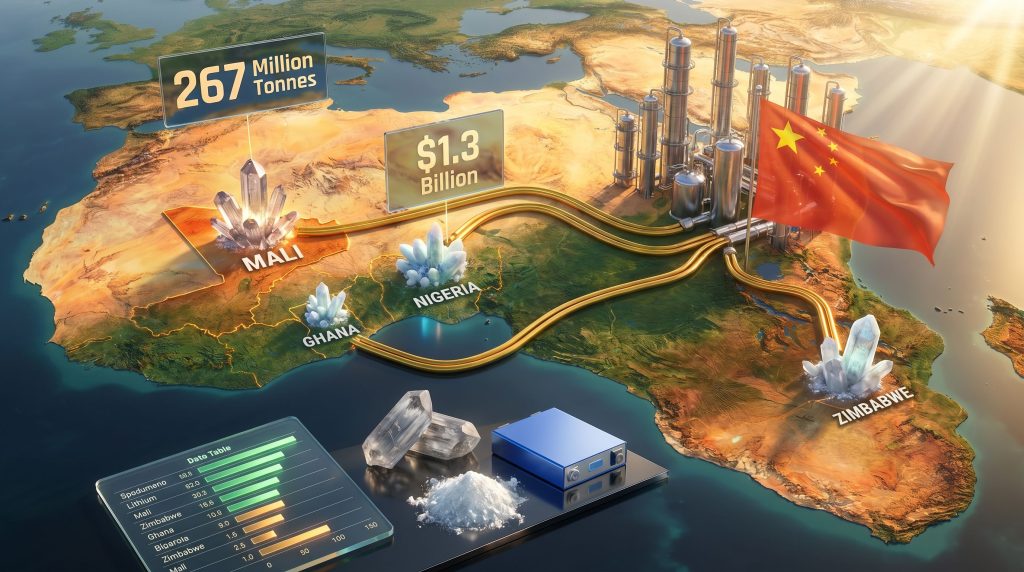
Mali's Goulamina project alone illustrates the scale involved. With a resource estimate expanded to 267 million tonnes in 2024, representing approximately 9.11 million tonnes of lithium carbonate equivalent, Goulamina ranks among the world's largest hard-rock lithium deposits by resource tonnage, according to Mysteel analysis cited by Business Insider Africa. Total capital deployed at the project is estimated at $644 million, with production commencing in 2024 and export flows established by 2025.
Africa is not simply a mineral supplier in this emerging order. It is the upstream geography through which the global EV battery supply chain will be contested and potentially controlled for decades.
China's Integrated Acquisition Playbook: How the Model Actually Works
The structural advantage underpinning China's Africa lithium strategy is frequently described in competitive terms, but it is better understood as an architectural difference between two fundamentally distinct investment models.
The Western approach typically sequences deal components across separate negotiation phases:
- Equity acquisition negotiated independently
- Project development financing arranged through commercial markets
- Infrastructure requirements addressed separately with host governments
- Offtake agreements negotiated after development milestones are achieved
Each phase introduces delay, counterparty risk, and capital uncertainty. Western-listed juniors developing African assets must satisfy shareholders, environmental compliance frameworks, and commercial lenders simultaneously, often over multi-year timelines that create funding gaps vulnerable to external capital reallocation.
The Chinese approach collapses these phases into a single integrated transaction structure:
- Equity acquisition bundled with development financing commitments
- Infrastructure co-investment offered as part of the deal package
- Long-term offtake agreements guaranteed at signing, feeding directly into Chinese refining capacity
- State-linked financing accessed at preferential rates unavailable to commercial market participants
This integration dramatically compresses timelines and removes the funding uncertainty that repeatedly stalls Western-led project development.
| Dimension | Chinese Model | Western Model |
|---|---|---|
| Deal structure | Integrated across all phases | Sequenced and separately negotiated |
| Financing source | State-linked, preferential cost of capital | Commercial markets, higher WACC |
| Processing integration | Feeds captive 60-80% global refining share | Limited or no downstream integration |
| Risk tolerance | Long-horizon strategic patience | Near-term return expectations |
| Execution speed | Rapid consolidation through waiver mechanisms | Extended due diligence and milestone cycles |
China's New Energy Vehicle Industry Development Plan (2021-2035) provides the policy architecture that drives this model. The 15-year strategic horizon allows state-linked enterprises to deploy capital across multi-decade project development timelines without the quarterly performance pressure that constrains Western mining investment. Furthermore, this patience capital, combined with processing integration, creates an asymmetric competitive advantage that African lithium developers have increasingly found impossible to resist, particularly when Western backers withdraw.
Country-by-Country: Mapping China's African Lithium Footprint
Mali: The West African Lithium Corridor Takes Shape
Mali has emerged as the most strategically concentrated node of Chinese lithium control in West Africa. Two separate Chinese operators have established controlling positions in the country's two most significant lithium projects, creating what amounts to a coordinated supply corridor under Beijing's effective oversight.
Ganfeng Lithium, one of China's largest lithium producers, has achieved full consolidation of the Goulamina project through its Mali Lithium special purpose vehicle. The SPV structure is standard practice in international project finance, separating asset-level liabilities from parent balance sheet exposure while enabling non-recourse debt arrangements. Goulamina's 2024 resource expansion to 267 million tonnes, translating to approximately 9.11 million tonnes of LCE, positions it as a generational supply asset, not a short-cycle extraction play.
Meanwhile, Hainan Mining holds a 51% controlling stake in Mali's Bougouni lithium mine, with total project investment estimated at approximately $118 million. The Bougouni operation reached a critical commercial milestone in December 2025, shipping its first vessel of lithium ore following Malian government export approval, according to Business Insider Africa. That approval milestone matters geopolitically as much as commercially, confirming that Mali's regulatory framework can accommodate Chinese-operated lithium export at scale.
Ghana: The Ewoyaa Acquisition and a Western Exit
Ghana's Ewoyaa lithium project has become the clearest illustration of how Chinese capital displaces underfunded Western operators at the project development stage.
Zhejiang Huayou Cobalt, one of China's largest battery materials processors, has proposed a $210 million all-cash acquisition of Atlantic Lithium at $0.25 per share, the project's primary developer. The transaction includes a critical structural mechanism: Huayou agreed to assume all remaining development funding obligations and confirmed that the development costs conditions precedent under the earlier project agreement are either satisfied or waived, according to Business Insider Africa's reporting of Mining Weekly sourced information.
This waiver mechanism deserves specific attention because it reveals how Chinese acquirers remove the principal friction that stalls project advancement. Conditions precedent in project finance agreements typically require proof of certain milestones, such as environmental clearances, resource confirmations, or financing closures, before capital deployment obligations trigger. By agreeing to waive or satisfy these conditions, Huayou accepted development-stage risk in exchange for project control, eliminating the funding uncertainty that had previously paralysed Ewoyaa's development trajectory.
The catalyst for Huayou's opportunity was a US-linked operator's retreat. Elevra Lithium, formerly known as Piedmont Lithium, held rights to a 22.5% stake in the Ewoyaa project alongside rights to at least 50% of the spodumene concentrate offtake. According to Business Insider Africa, Atlantic Lithium disclosed that Elevra had downgraded Ewoyaa within its capital allocation priorities and sought structural changes to the joint venture arrangement.
Elevra's CEO Lucas Dow confirmed the company's strategic redirection, stating that the transaction improves financial flexibility and enables a sharper focus on North American assets, while removing development funding obligations and eliminating the structural complexities associated with Ewoyaa's ownership arrangement. Elevra expects to receive approximately $71 million in cash proceeds from the transfer of all its rights and obligations to Huayou.
If both transactions receive regulatory approval, including Ghanaian government clearance, Huayou has indicated it could indirectly control approximately 87% of the Ewoyaa project, with Ghana's free carried state interest representing the remaining 13%, according to Business Insider Africa.
The Elevra exit is not simply a corporate portfolio decision. It is a template for how underfunded Western-backed African lithium juniors, facing domestic capital reallocation pressure, become acquisition targets for Chinese strategic buyers with patient, integrated capital.
Zimbabwe: Arcadia as the Proof-of-Concept Blueprint
Huayou's $422 million acquisition of the Arcadia Lithium Project in 2022 established the operational framework now being replicated across the continent. The Arcadia transaction was among the earliest demonstrations that Chinese acquirers could move from acquisition through development to production faster than Western-led alternatives in African jurisdictions.
The Zimbabwe operation reached a continental milestone in early 2026, when trial lithium sulphate production commenced at the Arcadia project near Harare, producing Africa's first lithium sulphate output from an African-based project, according to Business Insider Africa. Lithium sulphate is an intermediate chemical product that sits further along the processing value chain than raw spodumene concentrate, indicating that Chinese operators are beginning to shift some processing activity to African soil rather than exporting purely unprocessed ore.
Nigeria: Processing-First Entry at Scale
Nigeria represents a structurally different form of China's African lithium engagement. Rather than acquiring existing mineral deposits, Chinese capital has entered Nigeria primarily through processing infrastructure investment, with approximately $1.3 billion deployed since September 2023 from firms including Canmax Technology, Jiuling Lithium, Avatar New Energy, and Asba.
This processing-first model was highlighted at the 2025 China Mining Conference as a distinct market entry strategy, positioning Nigeria as a potential processing hub rather than a pure extraction jurisdiction. From Nigeria's perspective, this arrangement offers a path toward economic diversification away from oil dependency while building domestic clean energy processing infrastructure, though the ultimate beneficiary of that processing capacity remains predominantly Chinese downstream demand.
Côte d'Ivoire and Guinea: Securing the Exploration Frontier
Before large deposits even reach development stage, Chinese capital is already establishing exploration positions. Ganfeng Lithium's joint venture with Lithium Africa Corp, a 50/50 partnership formed following the 2026 merger between Lithium Africa Resources and Canada's Lombard Street Capital, has secured exploration permits covering 1,254 square kilometres in Côte d'Ivoire's Adzopé region.
Early-stage assay results have returned 1.26% lithium over 8 metres from initial trenching, a result consistent with early-stage spodumene mineralisation in prospective pegmatite terrain. A drilling programme is scheduled for the first half of 2026, funded by approximately $1.97 million from the merger's capital injection, with a total CAD 2.68 million fund injection supporting accelerating West African exploration activity.
Chinese Investment Across Africa's Lithium Sector: Comparative Overview
| Country | Primary Chinese Operator(s) | Project | Capital Deployed | Ownership / Control | Operational Status |
|---|---|---|---|---|---|
| Mali | Ganfeng Lithium | Goulamina Mine | ~$644M | Full control via Mali Lithium SPV | Production 2024; exports 2025 |
| Mali | Hainan Mining | Bougouni Mine | ~$118M | 51% controlling stake | First ore shipment Dec 2025 |
| Ghana | Zhejiang Huayou Cobalt | Ewoyaa Project | ~$210M (proposed) | ~87% post-transaction | Pending regulatory approval |
| Zimbabwe | Zhejiang Huayou Cobalt | Arcadia Lithium | ~$422M | Majority | Trial production commenced 2026 |
| Nigeria | Canmax, Jiuling, Avatar, Asba | Processing facilities | ~$1.3B | Operational stakes | Ongoing since Sep 2023 |
| Côte d'Ivoire | Ganfeng + Lithium Africa Corp | Adzopé Exploration | ~$1.97M (phase 1) | 50/50 JV | Drilling planned H1 2026 |
Why the Western Response Is Structurally Inadequate
The policy conversation in Washington and Brussels about critical minerals security frequently references frameworks like the US Inflation Reduction Act and allied mineral security partnerships. What those frameworks do not address is the deal-level structural gap that allows Chinese acquirers to displace Western operators at the project development stage.
The Elevra case illustrates the problem with precision. Despite holding a significant stake and majority offtake rights in a world-class lithium deposit, the company faced domestic capital allocation pressure that caused it to downgrade the project in its internal priority ranking. That downgrade created a funding gap, which in turn created an acquisition opportunity. Huayou filled it within a single transaction structure.
Western financing institutions, including development finance agencies and multilateral banks, have not matched Chinese deal velocity or financing integration depth in Africa. As analysis from Benchmark Minerals highlights, China is set to dominate African lithium production this decade. The Belt and Road Initiative's critical minerals engagement has reportedly reached $21.7 billion in total BRI commitments across Africa, with an estimated $8 to $10 billion directed toward critical minerals including lithium. No equivalent Western capital mobilisation at comparable scale and deal integration has materialised across the same African jurisdictions.
The structural comparison reveals a fundamental asymmetry:
- Chinese deals close faster because they integrate financing, equity, and offtake into one transaction
- Chinese capital costs less because state-linked financing operates below commercial market rates
- Chinese acquirers accept development-stage risk because their 15-year policy planning horizon absorbs project-level uncertainty
- Western operators retreat when domestic capital pressure conflicts with long-duration African project timelines
The next major ASX story will hit our subscribers first
The Risks Accumulating Inside This Supply Chain Architecture
For African Host Nations
The concentration of foreign ownership at the 87% level, as proposed in Ghana's Ewoyaa project, raises legitimate questions about resource governance and the degree to which African economies capture value from their own geological endowment. The 13% free carried state interest in Ewoyaa provides a structural floor for national benefit, but free carried interests do not participate in project financing decisions, offtake pricing negotiations, or processing location choices.
Long-term offtake pricing is a particularly under-examined dimension. If offtake agreements establish pricing formulas at project inception, before production ramp-up and before spot market dynamics fully reflect scarcity conditions, host nation royalties and government revenues may systematically underperform relative to the lithium value actually extracted. Nigeria's processing-first model represents a more balanced entry point, as processing infrastructure creates employment, taxation revenue, and industrial capacity that pure extraction operations do not.
For the Global Battery Supply Chain
The combination of upstream African asset control and 60 to 80% global refining capacity dominance creates a vertically integrated supply chokepoint. Western EV manufacturers dependent on battery-grade lithium hydroxide or carbonate sourced through Chinese-controlled processing infrastructure face a concentration risk that no individual company policy can resolve.
If African spodumene concentrate flows exclusively through Chinese refining capacity under long-term offtake obligations, non-Chinese battery manufacturers face either a pricing premium for independently sourced material or direct supply constraints during periods of geopolitical tension. Furthermore, innovations like direct lithium extraction technology have not yet offset the processing dominance that Chinese operators currently hold.
For Geopolitical Competition
Africa has become the active theatre of the US-China critical minerals rivalry, not merely a passive resource frontier. As the Stimson Center's analysis of competing US and Chinese critical minerals investment strategies demonstrates, African governments hold meaningful leverage through regulatory approval processes, royalty structure negotiations, and national interest provisions. However, exercising that leverage requires coordination capacity that individual states have not consistently demonstrated.
The acceleration of Chinese acquisition activity through 2025 and 2026 may also reflect anticipatory positioning ahead of tighter Western regulatory scrutiny of Chinese mining investments globally. Securing African assets before equivalent restrictions apply to African jurisdictions preserves long-term supply access regardless of how investment screening frameworks evolve in Western economies.
What This Means for Investors Watching African Lithium
The wave of Chinese acquisitions across Africa carries clear signals for investors holding or evaluating positions in African lithium development companies.
Acquisition premium benchmarking: Huayou's $0.25 per share offer for Atlantic Lithium establishes a reference valuation for comparable-stage African lithium assets. Junior developers with advanced resource estimates and permitting progress in West or Southern African jurisdictions may attract Chinese JV approaches or acquisition interest before reaching development stage financing requirements.
Binary outcome risk for underfunded juniors: The pattern across Ghana, Zimbabwe, and Mali consistently shows that Western-backed operators facing capital allocation pressure become acquisition targets. Junior miners with African lithium exposure and unresolved project financing requirements face a binary outcome: secure committed development capital through alternative sources, or become the next acquisition opportunity for a Chinese strategic buyer.
Early-stage exploration value: Ganfeng's entry into Côte d'Ivoire at the exploration permit stage, before resource definition drilling, suggests Chinese operators are increasingly willing to pay for optionality on prospective pegmatite terrain. In addition, the role of spodumene extraction economics in determining project viability means early-stage African lithium exploration companies in favourable geological settings may attract JV interest earlier in the development cycle than historical precedent suggests.
Disclaimer: This article is for informational purposes only and does not constitute financial or investment advice. Readers should conduct their own due diligence and consult a licensed financial adviser before making investment decisions. Forecasts, valuations, and transaction outcomes referenced are subject to regulatory approval, market conditions, and other uncertainties.
Can Africa Capture More of Its Own Lithium Value?
The most consequential long-term question emerging from China's Africa lithium consolidation is not whether Chinese firms will continue acquiring assets. The evidence suggests they will, and at pace. The question is whether African governments and regional frameworks can create conditions under which a greater share of the lithium value chain is retained within the continent.
Nigeria's $1.3 billion processing investment offers a potential template, demonstrating that China lithium investments in Africa can be directed toward in-country industrial capacity rather than purely extraction-focused operations. The distinction matters enormously for long-term economic outcomes. Processing transforms raw ore into intermediate chemical products, creating employment, technical skill development, and tax revenue that extraction alone cannot match.
Regional frameworks including the African Continental Free Trade Area and emerging African Union critical minerals policy discussions offer a pathway toward collective bargaining leverage that individual countries lack when negotiating bilaterally with large Chinese operators. A coordinated African position on minimum processing requirements, royalty structures, or local ownership thresholds could meaningfully shift the value distribution of current and future lithium investment flows.
The urgency is real. Exploration is advancing, resource estimates are expanding, and acquisition structures are compressing timelines between discovery and Chinese control. The next five years will determine whether Africa's lithium generation becomes a story of continental industrial transformation or one of sophisticated resource extraction serving primarily Chinese manufacturing dominance.
The continent holds the geological endowment to supply the clean energy transition for decades. Whether African economies become price-takers or value-chain participants in that transition depends on decisions being made now, at the regulatory, financing, and policy level, before the next wave of acquisitions closes.
Want To Position Yourself Ahead of the Next Major Mineral Discovery?
Discovery Alert's proprietary Discovery IQ model delivers real-time alerts on significant ASX mineral discoveries — instantly translating complex data across 30+ commodities into actionable investment insights for both short-term traders and long-term investors. Explore how historic discoveries have generated substantial returns on Discovery Alert's dedicated discoveries page, and begin your 14-day free trial today to secure a market-leading advantage.