June 15, 2026
The Strategic Logic Behind Government-Backed Lithium Investment in North America
The global race to secure battery-grade lithium has entered a phase where geology alone no longer determines winners. Capital structure, energy source, jurisdictional stability, and supply chain proximity now carry equal weight in determining which lithium assets survive long enough to matter. This shift has produced a new financing model across resource-intensive economies, where the Canada Growth Fund invests in the North American Lithium mine as part of a broader strategy where public investment funds absorb early-stage project risk to attract private capital at scale. Understanding how this model works, and why it is being applied to a specific open-pit mine in northern Quebec, reveals as much about the future of battery supply chains as it does about any single project.
When big ASX news breaks, our subscribers know first
What the Canada Growth Fund Is Actually Designed to Do
Formally established in 2023, the Canada Growth Fund (CGF) is a C$15 billion federal investment vehicle with a mandate that is more surgical than broad. Its purpose is not to replace private capital markets but to change the risk calculus that prevents institutional and commercial investors from deploying capital into large-scale Canadian projects at the pace the energy transition demands.
The fund operates through milestone-contingent capital structures, meaning disbursements are tied to measurable project progress. This is a meaningful distinction from grants or unconditional subsidies. Capital flows when defined benchmarks are met, whether those benchmarks involve permitting advancement, engineering completion, or demonstrated operational performance.
By May 2026, the CGF had announced 23 transactions totalling over C$5 billion committed across six provinces, a deployment pace that reflects a systematic investment philosophy rather than opportunistic deal-making. The portfolio includes assets across lithium, nickel, and graphite, each representing a different node in the battery materials supply chain.
| Project | Province | CGF Commitment | Mineral |
|---|---|---|---|
| North American Lithium (NAL) | Quebec | ~C$145 million | Lithium (spodumene) |
| Vale Base Metals – Thompson | Manitoba | ~C$116 million | Nickel |
| Nouveau Monde Graphite – Matawinie | Quebec | ~C$113 million | Graphite |
The CGF model mirrors frameworks deployed elsewhere in critical minerals finance, including the U.S. Department of Energy's Loan Programs Office and Australia's Critical Minerals Facility. What distinguishes the CGF is its explicit focus on crowding in private capital rather than substituting for it, using public funds as a first-loss buffer that improves project economics for subsequent commercial investors.
The concentration of investments in Quebec, represented by both NAL and the Nouveau Monde Graphite commitment, reflects structural advantages in that province rather than political preference. Quebec generates roughly 90 per cent of its electricity from hydroelectric sources, providing both a cost and emissions advantage that materially affects the economics and carbon footprint of energy-intensive mineral processing operations.
Furthermore, the broader global lithium market dynamics make this kind of government-backed financing model increasingly relevant, as private capital alone struggles to match the pace and scale required by the energy transition.
Canada's Largest Operating Lithium Mine: A Profile of NAL
The North American Lithium mine sits in La Corne, Abitibi-Témiscamingue, approximately 570 kilometres north of Montreal and roughly 60 kilometres north of Val-d'Or. The Abitibi region has long been one of Canada's most productive mining corridors, with established infrastructure, experienced workforce pools, and regulatory familiarity with hard rock mining operations.
NAL operates as an open-pit spodumene mine, targeting lithium-bearing pegmatite ore bodies. Spodumene is a pyroxene mineral that serves as the primary feedstock for battery-grade lithium chemicals, specifically lithium hydroxide and lithium carbonate, which are essential inputs for lithium-ion battery cathode manufacturing.
The mine's competitive position rests on three structural advantages that are difficult to replicate quickly in competing jurisdictions:
- Energy cost and emissions profile: Grid connection to Quebec's hydroelectric network provides electricity at carbon intensity levels well below coal or gas-powered mining regions, materially reducing Scope 2 greenhouse gas emissions per tonne of concentrate produced
- Brownfield capital efficiency: Existing processing infrastructure, established permitting history, and an experienced local workforce reduce the capital cost per tonne of annual production capacity compared to greenfield alternatives requiring full infrastructure construction
- Supply chain proximity: NAL's Quebec location places it within logical logistics range of North American electric vehicle manufacturing corridors in the U.S. Midwest and Ontario, reducing transportation costs and supply chain exposure relative to offshore alternatives in Western Australia or South America
The operation currently supports approximately 252 direct jobs in the surrounding regional economy, a figure that is expected to grow as the planned expansion progresses through its staged development phases.
Understanding Spodumene Concentrate and Its Role in Battery Supply Chains
A detail that is often underappreciated by investors outside the lithium sector is that spodumene extraction yields an intermediate product, not an end product. The value chain runs from ore in the ground through several distinct processing stages before reaching a battery cell manufacturer.
- Mining: Ore is extracted from open-pit operations and sent to the concentrator
- Concentration: Spodumene is separated from gangue minerals using dense media separation and flotation circuits, producing a concentrate typically grading 5 to 6 per cent lithium oxide (Li₂O)
- Conversion: Spodumene concentrate is shipped to chemical conversion facilities where it is processed into lithium hydroxide monohydrate or lithium carbonate via either the sulphuric acid roast process or newer pressure leach technologies
- Cathode manufacturing: Purified lithium chemicals are incorporated into cathode active materials (NMC, LFP, or LMFP chemistries)
- Cell manufacturing: Cathode materials are used in battery cell production for EVs and stationary storage
NAL's position at step one and two of this chain means its commercial value is closely tied to spodumene concentrate spot pricing, which has historically been more volatile than downstream lithium chemical prices. This structural exposure to price cycles is central to understanding both the asset's historical difficulties and the rationale for government co-investment as a stabilising mechanism.
From Bankruptcy to Canada's Most Strategic Lithium Asset
NAL's operational history compresses several decades of typical mining industry cycles into less than a decade. Its trajectory from commissioning through insolvency and then recovery illustrates a pattern that recurs frequently in hard rock lithium mining: assets with sound geological fundamentals can fail under misaligned capital structures or adverse market timing, only to re-emerge when ownership, market conditions, and strategic context converge more favourably.
The mine entered commercial production in 2018 under North American Lithium Inc., backed by China's Tianqi Lithium. The timing proved difficult. Processing plant reliability issues created operational instability, elevated costs relative to production output, and the lithium market entered a sustained period of price weakness that stripped margin from producers across the cost curve. Operations were suspended in 2019, and the asset entered insolvency proceedings.
The insolvency period lasted until 2021, when Sayona Mining acquired the asset out of bankruptcy in a joint venture with Piedmont Lithium, establishing Sayona Québec as the operating entity. The acquisition provided an opportunity to address the plant reliability deficiencies that had contributed to the original shutdown and to restructure operating cost profiles.
Following targeted plant upgrades and process optimisation, NAL successfully restarted production in 2023, resuming output of spodumene concentrate. This restart demonstrated that the asset's geological fundamentals remained sound and that the previous failures were primarily operational and financial in nature rather than geological.
In August 2025, Sayona Mining and Piedmont Lithium completed a formal corporate merger, creating Elevra Lithium, an Australia-headquartered company with a North America-focused operational strategy.
The pattern at NAL reflects a recurring dynamic in critical minerals: when commodity prices are low, assets with genuine geological merit become available at discounts to replacement cost. Patient capital that acquires during these periods and invests in operational improvement can generate significant value when market conditions recover. The challenge is that recovery timelines are rarely predictable, making the risk-return profile unattractive for conventional private capital without some form of structural support.
Breaking Down the C$417 Million Financing Package
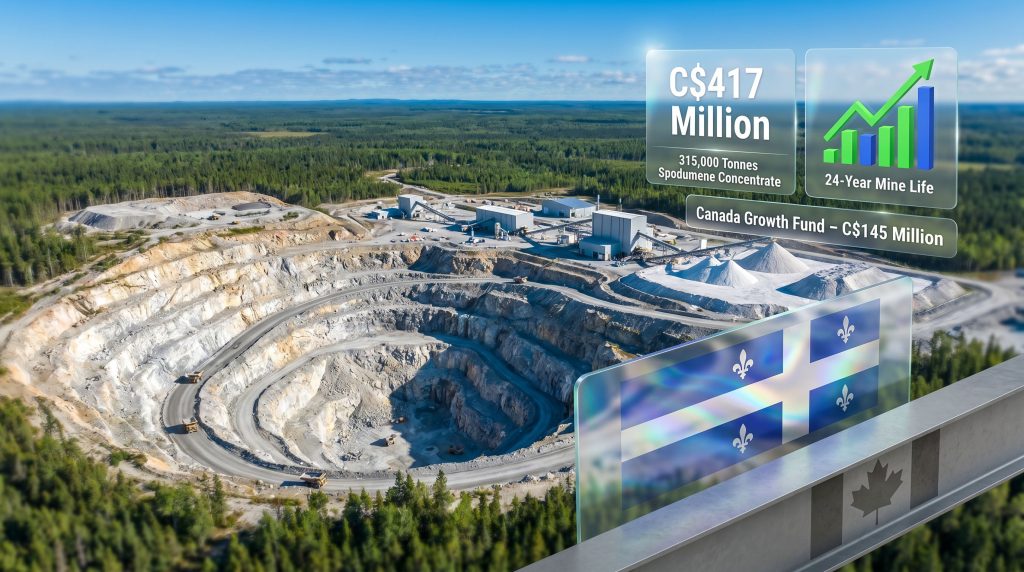
The investment structure supporting NAL's brownfield expansion involves two primary capital instruments totalling approximately C$417 million. According to the Canada Growth Fund announcement, the commitment is structured to ensure capital deployment is tied to measurable progress milestones.
| Capital Source | Amount | Instrument Type |
|---|---|---|
| Canada Growth Fund | ~C$145 million | Strategic milestone-contingent investment |
| Public Equity Offering | ~C$272 million | Common share public offering |
| Total | ~C$417 million | Combined capital raise |
The CGF component, representing approximately 35 per cent of the total package, is structured as a milestone-contingent commitment. This means a portion of the C$145 million is conditional on Elevra achieving defined operational and development milestones at NAL. This structure protects public capital from deployment before value-creating conditions are met while simultaneously providing Elevra with greater certainty over its expansion funding envelope.
The remaining approximately C$272 million from the public equity offering represents private market capital mobilised in conjunction with the CGF commitment, consistent with the fund's stated objective of crowding in commercial investment alongside public capital.
What the Expansion Capital Is Designed to Achieve
The combined funding package is targeted at a staged brownfield expansion with the following key outcomes:
- Increase annual spodumene concentrate production to approximately 315,000 tonnes
- Extend the operational mine life to an estimated 24 years
- Improve per-unit processing economics through throughput scale
- Position NAL as a long-term platform asset within Elevra Lithium's multi-asset portfolio
Lucas Dow, Managing Director and CEO of Elevra Lithium, indicated that the financing supports the near-term expansion plan at NAL and positions the asset as a long-term growth platform. He noted that the CGF capital specifically helps de-risk the staged expansion and provides greater certainty for delivering growth at the operation, while also reinforcing the importance of building a resilient North American lithium supply chain anchored in Quebec.
The staging of the expansion is itself a risk management mechanism. Rather than committing full capital upfront, a staged approach allows the operator to calibrate investment pace against operational performance, market conditions, and milestone achievement, reducing the risk of capital misallocation that contributed to the original 2019 shutdown.
The North American Content Dimension: IRA Alignment and Trade Resilience
The commercial rationale for locating battery material supply chains in Canada is partially shaped by the North American regulatory environment. North American content requirements embedded in the Inflation Reduction Act (IRA) create direct commercial incentives for electric vehicle manufacturers to source critical minerals from qualifying North American jurisdictions.
Under the IRA's battery critical minerals requirements, a specified percentage of the value of critical minerals in an EV battery must be extracted or processed in the United States or a country with which the U.S. has a qualifying free trade agreement. Canada qualifies through the Canada-United States-Mexico Agreement (CUSMA), meaning spodumene concentrate produced at NAL and subsequently converted to lithium chemicals for North American battery supply chains can contribute toward IRA compliance thresholds.
This regulatory framework creates structural demand advantages for North American lithium producers over offshore alternatives, provided the logistics economics are competitive. NAL's Quebec location, with rail and road access to U.S. manufacturing corridors, supports the logistics feasibility of this positioning.
It is important to note that while the IRA framework creates a favourable policy environment for North American lithium producers generally, this does not constitute project-specific government support for NAL. The commercial benefits of IRA alignment accrue to any qualifying North American lithium source and depend on Elevra Lithium's ability to secure downstream supply agreements with battery manufacturers or converters seeking IRA-compliant feedstock.
A 24-year mine life is a commercially significant figure in this context. Original equipment manufacturers designing their battery material procurement strategies require long-duration supply certainty, often seeking agreements extending 10 to 15 years in length. A 24-year mine life provides the supply longevity that OEM procurement teams need to justify contracting with NAL as a primary feedstock source rather than a supplementary one.
The next major ASX story will hit our subscribers first
Elevra Lithium's Multi-Asset Platform: NAL in Portfolio Context
The CGF investment in NAL takes on additional strategic meaning when viewed within Elevra Lithium's broader asset portfolio. NAL is not a standalone investment; it is the operating anchor of a multi-asset lithium platform spanning two continents.
| Asset | Location | Elevra Interest | Development Status |
|---|---|---|---|
| North American Lithium (NAL) | Abitibi, Quebec | Majority | Operating and expanding |
| Moblan Lithium Project | James Bay, Quebec | 60% | Development stage |
| Carolina Lithium Project | North Carolina, USA | 100% | Permitting and development |
| Pilbara Exploration Assets | Western Australia | Undisclosed | Exploration |
The Moblan project in Quebec's James Bay region represents a significant future development option. The James Bay region has attracted substantial exploration interest in recent years due to the discovery of multiple high-grade lithium pegmatite systems, and Moblan's 60 per cent held interest positions Elevra as a meaningful participant in that emerging district.
The Carolina Lithium project in North Carolina adds a U.S.-domiciled asset to the portfolio, directly supporting IRA domestic content requirements for lithium extracted within U.S. borders, which carry a higher compliance value under the legislation than imports from free trade agreement partners.
This multi-jurisdictional structure reduces single-asset operational risk while creating optionality across different market scenarios. If spodumene concentrate markets tighten, the portfolio generates leverage across multiple projects. If specific jurisdictional risks materialise, the geographic diversification limits concentration exposure.
Risks That Investors and Analysts Should Not Discount
Lithium Price Volatility: The Structural Risk That Never Disappears
Lithium carbonate and spodumene concentrate prices experienced severe volatility across the 2023 to 2025 period, with prices declining sharply from the peaks reached in late 2022 before partially recovering. This volatility directly tested the economics of lithium producers across the cost curve and contributed to project deferrals and production curtailments globally. Understanding the lithium carbonate market dynamics is, therefore, essential context for evaluating NAL's expansion rationale.
NAL's original 2019 shutdown was partially attributable to exactly this dynamic. The CGF's milestone-contingent structure and the C$417 million financing package are designed to improve NAL's cost competitiveness through scale, reducing the minimum price required for the operation to remain economic. However, the underlying commodity price risk has not been eliminated; it has been partially mitigated through improved economics.
Investors should note that forecasts regarding future spodumene concentrate or lithium chemical prices involve significant uncertainty. Any investment analysis involving Elevra Lithium or the North American Lithium operation should incorporate multiple commodity price scenarios rather than relying on a single price assumption.
Processing Plant Performance: A History That Cannot Be Ignored
The original NAL operation's primary failure mode was processing plant reliability, not geological shortfall. The 2019 shutdown resulted from a combination of plant equipment failures, elevated operating costs per tonne, and unfavourable market prices that removed any margin buffer for operational inefficiency.
Post-acquisition upgrades by Sayona Mining addressed identified reliability issues, and the 2023 restart demonstrated improved operational stability. However, scaling to 315,000 tonnes per annum represents a materially higher throughput than previous operational targets, requiring sustained processing plant performance at a significantly larger scale.
Milestone Contingency: Capital Is Not Guaranteed
A portion of the CGF's C$145 million commitment remains conditional on Elevra achieving defined project milestones. While the total commitment represents a strong signal of institutional confidence in the project, the contingent structure means full capital deployment is not assured at the outset. Failure to achieve defined milestones could affect the pace or quantum of CGF disbursements, which in turn could affect the timeline and scope of the expansion plan.
Quebec as a Battery Materials Hub: Why This Geography Matters Long-Term
The CGF's concentration of critical mineral investments in Quebec reflects the province's structural position in the battery materials ecosystem rather than any single policy decision. Quebec's advantages compound across multiple dimensions simultaneously:
- Electricity cost and decarbonisation: Hydroelectric-dominated grid provides low-cost, low-carbon power at scale, a critical input for energy-intensive mineral processing
- Established mining infrastructure: Abitibi and James Bay regions contain extensive road networks, rail connections, processing facilities, and experienced workforces built over decades of gold, copper, and zinc mining
- Regulatory familiarity: Quebec's provincial mining regulatory framework has processed hundreds of project applications, creating predictable timelines relative to jurisdictions with less developed regulatory capacity
- Geographic proximity: Southern Quebec sits within economically viable transportation distance of U.S. Midwest EV manufacturing clusters in Michigan, Indiana, and Ohio
The CGF's investments in both NAL and Nouveau Monde Graphite's Matawinie project suggest a deliberate strategy of building complementary battery material supply chains within a single province, potentially creating the density of activity needed to support downstream processing infrastructure such as lithium hydroxide conversion facilities.
In addition, innovations such as direct lithium extraction technologies may further enhance the commercial viability of Quebec-based lithium operations over the coming decade, complementing the hard rock spodumene approach at NAL with alternative processing pathways. Furthermore, understanding how lithium mining works across different deposit types helps contextualise why NAL's hard rock pegmatite geology represents both a proven resource type and a distinct operational model compared to brine-based lithium extraction.
Whether Quebec ultimately develops an integrated battery materials processing hub, from mining through chemical conversion, remains a question of commercial economics and further investment decisions. What the current CGF deployment pattern demonstrates is that the foundational mining capacity to support such a hub is being systematically de-risked and expanded. Elevra's C$417 million raise is a meaningful signal that private capital is increasingly willing to follow public investment into this geography when the structural conditions are right.
This article is intended for informational purposes only and does not constitute financial, investment, or legal advice. Forward-looking statements regarding production targets, mine life estimates, capital deployment timelines, and commodity market conditions involve significant uncertainty and should not be relied upon as predictions of future outcomes. Readers should conduct their own due diligence before making investment decisions.
Want to Track the Next Major Mineral Discovery Before the Market Moves?
Discovery Alert's proprietary Discovery IQ model delivers real-time alerts on significant ASX mineral discoveries — turning complex geological and commodity data into actionable investment insights for traders and long-term investors alike. Explore how historic discoveries have generated substantial returns on Discovery Alert's dedicated discoveries page, and begin your 14-day free trial today to position yourself ahead of the broader market.