August 6, 2026
The Upstream Battleground Nobody Is Talking About
For most analysts tracking the global electric vehicle transition, the competitive lens remains fixed on battery manufacturing capacity, charging infrastructure rollout, and downstream automaker strategy. Yet the most consequential competition for the next generation of battery supply chains is being fought at a far less visible level: in the hard-rock pegmatite deposits of West and Central Africa, where China tightens grip on West Africa lithium through spodumene-bearing ore bodies locked into long-term offtake agreements before most Western policymakers have even mapped their full extent.
Spodumene concentrate, chemically identified as lithium aluminum silicate (LiAlSi₂O₆), is the primary hard-rock feedstock from which lithium hydroxide monohydrate and lithium carbonate are refined. Both compounds are essential precursor materials for the cathode chemistry used in lithium-ion battery cells. Understanding spodumene extraction basics helps clarify why whoever controls concentrate at the mine-mouth level effectively pre-positions for battery market share years before any cell rolls off a production line.
That upstream contest is no longer theoretical. The cumulative picture reveals a structural realignment of the global battery supply chain that is accelerating rather than plateauing.
When big ASX news breaks, our subscribers know first
Why West Africa Became a Tier-One Lithium Frontier
Mali and Ghana have emerged as two of the most strategically important hard-rock lithium jurisdictions outside Australia and Latin America. Their ascent reflects a combination of geology, infrastructure access, and investment timing that makes them uniquely attractive to long-horizon acquirers.
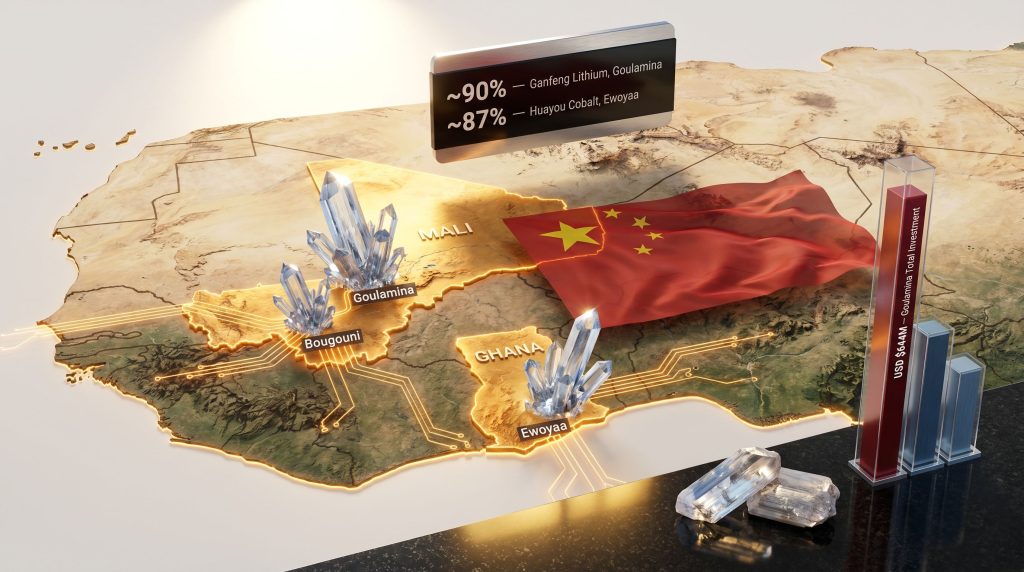
Mali's Goulamina project alone expanded its resource estimate to 267 million tonnes in 2024, equivalent to approximately 9.11 million tonnes of lithium carbonate equivalent (LCE), according to Mysteel analysis, with total project investment estimated at $644 million. That single asset places Mali within the tier-one league of global lithium projects by resource scale, independent of broader Sahelian deposit surveys.
The Ewoyaa project progress, meanwhile, has positioned Ghana's flagship asset as the standout West African lithium project for the Gulf of Guinea region, distinguished by its proximity to established port infrastructure and its relatively advanced development stage.
The strategic significance of these deposits extends beyond headline resource figures. When comparing hard-rock vs brine lithium sources, hard-rock spodumene deposits in West Africa carry a processing advantage: production timelines from discovery to first concentrate are measurably shorter, and concentrate quality is typically more consistent for battery-grade hydroxide refining.
For Chinese battery material processors operating integrated refinery networks, feedstock consistency and supply volume reliability outweigh marginal cost differences between source geographies. Furthermore, Africa's giant lithium deposit at Manono in the DRC illustrates just how vast the continent's untapped potential remains beyond West Africa alone.
The real competition for battery supply chain dominance is not being decided in Gigafactory construction announcements or EV sales dashboards. It is being decided in offtake agreement clauses signed at mine-development stage, years before first production.
Mapping Chinese Lithium Acquisitions Across West Africa
The scale of Chinese capital deployment across West African lithium jurisdictions is not a collection of opportunistic deals. Examined collectively, it reveals a systematic, multi-entity consolidation of the most advanced projects in the region.
| Country | Project | Chinese Entity | Ownership Stake | Capital Deployed |
|---|---|---|---|---|
| Mali | Goulamina Lithium | Ganfeng Lithium (Mali Lithium SPV) | ~90% (increased from 50%) | ~USD $342.7 million |
| Mali | Bougouni Lithium | Hainan Mining | 51% | ~USD $118 million |
| Ghana | Ewoyaa Lithium | Zhejiang Huayou Cobalt | ~87% (pending approvals) | ~USD $210 million |
| Zimbabwe | Arcadia Lithium | Zhejiang Huayou Cobalt | Majority control | ~USD $422 million |
Aggregating these four disclosed transactions yields approximately $1.1 billion in identified Chinese capital deployment across the region's most advanced lithium assets. This figure excludes additional Chinese entities active in Zimbabwe's concentrate export market, including Sichuan Yahua Industrial Group, Chengxin Lithium, and Sinomine Resources. These companies collectively received selective export quotas following Zimbabwe's February 2025 suspension of raw lithium exports.
Zimbabwe's lithium concentrate exports to China reached approximately 1.1 million tonnes in that period, illustrating how export control mechanisms have been deployed to channel supply exclusively toward Chinese processing pipelines rather than to diversify destination markets. According to Benchmark Minerals, China is on track to dominate African lithium production throughout this decade, a trajectory consistent with the transaction data above.
Ganfeng's Goulamina Blueprint: Equity Plus Offtake as a Dual Lock-In
Ganfeng Lithium's decision to increase its stake in Mali's Goulamina project from 50% to approximately 90% through the Mali Lithium special purpose vehicle, at a cost of roughly $342.7 million, represents more than a simple ownership expansion. The transaction bundled equity consolidation with offtake rights of up to 1 million tonnes per year of spodumene concentrate, creating a dual mechanism that is structurally more durable than either equity or offtake alone.
Equity without offtake can be diluted through future capital raises or government stake requirements. Offtake without equity can be renegotiated when contracts expire. The combination of both eliminates both vectors of competitive re-entry for non-Chinese acquirers.
Industry analysis suggests this transaction could lift Ganfeng's upstream self-sufficiency from approximately 40% to 70%, significantly reducing the company's exposure to spot market pricing and third-party supply disruptions. The acquisition also occurred during the 2021-2025 lithium price correction, meaning Chinese entities effectively used Western capital market volatility as an acquisition timing tool.
Hainan Mining and the Significance of Bougouni's First Shipment
Hainan Mining's 51% stake in Mali's Bougouni lithium mine moved from development to physical production in December 2025, when the project shipped its first vessel of lithium ore following Malian government export approval. With total investment estimated at approximately $118 million, Bougouni represents a comparatively capital-efficient entry into Malian lithium production relative to Goulamina's larger scale.
The December 2025 shipment milestone carries significance beyond the single cargo. It demonstrates that the Chinese-controlled West African lithium supply chain has crossed from acquisition and development phase into physical production, a threshold that changes the competitive calculus entirely.
Mali's updated mining code, which permits government retention of up to 35% equity in major projects, adds a layer of resource nationalism complexity to both the Goulamina and Bougouni ownership structures. Chinese entities with established government relationships and flexible capital structures can accommodate equity dilution requirements more readily than Western junior miners operating within institutional shareholder return constraints.
The Ewoyaa Equation: Ghana's Flagship Asset Changes Hands
Ghana's Ewoyaa lithium project had been positioned as a potential counterexample to Chinese consolidation across the region. Its development structure included U.S.-linked involvement through Elevra Lithium (formerly Piedmont Lithium), which held rights to a 22.5% project stake alongside rights to at least 50% of spodumene concentrate offtake, according to Business Insider Africa reporting. That structure theoretically embedded Western supply chain access into Ghana's flagship lithium asset at the project level.
The arrangement did not hold. Elevra downgraded Ewoyaa within its internal capital allocation priorities and sought restructuring of the joint venture's operational and funding arrangements. Atlantic Lithium disclosed the deterioration publicly, acknowledging that the partnership had become structurally strained by capital commitment obligations that Elevra was no longer willing to sustain as a portfolio priority.
How Zhejiang Huayou Cobalt Stepped Into the Vacuum
Zhejiang Huayou Cobalt moved decisively into the resulting opening. The company agreed to acquire Atlantic Lithium at $0.25 per share, valuing the total transaction at approximately $210 million, while simultaneously agreeing to assume all remaining development funding obligations that had deterred Elevra. Under the arrangement, Elevra was set to receive approximately $71 million in cash from the transfer of its rights, obligations, and offtake entitlements to Huayou, according to Mining Weekly reporting.
Elevra's chief executive Lucas Dow confirmed publicly that the exit was driven by the company's desire to redirect capital toward its North American asset portfolio. This statement is instructive precisely because it frames the exit not as a geological or commercial failure of the Ewoyaa asset, but as a capital allocation decision driven by the mismatch between African greenfield development timelines and Western public market expectations.
Deal Architecture at a Glance:
| Component | Value / Detail |
|---|---|
| Huayou's proposed acquisition price per share | $0.25 |
| Total Atlantic Lithium valuation | ~$210 million |
| Cash proceeds to Elevra from rights transfer | ~$71 million |
| Huayou's potential indirect control of Ewoyaa | ~87% |
| Ghana's retained free-carried state interest | 13% |
| Prior Huayou Zimbabwe (Arcadia) acquisition | ~$422 million |
If Ghanaian regulatory approvals are granted, Huayou would hold approximately 87% indirect control of the Ewoyaa project, with Ghana's government retaining a 13% free-carried interest that grants equity participation without capital contribution. This structure creates concentrated operational and offtake control within a single Chinese entity while preserving the symbolic resource sovereignty that host governments increasingly require.
The Arcadia precedent reinforces confidence in the Ewoyaa trajectory. Huayou acquired Zimbabwe's Arcadia Lithium Project for approximately $422 million in 2022 and subsequently advanced the project to trial lithium sulphate production. This production milestone, achieved within approximately four years of acquisition, demonstrates that Huayou possesses both the project execution capability and the capital commitment required to advance complex African assets through to commercial operation.
China's Integrated Financing Model: The Architecture of Competitive Advantage
The consistent success of Chinese entities in acquiring, financing, and advancing West African lithium projects is not explained by geological expertise or operational brilliance alone. It reflects a structurally distinct approach to resource investment that Western competitors, operating through fragmented public capital markets, are functionally unable to replicate without significant institutional architecture changes.
The model operates through five sequential mechanisms:
- Acquisition at discounted valuations during commodity price corrections, when Western junior miners face financing constraints and asset valuations are depressed relative to in-situ resource values.
- Infrastructure bundling that aligns mine development commitments with road, rail, or port infrastructure investments that host governments prioritise, creating durable political relationships.
- Processing integration that links mine-mouth concentrate production directly to Chinese domestic refinery networks, ensuring captive feedstock supply and eliminating spot market exposure.
- Offtake lock-in through long-duration agreements that provide revenue certainty to the project while guaranteeing supply chain control to the acquirer simultaneously.
- Regulatory relationship depth established over multiple project cycles and jurisdictions, which reduces permitting uncertainty and export approval timelines relative to first-time entrants.
Each component of this model reinforces the others. Offtake security justifies processing investment. Processing capacity utilisation justifies further upstream acquisition. Regulatory relationships reduce risk premiums on new acquisitions, enabling higher valuations and faster execution than Western competitors facing political uncertainty.
Why Western Capital Markets Cannot Match Chinese Timelines
The structural mismatch between Western investment horizons and African greenfield development reality is a fundamental incompatibility between quarterly reporting cycles, shareholder return expectations, and portfolio concentration limits governing Western institutional capital, and the 8-15 year development timelines that characterise African hard-rock lithium projects.
| Dimension | Chinese Approach | Western Approach |
|---|---|---|
| Capital source | State-backed entities and corporate balance sheets | Listed junior miners and private equity |
| Investment horizon | 10-20+ years | 3-7 years typical |
| Offtake structure | Vertically integrated, mine to battery | Fragmented, market-priced |
| Infrastructure bundling | Standard practice | Rare |
| Frontier jurisdiction risk tolerance | High | Low to moderate |
| Government relationship depth | Multi-decade, multi-project | Often project-specific |
| Response to commodity price downturns | Accelerate acquisitions | Retrench and rationalise |
The 2021-2025 lithium price correction crystallised this divergence. Where Western junior miners reduced African exposure, consolidated balance sheets, and rationalised portfolios toward near-term cash flow visibility, Chinese entities accelerated acquisition activity. Shifts in the global lithium market dynamics during this period further amplified the gap, as discounted entry points became available precisely when Western capital was retreating.
Western Responses: Infrastructure Initiatives and Their Limitations
Western governments have not been passive observers of Chinese consolidation across African critical mineral assets. The U.S.-backed effort to revive the Lobito rail corridor forms part of the broader G7 Partnership for Global Infrastructure and Investment (PGII), which represents a collective commitment of $600 billion toward countering Chinese infrastructure dominance in developing economies.
The European Union has separately pledged €440 billion toward African development projects, with emphasis on critical mineral value addition and in-country processing capacity. However, as the Africa Report notes, the West faces a long struggle to loosen China's grip on African critical minerals, with infrastructure investment providing necessary but insufficient responses.
The fundamental limitation of both initiatives is that infrastructure investment does not directly address the upstream equity and offtake deficit that defines China's current competitive advantage. A modernised rail corridor improves logistics economics for all mineral producers, including Chinese-controlled ones.
Resource Nationalism as a Variable Neither Side Fully Controls
African governments have demonstrated sophisticated negotiating behaviour that resists characterisation as passive recipients of foreign investment decisions. Zimbabwe's February 2025 suspension of raw lithium exports, subsequently followed by selective six-month export quotas allocated to Chinese operators, illustrates a deliberate strategy of using supply restriction as a negotiating tool while selectively maintaining revenue flows through preferred partnerships.
Mali's mining code revision establishing up to 35% government equity retention, and Ghana's 13% free-carried interest at Ewoyaa, both reflect a regional convergence toward government participation models that preserve sovereignty optics while accommodating foreign operational control. These structures interact more smoothly with Chinese acquisition models that can absorb equity dilution without triggering shareholder governance conflicts.
The next major ASX story will hit our subscribers first
Supply Chain Concentration Risk: Three Scenarios
Scenario A: Status Quo Acceleration
Chinese entities continue their acquisition trajectory through 2026-2028, with Goulamina, Bougouni, Ewoyaa, and Arcadia all reaching commercial production within a converging window. Western battery manufacturers face structural dependence on Chinese-controlled upstream supply, and diversification targets embedded in frameworks such as the U.S. Inflation Reduction Act and the EU Critical Raw Materials Act become progressively harder to achieve.
Scenario B: Western Re-entry via Government-to-Government Agreements
U.S. and EU governments negotiate direct bilateral mineral agreements with Ghana, Mali, and Zimbabwe, establishing Western-backed in-country processing facilities that compete for concentrate allocation. This scenario requires sustained political will across multiple electoral cycles, long-duration sovereign financing vehicles, and in-country value addition investment aligned with African development priorities.
Scenario C: African Resource Nationalism Disrupts Chinese Dominance
African governments escalate domestic processing mandates and export restrictions to thresholds that Chinese operators cannot absorb through selective quota allocation. New licensing rounds impose diversified ownership requirements, creating forced entry points for non-Chinese capital. This scenario is most plausible in jurisdictions with strong governance institutions and multiple competing investor offers, conditions that currently characterise Ghana more than Mali.
Frequently Asked Questions
Why is China acquiring so much lithium in West Africa?
Chinese battery manufacturers and battery material processors require long-duration, high-volume spodumene concentrate supply to sustain production capacity that is expected to expand significantly as electric vehicle adoption accelerates globally. Securing mine-level offtake rights in West Africa provides supply chain certainty at below-market acquisition costs, particularly during commodity price corrections when asset valuations are compressed.
Which Chinese companies are most active in West African lithium mining?
- Zhejiang Huayou Cobalt: Ewoyaa (Ghana, ~87% pending approvals), Arcadia (Zimbabwe, majority control, $422 million)
- Ganfeng Lithium: Goulamina (Mali, ~90% via Mali Lithium SPV, $342.7 million, up to 1 million tonnes/year offtake)
- Hainan Mining: Bougouni (Mali, 51%, $118 million, first shipment December 2025)
- Sichuan Yahua, Chengxin Lithium, Sinomine Resources: Zimbabwe concentrate export quota recipients following the February 2025 export suspension
What is spodumene concentrate and why does it matter strategically?
Spodumene concentrate is the primary lithium-bearing mineral extracted from hard-rock pegmatite deposits. It serves as the feedstock for producing lithium hydroxide and lithium carbonate, the refined lithium chemicals used in electric vehicle battery cathodes. Controlling spodumene concentrate at mine level determines who has access to battery-grade lithium chemicals before competitive processing consolidation can intervene.
Can Western nations realistically challenge China's lead?
The window for meaningful competitive re-entry is narrowing as Chinese-controlled projects transition from development into production phase. Without sovereign-backed financing vehicles with 15-20 year investment horizons, direct government-to-government offtake agreements, and in-country processing commitments aligned with African development priorities, Western strategies remain structurally outgunned by a model optimised for exactly the investment conditions that African greenfield lithium development requires.
The Structural Reality Behind the Headline Numbers
Three converging facts define the trajectory of this competition over the next decade.
First, Chinese entities now hold controlling positions, including combined equity and offtake rights, across the most advanced lithium development projects in Mali, Ghana, and Zimbabwe, with production timelines converging between 2025 and 2028.
Second, Western capital markets remain structurally misaligned with African greenfield development reality. The Elevra exit from Ewoyaa was not an anomaly. It was a predictable outcome of placing a long-duration, high-complexity African project within a portfolio governed by North American investment horizons.
Third, African governments are sophisticated actors deploying resource nationalism not to exclude foreign investment, but to extract better terms from a competition they understand is intensifying. That sophistication creates residual opportunity for non-Chinese capital, but only at the price of genuine long-term commitment that Western policy has rarely sustained across electoral cycles.
The contest for West Africa's lithium resources is ultimately a competition between two fundamentally different models of resource capital deployment: one optimised for speed, vertical integration, and multi-decade commitment; the other constrained by short investment horizons, fragmented ownership, and institutionally inconsistent political support. The battery supply chain that powers the next generation of electric mobility will reflect whichever model proves more durable.
This article contains forward-looking analysis and scenario projections based on publicly available information as of mid-2026. It does not constitute financial advice. Readers should conduct independent research before making investment decisions related to any companies, projects, or jurisdictions mentioned. Transaction completions are subject to regulatory approvals that had not been confirmed at time of publication.
Want to Track the Next Major ASX Mineral Discovery Before the Market Moves?
Discovery Alert's proprietary Discovery IQ model scans ASX announcements in real time, instantly identifying significant mineral discoveries across lithium and over 30 other commodities — transforming complex data into clear, actionable investment insights for both short-term traders and long-term investors. Explore how historic mineral discoveries have generated extraordinary returns, then begin your 14-day free trial at Discovery Alert to position yourself ahead of the broader market.