
June 23, 2026
## Botswana diamond demand recovery is becoming a test of commodity resilience
In resource-dependent economies, early cyclical improvement can look larger than it really is. A few better sales cycles, firmer buyer inquiries, or less inventory congestion may lift sentiment, yet none of that guarantees a durable rebound. That is especially true in diamonds, where consumer confidence, luxury spending, branding, and production restraint all interact across a long and often opaque pipeline.
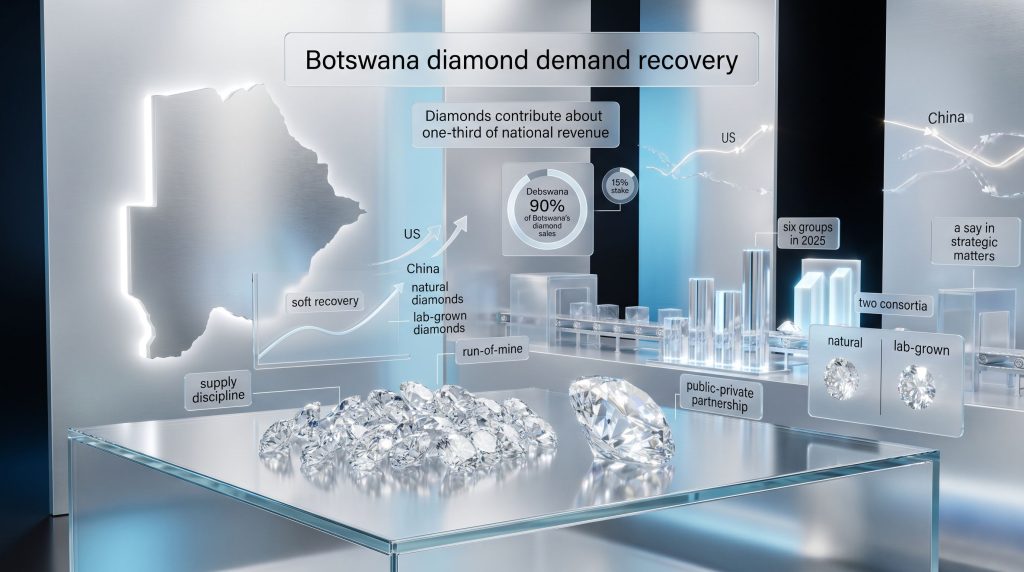
For Botswana, this matters far beyond mining headlines. The country is seeing a soft recovery in demand from major consumer markets, notably the US and China, according to reporting published on 23 June 2026. However, policymakers are still signalling caution, not celebration.
The reason is simple: when diamonds typically generate about one-third of national revenue, even a modest change in demand can reverberate through fiscal planning, export receipts, employment, and foreign exchange stability. In addition, broader shifts in the commodity investment outlook remind investors that fragile rebounds often need confirmation across several indicators.
That is why the current Botswana diamond demand recovery should be read through a policy lens as much as a market lens. The key issue is not whether demand has improved at the margin. It is whether that improvement is strong enough to support higher production, healthier pricing, and more predictable public finances without reigniting oversupply risks.
The current phase looks more like cautious stabilisation than a full rebound. Demand is improving, but the market remains vulnerable to weak consumer sentiment, synthetic competition, and pricing pressure.
## Why Botswana diamond demand recovery matters beyond the gems market
Botswana’s diamond sector has an outsized macroeconomic role. In many mining jurisdictions, one commodity may be important. In Botswana, diamonds are deeply embedded in the national economic structure.
### How a one-commodity revenue profile raises the stakes
When a sector contributes roughly one-third of state revenue, the diamond cycle affects far more than mine output. It shapes:
- Budget assumptions for government spending
- Foreign exchange inflows from exports
- Employment and contractor activity linked to mining operations
- Investor confidence in macro stability
- Sovereign bargaining power in negotiations across the value chain
A soft improvement in rough diamond demand can therefore influence treasury planning even before it becomes visible in headline GDP data. Consequently, partial recoveries matter because they slightly reduce stress, not because they fully restore prior conditions.
### Why diamond weakness becomes a policy issue
If global diamond demand weakens, the problem is not limited to lower sales. It can also compress export earnings, reduce government revenue, and weaken room for fiscal flexibility. That turns what might appear to be a commercial issue into a national economic one.
Botswana’s response shows this clearly: officials have paired cautious optimism on demand with continued emphasis on supply discipline. Recent commentary on a soft recovery in diamond demand reinforces that official tone.
## What soft recovery means in the 2026 diamond market
A practical definition helps. In the current context, a soft recovery means demand is improving gradually, but not strongly enough to signal a full market rebound.
### How to distinguish recovery stages
| Market stage | What it looks like | What it does not guarantee |
|---|---|---|
| Stabilisation | Sales stop worsening, buyer sentiment improves | Strong pricing power |
| Inventory normalisation | Excess stock begins clearing | Sustained end-market demand |
| Soft recovery | Some consumer markets improve | Broad-based industry rebound |
| Full-cycle recovery | Stronger volumes, firmer prices, wider confidence | Immunity from structural threats |
This distinction matters because Botswana diamond demand recovery is not yet the same thing as a restored bull market for natural diamonds.
### Why the US and China matter most
The US and China remain the most important demand signals cited in current reporting. These markets influence rough diamond offtake through downstream jewellery demand, retailer ordering patterns, and luxury purchasing confidence.
In practical terms, analysts tracking Botswana should watch:
- US bridal and jewellery demand
- China luxury consumption recovery
- Retailer restocking behaviour
- Polished diamond pricing trends
A soft pickup in these markets can improve rough demand, but only if cutters, polishers, wholesalers, and retailers believe the demand is durable enough to rebuild inventories.
### Why demand improvement does not automatically lift mine output
In fragile markets, producers often resist the temptation to raise output too early. That is the logic behind Botswana’s continued emphasis on supply restraint. Increasing rough supply into a still-fragile demand environment can pressure prices and slow the broader healing process across the diamond pipeline.
Furthermore, the relationship between pricing and producer discipline reflects the wider commodity price impact seen across mining markets.
## How supply discipline is shaping the market response
### What supply discipline means in plain English
Supply discipline refers to deliberate restraint in production or sales volumes to avoid flooding the market. In natural diamonds, this can help support price realisation when downstream demand is uneven.
This is especially relevant now because the market is still working through the aftereffects of a prolonged downturn tied to:
- Economic uncertainty
- Weaker discretionary spending
- Competition from lab-grown diamonds
### From inventory overhang to run-of-mine management
Recent official commentary suggests Botswana has largely pushed through earlier inventory pressure and is now focusing more directly on run-of-mine management. For non-specialist readers, run-of-mine refers to rough output as it comes from the mine before extensive sorting, valuation, or downstream processing.
That shift is meaningful. It suggests the policy conversation is moving from clearing old stock towards controlling fresh supply at the source.
### Why mine slowdowns can be strategic
Last year, Debswana Diamond Company temporarily paused production at some mines. That move was not merely an operational inconvenience. It can also be interpreted as a value-protection measure in a weak pricing environment.
When prices are under strain, production curtailment can serve several purposes:
- Preserve long-term resource value
- Avoid adding new supply into a weak market
- Support broader pricing discipline
- Reduce the risk of a deeper inventory overhang
Early demand improvement is not enough on its own. A healthier diamond market generally requires better pricing, lower inventories, and stronger retailer confidence at the same time.
## Structural threats still cloud Botswana diamond demand recovery
### Lab-grown diamonds are changing the competitive map
One reason the rebound remains fragile is that natural diamonds are no longer competing only with cyclical weakness. They are also facing a structural challenger in lab-grown diamonds.
| Factor | Natural diamonds | Lab-grown diamonds |
|---|---|---|
| Supply profile | Geologically constrained | Industrially scalable |
| Price positioning | Typically higher | Typically lower |
| Consumer narrative | Scarcity, origin, heritage | Affordability, innovation |
| Branding need | Increasingly important | Also important, but often price-led |
| Policy relevance for producer states | High, due to export and revenue exposure | Competitive pressure on natural producers |
Lab-grown stones have gained traction particularly where affordability matters most. That creates substitution pressure in parts of the bridal and fashion jewellery market. For producer countries such as Botswana, the issue is not simply lost market share.
It is also potential pressure on national revenues tied to natural diamond pricing. For broader context, diamond economics show how structural transformation is reshaping the sector well beyond temporary demand cycles.
### Why macro uncertainty still matters
Luxury purchases are highly sensitive to household confidence. If inflation, interest rates, or broader economic uncertainty weigh on consumers, diamond demand can remain patchy even if markets look better than they did a year earlier.
That helps explain why policymakers may welcome signs of recovery while still avoiding aggressive production increases. In addition, concern about global recession risk continues to influence sentiment around discretionary spending.
### Why category marketing matters more now
Current reporting links part of the recovery to a global marketing campaign for natural diamonds. That matters because category marketing has become a defensive tool as well as a promotional one.
In a market where synthetics offer lower price points and greater scalability, natural diamonds need stronger differentiation around rarity, provenance, and emotional value.
## Botswana’s diamond exposure is highly concentrated
### What Debswana’s 90 percent share means
Debswana accounts for 90% of Botswana’s diamond sales, making the country’s diamond ecosystem unusually concentrated.
That concentration creates clear risks:
- Revenue concentration in one dominant platform
- Operational exposure if major mines slow or pause
- Employment sensitivity around mine and contractor activity
- Policy dependence on a narrow set of strategic decisions
### Why concentration can also improve coordination
There is, however, a counterpoint. A concentrated sector can make supply discipline easier to execute during downturns. In fragmented commodity systems with many small players, coordinated restraint is difficult.
Botswana’s more centralised structure may improve the state’s ability to align production strategy with market conditions.
## Why the De Beers sale matters for Botswana diamond demand recovery
Ownership changes can reshape more than the shareholder register. They can influence branding, sales philosophy, capital allocation, and the willingness to prioritise market discipline over short-term volume.
### Botswana already has a strategic foothold
Botswana already holds a 15% stake in De Beers. That existing position gives it standing in discussions over the future structure of one of the most influential names in natural diamonds.
Late-stage negotiations were reported as ongoing in June 2026, with indications that a transaction could emerge within weeks. Earlier buyer interest reportedly narrowed from six groups in 2025 to two consortia still in contention.
### Why producing states may want influence, not only returns
Current signals from regional policymakers suggest some producing countries are not looking merely for passive financial exposure. They appear to want influence over strategic matters, including decisions that affect supply management, branding, and long-term sector positioning.
That distinction is important:
- Passive stake means economic exposure without much operational say
- Strategic stake means governance influence over major decisions
A future public-private partnership structure has been flagged as a possible ownership model. If that happens, the sector could move towards a hybrid governance framework balancing commercial objectives with producer-state priorities.
## Signals to watch if you want to judge whether the recovery is real
### Demand-side indicators
| Indicator | Why it matters | Bullish signal | Cautious signal |
|---|---|---|---|
| US jewellery demand | Core end-market support | Sustained sales growth | Short seasonal spikes only |
| China luxury spending | Key driver of global sentiment | Broader consumer recovery | Weak discretionary spending |
| Retailer restocking | Confidence in future sales | Inventory rebuild | Hand-to-mouth buying |
| Polished diamond prices | Downstream pricing health | Stable to rising prices | Continued softness |
### Supply-side indicators
- Rough diamond sales volumes
- Mine restart timing after earlier production curtailments
- Inventory drawdown rates
- Degree of ongoing supply discipline
### Policy and corporate indicators
- Progress on the De Beers transaction
- Government messaging on output restraint
- Ongoing support for natural diamond marketing
- Any shifts in beneficiation or export strategy
Beneficiation deserves special attention. In African mining policy, the term generally refers to capturing more local value through sorting, cutting, polishing, jewellery manufacturing, or other downstream activity rather than exporting raw material only.
Developments among commodity trading giants may also matter, especially if asset strategies and sales channels shift around major resource portfolios.
## How policymakers, businesses, and investors should interpret Botswana’s position
### For policymakers
Botswana’s stance suggests a prudent approach:
- Preserve fiscal flexibility while recovery remains incomplete
- Avoid building budgets around an early-cycle rebound
- Continue evaluating diversification options outside diamonds
- Support value-add strategies where commercially viable
### For mining and diamond industry participants
The most realistic base case is an uneven recovery rather than a straight-line rebound. Operators, traders, and manufacturers may need to balance:
- Output management
- Inventory control
- Pricing discipline
- Marketing support for natural diamonds
### For investors and market watchers
This is also a case study in market psychology. Commodity investors often overreact to the first signs of improvement after a downturn. In diamonds, that can be particularly misleading because headline demand improvement may coexist with weak pricing power and structural competitive pressure from synthetics.
Moreover, the interaction between luxury demand and trade tensions and safe havens can influence global capital flows and consumer confidence in unexpected ways.
Speculative upside exists if US and China demand strengthens more durably, ownership uncertainty around De Beers clears, and natural diamond marketing gains traction. But downside risk remains if consumers trade down, lab-grown penetration rises further, or producers loosen supply too early.
## Is Botswana diamond demand recovery enough to offset lab-grown competition
Not yet. The current Botswana diamond demand recovery may help stabilise the sector, but it does not eliminate the longer-term challenge from lab-grown stones. Cyclical improvement and structural disruption can happen simultaneously.
For a stronger recovery to become more convincing, the market would likely need several conditions to improve together:
- More durable US demand
- A broader recovery in China luxury spending
- Healthier polished and rough pricing
- Lower inventories across the pipeline
- Clearer post-transaction strategy at De Beers
The clearest takeaway in 2026 is that Botswana appears to be moving from stress management towards cautious stabilisation. That is progress. However, it is still a policy-sensitive, supply-managed, and structurally challenged market rather than a fully restored diamond boom.
Ready To Spot The Next Major Discovery?
Powered by Discovery Alert’s proprietary Discovery IQ model, Discovery Alert delivers real-time ASX mineral discovery alerts that help investors act quickly when market-moving announcements emerge. To see how major discoveries have historically driven exceptional returns, explore Discovery Alert’s discoveries page and start a 14-day free trial today.