June 23, 2026
## Vedanta CopperTech Metals US IPO: Why This Copper Listing Matters Beyond the First Day of Trading
Capital markets rarely price mining stories on headline scale alone. What tends to matter more is whether investors believe a complex asset can convert geology into reliable cash flow without being derailed by politics, funding strain, or operational setbacks. That is why the Vedanta CopperTech Metals US IPO matters. It sits at the crossroads of copper demand optimism, African mine expansion risk, and a reopening US equity issuance market that appears more willing to fund long-duration industrial themes.
Rather than viewing this transaction as a simple new listing, investors should treat it as a live test of how the market values a cross-border critical-minerals platform with a complicated operating history. CopperTech is US-domiciled, but its core operating asset is Konkola Copper Mines in Zambia’s Copperbelt Province.
That alone creates a layered valuation debate involving jurisdiction, governance, future capital needs, and commodity-cycle timing. For readers assessing the story, the central takeaway is straightforward: this is a potentially significant copper growth vehicle, but it is also a financing and execution story with little room for operational disappointment.
## What the Vedanta CopperTech Metals US IPO Signals About the 2026 Mining Capital Market
The deal reflects a broader improvement in equity issuance conditions in 2026. New listings have accelerated after a softer period earlier in the year, helped by firmer stock markets and stronger investor appetite for fresh paper. Reuters noted that other names entering the US IPO window included Lime, Sinda, ITG, and Bending Spoons.
However, mining IPOs are judged differently from software, consumer, or platform businesses. Investors tend to focus less on narrative expansion and more on four harder questions:
- Can the asset ramp on time?
- Will capital costs stay under control?
- Is the jurisdiction stable enough for long-dated investment?
- Can management fund the buildout without excessive dilution?
In that sense, the offering is more than a fundraising event. It is a credibility test for a large copper-and-cobalt asset that has already lived through a severe ownership disruption. According to Reuters coverage of the filing, the proposed US listing underlines renewed investor willingness to back large-scale resource platforms.
### CopperTech IPO Snapshot
| Metric | Reported figure | Why it matters to investors |
|---|---|---|
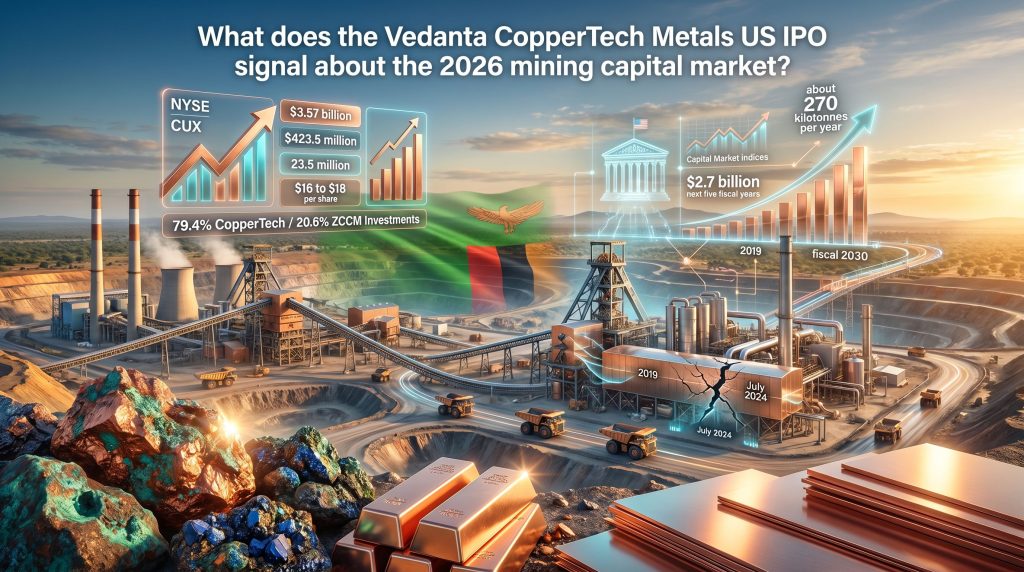
| Target equity valuation | Up to $3.57 billion | Sets expectations for future growth already embedded in pricing |
| Capital sought | Up to $423.5 million | Indicates near-term funding capacity but not full project financing |
| Shares offered | 23.5 million | Helps frame float size and market liquidity |
| Indicative price range | $16 to $18 | Signals valuation band and demand testing |
| Listing venue | NYSE | Broadens investor reach and reporting expectations |
| Proposed ticker | CUX | Market identifier for the new listing |
| Core asset | Konkola Copper Mines | The operational backbone of the investment case |
| Asset location | Copperbelt Province, Zambia | Introduces jurisdictional opportunity and risk |
| Underwriters | Citigroup and Cantor | Adds institutional execution capacity for the deal |
## How Investors Should Interpret a $3.57 Billion Valuation
A $3.57 billion target valuation can look either reasonable or demanding depending on the lens used.
If investors underwrite strong long-term copper prices, believe the expansion can be delivered, and assign meaningful value to future cobalt exposure, the valuation can be defended. In contrast, if they apply a higher discount rate to reflect Zambia-related political memory, operating complexity, and additional funding needs, the same valuation can appear ambitious.
### A Balanced View on Whether the Valuation Is High
The valuation looks reasonable in a bullish copper framework where supply remains tight and expansion milestones are met. For instance, broader expectations around a copper supply crunch support the view that scarce future tonnes could justify stronger market multiples.
It looks more demanding in a cautious framework where investors require a heavy discount for jurisdiction, financing, and restart risk. Furthermore, much depends on how the market interprets key copper price drivers over the next several years.
### Bull vs Bear Interpretation Framework
| Valuation factor | Bull case interpretation | Bear case interpretation |
|---|---|---|
| Copper price leverage | Strong upside if copper scarcity persists | Highly exposed to cyclical downturns |
| Expansion credibility | Large asset base can support a major production step-up | Delivery risk may be underappreciated |
| Sovereign risk | Prior issues are now in the rear-view mirror | Historical disputes still raise required returns |
| State-partner alignment | Local alignment may support long-term continuity | Negotiation complexity may return in future |
| Funding runway | IPO can unlock broader financing options | Raise is too small relative to total spend |
A critical nuance is that miners are often valued on future earning power, but only when the market believes that pathway is financeable. In this case, investors are being asked to fund part of a much bigger buildout, not the whole thing.
## Why Konkola Is Central to the CopperTech Investment Case
Konkola is not a side asset in this story. It is the operational core. Located in Zambia’s Copperbelt, one of the world’s best-known producing regions, the mine complex gives investors exposure to copper and cobalt, two commodities tightly linked to electrification, industrial wiring demand, grid upgrades, and broader energy system buildout.
Vedanta has invested more than $3 billion in Konkola and had held majority ownership since 2004 before losing control during the 2019 seizure. Control was restored in July 2024, a fact that improves operational clarity but does not erase market memory. In addition, the strategic importance of Zambia copper production adds another layer to the asset’s relevance.
### Ownership Structure Investors Need to Understand
The mine ownership split is:
- 79.4% CopperTech
- 20.6% ZCCM Investments
This state-partner dynamic can cut both ways. A local partner can improve alignment with domestic stakeholders, but it can also add complexity around future decisions, capital allocation in copper, and negotiation over strategic priorities.
“Attractive ore bodies can still trade at a discount when investors remain uncertain about governance durability, contractual stability, or long-term stakeholder alignment.”
### Why the 2019 to 2024 Control Episode Still Matters
Mining investors usually have long institutional memories. Even after formal control is restored, markets often continue to price in the possibility of future disruption through higher discount rates. That can affect:
- Equity valuation multiples
- Debt pricing and lender appetite
- Aftermarket share performance
- Sensitivity to any adverse operational update
This is especially relevant because the company combines an American listing structure with a Zambian operating base, creating a dual test of governance standards and local operating resilience.
## Can a $423.5 Million IPO Support a $2.7 Billion Expansion Plan?
Not on its own.
The proposed raise of up to $423.5 million is materially smaller than the planned $2.7 billion expansion spend over the next five fiscal years. Consequently, the offering should be viewed as an anchor funding event, not a complete financing solution.
### Funding Gap Framework
| Capital source | Potential role | Investor implication | Key risk |
|---|---|---|---|
| IPO proceeds | Seed capital for expansion and balance-sheet support | Positive first step | Insufficient as stand-alone funding |
| Operating cash flow | Internal funding from mine performance | Reduces dilution if achieved | Depends on production and copper prices |
| Project debt | Can scale buildout without heavy equity issuance | Boosts capital efficiency | Lender terms may reflect jurisdiction risk |
| Asset-level partnerships | Could share development burden | Brings flexibility | May reduce upside or strategic control |
| Refinancing or follow-on equity | Fills remaining capital gap | Keeps project moving | Potential shareholder dilution |
### A Practical Way to Analyse Mining Funding Adequacy
Investors can use a simple framework:
- Compare the equity raise to the total capex plan
- Estimate annual capital needs across the project timeline
- Stress-test the base case under different copper prices
- Assess debt-market access and likely borrowing costs
- Factor in sovereign, infrastructure, and commissioning contingencies
On simple maths alone, $2.7 billion over five years implies an average spend of about $540 million per year. However, real-world mine expansions are rarely linear.
## What Production Growth Is Being Targeted and Why Timing Matters
CopperTech plans to lift output at Konkola to an average of roughly 270 kilotonnes per year from fiscal 2030. That target is important because copper markets are increasingly shaped by concern over future supply rather than current inventories alone.
Investors, however, should focus on when production arrives, not just on the headline tonnage. In mining, timing slippage can be just as damaging as reserve disappointment.
### Why Ramp-Up Risk Deserves More Attention Than the Headline Target
Several factors can affect whether a mine expansion meets its production plan:
- Grade variability across mining zones
- Plant reliability during commissioning
- Workforce readiness for sustained higher throughput
- Underground development progress and mine sequencing
- Power, water, and processing constraints
A recurring mistake among retail investors is treating nameplate output as if it were guaranteed. In practice, mineshaft condition, ore handling efficiency, metallurgical recovery, and maintenance performance often make the difference between an attractive feasibility case and a disappointing commercial reality.
## Why Copper IPOs Are Attracting Attention in 2026
Copper has regained capital-markets relevance because it sits inside several overlapping structural themes:
- AI data centre buildout
- Grid modernisation
- Electrification of transport and industry
- Broader energy transition infrastructure
The International Energy Agency has repeatedly highlighted that electrification pathways are far more metals-intensive than traditional energy systems. Therefore, long-range demand expectations remain constructive. For investors building exposure, broader copper investment strategies increasingly hinge on distinguishing genuine production growth from simple promotional narratives.
Investors are also becoming more selective. The market is increasingly distinguishing between:
- Current producers with visible cash flow
- Developers that still require permitting and construction
- Expansion stories with existing assets but large reinvestment needs
CopperTech falls into the third category, which attracts investors willing to tolerate more execution complexity in exchange for scale and optionality.
## The Biggest Risks in the Vedanta CopperTech Metals US IPO
No serious analysis of the Vedanta CopperTech Metals US IPO is complete without a disciplined risk review.
### Risk Matrix
| Risk category | Why it matters | Probability | Potential severity | Monitoring indicator |
|---|---|---|---|---|
| Political and jurisdictional | Zambia exposure and legacy dispute memory | Medium | High | Fiscal terms, legal developments, stakeholder disputes |
| Operational | Expansion, mine reliability, processing performance | Medium to high | High | Production updates, capex revisions, commissioning milestones |
| Market | Copper and cobalt price volatility | High | Medium to high | LME prices, treatment charges, demand signals |
| Governance | Minority shareholder protections and sponsor discipline | Medium | High | Prospectus disclosures, related-party terms, board structure |
| Financing | Need for additional capital beyond IPO | High | High | Debt arrangements, follow-on equity needs, cash burn trends |
“In mining IPOs, headline deposit appeal is often less important than the gap between technical ambition and financeable execution.”
A further point often missed by non-specialist investors is that copper mine economics can change quickly when three variables move together: copper price, unit operating cost, and capital inflation.
## Could the Vedanta CopperTech Metals US IPO Reshape US Investor Access to African Copper Growth?
A successful NYSE listing could expand the toolkit available to US investors seeking exposure to large-scale African copper assets without going through offshore exchanges or less liquid structures. Moreover, Vedanta’s exchange filing gives investors a direct route to review official disclosures behind the transaction.
Success after listing would probably look like this:
- Stable trading performance after the IPO
- Visible and disciplined deployment of proceeds
- Regular milestone updates tied to the expansion plan
- Improving market confidence in the path to fiscal 2030 output
Failure would likely look different:
- Weak aftermarket support
- Cost inflation or timeline slippage
- Fresh governance concerns
- Earlier-than-expected need for dilutive capital raising
## FAQ: Vedanta CopperTech Metals US IPO
### What is the Vedanta CopperTech Metals US IPO?
It is a proposed US public offering for a copper- and cobalt-focused company whose principal operating asset is Konkola Copper Mines in Zambia.
### How much is CopperTech trying to raise?
The company is seeking up to $423.5 million through the sale of 23.5 million shares priced at $16 to $18 each.
### What valuation is being targeted?
The deal targets an equity valuation of up to about $3.57 billion.
### Where will the shares list?
The shares are proposed to list on the New York Stock Exchange.
### What is the main risk?
The biggest overall risk is execution, spanning funding, operations, jurisdiction, and governance.
## Final Take: Financing Milestone or High-Stakes Execution Story?
The Vedanta CopperTech Metals US IPO is both. It represents a meaningful capital-markets event for copper supply growth, but it is also a test of whether public investors are ready to support a complex, capital-intensive, jurisdictionally sensitive mining expansion narrative at scale.
The long-term copper backdrop is supportive. Demand linked to electrification, AI infrastructure, and grid investment remains a real strategic theme. Yet that macro story does not eliminate mine-level realities. This listing still depends on disciplined capital allocation, stable governance, and a credible path from funding to output.
Key investor takeaways are clear:
- The valuation offers leverage to the copper scarcity narrative
- The IPO raise is moderate relative to the full capex plan
- Asset quality cannot be separated from governance history
- Post-listing execution will likely matter more than day-one pricing
Investors should remember that this article is informational only and not financial advice. Any assessment of value depends on the final prospectus, disclosed risks, commodity-price assumptions, and each investor’s tolerance for cyclicality and jurisdictional exposure.
Want Earlier Insight Into Major Copper Discoveries?
Discovery Alert’s proprietary Discovery IQ model delivers real-time ASX mineral discovery alerts that help investors spot actionable copper opportunities before the broader market, with a 14-day free trial available on the Discovery Alert home page. To see how major discoveries have historically driven exceptional returns, explore the Discovery Alert discoveries page.