June 23, 2026
China green ship fuel deal: why this matters far beyond one policy dispute
Shipping decarbonisation is no longer a niche sustainability discussion. It is becoming a test of whether heavy industry can move from pilot projects to trade-scale clean energy systems without collapsing under higher costs, infrastructure gaps, and uneven regulation. That is why the China green ship fuel deal has become such an important market signal.
That idea is not one standalone agreement or a single commercial contract. Instead, it reflects the broader alignment of maritime rules, fuel production, port readiness, ship technology, and long-term buyer commitments needed to make low-emission marine fuels financially viable. In addition, this sits alongside wider shifts in energy transition in mining and heavy industry.
For investors, commodity producers, port operators, and shipping companies, the key question is simple: can industrial-scale supply be matched with dependable demand?
The central challenge is not whether clean marine fuels can be produced. It is whether enough ships, ports, and cargo owners will use them at prices that justify large capital investment.
What is the China green ship fuel deal?
The term China green ship fuel deal refers to the policy, industrial, and commercial framework through which China could help accelerate adoption of low- or zero-emission fuels in international shipping.
Three moving parts sit at the core of the idea:
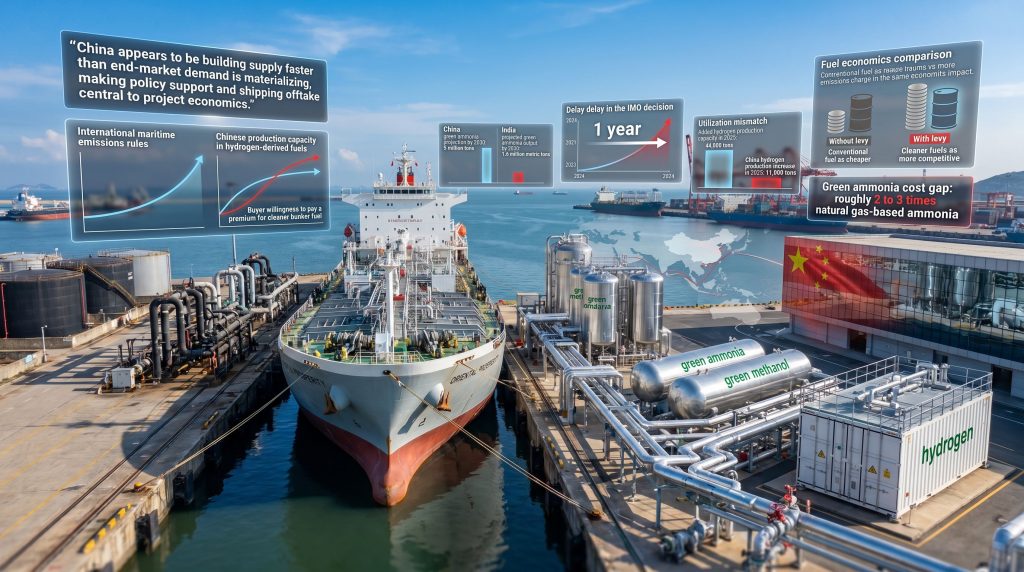
- International maritime emissions rules that change fuel economics
- Chinese production capacity in hydrogen-derived fuels such as ammonia and methanol
- Buyer willingness to pay a premium for cleaner bunker fuel through long-term offtake contracts
In practical terms, the market only scales if those three parts develop together. Announced production capacity alone does not create a real fuel market.
Why shipping fuel has become a strategic decarbonisation battleground
Shipping is widely seen as one of the hardest sectors to decarbonise because batteries are poorly suited to long ocean voyages and efficiency gains alone cannot deliver deep emissions cuts. Fuel switching is therefore central to the sector’s long-term pathway.
Furthermore, this pushes marine fuels into a bigger strategic debate involving:
- Industrial competitiveness
- Energy security
- Export trade decarbonisation
- Port and shipbuilding investment
- Control over future fuel supply chains
The shipping sector matters because it sits underneath global commodity flows, including iron ore, grains, coal, containers, and refined products. Consequently, any meaningful change in bunker fuel economics can affect freight pricing, vessel ordering, port investment, and the carbon footprint of traded goods.
Marine fuel comparison
| Fuel | Emissions profile | Infrastructure readiness | Relative cost | Safety complexity | Scalability outlook |
|---|---|---|---|---|---|
| Conventional bunker fuel | High lifecycle and combustion emissions | Very high | Lowest | Established | Already dominant |
| LNG | Lower CO2 than bunker fuel but methane slip remains a concern | Moderate to high | Moderate | Moderate | Transitional at best |
| Green methanol | Lower emissions if produced from low-carbon pathways | Moderate | High | Easier than ammonia | Potentially faster early adoption |
| Green ammonia | No carbon at point of use | Low to moderate | High | High due to toxicity | Strong long-haul potential |
The table shows why green shipping is not a one-fuel story. Different routes, vessel types, and cargo owners may back different pathways.
Key figures shaping the debate
Several numbers define the current state of the market:
- The International Maritime Organization decision on a major emissions charge was postponed by one year in October 2025
- China had supported a draft proposal in April 2025
- BloombergNEF projects China could reach 5 million tons of green ammonia production by 2030
- The comparable projection for India is 1.6 million metric tons by 2030
- Green ammonia remains roughly 2 to 3 times more expensive than ammonia made from natural gas
- In 2025, China added 44,000 tons of hydrogen production capacity, but actual output rose by only 11,000 tons
That last point may be the most important commercial signal of all.
China appears to be growing supply capacity faster than end-market demand is emerging, which puts the spotlight on utilisation rates, offtake certainty, and policy timing.
How a policy-backed shipping fuel market would work
A maritime emissions charge is often discussed because it can change the relative economics of fuel choices.
Step-by-step mechanism
- Ships using carbon-intensive fuels face higher operating costs
- Cleaner fuels become more competitive on a relative basis
- Fuel buyers gain a stronger reason to sign long-term contracts
- Developers can finance larger projects with lower demand risk
- Ports and bunkering networks gain confidence to invest
Fuel economics without and with a levy
| Market setting | Fossil bunker fuel | Green methanol | Green ammonia |
|---|---|---|---|
| Without emissions levy | Clear cost advantage | Premium hard to justify | Premium hard to justify |
| With emissions levy | Cost rises | Gap narrows | Gap narrows |
A levy does not make green fuel instantly cheap. However, it does reduce the penalty for choosing it.
Why demand certainty matters more than production headlines
Developers often announce nameplate capacity, but lenders care more about how often a plant runs and whether its output has a committed buyer.
The 2025 China hydrogen figures are a useful example. Adding 44,000 tons of capacity while increasing output by just 11,000 tons suggests underutilisation rather than balanced growth.
In project finance terms, that can mean:
- Low plant load factors
- Reduced returns on invested capital
- Slower downstream infrastructure buildout
- More difficulty securing debt or offtake agreements
This is why utilisation is often a better signal than capacity announcements.
Where hydrogen, ammonia, and methanol fit in China’s strategy
Green hydrogen is the upstream building block
Green hydrogen is produced by splitting water using electricity from low-carbon sources. In marine decarbonisation, hydrogen is often less important as a direct ship fuel than as a feedstock for other fuels.
The main downstream pathways are:
- Green ammonia, made from hydrogen and nitrogen
- Green methanol, made from hydrogen combined with a carbon source
Hydrogen production leadership does not automatically create marine bunkering leadership. Downstream conversion, storage, port handling, and vessel demand must also scale.
Why green ammonia is attracting attention
Green ammonia is closely watched because it offers several strategic advantages:
- No carbon at point of use
- Potential suitability for long-haul voyages
- Strong relevance for bulk shipping lanes
But commercialisation remains difficult because of:
- Toxicity and handling risks
- Engine and vessel readiness constraints
- Immature bunkering standards
- A significant price premium
Quick take on green ammonia
- Best fit: long-distance shipping decarbonisation scenarios
- Main barrier: cost and infrastructure maturity
- Likely catalyst: regulation plus long-term offtake certainty
Could green methanol scale faster?
Green methanol may gain earlier traction because it is easier to handle than ammonia and vessel technology is further advanced in some segments. Yet it has its own limits, especially around lifecycle emissions and traceability.
| Factor | Green ammonia | Green methanol |
|---|---|---|
| Storage and handling | More complex | Easier relative handling |
| Toxicity | High | Lower than ammonia, but still hazardous |
| Vessel readiness | Emerging | More advanced in some ship classes |
| Technology maturity | Earlier stage | Stronger near-term commercial footing |
| Emissions profile | Strong at point of use | Depends heavily on production route |
Moreover, upstream power costs will matter. Large-scale marine fuels depend on renewable energy solutions and credible pathways for industrial decarbonisation.
Why international regulation has become the main bottleneck
What happened at the IMO?
A major decision on maritime emissions pricing was delayed by one year at the International Maritime Organization in October 2025. China had supported a draft proposal in April 2025, but the delay mattered because it weakened the timing signal the market wanted.
This was more than an administrative pause. For capital markets, it signalled that the timeline for enforced demand remains uncertain. For broader context on China’s ambitions, reports on a global emissions deal and Shanghai’s green shipping hub status suggest the strategic direction is clear even if implementation still lags.
Likely consequences include:
- Slower final investment decisions
- More cautious fuel offtake negotiations
- Extended competitiveness for fossil marine fuels
- Lower confidence in near-term clean fuel demand
Why China’s stance matters disproportionately
China is not just another market participant in shipping decarbonisation. Its role matters because of:
- Large manufacturing capacity
- Massive trade volumes
- A powerful shipbuilding ecosystem
- Growing clean hydrogen and ammonia ambitions
- Influence across Asian freight corridors
That combination gives China the potential to shape both supply and first-use adoption. In addition, it connects with wider debates around critical minerals and energy security.
Is China building too much supply before enough demand exists?
The strongest evidence of a mismatch is the gap between 44,000 tons of added hydrogen capacity and only 11,000 tons of output growth in 2025. That may indicate:
- Projects operating below nameplate capacity
- Demand lagging investment
- Weak or delayed offtake contracting
- Infrastructure failing to keep pace
What the 5 million ton green ammonia projection really means
A projection of 5 million tons of green ammonia by 2030 signals industrial ambition, not guaranteed end-use consumption. Compared with India’s projected 1.6 million metric tons, China clearly has scale potential. But the real question is where that ammonia goes.
The main possible destinations are:
- Export markets
- Domestic port bunkering
- Industrial demand outside shipping
Scenario matrix
| Scenario | IMO progress | Fuel price premium | Plant utilisation | Port adoption | Likely winners |
|---|---|---|---|---|---|
| Policy acceleration | Stronger global rules | Narrows faster | Improves | Expands across major hubs | Integrated producers, ports, shipowners with early positioning |
| Gradual commercialisation | Partial progress | Stays elevated | Mixed | Selective corridor rollout | Flexible fuel suppliers and dual-fuel vessel operators |
| Oversupply and delayed demand | Weak progress | Remains high | Poor | Slow and fragmented | Lowest-cost producers with patient balance sheets |
This framework matters because market outcomes will likely be corridor-specific rather than globally uniform.
Which industries could benefit most
Ports, bunkering, and marine infrastructure
If a China green ship fuel deal gains traction, marine infrastructure could benefit through:
- Fuel storage terminal development
- Safety and leak-management systems
- Fuel handling retrofits
- Certification and emissions monitoring services
Useful credibility markers include port authority plans, classification society rules, and shipowner pilot programmes.
Renewable power and electrolysers
Marine fuel economics depend heavily on upstream electricity costs. Large-scale green hydrogen and ammonia projects need:
- Low-cost renewable power
- Strong capacity factors
- Adequate transmission access
- Reliable water supply
- High electrolyser utilisation
Without those inputs, low headline production costs can be difficult to sustain commercially. As a result, the underlying decarbonisation economics become just as important as the fuel technology itself.
Bulk shipping and commodity exporters
Freight decarbonisation could eventually affect commodity sellers into Asia, especially along iron ore and other heavy bulk routes. For large listed resource exporters, cleaner freight may become part of customer negotiations, reported emissions profiles, or premium market access over time. That pressure may also influence sectors exposed to green steel pricing.
The biggest commercial barriers
Cost is still the core obstacle
The most direct economic hurdle remains price. Current estimates indicate green ammonia is around 2 to 3 times more expensive than natural gas-based ammonia.
That affects:
- Charter economics
- Fuel procurement budgets
- Margin pass-through capacity
- Cargo owner willingness to pay
Infrastructure lock-in and vessel readiness
Adoption also faces physical bottlenecks:
- Limited bunkering networks
- Engine retrofits or specialised newbuilds
- Crew training requirements
- Insurance and safety approval complexity
- Port development delays
Policy uncertainty keeps capital cautious
In emerging fuel markets, cheap production is not enough. Developers need confidence that buyers will take material volumes for long enough to justify the asset base.
That is why one delayed regulatory decision can ripple through financing timelines, contracting behaviour, and infrastructure planning.
How to evaluate green shipping fuel claims
A practical checklist
When assessing momentum in the China green ship fuel deal, ask:
- Is there a binding offtake agreement?
- Is port infrastructure actually committed?
- Is vessel technology commercially deployed, not just tested?
- Is policy enforceable or still aspirational?
- Are utilisation rates improving?
Common misunderstandings to avoid
- Capacity additions equal demand is false
- Hydrogen leadership automatically means shipping leadership is incomplete
- One policy vote instantly transforms the market is overstated
- The cheapest producer always scales fastest is not true if infrastructure and regulation lag
FAQ
What is meant by the China green ship fuel deal?
It refers to the policy, industrial, and commercial alignment needed for China to help scale low-emission shipping fuels such as green ammonia and green methanol.
Why is China important to green shipping fuel adoption?
China combines production scale, major trade volumes, shipbuilding strength, and the ability to influence fuel adoption across Asian shipping corridors.
What fuel is China expected to produce most aggressively for shipping?
Green ammonia appears to be the most prominent large-scale pathway, with green hydrogen serving as the upstream input and green methanol as a major competing option.
Why are green shipping fuels not scaling faster?
The main obstacles are high cost premiums, limited infrastructure, uncertain regulation, and weak demand certainty.
How expensive is green ammonia compared with conventional ammonia?
Current reference points suggest green ammonia is roughly 2 to 3 times more expensive than ammonia produced from natural gas.
What data best shows the demand challenge?
One of the clearest indicators is that China added 44,000 tons of hydrogen production capacity in 2025 while actual output increased by only 11,000 tons, suggesting underutilisation and lagging demand.
Want To Spot The Next Major ASX Discovery?
Discovery Alert’s proprietary Discovery IQ model delivers real-time alerts on significant ASX mineral discoveries, helping investors cut through complex market noise and act on actionable opportunities faster. See how historic discoveries have delivered exceptional returns on the Discovery Alert discoveries page or begin a 14-day free trial at the Discovery Alert home page.