July 29, 2026
The Geopolitics Hiding Inside an Oil Contract
Few industries reveal the intersection of commerce and statecraft as clearly as upstream oil development in the Middle East. When a major redevelopment contract is structured to include a Western supermajor, a large American independent, and a Turkish state energy company operating in one of history's most contested oil provinces, the arrangement carries weight far beyond barrels per day. The configuration itself becomes a diplomatic signal, a risk management tool, and a statement about how Iraq intends to manage its most prized upstream assets going forward.
That is precisely the lens through which the expanded Kirkuk consortium deserves to be examined. BP adds TPAO to Kirkuk oil field redevelopment in Iraq, completing a three-way partnership that bundles technical capability, financial scale, and geographic proximity into a single contractual structure targeting one of the Middle East's most significant untapped redevelopment opportunities. Furthermore, the broader geopolitical landscape shaping energy investment decisions in 2025 makes the timing and structure of this arrangement all the more significant.
When big ASX news breaks, our subscribers know first
Understanding Why the Kirkuk Basin Still Matters After a Century of Production
A Field That Has Outlasted Empires
Kirkuk has been producing oil since the late 1920s, placing it among the world's oldest continuously operated petroleum provinces. That longevity is not simply a historical footnote. It means the reservoir systems beneath the Baba and Avanah domes have been subject to decades of variable production practices, ownership changes, periods of conflict-related damage, and prolonged underinvestment that have collectively suppressed output well below the field's technical potential.
The reservoir geology of the Kirkuk field is dominated by fractured carbonate formations, a characteristic that creates both opportunity and complexity. Fractured carbonates can deliver extremely high flow rates from individual wells, but they also present challenges around water breakthrough, pressure maintenance, and production decline management that require sophisticated reservoir engineering to navigate effectively.
Decades of suboptimal water injection practices and infrastructure neglect mean that significant incremental production potential remains locked within reservoirs that have been producing for nearly a century. Unlocking that potential is the core technical mandate of the redevelopment programme.
What 3 Billion BOE Actually Represents
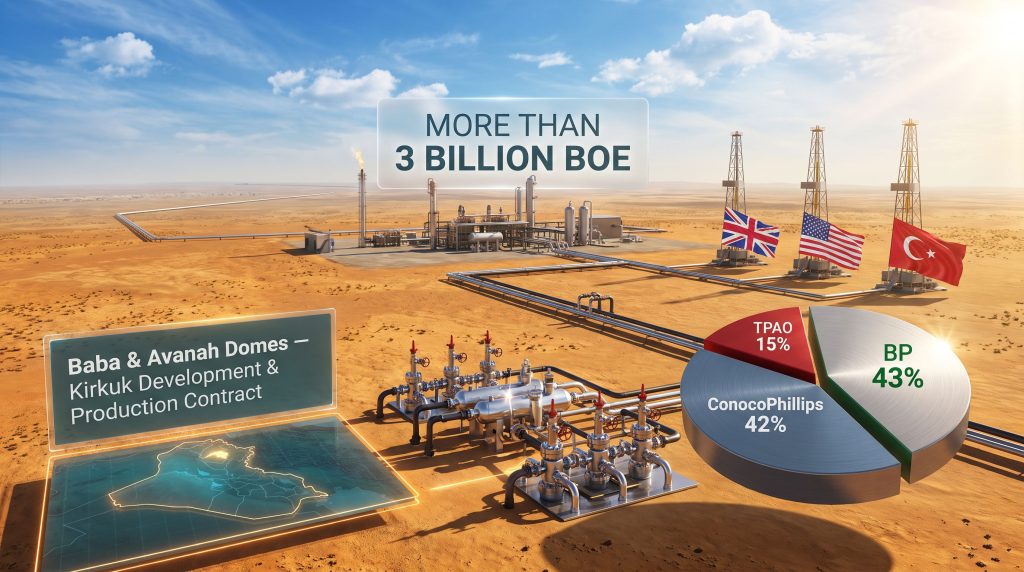
The initial development phase of the Kirkuk Development and Production Contract targets more than 3 billion barrels of oil equivalent (Bboe) in recoverable resources. To contextualise that figure, Iraq's total proven oil reserves are estimated at approximately 145 billion barrels, making it the fifth-largest reserve holder globally according to OPEC data. The Kirkuk basin alone has historically been credited with holding reserves in the range of 8 to 10 billion barrels, though political and technical disputes over reserve certification have made precise figures difficult to establish.
The contract covers five distinct asset areas:
- The Baba dome, the largest and most historically productive structure within the Kirkuk field
- The Avanah dome, an adjacent structure with significant remaining resource potential
- Bai Hassan, a producing field to the northwest of Kirkuk city
- Jambur, located southeast of the main Kirkuk structures
- Khabbaz, an additional federal Iraq field within the contract perimeter
The contract area also carries exploration upside, meaning the 3 Bboe initial phase target represents a conservative floor rather than the ceiling of the opportunity.
How the Three-Party Consortium Was Constructed
Equity Allocation and What It Signals
The ownership structure of BP Energy Company of Kirkuk Limited (BP ECKL) reflects a deliberate balancing act across multiple dimensions of risk. BP and Iraq finalized the contract for Kirkuk redevelopment before ConocoPhillips and TPAO were subsequently brought into the consortium.
| Partner | Stake in BP ECKL | Category |
|---|---|---|
| BP | 43% | Lead technical operator and developer |
| ConocoPhillips | 42% | U.S. major independent, strategic co-investor |
| TPAO | 15% | Turkish state company, newly added partner |
BP's retention of a 43% interest keeps it in the operator seat with sufficient equity to maintain strategic direction over technical decisions. ConocoPhillips at 42% brings a near-equal financial commitment that distributes capital expenditure risk without diluting operational control. TPAO's 15% stake, while smaller, carries outsized strategic significance given Turkey's role as a transit country for northern Iraqi oil exports.
Why TPAO's Involvement Extends Well Beyond Equity
The Kirkuk-Ceyhan Pipeline Dimension
One of the most underappreciated aspects of TPAO's inclusion is its relationship to export infrastructure. The Kirkuk-Ceyhan pipeline, which runs approximately 970 kilometres from northern Iraq to the Turkish Mediterranean port of Ceyhan, has historically been the primary export route for Kirkuk crude. This pipeline has been subject to repeated disruptions over the past decade due to disputes between the Iraqi federal government, the Kurdistan Regional Government (KRG), and Turkish authorities over transit fees, legal disputes, and periodic security incidents.
By embedding a Turkish state energy company directly into the equity structure of the Kirkuk redevelopment, the consortium creates a commercial alignment of interests that extends to the export corridor itself. TPAO has a direct financial incentive to ensure that Kirkuk production can flow efficiently to international markets through Turkish territory. This is not a formalised export guarantee, but the commercial logic is difficult to ignore. In addition, the oil market impacts of such geopolitical alignments are increasingly shaping how major projects are financed and structured globally.
Three Decades of Operational Chemistry
BP and TPAO's working relationship is documented across more than 30 years of joint operations, primarily in the Caspian region. Their collaboration through projects in Azerbaijan and across the broader Caspian basin has created institutional familiarity between the two organisations at the technical, operational, and management levels. A strategic cooperation Memorandum of Understanding signed between the two companies earlier in 2026 provided the formal framework for the Kirkuk partnership.
That pre-existing operational chemistry reduces a risk category that often receives insufficient attention in upstream project analysis: integration risk. Bringing together multiple partners with no prior working relationship introduces coordination costs, decision-making friction, and technical misalignment that can materially affect project timelines and cost outcomes. The BP-TPAO relationship partially mitigates this.
The Remuneration Model: How Partners Get Paid
An Incentive Structure Built for Efficiency
The Kirkuk Development and Production Contract departs meaningfully from the production-sharing agreements (PSAs) that dominated earlier rounds of Iraqi upstream contracting. Partner compensation is linked to three interdependent variables:
- Incremental production volumes achieved above an established baseline
- Prevailing commodity prices at the point of production delivery
- Actual project costs incurred through the development programme
This structure creates a powerful alignment between commercial returns and operational execution. Partners are simultaneously incentivised to maximise production and control costs, because both variables directly affect the remuneration calculation. It also means partners absorb commodity price risk, which distinguishes this model from pure service contract arrangements where fees are often fixed or cost-linked. Consequently, understanding oil price geopolitics becomes essential for any investor seeking to model realistic return scenarios under this framework.
Each consortium member books production and reserves on its own balance sheet in proportion to its equity interest and contractual entitlements. For BP and ConocoPhillips as publicly listed companies, this reserve booking capacity is a material consideration in evaluating the project's financial attractiveness.
| Feature | Kirkuk Development Contract | Traditional PSA |
|---|---|---|
| Remuneration basis | Incremental production plus price and cost variables | Cost recovery plus profit oil split |
| Host country operational role | NOC/NGC retain and eventually lead operations | Typically contractor-operated |
| Reserve booking | Proportional to contract terms | Contractor booking varies by jurisdiction |
| Operatorship transition | Planned transfer to NOC/NGC-led entity | Usually contractor-operated throughout |
Iraq's Sovereign Control Framework and What It Means for Project Execution
The NOC/NGC-Led Operatorship Transition
One of the defining structural features of the Kirkuk contract is the planned transition of operatorship to an unincorporated joint venture led by NOC and NGC personnel, with BP secondees providing technical support during the transition period. This arrangement reflects Iraq's evolving approach to upstream development, which prioritises the transfer of technical capability to national institutions rather than long-term dependence on foreign operator control.
For investors and analysts tracking Iraqi upstream exposure, this operatorship transition represents a genuine execution risk. The handover of complex reservoir management responsibilities, particularly for a technically demanding fractured carbonate system with a century of production history, requires careful sequencing and robust knowledge transfer programmes. The timeline for that transition and the depth of NOC/NGC technical capacity will be critical variables in determining whether the project achieves its production targets.
Kirkuk in the Context of Iraq's Broader Upstream Landscape
Situating the Kirkuk project within Iraq's wider portfolio of international partnerships provides useful scale perspective. ConocoPhillips reached agreement to support the redevelopment of producing oil fields in Iraq, confirming its commitment to the consortium prior to TPAO's formal inclusion.
| Field | Lead Operator | Key Partners | Estimated Resource Scale |
|---|---|---|---|
| Kirkuk (initial phase) | BP | ConocoPhillips, TPAO | 3+ Bboe |
| Rumaila | BP | CNPC | ~17 Bboe proven reserves |
| West Qurna-1 | ExxonMobil | PetroChina | ~8.7 Bboe |
| Majnoon | Basra Oil Company | Previously Shell | ~12.6 Bboe |
Kirkuk's initial phase target positions it as a significant but not the largest active Iraqi upstream project. However, the exploration upside within the contract area means the long-term resource profile could expand materially beyond the initial 3 Bboe figure.
The next major ASX story will hit our subscribers first
Key Risk Dimensions Investors Should Understand
Geopolitical Complexity in a Contested Region
Kirkuk occupies some of the most politically sensitive territory in the Middle East. The city and surrounding oil infrastructure sit in a zone of historical dispute between Iraq's federal government in Baghdad and the Kurdistan Regional Government based in Erbil. The KRG unilaterally controlled Kirkuk's oil fields between 2014 and 2017 before federal forces retook the area. That history introduces a layer of political risk that sits beneath the contract's commercial structure.
Key risk factors include:
- Ongoing federal-regional governance tension over resource control and revenue sharing
- Export route vulnerability through the Kirkuk-Ceyhan pipeline, which has experienced extended shutdowns related to legal disputes and infrastructure damage in recent years
- Regulatory approval timelines for the TPAO stake acquisition, which remain subject to completion in relevant jurisdictions
- Reservoir management complexity arising from the field's age, production history, and fractured carbonate geology
- Workforce and knowledge transfer risks associated with the planned operatorship transition to NOC/NGC
The Exploration Upside: A Factor Often Underweighted
Industry analysts frequently focus on the stated 3 Bboe initial phase target when evaluating the Kirkuk contract, but the inclusion of additional exploration potential within the contract area deserves closer attention. The Kirkuk basin's geological setting, within the Zagros fold belt, is characterised by multiple stacked carbonate reservoir intervals. Some of these intervals remain incompletely appraised despite nearly a century of field activity, primarily because historical production focused on the most accessible intervals rather than conducting comprehensive subsurface evaluation.
The possibility that thorough modern seismic reprocessing and targeted exploration drilling could reveal resource volumes significantly beyond the initial phase estimate is a speculative but technically grounded scenario worth monitoring as the programme advances.
What This Structure Tells Us About the Direction of Middle East Upstream Development
The BP-ConocoPhillips-TPAO consortium at Kirkuk is not an isolated transaction. It reflects several converging trends reshaping how international oil companies engage with resource-rich Middle Eastern states. Furthermore, the Middle East resource strategy being pursued by regional governments increasingly involves embedding foreign partners in ways that serve both commercial and diplomatic objectives simultaneously.
First, resource nationalism is becoming more sophisticated rather than more restrictive. Iraq is not excluding foreign capital; it is structuring partnerships that maximise the transfer of technical capability and operational control to national institutions while still attracting the investment scale and expertise needed to develop complex reservoirs.
Second, geopolitical embeddedness is becoming a feature rather than a bug in upstream project design. The deliberate inclusion of TPAO during a formal Iraqi-Turkish diplomatic visit demonstrates that commercial energy agreements are increasingly structured to carry bilateral political significance, creating a form of mutual dependency that can reduce certain categories of sovereign risk.
Third, incentive-linked remuneration models are displacing older service contract structures as Iraq seeks to ensure that foreign partner financial returns are tightly coupled to actual production performance rather than fee income. In this context, the OPEC market influence over global supply and pricing dynamics adds another layer of complexity to how these remuneration structures perform across different commodity price environments.
For the global energy sector, BP adds TPAO to Kirkuk oil field redevelopment in Iraq as part of one of the most compelling redevelopment opportunities currently active in the Middle East, combining scale, geological upside, diplomatic architecture, and a commercially sophisticated contract structure into a single project framework.
Readers seeking ongoing coverage of Iraqi upstream developments and international oil company activity across the Middle East can access related industry reporting via World Oil at worldoil.com.
This article contains forward-looking assessments and speculative analysis regarding project timelines, resource estimates, and geopolitical dynamics. These represent analytical perspectives only and should not be construed as investment advice. All investment and commercial decisions should be made in consultation with qualified professional advisors.
Want to Track the Next Major Resource Discovery Before the Broader Market Does?
Discovery Alert's proprietary Discovery IQ model scans ASX announcements in real time, instantly identifying significant mineral discoveries and turning complex resource data into actionable investment insights — explore the historic returns major discoveries have generated and begin your 14-day free trial to position yourself ahead of the market.