July 29, 2026
The Structural Gap That Defines Libya's Gas Opportunity
For decades, the global energy industry has understood a counterintuitive truth: the largest resource opportunities are rarely found in the most developed markets. They emerge in places where geology is generous but governance has been fractured, where infrastructure exists but has decayed, and where international capital once retreated and is now reconsidering its position.
North Africa offers precisely this dynamic, and within that region, Libya represents one of the most consequential untapped natural gas stories of the coming decade. The country holds Africa's largest proven oil reserves and substantial associated gas volumes, yet a persistent combination of political instability, conflict-related infrastructure damage, and a near-complete halt in international investment has prevented it from converting that geological wealth into meaningful export revenue.
The scale of this underperformance becomes clearer when Libya is measured against its regional neighbours. Algeria operates multiple mature LNG export terminals at Skikda and Arzew and maintains established pipeline routes into Europe via TransMed and Medgaz. Egypt has expanded its LNG infrastructure at Idku and Damietta and attracted sustained high-level IOC engagement. Even Tunisia, with far more modest reserves, maintains a Transmed pipeline connection that keeps it integrated into Mediterranean gas flows.
Libya, by contrast, has operated the Marsa El Brega LNG facility significantly below its nameplate capacity for years, while gas flaring and reinjection losses have eroded the country's ability to monetise associated gas at scale.
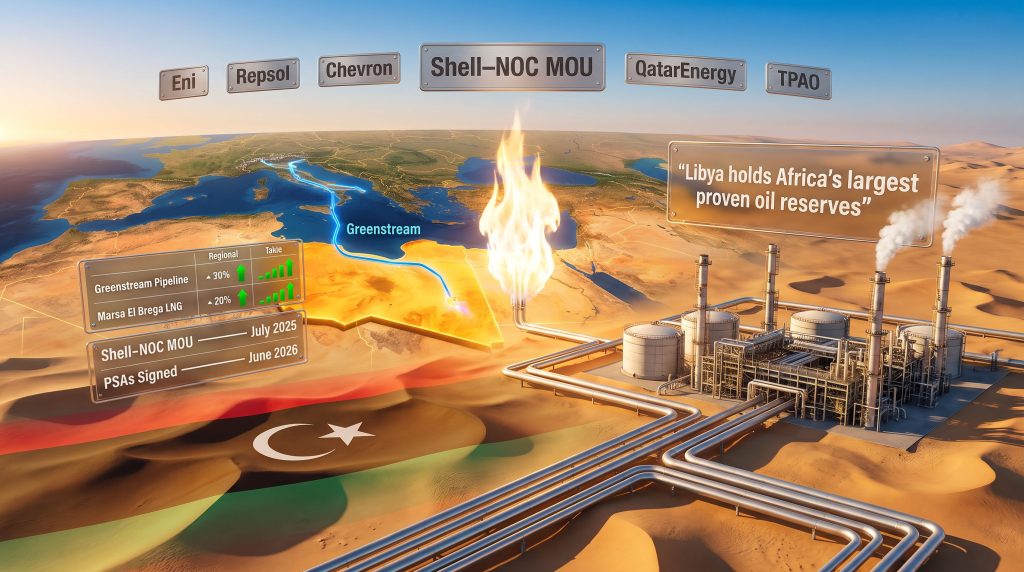
The geography, however, has never been the problem. Libya sits directly across the Mediterranean from Southern European energy markets. The Greenstream pipeline, which connects Libyan gas fields to Italy, represents an existing midstream asset that only requires sufficient upstream supply to become a meaningful European import corridor. That physical proximity, combined with existing infrastructure, is precisely why the Libya Shell natural gas strategy now commands attention from energy planners far beyond Tripoli.
When big ASX news breaks, our subscribers know first
What Shell's Return to Libya Actually Signals to the Market
The 2012 Exit and What Has Changed Since
Shell's original departure from Libya in 2012 was not impulsive. It followed a careful assessment that concluded exploration results across its Libyan acreage did not justify continued capital deployment against a backdrop of deteriorating security and political uncertainty following the 2011 conflict. For an international oil company operating under strict capital allocation discipline, this was a rational decision, even if the long-term resource opportunity remained intact.
The conditions that now justify re-engagement are meaningfully different. Libya conducted its first major licensing round in nearly two decades in 2025, a structural signal that Tripoli was prepared to rebuild the institutional frameworks necessary for sustained IOC participation. The results, announced in February 2026, were significant: exploration rights on multiple blocks were awarded to Eni, Repsol, Chevron, QatarEnergy, and TPAO.
Production-sharing agreements across these blocks were subsequently signed in June 2026, marking the broadest wave of international energy company re-engagement Libya has experienced in roughly two decades.
For IOCs evaluating frontier and re-entry markets, licensing round participation from this calibre of company group carries considerable de-risking weight. Each of these companies operates its own internal political risk assessment functions, and their collective decision to commit capital to Libyan acreage provides meaningful third-party validation of the investment environment's trajectory.
From MOU to Master Plan: The Architecture of the Shell–NOC Partnership
The Shell–NOC engagement has evolved through a deliberate, staged architecture that distinguishes it from a conventional exploration commitment.
| Milestone | Timeframe | Strategic Significance |
|---|---|---|
| Shell–NOC MOU signed | July 2025 | Established framework for technical and feasibility studies |
| Al-Atshan field assessment initiated | Late 2025 | First upstream asset evaluation under new agreement |
| Comprehensive gas strategy discussions begin | July 2026 | Expanded scope to sector-wide planning beyond individual projects |
| Production-sharing agreements signed | June 2026 | Broader IOC entry including Eni, Repsol, Chevron, QatarEnergy, TPAO |
What differentiates this arrangement from a standard exploration licence is its explicit ambition to produce a long-term gas sector roadmap. Shell's Vice President for Iraq, the UAE, and Libya met with NOC Chairman Masoud Suleman in late July 2026 to review progress on the memoranda of understanding, examine technical studies across assessed fields, and discuss the next phases of implementation.
The NOC's stated objective is to establish a clear timetable for completing ongoing assessments and transitioning to well-defined operational programmes, reflecting an institutional shift from ad hoc project approvals toward programmatic, sequenced development planning.
How Shell Is Approaching Libya's Gas Resources Technically
The Al-Atshan Field Assessment
The Al-Atshan field has been selected as one of the priority upstream assets for technical and economic feasibility evaluation under the 2025 agreements. While detailed public subsurface data on Al-Atshan remains limited, the methodology Shell is applying to assets of this type typically involves seismic reinterpretation using modern processing algorithms, updated subsurface modelling to refine resource volume estimates, and production cost benchmarking against comparable basin analogues to test commercial viability thresholds.
This approach is important because Libya's upstream data quality varies significantly across its sedimentary basins. Much of the existing seismic and well data was acquired decades ago using older acquisition technologies, meaning reinterpretation with current methods can materially change resource estimates in either direction. The willingness to invest in this technical work before committing development capital reflects the disciplined feasibility-first approach that the NOC has explicitly requested.
The Three-Tier Gas Monetisation Hierarchy
For Libya's gas resources to generate sustainable economic value, development must proceed through a logical sequencing of monetisation options:
-
Associated gas capture involves reducing flaring losses across existing oil production operations to build a baseline volume of gas available for commercial use. Libya has historically lost substantial gas value through routine flaring, and addressing this represents the fastest path to incremental export volumes.
-
Domestic gas utilisation focuses on supplying Libya's power generation sector and potential industrial feedstock requirements. Libya's chronic electricity deficit, partly caused by dependence on oil-fired generation, creates an immediate domestic market for gas-to-power conversion. Redirecting gas into domestic supply also frees up crude oil volumes that were previously consumed domestically, allowing them to generate export revenue instead.
-
Export infrastructure development involves rehabilitating and potentially expanding the Marsa El Brega LNG plant and optimising throughput on the Greenstream pipeline to Italy. Longer-range scenarios include the possibility of greenfield LNG capacity, potentially at Ras Lanuf, though this would require confirmed gas volume thresholds and capital cost structures that can compete with alternative European supply sources.
If Shell's feasibility studies confirm commercially viable gas volumes across assessed NOC assets, Libya could realistically target a meaningful uplift in LNG export capacity within a 7 to 10 year development horizon, positioning it as a supplementary supply source for European buyers continuing to diversify away from Russian pipeline gas dependence.
Libya's Strategic Objectives Behind the Shell Partnership
Rebuilding Domestic Energy Security
Libya's power generation sector has suffered from chronic underinvestment alongside the broader energy sector, leaving the country dependent on aging oil-fired generation infrastructure. A transition toward gas-to-power conversion would reduce fuel subsidy costs, improve generation reliability, and support the kind of industrial base expansion that diversifies economic activity away from raw hydrocarbon exports.
The industrial growth multiplier argument is particularly relevant here. Natural gas as a petrochemical and fertiliser feedstock creates significantly more economic complexity than direct commodity export. Countries that have successfully built gas-based industrial sectors, such as Qatar and Algeria, demonstrate that the downstream value chain can dwarf upstream revenues over time.
Positioning Libya as a Reliable European Gas Supplier
The structural shift in European energy procurement behaviour since 2022 has created a durable opportunity for North African gas producers. Furthermore, European gas prices and procurement strategies have changed markedly, with buyers actively seeking to extend long-term supply contracts with suppliers capable of delivering consistent, pipelined or liquefied volumes. Libya's geographic position makes it a natural candidate.
The Greenstream pipeline to Italy currently operates well below its technical capacity. A credible upstream development programme, co-designed with a technically credible IOC partner, provides the supply-side confidence that European buyers need before committing to long-term offtake agreements. Shell's involvement serves this signalling function even before a single additional cubic metre of gas flows through the system.
Attracting Sustained International Investment Capital
The signalling effect of one major IOC's technical credibility can materially de-risk the perceived investment environment for others. When Shell invests in feasibility studies, it implicitly communicates a minimum threshold of confidence in the regulatory and geological environment that other capital allocators can observe.
Libya's 2025 licensing round broke a nearly two-decade absence of structured IOC engagement. The subsequent February 2026 award to five major international energy companies, followed by June 2026 production-sharing agreement signings, created a momentum dynamic that is self-reinforcing when maintained. In addition, the natural gas supply outlook for global markets makes Libya's positioning increasingly relevant to international capital allocators.
How Libya Compares to Other North African Energy Strategies
| Indicator | Libya | Algeria | Egypt | Tunisia |
|---|---|---|---|---|
| Proven gas reserves | Large, underexplored | Mature, declining | Significant, active development | Modest |
| IOC engagement level (2025-2026) | Accelerating | Stable | High | Limited |
| LNG export infrastructure | Underutilized (Marsa El Brega) | Established (Skikda, Arzew) | Expanding (Idku, Damietta) | None |
| Political risk profile | Elevated, improving | Moderate | Low-moderate | Low |
| Gas-to-Europe pipeline access | Greenstream (Italy) | Multiple (TransMed, Medgaz) | Indirect via LNG | Transmed connection |
The table reveals why Libya occupies a distinctive position in the North African energy landscape. Algeria and Egypt are the more mature stories, with established infrastructure and relatively predictable investment environments. Libya, however, offers a higher-risk, higher-upside profile: larger undeveloped reserve potential, existing export infrastructure that can be rehabilitated faster than greenfield alternatives, and an IOC engagement wave that is only now beginning to build momentum.
As highlighted in research on Mediterranean gas competition, the dynamic between Algeria and Libya as competing suppliers to European markets adds a further layer of strategic complexity that both NOCs and IOCs must navigate carefully.
Key Risks That Could Derail Libya's Gas Ambitions
Political and Institutional Risk Scenarios
Libya's dual-government challenge remains the most significant structural obstacle facing any long-horizon investment programme. The country's divided political landscape has historically disrupted NOC operations at critical junctures, and IOC planning must account for three plausible trajectories:
-
Scenario A (Stable consolidation): Unified governance enables accelerated licensing approvals, fast-tracked feasibility sign-offs, and IOC capital deployment within three to five years. This represents the bull case for Libya's gas development timeline.
-
Scenario B (Managed fragmentation): Partial stability allows project-by-project progress to continue but delays the implementation of a sector-wide master plan. Development proceeds, but more slowly and with higher transaction costs.
-
Scenario C (Renewed instability): Security deterioration triggers IOC operational suspension, replicating the dynamics that preceded Shell's 2012 exit. This remains a tail risk rather than a base case, but it cannot be excluded from scenario planning.
Infrastructure and Technical Risk Factors
Beyond politics, the physical scale of rehabilitation required across Libya's upstream and midstream gas infrastructure should not be underestimated. Years of conflict-related damage and maintenance deferrals have left significant portions of the gas gathering, compression, and processing network in states requiring substantial capital expenditure before they can support incremental production.
Libya also faces a domestic technical workforce capacity constraint. The country's oil and gas sector workforce has been depleted by years of instability, creating dependence on international contractors for technical execution. This adds cost and scheduling complexity to any accelerated development scenario.
Evolving international ESG standards introduce a further layer of consideration. As major IOCs face increasing pressure from institutional investors on flaring and emissions performance, Libya's historically high gas flaring rates could affect financing conditions and investment thresholds unless the country can demonstrate credible progress on associated gas capture. Consequently, the energy transition demand environment places additional pressure on Libya to demonstrate emissions accountability alongside volume growth.
The next major ASX story will hit our subscribers first
The Long-Term Outlook: Libya's Path to Becoming a Meaningful Gas Exporter
Four Conditions That Must Align
Libya's gas export ambitions for the 2030s rest on four interdependent conditions, all of which must progress simultaneously:
-
Confirmation of commercially viable gas volumes through Shell's feasibility studies across Al-Atshan and other assessed NOC assets.
-
Sustained political stability sufficient to maintain IOC operational continuity across multi-year development cycles.
-
Rehabilitation and targeted expansion of the Marsa El Brega LNG facility and optimised Greenstream pipeline throughput as near-term export anchors.
-
Competitive production cost structures that allow Libyan gas to reach European buyers at prices competitive with alternative supply sources, including US LNG and Eastern Mediterranean pipeline gas.
Libya as a Test Case for Post-Conflict Resource Economics
The Libya Shell natural gas strategy carries significance that extends beyond the bilateral. Libya is functioning as a test case for whether the combination of IOC technical discipline, NOC institutional reform, and international capital can unlock a post-conflict hydrocarbon province within a commercially viable timeframe.
The role of multilateral development finance institutions, including the European Investment Bank and the African Development Bank, as potential co-financiers of infrastructure rehabilitation adds another dimension. If Libyan gas infrastructure rehabilitation can attract blended finance structures that lower the cost of capital for commercial participants, it could serve as a template for similar underinvested hydrocarbon provinces across the broader MENA region.
However, broader macroeconomic headwinds — including global trade tensions and oil market volatility — add uncertainty to the financing environment that Libya and its IOC partners must navigate carefully over the coming years.
The Shell-NOC gas strategy partnership is structured less as a single transaction and more as a phased institutional experiment, one that will test whether Libya's political and regulatory environment has stabilised sufficiently to support the multi-decade investment horizon that large-scale gas development genuinely demands.
Frequently Asked Questions: Libya Shell Natural Gas Strategy
What is Shell's current role in Libya's natural gas sector?
Shell is collaborating with Libya's National Oil Corporation to develop a comprehensive long-term gas sector strategy. This covers technical and economic feasibility studies on key upstream assets including the Al-Atshan field, alongside co-designing a sector-wide roadmap to improve efficiency, optimise resource development, and expand Libya's gas export capability.
Why did Shell return to Libya after exiting in 2012?
Shell's earlier departure was driven by exploration results that did not meet commercial thresholds combined with deteriorating security conditions. Its return reflects a changed investment environment shaped by Libya's 2025 licensing round, renewed NOC institutional leadership, and the heightened strategic importance of North African gas supply to European energy security since 2022.
What is the Al-Atshan field?
Al-Atshan is one of the NOC-owned upstream assets selected for technical and economic assessment under the 2025 Shell-NOC agreements. It serves as Shell's initial evaluation target in Libya and forms part of the broader effort to quantify gas volumes necessary to justify large-scale development and export infrastructure investment.
Which other international energy companies are active in Libya?
Following Libya's 2025 licensing round, exploration rights were awarded in February 2026 to Eni, Repsol, Chevron, QatarEnergy, and TPAO across multiple blocks. Production-sharing agreements were subsequently signed in June 2026, marking the most significant wave of IOC re-engagement Libya has seen in nearly two decades.
What is the Marsa El Brega LNG plant?
Marsa El Brega is Libya's operational LNG export facility. It has functioned significantly below capacity due to infrastructure deterioration and upstream supply constraints. Rehabilitation of this facility is considered a priority near-term target in Libya's gas export strategy, with longer-range scenarios potentially including new LNG capacity if confirmed gas volumes justify the capital investment.
Key Metrics at a Glance
| Strategic Dimension | Current Status | Forward Outlook |
|---|---|---|
| Shell-NOC partnership scope | Feasibility studies and sector master plan | Full development roadmap expected by mid-2020s |
| Al-Atshan field assessment | Underway | Results to determine next development phase |
| Marsa El Brega LNG rehabilitation | Priority near-term target | Capacity restoration before greenfield expansion considered |
| Libya licensing round (2025-2026) | Completed; PSAs signed June 2026 | Exploration drilling expected 2027-2028 |
| European gas export positioning | Greenstream pipeline underutilised | Strategic upside if gas volumes confirmed |
| Political risk | Elevated but improving | Scenario-dependent; primary variable for IOC commitment |
This article contains forward-looking scenarios, projections, and strategic analysis that are subject to material uncertainty. Readers should not interpret any scenario modelling or timeline estimates as investment advice. Libya's energy sector remains subject to significant political, operational, and market risks that could affect outcomes materially. Independent professional advice should be sought before making any investment decisions related to the companies, assets, or sectors discussed.
Want to Track the Next Major Resource Discovery Before the Broader Market Does?
Discovery Alert's proprietary Discovery IQ model delivers real-time alerts on significant ASX mineral discoveries — transforming complex geological and commodity data into actionable investment insights the moment they hit the exchange. Explore how historic discoveries have generated substantial returns on Discovery Alert's dedicated discoveries page, and begin your 14-day free trial today to position yourself ahead of the market.