July 29, 2026
When Arbitration Produces a Technical Breach and a Negligible Check: The Architecture of the Mexico Vulcan ICSID Ruling
Investor-state arbitration has long been portrayed as the nuclear option in cross-border commercial disputes, a mechanism capable of extracting billion-dollar penalties from sovereign governments that step too far into the territory of foreign investment. The reality, as demonstrated by the Mexico Vulcan ICSID ruling handed down in July 2026, is considerably more nuanced. After more than seven years of proceedings, one of the highest-profile mining disputes between Mexico and the United States concluded with a treaty violation confirmed and a compensation figure that represented less than one percent of the original claim. Understanding why that outcome matters, and what it signals for future investment disputes in Latin America, requires looking beyond the headline numbers.
When big ASX news breaks, our subscribers know first
How ICSID Arbitration Actually Functions: A Mechanism Built for Complexity
The International Centre for Settlement of Investment Disputes operates as the World Bank's dedicated arbitration body for conflicts between foreign investors and sovereign states. Its authority in the Mexico-US context derives from Chapter 11 of the North American Free Trade Agreement, now largely superseded by the United States-Mexico-Canada Agreement (USMCA), which embeds investor-state dispute settlement protections for qualifying companies operating across the three member economies.
What distinguishes ICSID proceedings from conventional commercial litigation is their finality and structural rigidity. There is no appellate court in the traditional sense. Once a tribunal issues an award, the grounds for challenging it through an ICSID ad hoc annulment committee are deliberately narrow:
- The tribunal manifestly exceeded the powers granted to it
- There was a serious departure from a fundamental procedural rule
- The tribunal failed to provide adequate reasons for its decision
- The tribunal was improperly constituted
- Corruption on the part of a tribunal member
This architecture creates high-stakes, one-shot adjudication. The seven stages of a full ICSID proceeding, from initial registration and tribunal constitution through jurisdictional rulings, provisional measures, merits arguments, quantum assessment, and final award, can span a decade or more when the case is politically sensitive and factually complex.
The Seven-Stage ICSID Process in Practice
- Registration — The claimant files a request; the ICSID Secretariat confirms prima facie jurisdiction exists
- Tribunal constitution — A three-member panel forms, with each party appointing one arbitrator and a presiding arbitrator selected by agreement or appointment
- Jurisdictional phase — The tribunal determines whether it has authority to hear the substantive dispute
- Provisional measures — The tribunal may issue interim orders to prevent aggravation of the dispute pending a final ruling
- Merits phase — Parties present substantive arguments on liability and causation
- Quantum phase — If liability is established, damages are assessed
- Award issuance — A binding decision is rendered, subject only to narrow annulment grounds
In the Vulcan case, all seven stages played out over more than seven years, an unusually protracted timeline that reflects both the procedural complexity and the broader political dimensions of the dispute. Furthermore, the broader geopolitical mining landscape in 2025 and beyond has made such long-running disputes increasingly common across resource-rich jurisdictions.
The Quintana Roo Operations: What Was Actually at Stake
The underlying commercial dispute centres on limestone quarrying operations in the Yucatan Peninsula state of Quintana Roo. Vulcan Materials Company, one of the largest construction aggregates producers in the United States, conducted these operations through its Mexican subsidiary Calizas Industriales del Carmen, commonly known as CALICA. The operations involved open-pit extraction of high-quality limestone and lime, materials with substantial export value given the Yucatan Peninsula's geological profile.
The Sac Tun quarry, the focal point of the environmental controversy, sits within a karst landscape characterised by a dense network of cenotes (natural sinkholes) and subterranean river systems. This hydrological infrastructure is not merely ecologically sensitive; it constitutes the primary freshwater source for large portions of coastal Quintana Roo. Mexican authorities alleged that quarrying activity had damaged cenote structures and introduced contaminants into underground waterways, allegations that ultimately shaped both the government's regulatory response and its defence strategy before the ICSID tribunal.
CALICA also held a port concession that formed an integrated part of its limestone export logistics chain, meaning the full scope of the investment extended beyond extraction to maritime transport infrastructure.
Timeline of Escalation: From Suspension to Arbitration
| Year | Development | Party Responsible |
|---|---|---|
| 2018 | Federal and state authorities suspend limestone extraction; CALICA property closed | Mexican federal and state authorities |
| 2018 | Vulcan Legacy LLC initiates ICSID arbitration under NAFTA | Vulcan Materials / Legacy LLC |
| 2022 | President López Obrador orders definitive closure of Sac Tun quarry citing cenote damage | Federal executive |
| 2022 | Tribunal issues Procedural Order No. 7; ancillary claim admitted into arbitration scope | ICSID Tribunal |
| 2024 | López Obrador publicly discloses a settlement offer exceeding US$400 million had been made | Mexican Government |
| 2025 | US lawmakers petition President Trump to treat the matter as expropriation | US Congress |
| March 2026 | President Sheinbaum publicly rejects expropriation characterisation; cites protected area designation | Mexican Government |
| July 2026 | ICSID tribunal issues final award; nearly all claims dismissed; approximately US$15 million awarded | ICSID Tribunal |
The Legal Claims Vulcan Brought: Investment Treaty Protections Under NAFTA
Vulcan's arbitration drew on the full suite of investor protections embedded in NAFTA Chapter 11. These included:
- Fair and Equitable Treatment (FET): The argument that Mexico's regulatory interventions denied Vulcan a stable and predictable operating environment
- National Treatment and Most-Favoured-Nation (MFN): Claims of discriminatory treatment relative to domestic competitors
- Expropriation (direct and indirect): The central contention that successive closures amounted to a government taking of the investment without adequate compensation
- Minimum Standard of Treatment: Obligations under customary international law incorporated through NAFTA's framework
The expropriation claim carried the highest potential damages. For indirect expropriation to succeed before an ICSID tribunal, a claimant must generally demonstrate that government measures, even if facially regulatory, had an effect substantially equivalent to the outright seizure of the investment. This is a high evidentiary bar, particularly when the respondent state can credibly demonstrate genuine environmental or public health justification for its actions. The UNCTAD investment dispute settlement database provides a comprehensive record of the full procedural history of this case.
Procedural Order No. 7 and the Ancillary Claim: Why These Milestones Mattered
Issued on 11 July 2022, Procedural Order No. 7 represented a significant interim development that shaped the trajectory of the final merits phase. The tribunal took the unusual step of directing Mexico to refrain from conduct that would further aggravate or extend the dispute, including public statements designed to pressure CALICA or Vulcan in the context of ongoing proceedings. This type of provisional measure is relatively uncommon in ICSID practice and signals that the tribunal considered the risk of dispute aggravation to be material.
The same order formally admitted Vulcan's ancillary claim covering the alleged wrongful shutdown of remaining quarrying operations. A subsequent ruling confirmed that this ancillary claim was admissible and within the tribunal's jurisdiction, overruling Mexico's renewed objection. These procedural outcomes in Vulcan's favour created reasonable expectations of a substantial merits phase, which makes the eventual compensation quantum all the more analytically significant.
Dissecting the Final Award: A 98.2% Compression of Claimed Damages
The tribunal's final award upheld precisely one claim: the matter connected to the January 2018 closure of a specific CALICA property. Every other claim, including those related to the Sac Tun quarry closure and the broader indirect expropriation argument, was dismissed.
The tribunal confirmed that Mexico had violated NAFTA in certain respects, a finding Vulcan publicly acknowledged while simultaneously describing the compensation as insignificant. The company declined to disclose the specific amount, though government sources cited by Reuters placed it at approximately US$15 million.
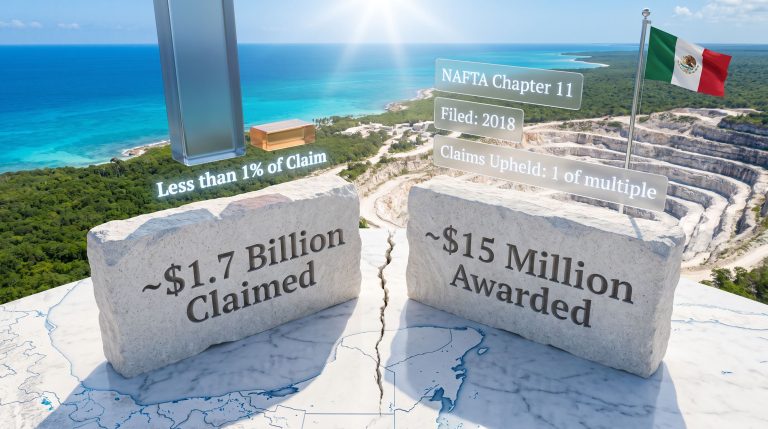
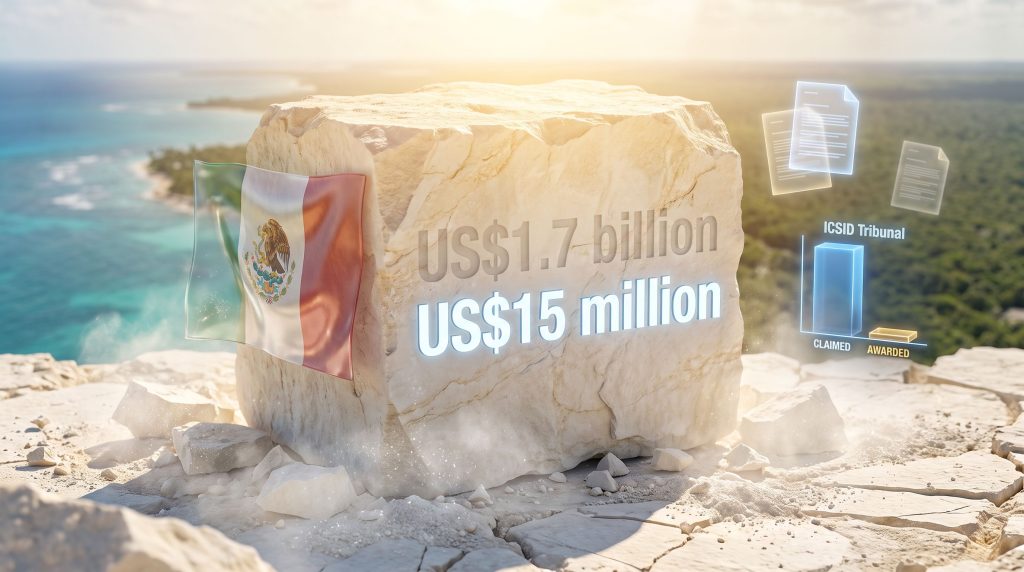
The arithmetic here is striking. Against an original demand of US$1.7 billion, the awarded figure of roughly US$15 million represents a reduction of approximately 98.2%. Even within ICSID practice, where claimants routinely receive substantially less than their claimed amounts, a compression of this magnitude is statistically exceptional. Notably, the commercial litigation analysis of ICSID decisions demonstrates that such outcomes, whilst rare, are not without precedent when jurisdictional and procedural complexities intersect with narrow treaty findings.
Why the Damages Gap Reveals Deeper Doctrinal Tensions
The scale of the reduction reflects several distinct analytical failures in Vulcan's case as assessed by the tribunal:
- Valuation methodology rejection: The tribunal likely found Vulcan's damages model, almost certainly based on discounted cash flow projections of future limestone revenues, either speculative or disconnected from the specific NAFTA violations found
- Causal chain disruption: For losses to be compensable, a claimant must establish a direct causal link between the treaty breach and the damages claimed; the tribunal appears to have accepted Mexico's argument that environmental conditions, not treaty violations, drove the bulk of the operational disruption
- Regulatory versus expropriatory threshold: The dismissal of the indirect expropriation claims suggests the tribunal accepted that most of Mexico's interventions fell within the scope of legitimate regulatory police powers rather than compensable taking
Mexico's Environmental Sovereignty Defense: Where It Held and Where It Cracked
Mexico's core legal defence rested on the designation of a protected natural area in Quintana Roo, framing the closure of CALICA's operations as a conservation and public health measure rather than a targeted expropriation. This approach draws directly on the police powers doctrine in international investment law, a well-established principle that states retain inherent authority to regulate in the public interest, including for environmental protection, without owing compensation to affected investors.
The near-total dismissal of Vulcan's claims suggests the tribunal accepted large portions of this defence. However, the partial award finding at least one NAFTA violation indicates Mexico's regulatory record was not entirely consistent. Where individual actions lacked clear procedural justification, violated due process norms, or were disconnected from the broader conservation rationale, the police powers shield did not fully apply.
Precedent Cases That Frame the Doctrinal Stakes
The Mexico-Vulcan dispute sits within a lineage of NAFTA and ICSID cases that have tested the boundary between environmental regulation and compensable expropriation:
- Metalclad Corporation v. Mexico (NAFTA, 2000): Mexico was ordered to pay approximately US$16.7 million after local authorities blocked the operation of a hazardous waste facility, an early and influential precedent on the reach of indirect expropriation doctrine
- Bilcon of Delaware v. Canada (NAFTA, 2015): Canada was found liable for blocking a quarry and marine terminal project on environmental grounds through a Joint Review Panel process, a cautionary reference point for resource regulators
- Pac Rim Cayman LLC v. El Salvador (ICSID, 2016): El Salvador successfully defended its refusal to grant gold mining permits on environmental grounds, demonstrating that police powers defences can prevail when consistently applied and well-documented
The Vulcan outcome extends this body of precedent by demonstrating that a respondent state can sustain an environmental defence across multiple contested regulatory actions while still facing liability on narrower procedural grounds. In addition, the evolving mining claims framework across North American jurisdictions reflects the same tension between environmental sovereignty and investor protection rights.
The next major ASX story will hit our subscribers first
The US$400 Million Settlement Disclosure: Reconstructing the Economics of Litigation Strategy
One of the more analytically striking dimensions of this dispute emerged before the final award. In 2024, former President López Obrador publicly disclosed that Mexico had offered Vulcan more than US$400 million to settle the dispute and avoid the full arbitration process. That settlement was not accepted.
The eventual award of approximately US$15 million means Mexico's decision to proceed to a final award rather than settle saved the government an estimated US$385 million in liability exposure. This outcome carries significant implications for how Mexican authorities and, by extension, other Latin American sovereigns will approach future high-value investment disputes:
- Early settlement offers in politically charged cases may substantially overestimate eventual tribunal awards
- The perceived litigation risk of ICSID proceedings may be higher than the actuarial reality in cases where strong environmental justifications exist
- Governments with well-documented regulatory records may be better served by full arbitration than by negotiated settlement when the underlying treaty violations are procedurally narrow
Investor note: This calculus cuts in both directions. Foreign investors considering ICSID claims against Latin American sovereigns should not assume that documented treaty violations will translate into compensation proportionate to claimed losses. The Vulcan case represents a concrete data point on the compression risk inherent in quantum assessments.
Post-Award Landscape: What Mexico Does Next and What It Means for Mining Investment
Mexico's Ministry of Economy indicated following the ruling that it is carefully analysing the decision to determine what legal options remain available. In ICSID practice, Mexico's primary post-award mechanism is an application to an ad hoc annulment committee on the narrow grounds described earlier. Whether Mexico pursues annulment will depend on a precise legal assessment of whether the tribunal's reasoning on the January 2018 CALICA closure claim meets the narrow threshold for any of the available annulment grounds.
Consequently, the broader implications of government intervention in mining across resource-rich economies will likely be scrutinised more carefully in light of this ruling. Sovereign states now have a clearer template for how environmental justifications can be deployed effectively in ICSID proceedings.
Investment Risk Recalibration for the Mining Sector
| Risk Dimension | Pre-Award Perception | Post-Award Signal |
|---|---|---|
| NAFTA/USMCA treaty protections | Contested by Mexico | Confirmed operative; violations found |
| Environmental closure exposure | High under López Obrador era | Largely validated by tribunal as legitimate regulation |
| Compensation quantum risk | Large awards assumed achievable | Dramatically compressed in practice |
| Political escalation impact | US congressional involvement raised pressure | Diplomatic pressure did not alter outcome |
| Settlement versus litigation calculus | Settlement viewed as risk reduction | Full litigation demonstrated to be more cost-effective for the sovereign |
President Sheinbaum's administration has adopted a markedly different tone on foreign investment compared to its predecessor, publicly emphasising legal certainty and treaty compliance. The Ministry of Economy's post-award statement reaffirming commitment to investment that brings innovation, fair wages, and environmental protection signals an attempt to reframe Mexico's investment climate narrative following the conclusion of this high-profile dispute.
Outstanding questions for companies with mining concessions in Mexico include the regulatory trajectory for operations in ecologically sensitive zones across other states, the pace of environmental impact assessment reform under the new administration, and how the USMCA Chapter 14 investment protection framework will be applied to future disputes. Furthermore, the US policy impact on mining under the Trump administration has added an additional political dimension to how cross-border resource disputes of this nature are perceived and escalated diplomatically.
Frequently Asked Questions: Mexico Vulcan ICSID Ruling
What is the Mexico Vulcan ICSID case about?
The dispute arose from a series of Mexican government actions between 2018 and 2022 that suspended and then permanently closed limestone quarrying operations in Quintana Roo belonging to CALICA, a Mexican subsidiary of US-based Vulcan Materials Company. Vulcan initiated ICSID arbitration under NAFTA, asserting that the actions constituted expropriation and multiple investment treaty violations.
How much compensation did Vulcan receive?
The ICSID tribunal awarded approximately US$15 million, representing less than 1% of the US$1.7 billion Vulcan originally claimed. The award was confined to one specific finding related to the January 2018 closure of a CALICA property.
Did Mexico violate NAFTA in the Vulcan case?
Yes. The tribunal confirmed that Mexico violated NAFTA in certain respects. However, it dismissed nearly all of Vulcan's claims and awarded only minimal compensation relative to the total amount sought.
Can Mexico challenge the ICSID ruling?
Mexico retains the right to apply for annulment through an ICSID ad hoc committee. The available grounds are narrow. Mexico's Ministry of Economy has publicly confirmed it is evaluating all available legal options.
What was Procedural Order No. 7?
Issued on 11 July 2022, this order directed Mexico to refrain from conduct that would further aggravate the dispute, including public statements directed at CALICA or Vulcan. It also formally admitted Vulcan's ancillary claim covering the shutdown of remaining quarrying operations into the scope of the arbitration.
What does this ruling mean for mining investment in Mexico?
The outcome sends a layered signal. Mexico's environmental sovereignty defence was broadly upheld, but NAFTA violations were confirmed. For foreign investors, the case confirms that ICSID protections remain operative under USMCA, but demonstrates that compensation awards can be dramatically lower than claimed amounts when environmental justifications are credibly established and procedural treaty breaches are narrow in scope. The broader trend of mining industry consolidation across North America means that investors will be watching rulings such as this one very closely when assessing sovereign risk in future projects.
Five Structural Lessons From a Seven-Year Dispute
The Mexico Vulcan ICSID ruling leaves behind a set of durable analytical takeaways that extend well beyond the specific facts of the Quintana Roo limestone operations:
- Procedural duration does not predict compensation magnitude: Seven years of litigation can produce a sub-1% award rate when the underlying liability finding is procedurally narrow
- Environmental sovereignty defences are increasingly robust: Consistently applied and well-documented conservation rationales substantially reduce compensable expropriation exposure
- Technical breach without substantial damages creates a new outcome category: Tribunals can acknowledge treaty violations while awarding compensation that bears no proportional relationship to claimed losses
- Settlement offer disclosure reshapes future dispute economics: Mexico's approximately US$385 million effective saving relative to its pre-award settlement offer will influence sovereign litigation strategy across Latin America
- Provisional measures shape merits trajectories: Procedural Order No. 7 illustrates how early tribunal interventions can expand or constrain the scope of issues ultimately reaching the final award phase
The central tension this case leaves unresolved is the one that has defined investment treaty law for a generation: precisely where does legitimate environmental regulation end and compensable expropriation begin? The tribunal's outcome in the Mexico Vulcan ICSID ruling, finding violations while awarding marginal damages, confirms that the answer remains deeply fact-specific and resistant to clean doctrinal formulation. For sovereign states and foreign mining investors operating across Latin America under USMCA and bilateral investment treaty frameworks, that persistent ambiguity is the most consequential legacy of this ruling.
This article contains forward-looking analysis and legal interpretation for informational purposes only. It does not constitute legal or investment advice. Readers should consult qualified legal counsel for guidance on specific investment treaty or arbitration matters.
Want to Stay Ahead of Significant ASX Mineral Discoveries Before the Broader Market Reacts?
While sovereign disputes like the Mexico-Vulcan ICSID ruling illustrate the complexities of large-scale mining investment, Discovery Alert's proprietary Discovery IQ model cuts through that complexity by delivering real-time alerts on significant ASX mineral discoveries the moment they are announced — explore the historic returns major discoveries have generated and begin your 14-day free trial to secure a genuine market-leading edge.