July 28, 2026
The Shrinking Foundation of American Metal: Why U.S. Primary Aluminium Capacity Matters More Than Ever
Few industrial stories carry as much strategic weight as the quiet collapse of American primary aluminium production. Over roughly two decades beginning in the early 2000s, the United States watched its domestic smelting infrastructure erode steadily, driven by a combination of expensive industrial electricity, aggressive low-cost competition from state-subsidised overseas producers, and a policy environment that offered little structural protection to energy-intensive manufacturers. At its peak, the U.S. operated dozens of active primary aluminium smelters. By the mid-2020s, that number had dwindled to a handful, leaving the world's largest economy dangerously exposed to import dependency for a material that sits at the foundation of aerospace, defence, transportation, and infrastructure manufacturing.
Against that backdrop, the Century Aluminum Mt Holly expansion carries significance that extends well beyond the commercial interests of a single producer. It represents one of the most concrete demonstrations in recent memory of what happens when trade policy, energy contracting, and industrial strategy align around a shared objective.
When big ASX news breaks, our subscribers know first
Understanding the Mt Holly Smelter and What the Expansion Involves
Project Fundamentals: Location, Scale, and Investment
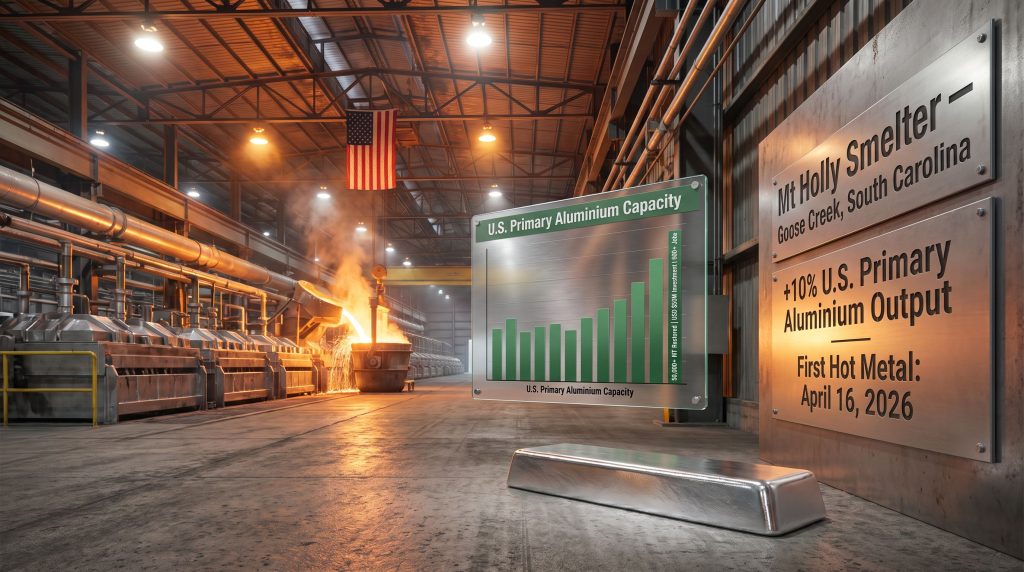
The Mt Holly Smelter is located in Goose Creek, South Carolina, and is operated by Century Aluminum, the largest primary aluminium producer currently operating in the United States. The facility had been running below its potential capacity for years, with key production lines, known in industry terminology as potlines, sitting idle due to unfavourable economics.
The expansion project involves restarting that idled capacity rather than constructing new infrastructure from scratch. This distinction matters. Restarting existing potlines is significantly less capital-intensive than greenfield smelter construction, but it still requires substantial investment in electrical systems, anode infrastructure, and workforce readiness. Century Aluminum committed USD $50 million to make it happen.
Key project milestones include:
- First hot metal produced on 16 April 2026, confirming the technical viability of the restart
- Full production capacity targeted by the end of June 2026
- Output levels are expected to reach their highest point since 2015
- More than 50,000 metric tons of previously idled annual capacity restored
- Initial workforce additions exceeding 125 new jobs, with total site employment projected to surpass 600 employees at full capacity
The Power Agreement That Unlocked the Economics
In primary aluminium smelting, electricity is not simply an operating cost. It is the defining variable that determines whether a smelter can compete at all. The electrolytic reduction process used to convert alumina into molten aluminium, known as the Hall-Heroult process, consumes enormous quantities of electricity, typically accounting for 30% to 40% of total production costs. Without access to competitively priced power, restarting idled capacity is commercially irrational regardless of prevailing aluminium prices.
The breakthrough that made the Century Aluminum Mt Holly expansion viable was securing an extended power supply agreement with Santee Cooper, South Carolina's state-owned electric utility, running through to 2031. This agreement provided the long-term electricity cost certainty that investors and lenders require before committing capital to a decade-long industrial asset. Energy contract security, in this context, functions as the foundational prerequisite for everything else.
"The Santee Cooper power deal illustrates a broader principle in primary metals manufacturing: competitive energy access is not a secondary consideration. It is the primary gating factor that determines whether domestic production is economically rational."
Quantifying the Impact: What a 10% Output Increase Actually Means
To appreciate the true significance of the Century Aluminum Mt Holly expansion, it is essential to understand just how thin U.S. primary aluminium production capacity had become before this project. According to Bloomberg's coverage of the expansion, the project is projected to deliver a 10% lift to U.S. output, a striking figure given how contracted the national supply base has become.
| Metric | Detail |
|---|---|
| Estimated increase in U.S. primary output | ~10% |
| Capacity restored | 50,000+ metric tons per year |
| Capital invested | USD $50 million |
| Jobs created (initial phase) | 125+ |
| Total workforce at full capacity | 600+ employees |
| Full production milestone | End of June 2026 |
| Last comparable output level | 2015 |
A single smelter restart adding approximately 10% to national primary aluminium output is a figure that speaks volumes about how far domestic capacity has contracted. For context, the United States consumes millions of metric tons of aluminium annually across its manufacturing economy, with a substantial portion sourced through imports. The gap between what America produces domestically and what it actually needs has widened considerably.
Globally, the U.S. remains a minor primary producer compared to China, which accounts for more than half of worldwide output, as well as significant producers including Russia, Canada, and the UAE. Furthermore, this concentration of global production in geopolitically sensitive or rival jurisdictions gives domestic capacity additions a strategic dimension that pure economics alone cannot capture. The top aluminium producers worldwide dwarf U.S. output, underscoring just how much ground American industry has lost.
The Policy Architecture Enabling the Investment
Section 232 Tariffs and Their Role in Smelter Economics
The commercial logic behind the Mt Holly expansion cannot be fully understood without examining the trade policy environment that shaped it. The broader US tariff landscape for critical materials, including aluminium, has shifted considerably under recent administrations, creating new commercial opportunities for domestic producers. Section 232 of the Trade Expansion Act of 1962 grants the U.S. President authority to impose tariffs on imports deemed to threaten national security.
Us aluminium and steel tariffs introduced under this provision create a price differential between domestically produced metal and foreign-sourced imports, effectively improving the margin available to domestic smelters. For years, idled U.S. smelting capacity sat dormant not because the technology was obsolete or the workforce unavailable, but because the economics of competing against subsidised foreign production were simply untenable without some form of structural protection.
Section 232 tariffs altered that calculus. By raising the effective cost of imported aluminium, they improved the relative competitiveness of domestic production and made restart investments commercially defensible. This is a critical and often underappreciated point: tariff policy in this context functions not as a permanent subsidy but as a mechanism to compress the price advantage that overseas producers hold through lower energy costs and, in some cases, government-directed pricing.
The aluminium tariff impact on domestic smelter economics has been demonstrably positive in the near term, however, whether that protection is sufficient over a long investment horizon depends entirely on whether the tariff framework remains intact.
Government and State Alignment
The ribbon-cutting ceremony at Mt Holly attracted an unusually senior collection of officials, including U.S. Secretary of Commerce Howard Lutnick, Senior Counselor to President Trump Dr. Peter Navarro, South Carolina Governor Henry McMaster, U.S. Senator Tim Scott, and South Carolina Attorney General Alan Wilson. The concentration of federal and state representation at an industrial milestone of this nature is atypical and warrants attention.
- The U.S. Department of Commerce framed the project as a meaningful contribution to domestic industrial output and supply chain resilience
- Secretary Lutnick described domestic aluminium production as essential to American industrial strength
- Dr. Navarro connected the investment to the administration's broader domestic manufacturing agenda
- Governor McMaster and Senator Scott emphasised job creation and South Carolina's positioning as a manufacturing hub
The convergence of these voices around a single industrial project signals that domestic primary aluminium has re-entered national policy conversations at the highest levels of government.
Downstream Industries Dependent on Secure Domestic Supply
Who Actually Needs U.S. Primary Aluminium?
Century Aluminum's customer base spans several sectors whose operational continuity and national security implications make domestic sourcing a strategic priority rather than a simple procurement preference.
Defence and aerospace represent the most strategically sensitive demand segment. Primary aluminium is a foundational input for airframes, military vehicle construction, and munitions-related components. Dependence on imported aluminium for these applications carries genuine national security risk, particularly when supply chains run through geopolitically unstable or adversarial regions.
Infrastructure and transportation represent the largest volume demand segments. The ongoing push to modernise U.S. roads, bridges, rail networks, and energy grid infrastructure generates sustained aluminium demand. In addition, automotive lightweighting trends, driven by fuel efficiency and electric vehicle requirements, have structurally increased the aluminium intensity of modern vehicle manufacturing. Consequently, initiatives around green metals production are increasingly relevant to how these downstream industries plan their supply chains.
Consumer goods and industrial manufacturing round out the demand picture, with packaging, electronics, and appliance sectors all relying on consistent domestic supply chains to manage cost and availability risk.
Beyond simple price competition, the case for domestic sourcing rests on three structural arguments:
- Supply chain resilience: Geopolitical disruption to import-dependent supply chains can create sudden shortages with no domestic fallback
- National security classification: The U.S. government has formally identified primary aluminium as a strategically critical material under national security provisions
- Friendshoring trends: U.S. manufacturers are actively seeking to reduce sourcing exposure to non-allied supply chains, increasing the premium placed on domestically produced or allied-nation-sourced materials
Is Mt Holly the Start of Something Larger?
Century Aluminum's Broader Strategic Ambitions
Century Aluminum's leadership has characterised the Mt Holly expansion not as an endpoint but as the opening move in a longer-term domestic capacity rebuilding effort. According to mining technology industry reporting, the company's expanded production at Mt Holly is already being positioned as a platform for further growth. The company is, furthermore, pursuing a joint venture with Emirates Global Aluminum targeting the construction of a greenfield primary aluminium smelter in Oklahoma.
If completed, this facility would represent the first newly constructed primary aluminium smelter in the United States in approximately 50 years, a distinction that underscores just how dormant domestic greenfield investment has been. The Mt Holly restart serves a dual function in this context. It demonstrates operational viability, workforce capability, and political support for domestic aluminium expansion, all of which reduce the perceived risk of the far more capital-intensive Oklahoma project.
Structural Barriers That Remain
Enthusiasm for a domestic aluminium renaissance must be tempered by a clear-eyed assessment of the structural challenges that have suppressed U.S. production for decades and have not disappeared.
| Scenario | Key Driver | Potential Impact |
|---|---|---|
| Mt Holly reaches full output by June 2026 | Power agreement secured, hot metal confirmed | +50,000 MT annually, +~10% national output |
| Oklahoma greenfield proceeds | EGA joint venture approved, tariff framework maintained | First new U.S. smelter in ~50 years |
| Section 232 tariff rollback | Policy reversal or new trade agreements | Reduced investment economics, potential re-idling risk |
| Industrial electricity cost spike | Grid pressure, energy policy changes | Margin compression, capacity viability at risk |
Energy cost competitiveness remains the most persistent challenge. Hydropower-advantaged producers in Canada, Norway, and Iceland operate with electricity cost structures that U.S. smelters running on conventional grid power struggle to match. The long-term competitiveness of the Oklahoma greenfield project will depend substantially on what power arrangement can be secured in that state.
Capital intensity is the second major barrier. Greenfield smelter construction is orders of magnitude more expensive than restarting existing infrastructure, requiring multi-billion-dollar commitments and decade-long payback horizons that demand extraordinary confidence in both tariff policy stability and aluminium price trajectories.
"Investors and analysts evaluating the long-term prospects of U.S. primary aluminium expansion should treat tariff policy continuity as a binary risk factor. The commercial logic underpinning these investments is structurally dependent on the Section 232 framework remaining intact."
The next major ASX story will hit our subscribers first
Frequently Asked Questions: Century Aluminum Mt Holly Expansion
What is the Century Aluminum Mt Holly expansion?
It is the restart and capacity expansion of Century Aluminum's primary aluminium smelter in Goose Creek, South Carolina, involving a USD $50 million investment to restore more than 50,000 metric tons of previously idled annual production capacity.
When did the Mt Holly expansion begin producing aluminium?
First hot metal from the expanded operations was recorded on 16 April 2026, with full production capacity targeted by the end of June 2026.
How many jobs has the Mt Holly expansion created?
More than 125 jobs were created in the initial phase, with total site employment expected to grow to over 600 employees as the smelter reaches full operational capacity.
Why is this expansion significant for U.S. aluminium production?
The project is projected to increase total U.S. primary aluminium output by approximately 10%, making it one of the most material single additions to domestic production capacity in recent years given how contracted the national supply base has become.
What role did Section 232 tariffs play?
Section 232 aluminium tariffs improved the commercial economics of restarting domestic smelting capacity that had previously been unable to compete against lower-cost imports, providing the margin certainty needed to justify a USD $50 million capital commitment.
Is Century Aluminum planning further expansion beyond Mt Holly?
Yes. The company is pursuing a joint venture with Emirates Global Aluminum to develop a greenfield primary aluminium smelter in Oklahoma, which would be the first newly constructed U.S. primary aluminium smelter in approximately 50 years.
Key Takeaways for Industry Observers and Investors
The Century Aluminum Mt Holly expansion is a case study in how industrial capacity, once lost, requires a precise alignment of factors to rebuild. Trade policy protection, competitive energy contracting, political will, and corporate balance sheet commitment all had to converge simultaneously for this project to reach first hot metal.
Several broader lessons emerge from the Mt Holly story:
- A 10% national output increase from a single facility reveals how structurally diminished U.S. primary aluminium production has become, and why even modest additions carry disproportionate strategic weight
- The Santee Cooper power agreement through 2031 illustrates that long-term energy cost certainty is the non-negotiable foundation for any primary aluminium investment decision
- The Section 232 tariff framework functions as the commercial bridge between domestic production costs and global pricing realities, making its political durability central to investment risk assessment
- The Oklahoma greenfield ambition suggests that Mt Holly is intended as a proof point, not a conclusion, in a longer domestic capacity rebuilding narrative
- Downstream demand from defence, aerospace, transportation, and infrastructure provides the strategic rationale for domestic sourcing that extends well beyond pure commercial calculation
Disclaimer: This article contains forward-looking statements and scenario projections based on publicly available information and announced targets. Actual outcomes may differ materially from projections due to changes in policy, energy markets, commodity prices, or broader economic conditions. This content is intended for informational purposes only and does not constitute financial or investment advice.
Want to Stay Ahead of the Next Major Metals Discovery on the ASX?
Discovery Alert's proprietary Discovery IQ model delivers real-time alerts on significant ASX mineral discoveries — instantly converting complex data across more than 30 commodities into clear, actionable insights for investors at every level. Explore why historic mineral discoveries have generated extraordinary returns and begin your 14-day free trial today to position yourself ahead of the broader market.