
July 28, 2026
When Single-Market Dependency Meets a Structural Demand Shift
The Kumba Iron Ore profit drop and ex-China sales strategy represents one of the most instructive case studies in commodity export concentration risk to emerge from the 2026 reporting season. Iron ore markets have long operated on a deceptively simple premise: build more steel, buy more ore. For decades, that logic was anchored almost entirely to China, whose extraordinary infrastructure expansion absorbed the majority of seaborne supply from Africa, Australia, and Brazil.
However, as China's construction cycle enters a prolonged period of consolidation, producers that over-indexed on that single buyer are now confronting an uncomfortable reality. It is a case study in what happens when a commodity exporter's geographic concentration strategy collides with a structural demand contraction at precisely the wrong moment.
Understanding what drove the 41% decline in headline earnings per share requires looking beyond any single variable. The compression was simultaneous, multi-layered, and self-reinforcing, which is precisely what makes the recovery path more complex than a simple commodity price rebound would resolve.
When big ASX news breaks, our subscribers know first
The Three-Variable Squeeze Behind the Earnings Collapse
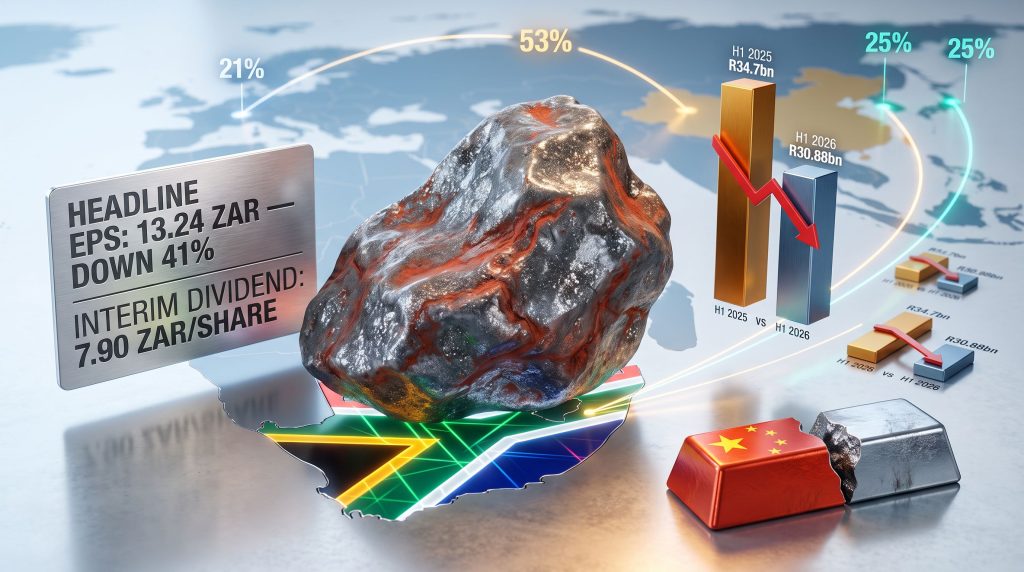
Kumba's headline earnings per share fell from 22.26 rand in H1 2025 to 13.24 rand in H1 2026, a decline that reflects the convergence of three distinct pressures operating at the same time rather than a single catastrophic event.
The most significant driver was currency. The South African rand strengthened approximately 11% against the US dollar during the first half of 2026. Because iron ore is priced globally in USD but Kumba reports in rand, every dollar earned converted into fewer rand than the prior year. This is a mechanical earnings headwind that operates entirely independently of how efficiently the mines are run or how much ore is shipped.
Layered on top of the currency effect was a 1% marginal decline in average realised iron ore prices, which compounded the revenue shortfall at the top line. Furthermore, on the cost side, cash costs surged 18% year-on-year, driven by higher fuel, shipping, and raw material expenses. A meaningful portion of this cost inflation traces back to elevated freight rates linked to disruptions associated with the Middle East conflict.
The combination of these three forces produced an 11% decline in total revenue to R30.88 billion, with iron ore sales volumes dipping a marginal 1% to 18.6 million metric tons. According to Kumba's official press release, these results reflect the full weight of macro-driven headwinds across the reporting period.
| Metric | H1 2026 | H1 2025 | Change |
|---|---|---|---|
| Headline EPS (ZAR) | 13.24 rand | 22.26 rand | -41% |
| Revenue | R30.88 billion | ~R34.7 billion | -11% |
| Iron Ore Sales Volume | 18.6 Mt | ~18.8 Mt | -1% |
| Cash Cost Growth | +18% YoY | Baseline | +18% |
| Interim Dividend (ZAR/share) | 7.90 rand | 16.60 rand | -52% |
| USD/ZAR Rate (period) | ~16.80 | ~18.60 | ZAR +11% |
"A 41% earnings decline driven by currency appreciation, cost inflation, and marginal price softness is not an operational failure. It is a structural exposure problem, and the difference matters enormously when designing a strategic response."
China's Steel Slowdown: Cyclical Blip or Permanent Recalibration?
The phrase "China's steel sector is weak" has appeared in iron ore company disclosures so frequently in recent years that it risks being dismissed as standard boilerplate. However, the data behind Kumba's H1 2026 results suggests something more durable than a temporary demand dip. Monitoring China steel demand closely reveals a pattern of structural rather than cyclical contraction.
China's crude steel production fell 3.1% year-on-year in the first half of 2026, extending a trend that reflects fundamental changes in the country's economic structure. The property sector, which historically accounted for an outsized share of steel consumption through construction activity, remains in a prolonged deleveraging cycle. Infrastructure investment, while still ongoing, is no longer generating the incremental steel demand volumes that characterised the 2000s and early 2010s growth phase.
For iron ore producers, this matters because China remains the world's largest seaborne iron ore importer by an enormous margin. When Chinese steel mills reduce output, they reduce ore purchasing, which suppresses benchmark 62% Fe CFR China prices and weakens the pricing environment for all producers globally. Consequently, iron ore price trends have reflected this sustained softness across multiple reporting periods.
The Concentration Risk That Made Kumba Vulnerable
At 58% China sales exposure in H1 2025, Kumba's earnings were structurally amplified in both directions by Chinese demand dynamics. When China buys aggressively, concentration works in a producer's favour. When Chinese steel output contracts for multiple consecutive periods, that same concentration accelerates earnings compression beyond what diversified producers experience.
The reduction to 53% China exposure in H1 2026 is deliberate strategy in action, not simply a demand-side outcome. However, a 5-percentage-point shift across six months, while meaningful directionally, still leaves the majority of Kumba's revenue dependent on a market undergoing structural contraction.
"Geographic concentration risk in commodity exports mirrors portfolio concentration risk in financial markets. The mathematics of diversification apply equally to customer geography as they do to asset allocation."
Decoding the Ex-China Sales Strategy: What It Actually Involves
Kumba's ex-China diversification framework is more nuanced than a simple headline about selling less ore to China. It represents a deliberate repositioning of the company's commercial relationships around the specific characteristics of its ore. The target is a medium-to-long-term sales mix where 45% to 55% of volumes are directed to non-Chinese buyers.
The current trajectory is shown clearly in the geographic shift already underway:
| Region | H1 2026 Share | H1 2025 Share | Direction |
|---|---|---|---|
| China | 53% | 58% | Declining (strategic) |
| Japan, South Korea and Other Asia | 25% | 21% | Growing |
| Europe | 21% | 21% | Stable |
The commercial logic underpinning this strategy rests on a critical piece of ore quality intelligence. Kumba's two primary operations, Sishen and Kolomela, both located in South Africa's Northern Cape province, produce iron ore with notably high iron content and low impurity levels. Sishen ore grades typically sit in the range of 64% to 66.5% Fe, well above the 62% Fe benchmark used in global pricing indices.
This distinction matters enormously in ex-China markets. European steelmakers and Japanese blast furnace operators have traditionally run furnace operations calibrated for high-grade, low-alumina, low-phosphorus ore. As a result, these buyers have historically paid a quality premium above the 62% Fe benchmark price, a premium that partially compensates Kumba for the longer shipping distances from South Africa compared to Australian competitors.
The Green Steel Opportunity: A Less-Discussed Demand Driver
One dimension of the ex-China strategy that receives less attention than it deserves is the growing relevance of direct reduction-grade iron ore in European and Japanese markets. The broader green iron transition is reshaping what buyers require from their ore suppliers, creating new commercial openings for producers with premium assets.
As steelmakers in these regions transition toward lower-carbon production pathways, including hydrogen iron ore reduction and electric arc furnace steelmaking, the ore specifications required change materially. Kumba's high-grade lump ore is naturally suited to feed these processes with minimal beneficiation.
This is not a near-term earnings catalyst but rather a long-duration demand development that could make the ex-China strategy more commercially robust over a five-to-ten-year horizon than current market pricing suggests.
The Structural Barriers the Strategy Must Overcome
Logistics: The Persistent Achilles Heel
No analysis of Kumba's commercial strategy is complete without addressing Transnet, South Africa's state-owned freight rail and port operator. Kumba's ore is transported via the Sishen-Saldanha iron ore export line, one of the longest single-commodity rail lines in the Southern Hemisphere at approximately 861 kilometres.
Transnet's operational performance has been a recurring constraint on Kumba's export capacity for several years, with volume throughput regularly falling short of nameplate capacity due to locomotive shortages, infrastructure maintenance backlogs, and operational disruptions. For a company attempting to build credibility as a reliable supplier to demanding international steelmakers, logistics unreliability is a commercial relationship risk that can undermine the very customer diversification strategy Kumba is trying to execute. The 1% dip in sales volumes to 18.6 million metric tons in H1 2026 is partly attributable to these constraints.
Freight Cost Disadvantage vs. Australian Suppliers
Australian iron ore producers benefit from significantly shorter shipping distances to Chinese and Northeast Asian ports compared to South African exporters. This geographic reality creates a structural freight cost disadvantage for Kumba that persists regardless of ore quality differentials. When iron ore benchmark prices are falling, this cost gap narrows the margin buffer available to absorb volatility.
Shipping to Europe partially addresses this asymmetry since voyage distances from South Africa to Rotterdam are more competitive relative to Australian departures. However, European import volumes are substantially lower than Asian demand pools, which limits the degree to which this advantage can offset the broader cost structure.
Dividend Policy and What the 52% Cut Signals
The interim dividend reduction from 16.60 rand to 7.90 rand per share is best understood as a mechanical consequence of Kumba's earnings-linked payout policy rather than a strategic signal about capital allocation priorities. The company's distribution framework is designed to pass earnings performance directly through to shareholders, both positive and negative.
A 41% earnings decline producing a 52% dividend cut reflects the specific calibration of that payout formula. Investors who hold Kumba for income rather than capital appreciation need to understand that this structure creates meaningful distribution volatility in periods of macro-driven earnings compression, even when underlying operations are performing adequately.
As reported by Energy News, the dividend reduction was widely anticipated given the scale of the earnings decline.
"The dividend cut is not a warning about balance sheet stress. It is the payout policy working exactly as designed in a down-earnings environment."
The next major ASX story will hit our subscribers first
Scenario Analysis: What Recovery Would Require
| Scenario | Key Trigger | Likely Earnings Impact |
|---|---|---|
| Base Case | Rand stabilises, iron ore holds ~$95-100/t | Modest H2 improvement vs H1 2026 |
| Bull Case | China stimulus boosts steel output, rand weakens | Material earnings recovery, dividend increase |
| Bear Case | Rand strengthens further, China steel output falls >5% | Further earnings compression, potential dividend suspension |
For a recovery to materialise, at minimum two of the three headwinds that compressed H1 2026 earnings need to reverse. A rand depreciation back toward the 18-19 range against the USD would mechanically boost rand-denominated revenue on unchanged USD iron ore prices. A stabilisation or modest improvement in Chinese steel output would support seaborne benchmark pricing. Furthermore, cost inflation needs to decelerate as freight market pressures potentially ease.
None of these outcomes are within Kumba's operational control, which underscores a fundamental reality about earnings trajectory for South African iron ore producers: macro forces often dwarf operational execution in determining financial results. The dynamics of the global iron ore market add yet another layer of external uncertainty that producers must navigate with limited direct influence.
Three Themes Every Iron Ore Investor Should Track
The Kumba Iron Ore profit drop and ex-China sales strategy carry broader lessons that extend beyond a single company's reporting period:
-
Currency management is as strategically important as commodity price. For rand-functional-currency miners selling dollar-denominated commodities, exchange rate movements can produce earnings swings that exceed the impact of commodity price changes. Investors should model both variables with equal rigour.
-
China's steel demand trajectory is a structural factor, not a cyclical one. The property sector deleveraging that underpins weaker Chinese steel consumption is a multi-year process. Producers that treat this as a temporary dip requiring patience rather than a structural shift requiring strategic adaptation are likely to remain exposed.
-
Ore quality is an underappreciated competitive differentiator in ex-China markets. High-grade, low-impurity ore commands real premiums from European and Japanese steelmakers, and the emerging green steel transition amplifies this dynamic. Consequently, African producers with premium ore assets are better positioned than their benchmark-grade counterparts to capture value in diversified markets.
The direction of Kumba's strategy is sound. The execution timeline, however, constrained by infrastructure, market absorption capacity, and macro forces beyond the company's control, remains the critical variable to monitor across the coming reporting periods.
Disclaimer: This article is intended for informational purposes only and does not constitute financial advice. Forecasts, scenario analyses, and forward-looking statements involve inherent uncertainty. Readers should conduct their own due diligence before making investment decisions. Past performance of commodity markets and mining equities is not indicative of future results.
Want To Stay Ahead of Major ASX Mineral Discoveries Before the Broader Market Catches On?
Discovery Alert's proprietary Discovery IQ model delivers real-time alerts on significant ASX mineral discoveries, transforming complex geological and market data into actionable investment insights for both short-term traders and long-term investors — explore historic examples of major discovery returns to understand the opportunity, then start your 14-day free trial at Discovery Alert to position yourself ahead of the market.