July 28, 2026
The Infrastructure Logic Behind Europe's Eastern Mediterranean Gas Bet
Deepwater gas development rarely follows a straight line from discovery to production. Between the moment a drill bit confirms a commercial accumulation and the day an LNG cargo departs for a European regasification terminal, years of engineering studies, commercial negotiations, government agreements, and partner alignment must converge. That convergence is precisely what makes a final investment decision meaningful, and why the Cronos gas field Cyprus FID, confirmed in July 2026, carries significance well beyond the borders of a small island nation in the Eastern Mediterranean.
Understanding why this matters requires looking at the infrastructure puzzle Eni and TotalEnergies solved, the commercial logic that underpins the 50/50 partnership, and the broader energy security context that elevates a deepwater Cypriot gas field into a project of regional strategic consequence.
When big ASX news breaks, our subscribers know first
From Discovery Province to Producing Nation: Cyprus's Upstream Crossroads
Cyprus has been an exploration story for well over a decade. The country's offshore blocks attracted significant international attention following the identification of substantial gas accumulations in its exclusive economic zone during the early 2010s, yet the path from resource confirmation to commercial development proved extraordinarily slow. Contractual complexities, geopolitical sensitivities involving competing maritime claims, and the fundamental challenge of commercialising stranded deepwater gas in a small sovereign jurisdiction without existing export infrastructure all contributed to a prolonged pre-development phase.
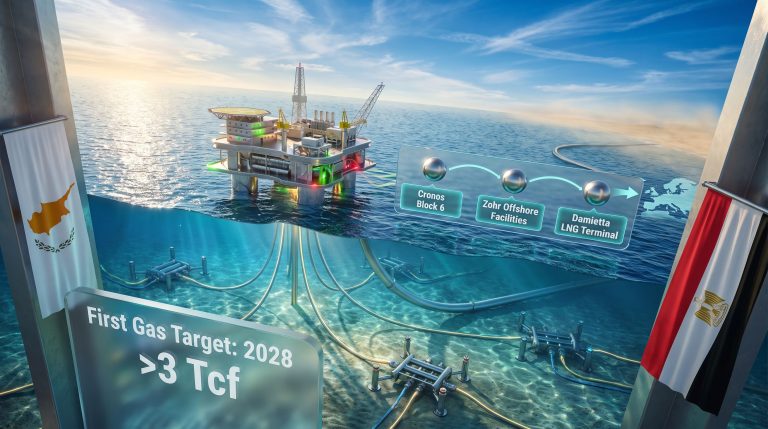
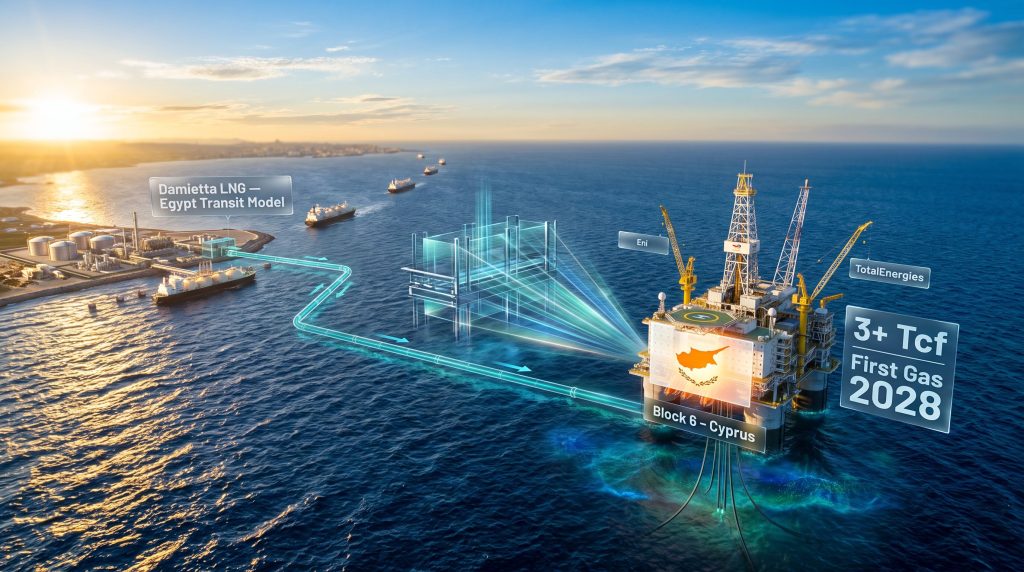
The Cronos gas field Cyprus FID changes that paradigm entirely. Cronos, located in deepwater Block 6 offshore Cyprus, is estimated to hold in excess of 3 trillion cubic feet (Tcf) of gas initially in place. Its development plan centres on four subsea deepwater wells targeting plateau production of approximately 500 million cubic feet per day (MMcfd), with first gas targeted for 2028. Critically, it represents the country's first-ever commercial hydrocarbon development, a threshold that no previous Cypriot gas project has managed to cross.
Cyprus's transition from exploration province to gas-producing EU member state is not merely symbolic. It repositions the country within European energy policy discussions and establishes a template for commercialising other undeveloped Eastern Mediterranean accumulations.
The FID Timeline: Understanding the Gap Between Optimism and Confirmation
The road to the July 2026 FID was not without friction. Cyprus's energy ministry had indicated as early as June 2026 that a final investment decision was imminent, contingent on cabinet approval of associated agreement signings. Industry observers noted shortly after that the expected announcement had not materialised on schedule, with negotiations between the Eni-TotalEnergies consortium and the Cypriot government described as stalled over liability provisions embedded within the contractual framework between the operating partners and the state.
This distinction matters for anyone seeking to understand the Cronos timeline accurately:
- A development and production plan approval was granted by Cyprus in May 2026, confirming regulatory acceptance of the field development concept.
- A formal FID is a separate, commercially driven decision by the equity partners to commit full capital expenditure, which requires all commercial agreements to be in place.
- The July 2026 FID announcement appears to represent the resolution of the contractual impasse that delayed the June timeline.
The July announcement described commercial agreements covering gas transportation, LNG liquefaction, and marketing to European buyers as constituting the execution framework for the project. This suggests the earlier contractual disputes had been resolved sufficiently to proceed.
How Cronos Gas Reaches Europe: The Egypt Transit Model
Perhaps the most technically sophisticated aspect of the Cronos development is its export pathway. Rather than constructing new greenfield LNG infrastructure, which would add years to the timeline and billions to capital costs, the partners designed a solution built around existing Egyptian assets. This approach to gas export infrastructure reuse is increasingly central to commercially viable deepwater development globally.
Step-by-Step: The Cronos Gas Export Pathway
- Subsea production from four deepwater wells in Block 6, offshore Cyprus.
- Offshore pipeline transit connecting Cypriot production westward to existing Egyptian offshore infrastructure, including facilities associated with the Zohr gas field.
- Onshore processing at Egyptian gas handling facilities prior to liquefaction.
- LNG liquefaction at the Damietta LNG terminal in northern Egypt.
- Cargo export from Damietta to European LNG receiving terminals.
This infrastructure-sharing approach compresses both cost and timeline in ways that greenfield development simply cannot match. The Damietta LNG plant, operated by Union Fenosa Gas, has existing nameplate capacity and established commercial relationships with European buyers, making it a natural anchor for the Cronos commercialisation strategy.
| Factor | Strategic Rationale |
|---|---|
| Existing liquefaction capacity | Eliminates multi-billion-dollar greenfield LNG construction |
| Zohr infrastructure linkage | Eni's operational familiarity reduces integration risk |
| Capital efficiency | Lower overall project capex compresses payback period |
| Timeline acceleration | 2028 first gas achievable only via existing capacity reuse |
| LNG cargo flexibility | Spot and term cargo optionality across European buyers |
| Reduced environmental footprint | Lower lifecycle emissions versus new-build LNG facilities |
Eni's role as both Cronos operator and the company behind Egypt's Zohr field development is not incidental. That dual positioning creates an institutional knowledge advantage: Eni understands the performance characteristics, capacity constraints, and operational protocols of the infrastructure through which Cronos gas will transit. This reduces integration risk in ways that would not be available to an operator without prior Egyptian offshore exposure. Furthermore, the LNG supply outlook for Europe makes this transit model particularly timely.
The 50/50 Partnership: Risk Architecture in Frontier Deepwater
Equal equity partnerships in deepwater frontier developments follow a particular commercial logic. When reservoir uncertainty remains elevated and the geopolitical environment introduces variables beyond either party's control, symmetrical ownership structures align incentives in ways that asymmetric arrangements cannot.
For Eni, Cronos extends its Eastern Mediterranean portfolio beyond Egypt and into Cyprus for the first time. The project fits within Eni's established strategy of fast-track deepwater development using infrastructure sharing to compress timelines and reduce the capital intensity that typically characterises frontier offshore projects.
For TotalEnergies, the strategic rationale operates on a different axis. The French major has actively pursued LNG supply diversification across its portfolio as a structural response to European energy security concerns. Cronos LNG cargoes flowing to European markets from 2028 onwards contribute to TotalEnergies' positioning as a supplier of non-Russian gas to its primary continental customer base, alongside its other Eastern Mediterranean and North African gas interests.
Eni's CEO described Cronos's fast-track approach as a concrete step toward positioning Cyprus as a European gas producer and exporter, while also characterising the project as an example of international cooperation contributing to European supply diversification. TotalEnergies' chairman and CEO described the launch as building a new regional gas hub in the Eastern Mediterranean, underpinned by Egypt's existing infrastructure base.
Risk Factors That Remain Even After FID
A final investment decision is a commitment to proceed, not a guarantee of delivery. Several risk dimensions remain live for the Cronos project despite the July 2026 milestone.
Contractual and Regulatory Exposure
The documented period of negotiation delay before the July FID signals that the liability framework between the consortium and the Cypriot state was a genuine point of contention. How thoroughly those issues were resolved, and whether residual contractual ambiguities could surface during project execution, remains an open question. Both the Cypriot and Egyptian governments are integral to the cross-border infrastructure arrangement, introducing sovereign risk from two separate jurisdictions.
Technical and Operational Interdependencies
- Deepwater subsea well construction in the Eastern Mediterranean carries the standard engineering challenges of high-pressure, high-temperature reservoirs at significant water depths.
- The Damietta LNG facility's operational capacity is not exclusively reserved for Cronos. If Egyptian domestic gas demand increases materially between now and 2028, throughput availability for Cypriot gas could face pressure.
- Any disruption to the offshore pipeline transit route through Zohr infrastructure introduces an operational interdependency risk that sits outside the direct control of the Block 6 partners.
Geopolitical Variables
The Eastern Mediterranean remains one of the world's more complex environments for upstream investment, and the broader geopolitical risk landscape demands continuous monitoring. Maritime boundary disputes between Cyprus and Turkey have historically created uncertainty for offshore operators. However, while Cronos sits within undisputed Cypriot exclusive economic zone waters, EU energy policy evolution post-2028 could also affect demand conditions for Eastern Mediterranean LNG imports.
Risk Callout: The Cronos project's commercial viability is structurally dependent on the continued operational availability of Egyptian LNG infrastructure, a dependency that introduces sovereign and operational risk factors outside the direct control of the Block 6 equity partners.
The next major ASX story will hit our subscribers first
Cronos in Regional Context: How the Field Compares
| Project | Country | Operator | Est. Resources | Export Route | Status |
|---|---|---|---|---|---|
| Cronos | Cyprus | Eni | 3+ Tcf GIIP | Damietta LNG via Egypt | FID July 2026 |
| Zohr | Egypt | Eni | ~30 Tcf GIIP | Domestic supply | Producing |
| Leviathan | Israel | NewMed/Chevron | ~22 Tcf | Pipeline to Egypt/Jordan | Producing |
| Aphrodite | Cyprus | Chevron/Shell | ~4.1 Tcf | Under negotiation | Pre-FID |
| Calypso | Cyprus | Eni/TotalEnergies | TBD | TBD | Exploration |
Note: GIIP = Gas Initially In Place. All resource figures represent publicly reported estimates subject to revision.
What the comparison table reveals is that Cronos, despite being the smallest confirmed development in the table by resource size, is the only Cypriot project to have crossed the FID threshold. Aphrodite, discovered before Cronos and carrying a larger estimated resource base of approximately 4.1 Tcf, remains in pre-FID status amid its own protracted commercial negotiations.
This reinforces a counterintuitive insight: resource size does not determine development pace. The availability of a credible, cost-effective export pathway often matters more than the volume of gas in place. In addition, the energy geopolitics shaping Mediterranean basin investment decisions continue to evolve in ways that advantage projects with clear commercial frameworks already in place.
The Cronos model — where Cypriot resources transit Egyptian infrastructure to reach European buyers via LNG — could serve as a template for unlocking other stranded Eastern Mediterranean accumulations. If Cronos demonstrates that the cross-border infrastructure-sharing mechanism is operationally and commercially viable, it strengthens the investment case for adjacent structures within Block 6 and potentially for other undeveloped Cypriot blocks.
Block 6 Beyond the Initial Development: Appraisal Upside
The partners have explicitly noted that Cronos's subsea infrastructure could support future commercialisation of additional gas resources within Block 6. This is a technically meaningful statement. Once a subsea production system, export pipeline, and processing agreement are in place, the marginal cost of adding production from nearby accumulations falls substantially compared to standalone development economics.
Calypso, also held by the Eni and TotalEnergies partnership within Cypriot waters, remains in exploration status. Should Cronos deliver on its production targets after 2028, it would considerably de-risk the commercial case for accelerating appraisal activity on adjacent structures. The infrastructure foundation being laid now is therefore not just about the initial 500 MMcfd plateau rate. It is about creating the physical and commercial architecture through which a broader Cypriot upstream industry can eventually be built.
What the Cronos FID Signals for European Energy Security
Europe's structural pivot away from Russian pipeline gas following 2022 created sustained demand for new, reliable, non-Russian LNG supply sources. The EU's REPowerEU framework accelerated the urgency of supply diversification, directing European energy policy firmly toward cultivating new import corridors. Against that backdrop, projects like the Cronos gas field Cyprus FID carry a significance that extends beyond their individual production volumes.
A field producing 500 MMcfd at plateau would represent a modest but meaningful addition to European LNG import capacity by 2028 — a period when several analysts anticipate tightening global LNG supply balances before a new wave of large-scale liquefaction projects comes online in the early 2030s. The timing alignment between Cronos's production ramp and a potentially supply-constrained European market window is commercially advantageous for both Eni and TotalEnergies. Consequently, European gas prices and import dynamics will be closely watched as the project advances toward first gas.
More broadly, the Cronos FID establishes Cyprus as a gas-producing EU member state, a status that carries both practical energy policy implications and symbolic weight within European institutional discussions about energy sovereignty. For a country whose energy sector has historically been entirely import-dependent, the commencement of domestic offshore production changes its position in regional and bloc-level energy negotiations. The Cypriot energy minister has noted that gas exports by end-2027 represent a stretch target, but one the government considers achievable given the current development trajectory.
Disclaimer: This article contains forward-looking statements regarding production timelines, resource estimates, and market conditions. All such projections are inherently uncertain and subject to change based on technical, commercial, regulatory, and geopolitical developments. This article does not constitute financial or investment advice.
Want to Stay Ahead of the Next Major Resource Discovery?
Discovery Alert's proprietary Discovery IQ model scans ASX announcements in real time, instantly identifying significant mineral discoveries and turning complex resource data into actionable investment insights — explore historic discoveries and their returns to understand the opportunity, then begin your 14-day free trial at Discovery Alert to position yourself ahead of the broader market.