July 29, 2026
When Environmental Law Becomes a Shield: The New Reality of Mining Arbitration in Mexico
Investor-state arbitration has long been viewed as the ultimate backstop for foreign companies operating in jurisdictions where political risk runs high. The theoretical promise is straightforward: if a host government crosses a line, treaty protections provide a path to meaningful compensation. But a growing body of arbitral outcomes is forcing a fundamental reassessment of that assumption, particularly in the extractive sector. The Mexico Vulcan Materials arbitration claim offers one of the most instructive examples of how environmental justification, applied strategically by a sovereign state, can compress a multi-billion-dollar claim into what the claimant itself described as a negligible financial outcome.
Understanding why that happens requires going deeper than the headline numbers.
When big ASX news breaks, our subscribers know first
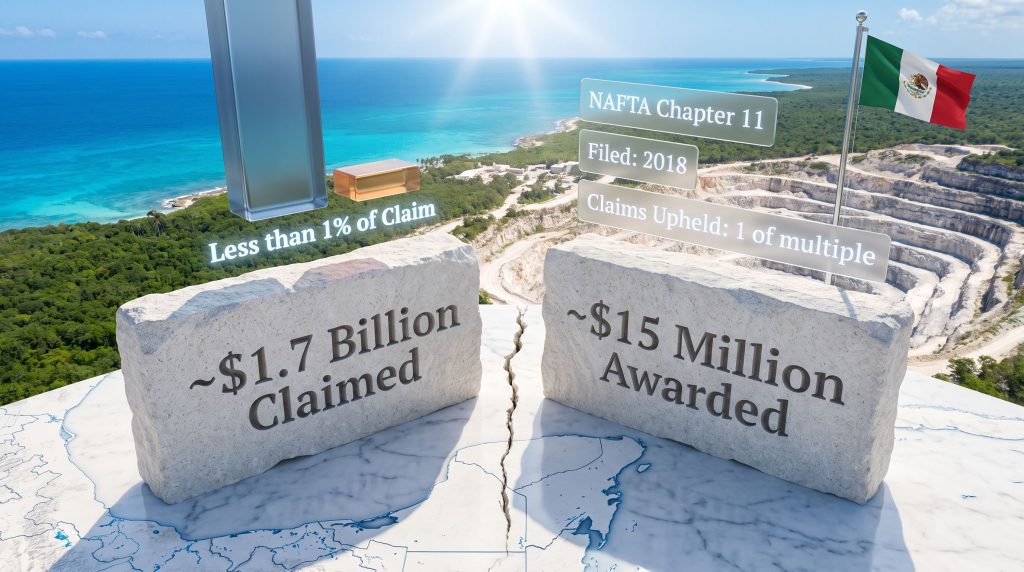
The $1.7 Billion Claim That Yielded Less Than 1%
When Vulcan Materials filed for international arbitration against Mexico in 2018, the scale of the dispute reflected the genuine commercial significance of its Quintana Roo operations. Through its Mexican subsidiary, Calizas Industriales del Carmen, commonly known as Calica, Vulcan had operated limestone quarrying and port infrastructure on the Yucatán Peninsula for decades. The company sought approximately $1.7 billion in compensation, arguing that Mexican authorities had unlawfully shut down its extraction operations in a manner that constituted de facto expropriation under the North American Free Trade Agreement.
The final outcome was strikingly different.
| Metric | Detail |
|---|---|
| Compensation Sought | ~$1.7 billion |
| Estimated Award | ~$15 million |
| Award as % of Claim | Less than 1% |
| Arbitration Filed | 2018 |
| Claims Upheld | 1 of multiple |
| Upheld Claim Relates To | January 2018 single-site closure |
Mexico's Economy Ministry confirmed that the arbitration tribunal dismissed nearly all of Vulcan's claims. Only one was upheld, relating specifically to the January 2018 closure of a single extraction site. The total compensation was reported at approximately $15 million, a figure so far removed from the original demand that it raises fundamental questions about how arbitral panels weigh treaty violations against state-invoked environmental justifications.
How the Quintana Roo Dispute Escalated to International Arbitration
The Calica Operations and Their Commercial Context
Limestone quarrying in Quintana Roo is not a peripheral industrial activity. The Yucatán Peninsula sits atop one of the world's most extensive karst limestone formations, making the region geologically exceptional for aggregate extraction. Calica's operations supplied construction-grade aggregate to markets including the United States Gulf Coast, with port infrastructure enabling seaborne export at scale. For Vulcan, one of the largest aggregates producers in North America, these operations represented a strategically important and logistically efficient supply source.
Karst geology, however, comes with a characteristic feature that made Calica's operations environmentally contentious from the outset: an intricate network of underground freshwater systems, including cenotes, sinkholes, and subterranean rivers, runs directly beneath the limestone cap. Extracting limestone below the water table in karst terrain means operating in close proximity to these hydrological systems, creating genuine potential for contamination and structural disruption.
Environmental Allegations and the Escalation Timeline
The dispute sharpened significantly under the administration of former Mexican President Andrés Manuel López Obrador, whose government intervention in Mexico argued that Vulcan's below-water-table extraction had caused severe damage to cenotes and contaminated underground river systems that form part of the region's ecologically sensitive aquifer network. These are not abstract environmental claims. The cenote systems of Quintana Roo are among the most extensive underwater cave networks on earth, and they supply freshwater to both local communities and a tourism economy worth billions of dollars annually.
Vulcan's position was categorically different. The company characterised the government's actions as politically motivated expropriation dressed in environmental language, and alleged that Mexico had disregarded a prior agreement specifically designed to release part of its aggregate reserves for continued extraction. The subsequent declaration of the affected land as an environmental protection zone, made after the operational closures, added another layer of legal complexity, as it raised questions about whether the designation was a legitimate conservation measure or a retroactive legal mechanism to limit compensation exposure.
The sequence of events leading to the 2018 arbitration filing followed a pattern of escalating regulatory interventions. The single closure event in January 2018, the only claim ultimately upheld by the tribunal, represented one discrete episode within a broader pattern of operational interference that Vulcan argued was coordinated and unlawful.
What the Tribunal Actually Decided
Confirmed Violations, Minimal Damages: Unpacking the Paradox
One of the most analytically important features of the Mexico Vulcan Materials arbitration claim outcome is that the tribunal did confirm NAFTA violations in several respects. Vulcan's own statements acknowledged this. Yet the financial award remained at roughly $15 million, a figure the company itself described as insignificant relative to its losses.
This apparent contradiction is not unusual in investor-state arbitration, and understanding why requires distinguishing between two entirely separate legal inquiries.
In investor-state arbitration, confirming a treaty violation and quantifying compensable damages are treated as distinct legal exercises with separate evidentiary standards. A tribunal may find that a government breached its treaty obligations while simultaneously determining that the claimant has not demonstrated a sufficiently direct causal link between that specific breach and the full quantum of commercial losses claimed. The burden of proof for damages is independent of the burden of proving a violation.
In practical terms, this means that Vulcan needed to demonstrate not simply that Mexico acted wrongfully, but that each dollar of claimed loss flowed directly from the specific treaty breach confirmed by the tribunal. When Mexico's environmental justifications were accepted as at least partially legitimate for the broader pattern of closures, the compensable scope narrowed dramatically to the single January 2018 incident where the tribunal found the state had acted without adequate legal basis.
Why Environmental Arguments Are So Effective in Limiting Arbitration Exposure
Sovereign states have increasingly recognised that environmental and public interest defences carry substantial weight in investor-state proceedings, and the Vulcan case illustrates the structural reasons for this. Furthermore, considerations around natural capital in mining are becoming central to how tribunals evaluate the legitimacy of state-imposed restrictions.
Three interconnected mechanisms reduced Vulcan's recoverable damages:
-
Causation gaps: The claimant must trace each element of financial loss to the specific unlawful act confirmed by the tribunal, not to the broader regulatory environment or business disruption caused by lawful state action.
-
Proportionality assessment: Tribunals routinely apply a proportionality analysis when evaluating state regulatory conduct, particularly where genuine public interest considerations are present. Even imperfect environmental enforcement may be deemed proportionate to legitimate conservation objectives.
-
Evidentiary thresholds for mining asset valuation: Quantifying the value of unexploited limestone reserves, projected cash flows from future extraction, and losses attributable to operational suspension involves complex modelling that faces intense scrutiny. Panels are often unwilling to accept speculative valuations for resources that were not yet extracted at the time of the breach.
Confidentiality and the Limits of Public Accountability
Vulcan indicated that the full tribunal decision would remain confidential until officially released. This is a common feature of investor-state arbitration that draws sustained criticism from transparency advocates. The public cannot independently evaluate the tribunal's reasoning, the evidentiary standards applied, or the methodology used to calculate the $15 million award. For observers trying to draw precedential lessons from the Mexico Vulcan Materials arbitration claim, this confidentiality creates meaningful analytical blind spots.
Comparing Arbitration Outcomes Across Mining Dispute Typologies
The Vulcan outcome is not an isolated anomaly. Across NAFTA and USMCA-era investor-state disputes involving extractive operations, award outcomes vary substantially depending on the nature of state action and the availability of public interest defences.
| Case Type | Claimed Amount | Award Outcome | Key Factor |
|---|---|---|---|
| Full expropriation, no environmental defense | High | Substantial recovery | Direct state seizure |
| Regulatory closure with environmental basis | High | Minimal recovery | Public interest defense |
| Partial operational interference | Moderate | Partial recovery | Proportionality applied |
| Single-site, time-limited closure | Low to Moderate | Limited award | Narrow breach confirmed |
The Vulcan case sits firmly in the second and fourth categories simultaneously: a high-value claim involving a closure with environmental justification, where the only upheld breach related to a narrow, time-limited event at a single site.
What This Ruling Signals for Foreign Mining Investment in Mexico
The Regulatory Risk Premium Revisited
For foreign companies operating in Mexico's extractive sector, the outcome of the Mexico Vulcan Materials arbitration claim recalibrates the perceived value of NAFTA and USMCA treaty protections. The lesson is not that treaty rights are worthless. The tribunal did confirm violations, and some compensation was awarded. Rather, the lesson is that the recoverable amount may be drastically lower than the commercial loss suffered, particularly when environmental justification is available to the state.
This has a direct effect on how sophisticated investors and legal teams should model political risk for Mexican mining operations. A treaty protection that yields less than 1% of claimed losses is better understood as a deterrent mechanism than a genuine financial backstop.
The USMCA Transition and Its Implications
The Vulcan arbitration was filed under NAFTA Chapter 11 in 2018, before the United States-Mexico-Canada Agreement came into force in 2020. USMCA significantly narrowed the scope of investor-state dispute settlement for US companies operating in Mexico. Under USMCA Annex 14-D, US investors in Mexico can only pursue ISDS claims related to direct expropriation or denial of justice in certain circumstances, and the broader fair and equitable treatment standard that underpinned many NAFTA Chapter 11 claims has been substantially curtailed.
Had the Vulcan dispute been initiated after USMCA came into force, the company's ability to bring several of its claims may have been more restricted. These strategic treaty implications are a critical consideration for US mining companies currently operating in Mexico, as the treaty architecture governing their dispute resolution rights is fundamentally different from the one that governed Vulcan's case.
The next major ASX story will hit our subscribers first
Due Diligence Frameworks for Ecologically Sensitive Mining Jurisdictions
The Vulcan case offers a practical template for what can go wrong when environmental risk is insufficiently integrated into operational and legal strategy from the outset. Robust mining project due diligence is essential for companies considering extraction in karst terrain, wetlands, or other ecologically sensitive geographies in Latin America. They should build the following considerations into their frameworks:
-
Conduct comprehensive environmental baseline documentation before any extraction commences, creating an independently verifiable record of pre-operational conditions.
-
Formalise any regulatory agreements in writing with binding, specific, and legally enforceable terms, avoiding reliance on informal understandings about reserve access or operational permissions.
-
Implement ongoing third-party environmental auditing to preempt state claims of damage and to build an evidentiary record that can be used in dispute proceedings.
-
Map applicable treaty protections under all relevant bilateral and multilateral investment agreements, accounting for the specific limitations of USMCA's ISDS provisions where applicable.
-
Develop contingency plans for operational suspension scenarios, including liquidity management and contractual force majeure provisions that limit downstream commercial exposure.
In addition, companies operating across multiple jurisdictions should review local mining claims framework structures to understand how regulatory designations can interact with international treaty rights, particularly where indigenous land rights or conservation designations may overlap with operational areas.
Frequently Asked Questions: Mexico Vulcan Materials Arbitration Claim
What was the Vulcan Materials arbitration claim against Mexico about?
Vulcan Materials, through its Mexican subsidiary Calizas Industriales del Carmen, filed for international arbitration against Mexico in 2018 under NAFTA Chapter 11 after Mexican authorities shut down its limestone quarrying and port operations in Quintana Roo state. Vulcan alleged that the closures constituted unlawful expropriation, while Mexico argued the actions were justified by environmental damage to cenotes and underground river systems caused by below-water-table limestone extraction.
How much did Vulcan Materials receive from the arbitration tribunal?
The tribunal awarded approximately $15 million, representing less than 1% of the roughly $1.7 billion Vulcan had sought in compensation. Reuters reported extensively on the company's subsequent legal actions following the expropriation of its land.
Did the tribunal find that Mexico violated NAFTA?
Yes. The tribunal confirmed NAFTA violations in several respects, but upheld only one specific claim related to the January 2018 closure of a single extraction site. The remaining claims were dismissed.
What environmental issues were central to Mexico's defence?
Mexico's position centred on allegations that Vulcan's extraction activities, conducted below the water table in karst limestone terrain, had damaged cenote systems and contaminated the underground rivers of the Yucatán Peninsula. The subsequent declaration of the affected land as an environmental protection zone reinforced the state's public interest justification.
What is Calizas Industriales del Carmen?
Calica is Vulcan Materials' Mexican operating subsidiary through which the Quintana Roo limestone quarrying and port operations were conducted. It was the formal claimant in the NAFTA arbitration proceedings. The UNCTAD investment dispute settlement database provides a detailed record of the case history and procedural timeline.
Does the ruling set a precedent for future mining disputes in Mexico?
The outcome reinforces the capacity of host states to invoke environmental justifications to limit arbitration exposure significantly, even when treaty violations are confirmed. For future claimants in Mexican extractive sector disputes, it underscores the importance of separating treaty violation claims from broader commercial loss claims and stress-testing damage models against potential environmental defences.
Key Takeaways From the Vulcan Arbitration Outcome
-
Confirmed treaty violations do not guarantee proportionate financial recovery. The gap between a NAFTA breach finding and the actual damages awarded can be substantial when environmental defences are accepted as even partially legitimate.
-
Environmental protection arguments are becoming structurally more effective in limiting state arbitration liability, particularly in ecologically sensitive geographies where public interest narratives carry weight with tribunals.
-
The USMCA framework provides narrower investor protections than NAFTA Chapter 11, meaning the Vulcan outcome may actually represent a relatively more favourable baseline compared to what future US claimants could pursue under current treaty architecture.
-
Headline arbitration claim figures are poor indicators of realistic recovery expectations. Legal and investment teams should apply substantial discounts to claimed amounts when modelling ISDS outcomes in disputes involving contested environmental justifications.
-
Karst geology creates unique legal exposure for mining operators because the hydrogeological interconnectivity of limestone terrains makes environmental impact claims both scientifically credible and politically resonant, providing host states with unusually strong narrative tools in arbitration proceedings.
This article is intended for informational and analytical purposes only and does not constitute legal or investment advice. Arbitration outcomes are jurisdiction and fact specific. Readers should seek independent legal counsel for guidance on investor-state dispute settlement matters.
Want to Stay Ahead of the Next Major ASX Mineral Discovery?
Discovery Alert's proprietary Discovery IQ model delivers real-time alerts on significant ASX mineral discoveries, transforming complex geological and market data into actionable investment insights — ideal for investors seeking an edge in the resources sector. Explore historic examples of exceptional discovery outcomes and begin your 14-day free trial at Discovery Alert to position yourself ahead of the broader market.