
July 10, 2026
How India's Insolvency Framework Became a Tool for Energy Sovereignty
When a sovereign nation cannot produce enough oil to meet its own industrial and transport needs, it faces a structural vulnerability that no trade agreement or diplomatic relationship can fully offset. India imports approximately 85% of its crude oil requirements, making it one of the most import-dependent major economies on the planet. In this context, every barrel of overseas equity oil that an Indian public sector undertaking secures is not merely a commercial asset — it is a strategic buffer against price shocks, supply disruptions, and geopolitical leverage from producing nations.
This is the lens through which the BPRL acquisition of Videocon oil and gas assets must be understood. What appears at first glance to be a distressed debt resolution — a consumer electronics conglomerate's upstream energy portfolio changing hands under India's insolvency framework — is, on closer examination, a calculated exercise in energy sovereignty executed through legal, financial, and diplomatic machinery that has been years in the making.
When big ASX news breaks, our subscribers know first
Understanding BPRL's Role in India's Upstream Architecture
Bharat PetroResources Ltd (BPRL) is the wholly owned upstream subsidiary of Bharat Petroleum Corporation Ltd (BPCL), one of India's largest state-owned oil marketing companies. While BPCL's primary business involves refining and fuel retail, BPRL was established specifically to pursue international upstream exploration and production opportunities — effectively functioning as BPCL's long-range instrument for equity oil acquisition.
BPRL operates through offshore holding structures, most notably BPRL Ventures BV, a Netherlands-registered entity. This structure is not incidental. Netherlands-domiciled special purpose vehicles offer Indian PSUs a range of practical advantages for cross-border upstream investment:
- Favourable bilateral tax treaty networks that reduce withholding tax on dividend repatriation
- Access to European debt markets at comparatively lower interest rates
- Structural insulation from domestic regulatory constraints on overseas borrowings
- Compatibility with joint venture agreements governed by non-Indian law
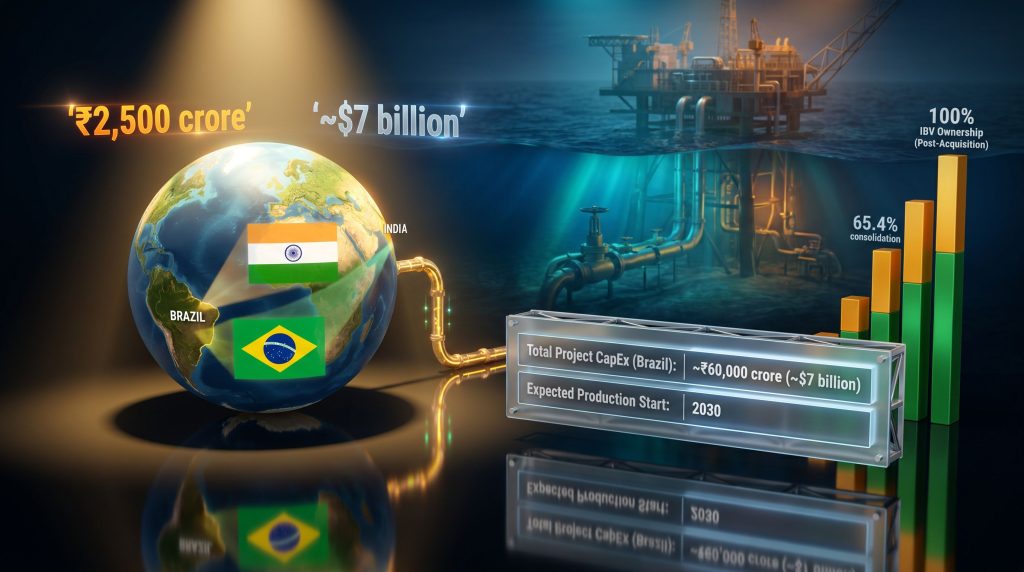
Prior to the Videocon transaction, BPRL already held a 65.4% stake in IBV Brasil Petroleo Ltda, the joint venture entity holding interests in Brazilian deepwater concessions. The remaining 34.6% stake was held by Videocon Energy Brazil Ltd (VEBL). Acquiring that residual position was the final step in BPRL consolidating full ownership of the IBV vehicle — and by extension, its Brazilian deepwater portfolio.
BPRL's international footprint also spans Indonesia, Mozambique, and Russia, mirroring India's broader upstream diversification strategy, which seeks to reduce exposure to any single geography or geopolitical relationship. Furthermore, governments intervening in the mining sector have demonstrated that state-directed asset consolidation is increasingly a global norm, not an exception.
Videocon's Upstream Portfolio: Strategic Value Hidden Inside a Collapsed Conglomerate
The Videocon Group was primarily known as a consumer electronics manufacturer, but its upstream energy division accumulated a genuinely significant global portfolio of offshore concessions. At the time of its insolvency, Videocon held interests in oil and gas assets across Brazil, Indonesia, and India.
The Brazilian assets are the crown jewels of this portfolio. The deepwater blocks BM-SEAL-11 and BM-C-30, located off Brazil's northeastern and southeastern coasts respectively, sit within one of the world's most prolific deepwater hydrocarbon provinces. Brazil's pre-salt and deepwater frontier has consistently attracted investment from the world's largest oil companies precisely because of its recoverable resource potential and Petrobras's technical capability as operator.
IBV Brasil Petroleo Ltda: Ownership Structure Before and After the Deal
| Entity | Stake in IBV Brasil Petroleo Ltda |
|---|---|
| BPRL (via BPRL Ventures BV) — Pre-Acquisition | 65.4% |
| Videocon Energy Brazil Ltd (VEBL) — Pre-Acquisition | 34.6% |
| BPRL — Post-Acquisition | 100% |
Petrobras remains the technical operator of these concessions, which is a critical structural feature. Operatorship by Brazil's national oil company means BPRL carries financial exposure without needing to deploy its own deepwater drilling and production infrastructure — a capital efficiency consideration that directly influenced BPRL's willingness to commit to the full development programme.
The Insolvency Mechanism: How a ₹30,000 Crore Debt Became a ₹2,500 Crore Acquisition
India's Insolvency and Bankruptcy Code (IBC), enacted in 2016, fundamentally restructured how distressed corporate assets change hands in India. Through the Corporate Insolvency Resolution Process (CIRP), creditors can collectively accept resolution plans that involve significant haircuts — accepting less than the full face value of their claims in exchange for a clean exit from a non-performing exposure.
The numbers here are extraordinary. Videocon's oil and gas division carried outstanding bank debt of approximately ₹30,000 crore owed to a consortium of 13 lenders. BPRL ultimately acquired the entire global upstream portfolio — Brazil, Indonesia, and India assets combined — for approximately ₹2,500 crore. The 13-bank creditor consortium effectively accepted a haircut of roughly 90%.
For context, this means BPRL acquired assets that will require a total capital investment of approximately ₹60,000 crore to develop — paying an entry price of just ₹2,500 crore to secure a 40% participating interest in one of the most prospective deepwater developments in the Southern Hemisphere. Indeed, BPCL's acquisition of Videocon's Brazil stake represents one of the most cost-efficient upstream entry points any Indian PSU has achieved in recent memory.
Why 13 Banks Accepted a 90% Haircut
Understanding why the creditor committee accepted these terms requires recognising several concurrent pressures:
- Videocon's consumer electronics business had collapsed comprehensively, eliminating any prospect of cross-subsidisation or group-level recovery
- Upstream oil and gas assets are jurisdiction-specific — Indian banks have limited ability to enforce claims against assets held in Brazilian or Indonesian legal structures
- Competing bids from Brazilian energy companies Eneva and PetroRio established a market-validated floor price, giving the creditor committee confidence that BPRL's offer reflected genuine arms-length valuation
- The alternative to accepting the resolution plan was prolonged litigation with uncertain recoveries — potentially worth even less in present value terms
- State Bank of India (SBI) led the creditor consortium and served as the primary settlement bank, with the mechanics involving a fund transfer from BPRL's Netherlands account to SBI's London account
This last point illustrates a nuance often missed in coverage of PSU-led insolvency acquisitions: when both the acquirer and the lead creditor are ultimately instruments of the Indian state, there is an implicit alignment of interest that can facilitate resolution at a pace and price that purely commercial negotiations might not achieve.
Legal Complexity: How BPRL Navigated a Multi-Agency Regulatory Labyrinth
The path to completing the BPRL acquisition of Videocon oil and gas assets was not linear. Over a period of several years, the transaction faced legal challenges across multiple Indian judicial and investigative bodies simultaneously. However, the resolution of each challenge ultimately reinforced the legitimacy of the process.
Key Legal Proceedings and Their Outcomes
- NCLT (National Company Law Tribunal): Approved the insolvency resolution plan for Videocon Oil Ventures Ltd (VOVL), providing the foundational legal authority for the asset transfer
- NCLAT (National Company Law Appellate Tribunal): Appellate proceedings ultimately resolved in BPRL's favour, clearing a significant pathway obstruction
- Enforcement Directorate (ED): Money laundering-related notices involving Videocon, in which BPCL was named as a party, were resolved over a period of approximately three to four months of intensive engagement
- Central Bureau of Investigation (CBI): BPCL's involvement as a named party in CBI proceedings was separately resolved prior to transaction completion
- Arbitration initiated by Videocon: Resolved in BPRL's favour, removing a contractual challenge to the transfer process
The Right of First Refusal: A Contractual Masterstroke
One of the most strategically significant — and least widely understood — elements of this transaction involves BPRL's Right of First Refusal (RoFR) embedded in the IBV Brasil shareholders' agreement.
When Brazilian companies Eneva and PetroRio submitted competing bids for Videocon's IBV stake during the insolvency process, BPRL was contractually entitled to match the highest offer price and exercise pre-emption rights to block any third-party acquisition. Counterintuitively, the existence of these competing bids benefited BPRL by generating an independent, market-validated price benchmark — meaning the ₹2,500 crore acquisition price was set by competitive market tension rather than unilateral negotiation with distressed sellers.
This is a sophisticated use of joint venture architecture that is common in international upstream agreements but rarely explained in public discourse. RoFR provisions are standard in upstream joint operating agreements precisely because producing nations and existing partners have strong incentives to prevent hostile or strategically misaligned parties from acquiring stakes in nationally significant hydrocarbon developments.
Brazil's ANP Approval: The Pending Regulatory Gateway
While the transaction between BPRL, the lender consortium, and Videocon was legally completed with the fund transfer from BPRL's Netherlands account to SBI's London account on June 29, 2026, a critical regulatory step remains outstanding.
Brazil's National Petroleum Agency (ANP) must separately approve any transfer of participating interests in Brazilian upstream concessions. The ANP's review timeline is notably wide: approval can technically be granted within 24 hours or may take up to six months, depending on the complexity of the review and the agency's administrative workload.
This creates an interesting legal asymmetry: the commercial and financial elements of the transaction are complete, but operationally, BPRL cannot exercise full rights over the Brazilian assets until ANP sign-off is received. This is not an unusual situation for cross-border upstream transactions — Brazilian hydrocarbon law requires the ANP to satisfy itself that the incoming party has the technical competence and financial capacity to meet its obligations under the concession agreement.
The next major ASX story will hit our subscribers first
The $7 Billion Development Programme: What BPRL Has Committed To
With acquisition complete and Cabinet approval for the full investment programme the next domestic milestone, the scale of BPRL's Brazilian commitment comes into sharp focus.
BM-SEAL-11 Development: Key Parameters
| Investment Parameter | Detail |
|---|---|
| Total Project CapEx | |
| BPRL Participating Interest | 40% |
| BPRL Capital Commitment | |
| Petrobras Capital Commitment | ~$3.2 billion |
| Petrobras Role | Operator |
| Expected Production Start | 2030 |
| Projected Annual Output | ~1 million tonnes of oil equivalent (MTOE) |
| Operating Committee Approvals | Already in place |
The production target of approximately 1 MTOE annually may appear modest relative to India's total crude import requirement of over 230 million tonnes per year, but equity oil from overseas assets carries strategic value disproportionate to its volume. Unlike purchased crude, equity oil can be directed to specific refineries, used as collateral for financing, or deployed as a hedge against spot market price spikes.
Financing the Commitment: Why BPRL Prefers Dutch Debt Over Domestic Equity
One of the more technically interesting dimensions of this transaction is BPRL's stated preference for financing its ~$2.7–$2.8 billion Brazilian capital commitment through project debt raised from its Netherlands-based subsidiary at approximately 6% per annum, rather than drawing equity from parent BPCL or borrowing domestically.
Comparative Financing Costs Across Indian NOC Upstream Structures
| Entity | Financing Approach | Estimated Cost of Capital |
|---|---|---|
| BPRL (Brazil) | Offshore debt via Netherlands SPV | ~6% p.a. |
| ONGC Videsh | Equity + bilateral debt | 7–9% |
| Chinese NOCs (CNOOC, CNPC) | State-backed concessional debt | 3–5% |
| IOC International | Parent equity + export credit | 7–8% |
The 6% offshore debt benchmark is notably competitive relative to India's domestic borrowing environment, where PSU bond yields and interbank rates often produce all-in borrowing costs above 7.5–8%. By raising capital in European markets through a Netherlands entity with a clean balance sheet and no exposure to India's domestic credit cycles, BPRL effectively achieves a 100–200 basis point cost advantage over alternatives.
BPCL remains available as an equity backstop if debt market conditions deteriorate, but the preference for offshore debt reflects a mature approach to capital structure optimisation that is increasingly common among India's more sophisticated PSU upstream operators.
Strategic Implications: What This Deal Signals Beyond the Transaction
The BPRL acquisition of Videocon oil and gas assets is significant not merely for what it secures — a 40% stake in a world-class deepwater development — but for what it demonstrates about the evolving sophistication of India's overseas upstream strategy. In addition, it sits within a broader global pattern of state-directed resource consolidation, where, for instance, critical mineral production under wartime powers is reshaping how governments think about strategic asset control.
Several broader signals emerge from this transaction:
- India's IBC framework is proving to be an unexpectedly powerful tool for PSU-led strategic asset acquisition, enabling access to globally significant hydrocarbon assets at distressed valuations that purely commercial processes would not replicate
- The Netherlands SPV model is becoming the structural standard for Indian PSU cross-border capital deployment, offering financing, tax, and legal advantages that domestic structures cannot match
- Brazil's deepwater frontier is now a core pillar of India's overseas upstream portfolio, complementing existing positions in Russia (ONGC Videsh's Sakhalin and Vankor stakes) and Mozambique
- The multi-agency legal resolution required to complete this deal — spanning NCLT, NCLAT, ED, CBI, and international arbitration simultaneously — reflects how complex Indian PSU overseas acquisitions have become, and how significant the institutional capacity required to execute them is
Consequently, these dynamics are not unique to India. The Ukraine-US minerals deal and similar resource-linked geopolitical arrangements further illustrate how major economies are using asset acquisition frameworks to reinforce energy and resource security simultaneously.
India's stated ambition of sourcing 15–20% of its crude oil from equity production by 2030 is an ambitious target given current equity oil volumes. BM-SEAL-11's projected 1 MTOE annual output, while meaningful, represents a single component in a portfolio that must grow substantially to approach that target. The strategic importance of this acquisition is real — but it also highlights how much work remains ahead.
Furthermore, as India continues to expand its overseas energy footprint, the import tax structure for LNG and broader energy pricing policy will remain closely intertwined with how effectively equity oil programmes like this one deliver on their supply security objectives. Similarly, partnerships such as the Energy Fuels and Chemours collaboration underscore how resource-rich nations are increasingly integrating upstream acquisition with downstream processing strategy — a model India may yet accelerate in its own energy transition planning.
Disclaimer: This article contains forward-looking statements regarding production timelines, capital expenditure projections, and regulatory approvals that are subject to material uncertainty. Actual outcomes may differ significantly from current estimates. Nothing in this article constitutes financial or investment advice. All figures are sourced from publicly available reporting and should be independently verified before being relied upon for any commercial purpose.
Want to Track the Next Major Resource Discovery Before the Market Moves?
Discovery Alert's proprietary Discovery IQ model scans ASX announcements in real time, instantly identifying significant mineral discoveries and turning complex resource data into actionable investment insights — the same category of strategic, high-conviction opportunities that drive the kind of long-term value creation explored in this article. Explore historic discovery returns on Discovery Alert's dedicated discoveries page and begin your 14-day free trial to position yourself ahead of the broader market.