June 20, 2026
The Information Gap Killing Brazil's Mining Investment Potential
Across the global mining investment landscape, one of the most persistent and costly problems is not geological risk or commodity price volatility. It is the structural disconnect between technically sound mineral assets and the capital markets that could fund their development. This gap is particularly pronounced in emerging market jurisdictions where geological endowment far outstrips institutional readiness, creating a paradox where resource-rich assets sit idle while investor capital searches elsewhere. The Braminvest 2026 seleção de projetos minerários para investidores has been designed to address precisely this challenge.
Brazil sits at the centre of this paradox in 2026, and addressing it has become both a commercial opportunity and a national economic priority.
When big ASX news breaks, our subscribers know first
Why Brazil's Mineral Wealth Is Attracting a New Wave of Global Capital
Few countries on Earth can claim the breadth of strategic mineral endowment that Brazil holds. The country is not merely a significant producer of one or two commodities. It occupies a genuinely rare position as a jurisdiction with substantial reserves across more than five critical minerals simultaneously, including gold, copper, nickel, lithium, niobium, rare earth elements, graphite, and manganese.
Why Niobium Matters
The significance of niobium alone deserves particular attention. Brazil accounts for over 90% of global niobium supply, a concentration of production dominance that is virtually unmatched in any other critical mineral category worldwide. Niobium is used to strengthen steel alloys and is increasingly explored for applications in battery technology, superconductors, and advanced materials. This level of market control in a mineral with growing industrial relevance is a strategic asset that few jurisdictions can replicate.
Beyond niobium, Brazil's lithium deposits, particularly those within the Quadrilátero Ferrífero region of Minas Gerais and across the northeastern states, are attracting intensified exploration activity. Furthermore, the critical minerals demand surge globally is reinforcing urgency among capital allocators to secure exposure to credible, developable projects. Rare earth projects are also gaining momentum, with active drilling campaigns underway at multiple Brazilian sites in mid-2026.
The macroeconomic backdrop reinforces this trend. Countries in the G7 are actively pursuing supply chain diversification strategies, which has elevated the perceived importance of stable, mineral-rich jurisdictions outside of Asia. Brazil's legal framework, through the Agência Nacional de Mineração (ANM), provides a functioning regulatory structure for mineral rights titling and environmental permitting that gives international investors a recognisable institutional foundation to engage with.
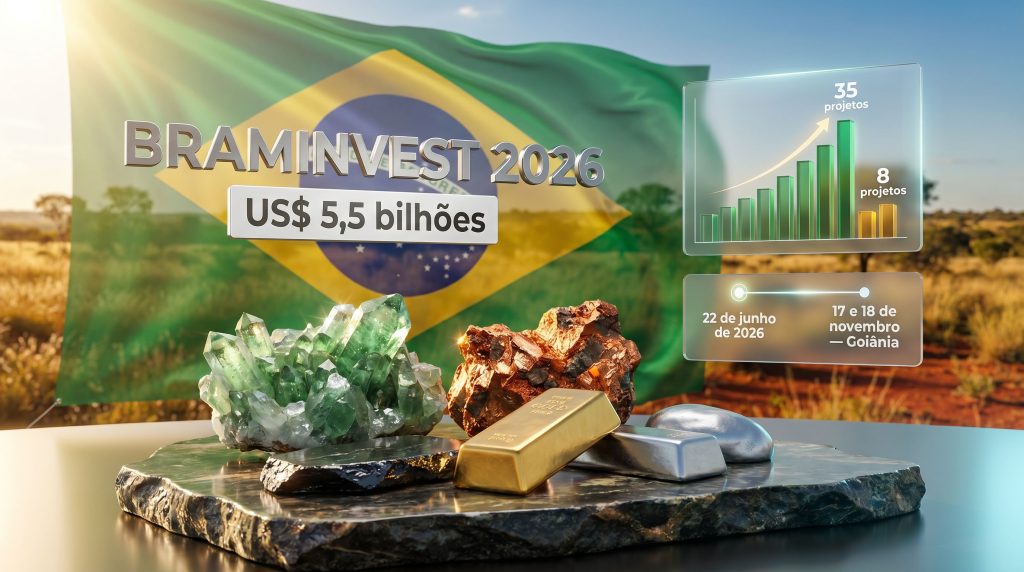
The Ministry of Mines and Energy's publication of the Investor Guide 2026 for Critical Minerals consolidates information about the investment environment, infrastructure availability, and support instruments for the sector. Brazil's participation at PDAC 2026 with a curated portfolio of 35 critical mineral projects valued at a combined estimated potential of US$5.5 billion, of which 8 projects were showcased at the Brazilian Mining Day, demonstrated growing institutional capacity. For broader context on that event's significance, the PDAC industry insights from 2025 illustrate just how central Brazil has become to global mining investment conversations.
Understanding the Core Problem: Why Good Projects Fail to Find Capital
Despite this geological and strategic backdrop, a significant proportion of Brazil's mineral assets remain stranded at early stages of development. The reasons are more structural than geological.
International investors conducting due diligence on Brazilian mineral projects frequently encounter several recurring obstacles:
- Incomplete or non-standardised technical documentation, including inconsistent geological mapping, missing geophysical or geochemical survey data, and unclear mineral rights status
- Environmental licensing uncertainty, which represents one of the most significant risk factors for foreign capital, given that delayed or incomplete licensing can immobilise projects for years
- Absence of investor-ready materials, meaning that even technically strong projects often lack the concise financial and technical teasers that investment committees require to begin serious evaluation
- No independent validation, leaving investors unable to distinguish between genuinely promising assets and projects with overstated potential
- Limited structured intermediation, where the pathway from identifying a project to formalising a partnership lacks defined processes and qualified facilitators
The cumulative effect is that investors either apply excessive valuation discounts to compensate for informational risk, or they bypass Brazilian projects entirely in favour of better-documented assets in competing jurisdictions. Consequently, viable projects remain underfunded not because capital is unavailable, but because the connective infrastructure between assets and investors has been missing. Understanding the broader junior mining investment landscape helps contextualise why this friction point is so costly for emerging jurisdictions like Brazil.
What the Braminvest 2026 Seleção de Projetos Minerários para Investidores Is Designed to Solve
The Braminvest 2026 event, scheduled for 17 and 18 November 2026 in Goiânia, Goiás, has been structured specifically to address this intermediation gap. Goiânia's selection as the host city is itself meaningful, reflecting Goiás state's growing profile in Brazil's mineral sector, with active exploration activity across gold, nickel, and other commodities in its geology.
The event operates as a curated business hub rather than a conventional mining fair. The distinction matters. At a traditional mining conference, any project can exhibit, creating significant noise for investors attempting to identify credible opportunities. At Braminvest, only assets that have passed a rigorous multi-stage technical curation process are presented to the investor audience. You can learn more about the event directly through the official Braminvest platform.
The Mineral Categories in Focus
The selection process for Braminvest 2026 seleção de projetos minerários para investidores targets assets across the following categories:
| Category | Minerals Included |
|---|---|
| Precious Metals | Gold |
| Base Metals | Copper, Nickel |
| Energy Transition Minerals | Lithium, Graphite |
| Brazilian Strategic Minerals | Niobium, Rare Earth Elements |
| Industrial Minerals | Manganese, Ornamental Rocks |
This breadth reflects a deliberate positioning strategy. By including both established investment categories like gold and copper alongside energy transition minerals like lithium and graphite, Braminvest is designed to appeal to a wide spectrum of capital, from traditional mining-focused funds through to energy transition-oriented investors and technology supply chain players.
How the Technical Curation Process Works in Practice
The formal curation process commenced on 22 June 2026, giving project holders sufficient lead time before the November event to complete documentation reviews and, where necessary, technical remediation.
The process operates as a sequential qualification framework:
Step 1: Initial Documentation Submission
Project holders submit foundational materials including:
- Active mineral rights registration with the ANM, confirming legal title and current status
- Geological research data encompassing geological mapping, geophysical surveys, and geochemical sampling results
- Current environmental licensing status, which functions as a primary risk indicator for international investors
- Landowner or surface rights agreements demonstrating operational access viability
Step 2: Preliminary Technical Assessment
The technical team conducts an independent evaluation against minimum criteria for economic attractiveness and technical viability. This is not a cursory review. Projects are assessed on the consistency and completeness of available data relative to their stated development stage. The outcome produces one of two pathways:
- Direct qualification for assets meeting all criteria
- Technical review referral for assets with identified documentation gaps or inconsistencies
Step 3: Qualification and Investor Material Preparation
| Assessment Outcome | Next Stage |
|---|---|
| Asset meets all criteria | Receives qualification seal for event presentation |
| Asset has identifiable gaps | Enters additional technical review and advisory period |
| Fully qualified asset | Investment teaser and qualification report generated |
The production of standardised investment teasers is one of the more practically important outputs of this process. These documents translate geological and technical data into the financial language that investment committees use. In addition, understanding drill results interpretation is essential context for appreciating why this translation process matters so much for bridging the communication gap between geologists and capital allocators.
A project with exceptional geology but poorly presented data will consistently lose out to a project with average geology and investor-ready documentation. The curation process at Braminvest attempts to correct this imbalance by ensuring technical merit is translated into commercial clarity.
The Technical Leadership Behind the Curation
The credibility of any technical curation process depends fundamentally on the qualifications of those conducting it. The Braminvest 2026 technical curation is coordinated by geologist Carlos Paraizo, whose professional profile spans 35 years of experience in the Brazilian and international mineral sector.
Paraizo holds a geology degree from the Universidade do Estado do Rio de Janeiro (UERJ), a master's degree in Structural Geology also from UERJ, and an MBA in Business Management from Fundação Getulio Vargas (FGV). The combination of advanced geological specialisation and formal business management training is relatively uncommon in the sector and directly relevant to the dual technical-commercial evaluation that curation requires.
His corporate career includes senior roles at Vale, Yamana Gold, MRN, and AngloGold Ashanti, with specialisations in exploration geology, mine planning, and operational management across gold, copper, and bauxite projects. Since 2006 he has held managerial positions, providing the administrative perspective necessary to evaluate not only geological merit but also operational feasibility and commercial viability.
The next major ASX story will hit our subscribers first
What Investors Can Expect from Qualified Projects
The value proposition for investors attending or engaging with Braminvest extends beyond simple project discovery. The curation framework is designed to reduce several of the most time-consuming and costly elements of the conventional mining investment process.
Comparative Value of Curated vs Non-Curated Projects
| Dimension | Uncurated Project | Braminvest-Qualified Project |
|---|---|---|
| Documentation quality | Variable and inconsistent | Standardised and independently verified |
| Informational risk for investor | High | Materially reduced |
| Due diligence timeline | Extended and expensive | Accelerated through pre-prepared materials |
| Credibility with international investors | Uncertain without third-party validation | Reinforced by independent technical seal |
| Available deal structures | Often undefined | Explicitly structured as full sale, partial stake, or joint venture |
The range of partnership structures available through the event is worth noting. For investors who have progressed to later-stage assets, the pathway toward a definitive feasibility study becomes a key milestone, and the structured deal frameworks at Braminvest are designed to support that progression. Specifically, the structures on offer include:
- Full asset acquisition covering complete transfer of mineral rights
- Partial stake acquisition allowing capital entry with defined project participation
- Joint venture formation establishing co-development structures with operational roles for both parties
- Strategic partnership agreements covering financing, technology access, or market facilitation without immediate ownership transfer
The Regulatory Architecture Underpinning Brazilian Mineral Investment
Understanding the ANM's role is essential for any investor evaluating Brazilian mineral assets. The ANM administers Brazil's mineral rights system, controlling the issuance, transfer, and maintenance of exploration authorisations and mining concessions. A project's ANM registration status is one of the first items any serious investor will verify, and any irregularities in titling can create significant transaction delays or liabilities.
Environmental licensing in Brazil operates through a tiered system involving federal, state, and municipal agencies depending on project scale and location. Projects within sensitive biomes such as the Cerrado or Amazon face additional regulatory layers. The distinction between a project with a preliminary licence, an installation licence, and an operating licence represents materially different risk profiles for investors, and the Braminvest curation process explicitly captures this information.
Surface rights agreements address a frequently underestimated complication in Brazilian mining investment. Mineral rights in Brazil are separate from surface land rights, meaning a valid ANM registration does not automatically confer the right to physically access and operate on the land. Projects that have not formalised surface access arrangements carry a form of operational risk that can cause significant delays or cost overruns.
How to Participate in the Braminvest 2026 Selection Process
For mineral asset holders seeking to participate in the Braminvest 2026 seleção de projetos minerários para investidores, the pathway is clearly structured:
- Confirm ANM registration status is current and the right is in good standing
- Compile all available geological research data, including mapping, geophysical surveys, and geochemical results, into a coherent package
- Document environmental licensing status precisely, noting the current licence stage and any pending applications
- Formalise surface rights arrangements or clearly document their current status
- Submit a pre-registration through the official portal at www.braminvest.com.br or via the Expert Brasil Mining team
- Engage with the technical review process and respond promptly to any requests for supplementary information
- Complete qualification to receive the event seal and participate in investor presentations in Goiânia on 17 and 18 November
Timing consideration: With the formal curation process having started on 22 June 2026, asset holders requiring technical remediation work should engage immediately to allow adequate time for the additional review cycle before the November event dates.
A Structural Shift in How Brazil Presents Its Mineral Assets to the World
The Braminvest model represents something more significant than a single event. It reflects a maturing recognition within Brazil's mining sector that geological endowment, however exceptional, is not sufficient on its own to attract international capital at scale. Initiatives like Braminvest collectively signal an evolution in how Brazil's mineral sector is positioning itself within global capital markets.
For investors, the practical implication is that the quality of information available on Brazilian mineral assets is improving in ways that reduce the historical due diligence premium applied to the jurisdiction. For project holders, the message is equally clear: technical merit must now be paired with investor-ready documentation and structured deal frameworks to compete for capital in an environment where multiple jurisdictions are actively courting the same pool of mining investment.
The Braminvest 2026 seleção de projetos minerários para investidores is designed to accelerate precisely this convergence.
This article contains forward-looking assessments and references to projected market conditions. Mineral investment involves significant risk including geological uncertainty, regulatory complexity, commodity price volatility, and capital loss. This content is informational in nature and does not constitute financial or investment advice. Readers should conduct independent due diligence and consult qualified advisors before making investment decisions.
Want to Stay Ahead of Significant Mineral Discoveries as They Happen?
Discovery Alert's proprietary Discovery IQ model delivers real-time alerts on significant ASX mineral discoveries, translating complex geological data into actionable insights for investors at every experience level — explore historic examples of major discovery returns to understand the potential at stake, and begin your 14-day free trial at Discovery Alert to position yourself ahead of the broader market.