
August 6, 2026
The Two-Phase Architecture of the Current Gold Bull Market
Monetary history does not repeat with precision, but it rhymes with remarkable consistency. Every major gold bull market and mining stocks cycle of the past century has followed recognisable patterns: a catalyst, an accumulation phase, a broadening of investor participation, and eventually a speculative blowoff or structural resolution. What distinguishes the present cycle is not simply that gold prices have risen, but how they have risen, and which forces have been driving the appreciation at each stage.
Understanding that architecture is essential for investors trying to navigate exposure today, because the rules of engagement have shifted meaningfully over the past twelve months, and the implications for portfolio positioning are profound.
When big ASX news breaks, our subscribers know first
What Is Actually Driving This Gold Bull Market?
Central Banks and the First Phase: Consistent, Non-Speculative Demand
The first phase of this bull market cycle was characterised by something genuinely unprecedented in modern monetary history: sustained, large-scale central bank gold demand as the primary demand driver. This was not episodic or reactionary purchasing. It represented a structural reallocation away from reserve currency assets, particularly US Treasuries, toward physical gold held in sovereign vaults.
This demand pattern produced a market dynamic with no direct historical precedent. Rather than the sharp rallies and equally sharp corrections that typically define commodity bull markets, gold during this phase exhibited a pattern of steady upward drift, punctuated by sideways consolidation periods that absorbed selling pressure before resuming the uptrend.
The consequence for related assets was equally unusual. Central banks do not purchase silver. They do not buy mining equities. The structural demand that was supporting gold had no transmission mechanism into those adjacent markets. This created a widening and sustained valuation gap: silver and gold mining stocks were priced as though the gold bull market was not happening, even as bullion climbed to successive record levels.
For investors with sector knowledge, this represented an extended window to accumulate gold-correlated assets at discounted relative valuations, a window that only closes once Western capital enters the market in force.
The Second Phase: Western Capital and the Shift to Volatility
The transition into the second phase of this cycle can be dated with some precision. Beginning around early August of the prior year, a notable inflection occurred in the gold-stock relationship between mining equities and gold itself. Gold mining stocks began outperforming bullion on a relative basis after months of lagging, signalling that a new class of buyer was entering the market.
The catalyst that formalised this shift was the Federal Reserve's Jackson Hole communication acknowledging the likelihood of forthcoming rate reductions. That signal acted as a starting gun for Western traders and institutional investors, who began rotating capital into gold-correlated instruments: mining equities, silver, and leveraged derivatives on gold futures and options markets.
The character of the gold market changed fundamentally with this shift:
- The steady, low-volatility appreciation of the central bank accumulation phase gave way to sharper rallies and steeper corrections
- Gold began trading as a macro risk asset, sensitive to central bank rhetoric and broader market sentiment
- During risk-off episodes, miners sold off alongside equities, decoupled from the actual gold price level
- Asian institutional buyers and central banks, rather than driving prices, transitioned toward absorbing supply at discounted levels
This two-phase structure is the defining architectural feature of the current cycle and explains much of the confusion investors experience when mining stocks decline despite elevated gold prices.
How Gold Mining Stocks Leverage the Gold Price
The Earnings Leverage Mechanism Explained
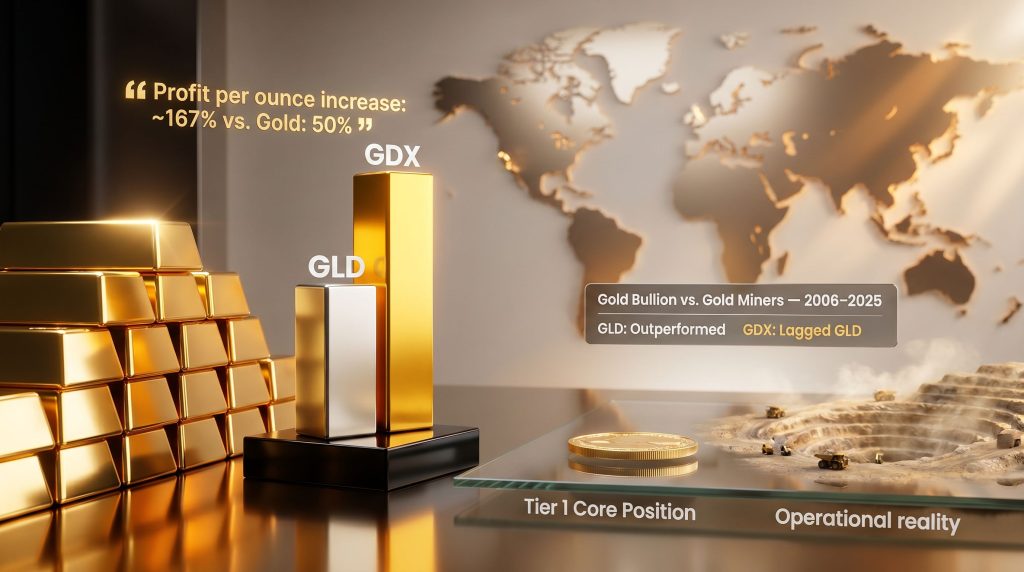
The investment thesis for owning mining equities rather than bullion rests on a specific financial mechanism: operating leverage arising from largely fixed cost structures. When a mining company produces gold at an all-in sustaining cost (AISC) of $1,200 per ounce and gold is priced at $2,000, the company earns an $800 margin. If gold rises to $3,000 per ounce without a proportional increase in costs, that margin expands to $1,800, representing a 125% increase in profitability on a 50% increase in the gold price.
This non-linear relationship between commodity price and corporate earnings is the theoretical foundation for why mining stocks should outperform bullion during strong bull market phases. Furthermore, research from VanEck has historically confirmed that gold equities have outperformed physical gold during sustained uptrends, precisely because of this margin expansion dynamic.
The Long-Term Data Complicates the Thesis
Despite the theoretical appeal, long-term performance data introduces important nuance. Over the full period from 2006 to 2025, the GDX gold miners ETF has lagged GLD, the physical gold bullion ETF. The earnings leverage argument holds in bull markets but works equally powerfully in reverse during downturns, and operational realities consistently erode the theoretical advantage.
| Metric | Gold Bullion (GLD) | Gold Miners (GDX) |
|---|---|---|
| Exposure Type | Direct price exposure | Earnings leverage |
| Volatility Profile | Moderate | High |
| Long-term (2006-2025) | Outperformed | Lagged GLD |
| Bull Market Behaviour | Steady appreciation | Historically outperforms |
| Primary Risks | Currency, storage | Operational, debt, reserves |
| Dividend Potential | None | Increasing at high gold prices |
| Ideal Investor Profile | Capital preservation | Higher return seeking |
The reasons mining stocks underperform their theoretical potential over full cycles include:
- Cost inflation: Energy, labour, and materials costs rise during the same commodity cycles that drive gold higher
- Reserve depletion: Ore bodies are exhausted; continuous reinvestment in exploration is required to sustain production
- Management quality variance: Unlike bullion, mining stocks require trusting a management team to execute complex capital decisions
- Geopolitical exposure: Many high-grade deposits are located in jurisdictions carrying meaningful sovereign risk
- Leverage amplification: Debt-laden miners face disproportionate downside during corrections
Anatomy of the Current Mining Stock Pullback
What the GDX Decline Reveals About Market Psychology
The GDX miner index fell from approximately 117 to a low near 73, representing a drawdown of roughly 38% from peak to trough. For investors new to the sector, a correction of this magnitude against a backdrop of still-elevated gold prices appears alarming, even contradictory.
The explanation lies in the market psychology shift described in the second-phase analysis above. When geopolitical tensions escalated and central bank rhetoric turned hawkish, traders who had entered mining equities as a leveraged macro trade treated them as risk assets and liquidated accordingly. The selling was sentiment-driven, not fundamentals-driven. Understanding how gold price and miners interact during these periods is consequently essential for investors who want to avoid reacting emotionally to short-term drawdowns.
Distinguishing between sentiment-driven sector corrections and genuine deterioration in company-specific fundamentals is arguably the most important analytical skill in precious metals investing. Conflating the two leads to selling at precisely the wrong moment.
The Bull Market Dip-Buying Framework
Historical analysis of every gold bull market cycle consistently supports a single strategic response to corrections within confirmed uptrends: systematic accumulation at depressed prices. This principle is reinforced by a recurring seasonal pattern in gold markets.
Gold has historically demonstrated a tendency to find cyclical lows between mid-July and mid-August, before strengthening through the fourth quarter of the year. This seasonal effect does not guarantee outcomes and should not be treated as a mechanical trading signal, but it has been a sufficiently consistent feature of gold market behaviour across multiple cycles to warrant attention in timing decisions.
The current pullback in mining equities appears disproportionate relative to the level of gold prices. Central banks and Asian institutional buyers have reportedly shifted from price-setting to price-taking behaviour, absorbing supply at discounted levels and providing a structural demand floor beneath the market.
Federal Reserve Policy and the Structural Rate Argument
The Debt Ceiling on Monetary Tightening
The debate over how hawkish the current Federal Reserve leadership intends to be misses a deeper structural constraint. The United States carries a sovereign debt load of such magnitude that the arithmetic of debt servicing places a practical ceiling on how high interest rates can be sustained. For the debt stack to remain serviceable without triggering a fiscal crisis, real interest rates must remain below the prevailing rate of inflation, a condition known as negative real rates.
Regardless of the rhetoric about inflation targets and balance sheet normalisation, the underlying mathematics of debt service constrains policy in ways that policy signals cannot override indefinitely. Any extended period of genuine positive real rates would accelerate debt servicing costs to levels that current fiscal revenues cannot support.
The investment implication is clear: periods of hawkish monetary signalling are likely to be temporary deviations from a structural trajectory toward easier monetary conditions. For gold and mining stocks, this creates a recurring dynamic where hawkish rhetoric generates pullbacks that resolve when structural reality reasserts itself.
Negative Real Rates: The Optimal Environment for Gold
The concept of negative real interest rates deserves precise definition for investors unfamiliar with the mechanism. A negative real rate occurs when the nominal interest rate offered on risk-free instruments falls below the prevailing rate of inflation. In this environment:
- The real return on holding cash or short-duration bonds becomes negative
- The opportunity cost of holding non-yielding assets like gold declines or disappears
- Investors seeking to preserve purchasing power are structurally incentivised to allocate toward hard assets
- Historical analysis consistently identifies negative real rate environments as the most powerful macro driver of gold price appreciation
The current policy environment, where hawkish rhetoric coexists with structurally constrained capacity for sustained rate increases, represents exactly the type of temporary divergence that creates buying opportunities in gold and mining equities.
Four Ways to Access a Gold Bull Market
Matching Investment Vehicle to Risk Tolerance
Not all forms of gold exposure carry equivalent risk profiles or return potential. Investors must, however, choose their position on the risk-return spectrum based on their objectives, time horizon, and capacity for volatility.
Physical Gold and Bullion-Backed ETFs
Provides the cleanest, most direct exposure to gold price movements without operational, management, or reserve-replacement risk. Appropriate for capital preservation objectives and portfolio diversification. Lower return ceiling but also the lowest probability of permanent capital loss. The gold safe-haven role is most purely expressed through this vehicle.
Senior Gold Producers
Established companies with producing assets, diversified reserve bases, and institutional-quality balance sheets. These offer earnings leverage to gold prices with lower operational risk than smaller peers. Free cash flow generation at elevated gold prices is increasingly supporting dividend programmes at major producers.
Royalty and Streaming Companies
These structures provide gold price exposure without direct operational risk. Revenue is generated through royalty agreements or streaming contracts with producing miners. Royalty companies offer a compelling risk-adjusted middle ground: higher return potential than pure bullion, with significantly lower volatility than mining equities. Many experienced sector investors consider royalty structures the optimal vehicle for long-term gold exposure.
Junior Explorers and Development-Stage Companies
The highest potential return category and the highest risk. Value creation in junior mining is driven by exploration success, resource definition, and eventual acquisition by larger producers. Understanding junior mining risks is essential before committing capital here, as the failure rate among junior companies is substantial. This category is appropriate only for investors with genuine sector knowledge and well-diversified portfolios.
The next major ASX story will hit our subscribers first
Key Principles for Mining Stock Selection
A Five-Point Evaluation Framework
Investors selecting individual mining stocks require a more disciplined analytical framework than general equity investors. The following criteria provide a structured approach:
- All-In Sustaining Cost (AISC) analysis: Calculate the margin between current AISC and the prevailing gold price. The wider the margin, the greater the earnings leverage and the more protected the company is during price corrections.
- Jurisdiction risk assessment: Prefer operating environments with stable mining-friendly regulatory frameworks. Sovereign risk can eliminate the return advantage of high-grade deposits.
- Reserve life and exploration pipeline: Companies with long reserve lives and active exploration programmes sustain production without continuous dilutive acquisitions.
- Balance sheet quality: Avoid heavily leveraged companies. Debt amplifies downside risk during corrections and can threaten solvency in extended bear markets.
- Management track record: Prior demonstrated success in building and operating mines is among the strongest available predictors of future capital allocation quality.
The Supply-Side Dynamic Supporting the Mid-Cycle Thesis
Why New Supply Cannot Quickly Respond to Higher Prices
A structural constraint on the supply side of the gold market strengthens the case that the current gold bull market and mining stocks cycle remains in an intermediate rather than terminal phase. Declining exploration investment over the preceding decade has created a depleted pipeline of future development projects.
New mine development timelines typically span 10 to 15 years from initial discovery through feasibility, permitting, construction, and first production. Even if the current gold price environment incentivises aggressive new exploration spending, the supply response cannot materialise within a timeframe that would cap the present cycle.
This supply-side inelasticity, combined with the structural monetary demand drivers described above, supports the argument that gold and quality mining equities remain attractively positioned for investors with medium-to-long time horizons. In addition, analysts tracking structural bull markets note that supply constraints of this nature have historically extended and amplified prior cycles well beyond initial expectations.
The Long-Term Endgame: Currency Depreciation and the Reset Scenario
Four Decades of Ever-Easier Money
The structural context for the current gold bull market extends well beyond the present economic cycle. Since the early 1970s, when the last formal connection between the US dollar and gold was severed, global monetary policy has followed a consistent trajectory: progressively easier financial conditions, declining real interest rates, and expanding money supply.
This multi-decade environment incentivised ever-increasing debt accumulation at every level of the economy. The current period represents what many analysts characterise as the terminal phase of that long cycle, defined by debt loads that cannot be sustainably serviced at historically normal interest rates.
Four and a half decades of ever-easier monetary conditions have produced a situation where the direction of travel, toward more rapid erosion of currency purchasing power, appears structurally embedded regardless of short-term policy signalling.
The Currency Reset Scenario
Historical precedent from every major monetary transition in modern history shows that credibility for fiat currency systems has ultimately been restored through some form of reconnection to a hard asset anchor. Gold has served this function consistently across different political and institutional contexts.
The timing of any such reset remains deeply uncertain. Whether a meaningful monetary revaluation or currency credibility crisis materialises in two years or twenty years is genuinely unknowable. What is more analytically tractable is the directional trend: purchasing power erosion is structurally embedded, and assets that preserve real value are structurally advantaged.
Scenario Framework: If a partial monetary reset or gold revaluation occurs, bullion holders capture the price appreciation directly. Mining equity holders capture both the price appreciation and the earnings leverage effect, potentially producing returns that are multiples of the gold price movement itself. This is the speculative endgame thesis that gives the current cycle its potentially historic character.
Disclaimer: Scenario projections involving monetary resets or currency revaluations are speculative by nature and should not be treated as investment advice or as predictions of likely outcomes. All investment decisions should be made in consultation with a qualified financial adviser.
Positioning Across Risk Tiers
A Practical Framework for Portfolio Construction
Building exposure across the gold sector requires matching allocation size to risk tier. A structured approach helps investors avoid concentration in the highest-risk categories while still capturing meaningful upside from the bull market thesis.
Tier 1: Core Position (Lower Risk)
- Physical gold or bullion-backed ETFs
- Large-cap senior producers with strong balance sheets and free cash flow
- Royalty and streaming companies
Tier 2: Growth Allocation (Moderate Risk)
- Mid-tier producers with expanding production profiles and defined resource bases
- Development-stage companies with clear pathways to production and manageable permitting risk
Tier 3: Speculative Allocation (High Risk)
- Junior explorers with high-impact drill targets in prospective geological terrain
- Early-stage companies in emerging gold districts where discovery potential is significant
The appropriate weighting across these tiers depends entirely on individual circumstances. What the structural evidence consistently supports is maintaining some exposure across multiple tiers rather than concentrating exclusively in either bullion or high-risk junior equities.
FAQ: Gold Bull Market and Mining Stocks
Do Gold Mining Stocks Always Outperform Gold in a Bull Market?
Not always. Mining stocks have historically outperformed gold during strong gold bull market and mining stocks phases due to earnings leverage, but over longer periods that include bear markets, the GDX miner index has lagged the GLD bullion ETF. Outperformance is most reliable during phases of strong gold price appreciation and expanding miner margins.
Why Did Mining Stocks Fall While Gold Remained Elevated?
Mining stocks are equity instruments and trade with equity market sentiment. During risk-off episodes, traders treat miners as risk assets rather than safe havens, and mining equities can decline even when gold holds its value. This disconnect often creates tactical buying opportunities for longer-term investors who understand the structural bull market case.
What Is AISC and Why Does It Matter?
All-In Sustaining Cost is the total cost per ounce required to sustain a mining operation, including direct mining costs, sustaining capital, and corporate overhead. The margin between AISC and the prevailing gold price is the primary determinant of mining company profitability and earnings leverage.
What Is the Gold Seasonal Pattern Investors Should Know?
Gold has historically exhibited a tendency to find cyclical lows between mid-July and mid-August, followed by stronger performance through the fourth quarter. This seasonal pattern does not guarantee outcomes but has been a consistent feature across multiple bull market cycles.
What Are Negative Real Interest Rates and Why Do They Matter for Gold?
A negative real interest rate occurs when the nominal interest rate falls below the rate of inflation, making the real return on cash or bonds negative. This environment historically drives strong gold price appreciation by reducing the opportunity cost of holding non-yielding assets. The structural debt constraint on US monetary policy creates conditions where negative real rates may persist regardless of short-term hawkish signalling.
Are Junior Mining Stocks Worth the Risk?
Junior mining stocks carry substantially higher risk than senior producers and are appropriate only for investors with high risk tolerance, genuine sector knowledge, and diversified portfolios. Potential returns can be exceptional when exploration programmes succeed, but failure rates among junior companies are significant and should not be underestimated.
General disclaimer: This article is for informational and educational purposes only and does not constitute financial, investment, or professional advice. All forecasts, scenario projections, and analytical frameworks represent opinion and involve uncertainty. Past performance of any asset class is not indicative of future results. Readers should conduct their own due diligence and consult a licensed financial adviser before making investment decisions.
Want to Identify the Next Major ASX Mineral Discovery Before the Broader Market Does?
Discovery Alert's proprietary Discovery IQ model delivers real-time alerts on significant ASX mineral discoveries, instantly translating complex geological data into actionable investment insights — whether you're building exposure in senior producers, royalty structures, or high-potential junior explorers. Explore historic examples of exceptional discovery returns and begin your 14-day free trial today to position yourself ahead of the market.