August 26, 2026
The Structural Fragility Behind Advanced Weapons Manufacturing
Decades of globalised supply chain optimisation produced something that looked like efficiency but functioned more like fragility. When the U.S. defence sector disaggregated its mineral supply chains across multiple international jurisdictions, the short-term cost savings masked a long-term strategic liability. Today, that liability is no longer theoretical. The world's most sophisticated weapons systems depend on materials that the United States no longer mines, processes, or refines in any meaningful domestic volume.
This is the underlying dynamic driving Lockheed Martin's active negotiations with North American mineral producers for long-term supply agreements covering scandium and germanium, two specialty materials with outsized significance in defence manufacturing. The story of Lockheed seeks US mineral supplies after Trump supply-chain push is not simply a procurement story. It is a window into a structural realignment that will reshape the economics of domestic mineral development for years to come.
When big ASX news breaks, our subscribers know first
Why Scandium and Germanium Are Not Interchangeable with Conventional Commodities
Most commodity shortages can be managed through substitution, price adjustment, or inventory buffering. Critical defence minerals operate under an entirely different logic. Their value is embedded not in volume but in specificity. These materials are written directly into the performance specifications of advanced weapons platforms, and their absence cannot be engineered around without fundamental redesign.
The Physics and Metallurgy Behind Scandium's Defence Role
Scandium's primary defence application lies in its ability to transform aluminium alloys. When added in small concentrations, scandium dramatically increases tensile strength, improves corrosion resistance, and enables welding without the grain coarsening that normally weakens aluminium structures. For aircraft manufacturers, this translates into structural components that are simultaneously lighter and stronger, a combination that directly affects payload capacity, fuel efficiency, and airframe longevity.
What makes this particularly significant is the dose-efficiency relationship: scandium delivers these metallurgical improvements at concentrations as low as 0.1 to 0.3 percent by weight. This means even modest supply volumes carry substantial manufacturing leverage. A relatively small annual supply contract can support production of a significant number of aircraft components.
Germanium's Role in the Electromagnetic Spectrum
Germanium occupies a different niche entirely. As a semiconductor with a narrow bandgap, it is the foundational material in thermal imaging systems, night-vision optics, and infrared sensors. Military platforms from the F-35 to ground-based surveillance systems incorporate germanium-containing lenses and detector arrays that function across low-visibility conditions. Furthermore, unlike scandium, where the supply chain challenge is upstream mining, germanium's complexity is concentrated in downstream refining and purification. The critical minerals for semiconductors dimension of this challenge adds yet another layer of strategic urgency.
| Mineral | Primary Military Application | Estimated Global Annual Consumption | U.S. Domestic Production Status |
|---|---|---|---|
| Scandium | Lightweight aluminium-scandium alloys for aircraft | ~60 metric tons and rising (USGS) | No domestic mining since 1969 |
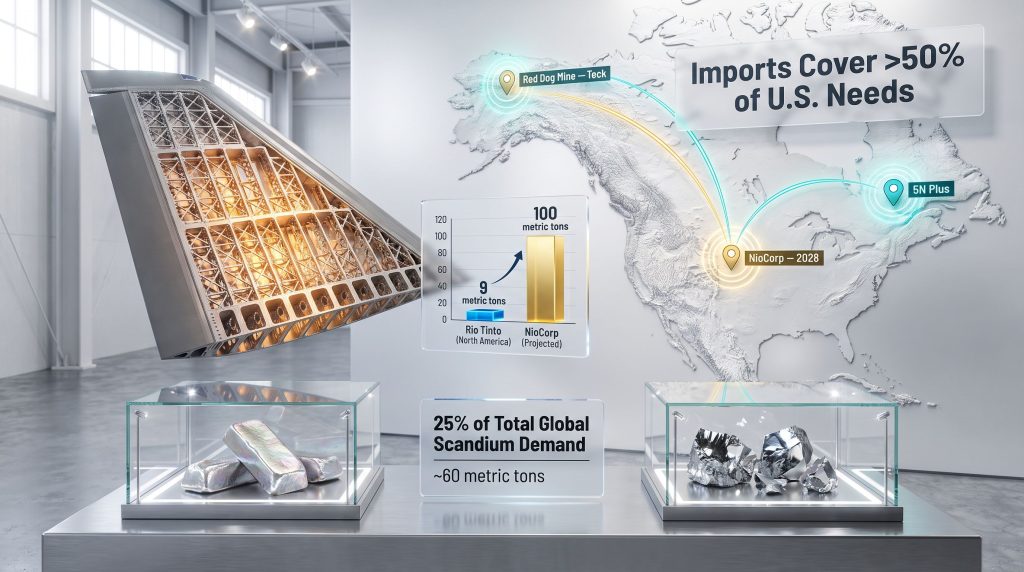
| Germanium | Infrared sensors, night vision, military electronics | ~60 metric tons and rising (USGS) | Imports cover more than 50% of U.S. needs |
The Executive Order That Changed the Procurement Calculus
From Voluntary Preference to Compliance Obligation
For years, defence contractors operated under a framework that nominally preferred domestic mineral sourcing but provided a practical escape valve: waivers. These waivers allowed contractors to continue purchasing minerals from Chinese suppliers and other restricted foreign entities when domestic alternatives were unavailable or uncompetitive on price. The waiver system effectively neutralised the policy intent of domestic sourcing mandates.
The Trump critical minerals order has restructured this framework by making waiver access significantly harder to obtain. This is not a marginal adjustment. It converts domestic mineral sourcing from a compliance preference into a practical necessity, creating a hard deadline rather than a soft incentive. For a company like Lockheed Martin, which faces multi-year platform production commitments with mineral inputs specified at the design level, this kind of regulatory shift demands immediate procurement action.
The removal of waiver pathways has fundamentally altered the risk calculus for defence procurement teams. Supply chain certainty has displaced price optimisation as the primary decision variable for defence-critical mineral contracts.
The Short, Medium, and Long-Term Cost Implications
The executive order creates a layered set of economic consequences across different time horizons:
- Short term: Contractors absorbing the Western-market price premium previously avoided through Chinese sourcing arrangements
- Medium term: Upward pressure on defence contract pricing as higher input costs flow through the procurement chain to government budgets
- Long term: Structural incentives for domestic mining investment as defence primes commit to long-term offtake agreements that provide revenue visibility for project developers
The policy also intersects with the broader Project Vault framework and Pentagon-supported mineral stockpile initiatives, which aim to buffer the transition period while domestic processing infrastructure is constructed. Consequently, allied-nation supply chains, particularly from Canada and Australia, are positioned as interim supply bridges during this development window.
NioCorp's Nebraska Project: The Numbers Behind the Agreement
Scale, Timeline, and Strategic Context
Colorado-based NioCorp Developments has reached a preliminary supply agreement to deliver approximately 15 metric tons of scandium per year to Lockheed Martin. The source of that supply would be NioCorp's planned Nebraska mine, which is targeting first production by 2028 with a projected annual output capacity of 100 metric tons.
To appreciate the significance of 15 metric tons in context: the U.S. Geological Survey estimates total global scandium consumption at roughly 60 metric tons annually. A single bilateral agreement between one defence contractor and one mining company would therefore represent approximately 25% of total global scandium demand. This is not a niche procurement arrangement. It would be a structurally significant reallocation of a globally scarce supply.
The current state of North American scandium supply makes this even more striking. Rio Tinto is the only active North American scandium producer, with annual output capacity of roughly 9 metric tons. The transition from a continent-wide capacity of 9 metric tons to a single project producing 100 metric tons would represent a fundamental transformation of North American supply architecture. This is precisely the kind of shift that the broader critical minerals demand surge has been accelerating across Western supply chains.
The Pentagon Relationship That Preceded Commercial Negotiations
The supply discussions between NioCorp and Lockheed did not emerge from a cold commercial approach. The two organisations already have an established working relationship through a Pentagon-funded research programme. This pre-existing technical collaboration is commercially significant because it means Lockheed's procurement teams have direct familiarity with NioCorp's metallurgical output characteristics and quality specifications, reducing the due diligence burden that typically slows new supplier qualification.
NioCorp's leadership has publicly positioned the Nebraska project as integral to the future of American defence technology, framing it not merely as a mining operation but as a national security infrastructure asset. The company's CEO has highlighted scandium's growing importance to defence platforms, a perspective that reflects the broader strategic framing Lockheed itself has adopted in acknowledging NioCorp's role in establishing a domestic scandium source.
Germanium: A More Architecturally Complex Supply Chain Problem
Why Byproduct Recovery Creates Multiple Points of Vulnerability
Germanium does not occur in economically recoverable primary deposits. It is extracted as a byproduct of zinc smelting, which means its supply chain is fundamentally linked to zinc production economics. When zinc markets weaken, smelter throughput declines, and with it the volume of germanium-bearing concentrate available for downstream processing. This creates a supply volatility mechanism entirely unrelated to germanium demand.
The separation of germanium from zinc concentrate also requires dedicated hydrometallurgical processing infrastructure. The step from mining a germanium-bearing zinc concentrate to delivering defence-grade germanium metal involves multiple processing stages, each representing a potential supply chain failure point.
Teck Resources and the Red Dog Production Pathway
Teck Resources operates the Red Dog mine in Alaska, the primary North American source of zinc-germanium concentrate. After mining, the concentrate is transported to Teck's smelting operations in British Columbia, where zinc and germanium are separated through a multi-stage processing sequence. Teck has described itself as the largest North American germanium producer and the fourth-largest globally, though it does not publish discrete annual germanium production figures.
Teck has also confirmed an agreement to work with the Canadian government to expand germanium processing capacity in British Columbia, a signal of allied-nation coordination on critical mineral supply that complements U.S. domestic sourcing initiatives. This Canada-U.S. supply chain integration is expected to remain a structural feature of American defence critical materials security throughout the domestic capacity build-out period.
5N Plus: Building Redundancy Through Recycled Feedstock
Quebec-based 5N Plus represents a second germanium supply pathway for Lockheed, one based on processing recycled feedstock rather than primary mine production. Earlier this year, 5N Plus received Pentagon funding to establish a germanium processing facility in Utah. This approach is strategically complementary to primary production because it draws on a different feedstock base, reducing concentration risk in the event of disruptions at primary mining or smelting operations.
The dual-track germanium sourcing strategy, combining Teck's primary production with 5N Plus's recycled-feedstock processing, reflects Lockheed's prioritisation of supply redundancy over cost efficiency.
What Are the Sticking Points in Over a Year of Negotiations?
Negotiations with both Teck and 5N Plus have been ongoing for more than twelve months. According to sources familiar with the discussions, the primary friction points are contract pricing and the duration of long-term supply commitments. Western germanium producers carry structurally higher cost bases than Chinese suppliers, driven by differences in environmental compliance requirements, labour costs, and regulatory frameworks.
| Factor | Western Producers | Chinese Suppliers |
|---|---|---|
| Environmental compliance costs | High | Lower regulatory burden |
| Labour cost structure | Higher | Lower |
| State subsidisation | Limited | Significant in some cases |
| Export control risk | None | Escalating (China tightening controls) |
| Supply chain security | High | Declining as geopolitical risk rises |
The core negotiating question is at what price premium supply chain security becomes economically rational for a contractor facing mandatory domestic sourcing compliance. China's escalating export controls on germanium and gallium are paradoxically improving the commercial case for Western alternatives by compressing the effective price advantage Chinese suppliers retain.
The Processing Infrastructure Gap: America's Acute Mineral Vulnerability
Mining Potential Versus Industrial Processing Capacity
A frequently misunderstood aspect of U.S. critical mineral vulnerability is that the primary constraint is not geological. The United States has substantial mineral endowment across a range of critical materials. The acute bottleneck is in midstream processing and refining infrastructure, the facilities that convert raw ore or concentrate into the specification-grade materials that defence manufacturing requires.
This distinction matters enormously for investment and policy timelines. Building a new mine takes years, but rebuilding an entire industrial processing sector takes longer and requires different capital, different engineering expertise, and different workforce capabilities. Allied-nation capacity, particularly Canada's hydrometallurgical infrastructure, is expected to carry a significant portion of U.S. defence mineral demand throughout the 2020s transition period. In addition, wartime mineral production frameworks are increasingly being invoked to accelerate permitting and financing timelines.
| Development Stage | Mineral | Key Constraint | Estimated Timeline |
|---|---|---|---|
| Advanced pre-production | Scandium | Financing and permitting | ~2028 (NioCorp Nebraska) |
| Active primary production | Germanium concentrate | Downstream processing capacity | Operational (Teck Red Dog) |
| Processing expansion | Germanium refined | Capital investment and feedstock | Near-term (5N Plus Utah) |
| Broader pipeline | Multiple critical minerals | Dozens of U.S. projects under development | 2026 to 2032 |
The next major ASX story will hit our subscribers first
What Lockheed's Procurement Strategy Signals to Capital Markets
The Shift from Spot Purchasing to Long-Term Supply Architecture
Lockheed seeks US mineral supplies after Trump supply-chain push not merely as a near-term compliance exercise, but as a fundamental repositioning of how defence contractors approach mineral inputs. For most of the past two decades, the availability of cheap Chinese supply made long-term domestic contracts economically unattractive. The current regulatory and geopolitical environment has inverted this calculus entirely.
Sources familiar with the germanium negotiations have described Lockheed's core objective as long-term supply chain security, independent of short-term price optimisation. This framing, supply certainty as the primary procurement objective, is a significant shift for an industry that has historically treated raw material sourcing as a cost management function.
The Cascading Effect on Western Mineral Project Development
When the world's largest defence contractor formalises long-term domestic supply agreements, it sends a powerful signal to the capital markets that fund mineral project development. Historically, one of the most significant barriers to financing domestic critical mineral projects has been the absence of committed long-term demand. Projects in feasibility or permitting stages have struggled to demonstrate offtake security to debt providers and equity investors.
Lockheed's procurement posture, if replicated by peer defence contractors facing the same waiver restriction pressures, could create a wave of offtake agreements that fundamentally de-risk the financing of domestic mineral projects across the development pipeline. This demand signal is arguably as important as direct government investment in accelerating the broader U.S. critical mineral build-out. Defence News has highlighted that these deals would mark a significant step in the U.S. push to build domestic mineral capacity.
Long-term supply agreements between major defence primes and domestic mineral producers function as de facto demand anchors, potentially unlocking private capital formation for projects that have historically been unable to secure commercial financing without government support.
Frequently Asked Questions
What makes scandium irreplaceable in defence aircraft manufacturing?
Scandium's value in defence applications stems from its unique interaction with aluminium at the metallurgical level. When incorporated into aluminium alloys at very low concentrations, scandium refines the grain structure of the metal, producing a material that is significantly stronger, more resistant to fatigue cracking, and weldable without strength loss. For platforms like the F-35, where every kilogram of structural weight directly affects range, manoeuvrability, and payload, these properties translate into measurable performance advantages that no currently available substitute can fully replicate.
Why does the U.S. import more than half of its germanium needs despite having relevant mineral resources?
The core issue is not geological availability but industrial infrastructure. Germanium is recovered as a byproduct of zinc smelting, which means domestic production requires both active zinc smelting operations and the specialised downstream processing equipment to separate and purify germanium to defence-grade specifications. The dismantling of much of the U.S. smelting sector over decades, combined with historically low Chinese prices, eliminated the economic incentive to maintain this processing capacity domestically.
How does the executive order change defence contractor procurement behaviour in practice?
Prior to the executive order, contractors could obtain waivers permitting Chinese mineral sourcing when domestic alternatives were unavailable or uneconomic. The restriction of waiver access converts this from a practical option into an exceptional circumstance requiring significant justification. Procurement teams at major defence contractors now face a compliance obligation to demonstrate active engagement with domestic or allied-nation supply chains, regardless of the short-term cost differential.
What is the significance of NioCorp's Nebraska project in the context of global scandium supply?
NioCorp's projected annual production of 100 metric tons from its Nebraska mine would represent a transformation of global scandium supply. Against a USGS-estimated global demand of approximately 60 metric tons per year, a single project would exceed total current global consumption. The preliminary agreement to direct 15 metric tons annually toward Lockheed would alone represent roughly 25% of total global scandium demand, illustrating both the scale of the project and the extent to which global scandium supply has historically been constrained.
Key Takeaways: The Strategic Realignment of U.S. Defence Mineral Supply Chains
- The restriction of Chinese mineral sourcing waivers has transformed domestic supply chain development from a strategic aspiration into a procurement compliance requirement for U.S. defence contractors
- Scandium and germanium represent structurally distinct supply chain challenges: scandium requires a single new primary mine, while germanium depends on a multi-party network of smelting, separation, and refining infrastructure across North America
- Western producers face a structural cost disadvantage relative to Chinese suppliers that will require either sustained supply disruption from China, government pricing support mechanisms, or both, to fully close on commercial terms
- Lockheed seeks US mineral supplies after Trump supply-chain push in a manner that signals supply chain certainty has displaced price optimisation as the primary procurement objective for defence-critical materials
- North American allied supply chains, particularly Canada's existing processing infrastructure, will remain integral to U.S. defence mineral security throughout the multi-year domestic capacity build-out
- If major defence primes formalise domestic supply agreements at scale, the resulting demand visibility could unlock private capital formation for the broader U.S. critical mineral development pipeline, accelerating project timelines independent of direct government investment
This article is provided for informational purposes only and does not constitute financial or investment advice. Statements regarding future production timelines, contract negotiations, and supply projections involve inherent uncertainties. Readers should conduct independent due diligence before making any investment decisions related to companies or sectors discussed herein. Further analysis on U.S. critical mineral supply chain development is available at Reuters.com.
Want to Track the Next Major Critical Mineral Discovery Before the Market Does?
Discovery Alert's proprietary Discovery IQ model delivers real-time alerts on significant ASX mineral discoveries — instantly translating complex geological data into actionable investment insights for both short-term traders and long-term investors. Explore historic examples of exceptional discovery returns or visit Discovery Alert to begin your 14-day free trial and position yourself ahead of the next major critical mineral find.