June 27, 2026
How Does Brazil's Rare Earth Endowment Actually Compare to the Rest of the World?
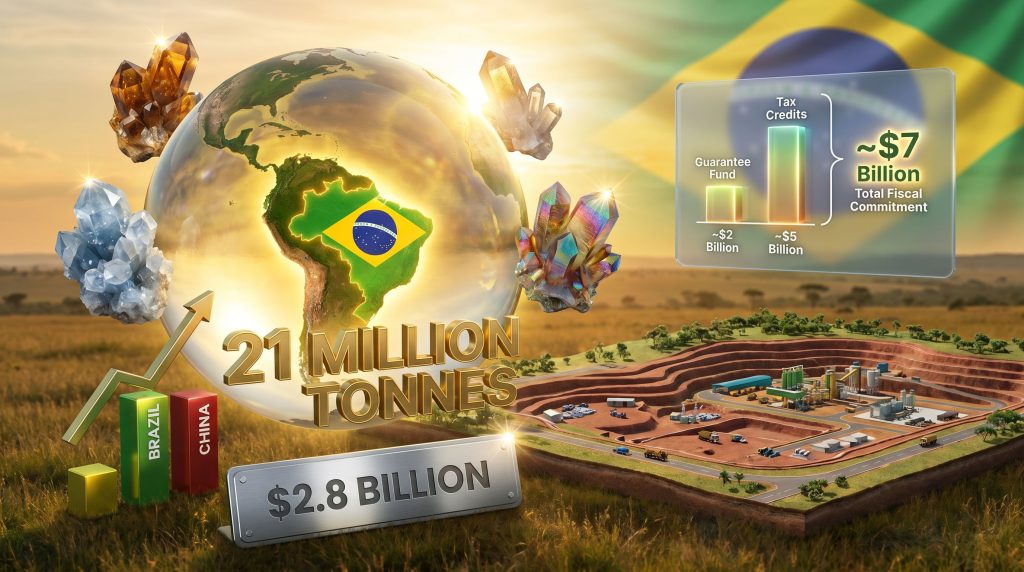
Brazil's geological position in the global rare earth hierarchy is frequently cited but rarely examined with the nuance it deserves. Lula wants Trump to invest in Brazil's rare earths, and understanding why requires looking beyond headline tonnage figures to the compositional and geological characteristics that determine genuine strategic value. The country holds an estimated 21 million tonnes of rare earth reserves, placing it among the top tier of global resource holders alongside China, Vietnam, and Russia.
| Country | Estimated Rare Earth Reserves (Million Tonnes) | Share of Global Total |
|---|---|---|
| China | ~44 million | ~34% |
| Vietnam | ~22 million | ~17% |
| Brazil | ~21 million | ~16% |
| Russia | ~21 million | ~16% |
| India | ~6.9 million | ~5% |
| Other | Remainder | ~12% |
What distinguishes Brazil's reserves from many competing jurisdictions is geological diversity. The country's deposits span three distinct formation types: ionic adsorption clays primarily concentrated in the Goiás state and parts of Minas Gerais; carbonatite-associated deposits centred on the Araxá region; and placer deposits associated with certain river systems. Each formation carries different processing requirements, environmental profiles, and economic characteristics.
The ionic adsorption clay deposits deserve particular attention. These formations contain rare earth elements adsorbed onto clay mineral surfaces rather than locked within dense crystalline rock structures. This geological configuration enables extraction through relatively low-intensity ion-exchange processes using dilute solutions, operating at ambient temperatures and pressures. The implications are significant:
- Energy consumption is approximately 40 to 50 percent lower compared to hard-rock processing operations
- Radioactive byproduct generation is substantially reduced, with ionic clay operations typically producing 0.5 to 1.0 tonnes of radioactive waste per tonne of rare earth oxide, versus 2 to 3 tonnes for conventional hard-rock methods
- Environmental permitting tends to be less contentious given the reduced tailings footprint
- Recovery rates for ionic clay processing average between 75 and 85 percent across the full suite of rare earth elements
Critically, Brazil's ionic clay deposits contain a notably favourable ratio of neodymium to praseodymium, two elements central to the production of neodymium-iron-boron (NdFeB) permanent magnets used in electric vehicle motors and wind turbine generators. Beyond light rare earth elements, Brazilian deposits also carry meaningful concentrations of heavy rare earth elements including dysprosium and terbium.
These elements command significant price premiums and represent the most strategically sensitive segment of the rare earth spectrum, given China's near-total dominance over global heavy rare earth processing capacity. Furthermore, understanding rare earth supply chains helps contextualise why Brazil's heavy rare earth content is so commercially significant.
The distinction between light and heavy rare earth elements is more than academic. LREEs like cerium and lanthanum are abundant and relatively low in value, while HREEs like dysprosium and terbium are scarce, expensive, and irreplaceable in high-performance permanent magnets. A deposit rich in HREEs is worth disproportionately more than its total tonnage would suggest.
When big ASX news breaks, our subscribers know first
What Is Serra Verde and Why Does It Anchor Brazil's Rare Earth Narrative?
Brazil's Only Operating Commercial Rare Earth Mine
Serra Verde, situated in the Goiás state of central Brazil, occupies a unique position in the global rare earth landscape as the country's sole commercial-scale operating rare earth mine. The project extracts mixed rare earth carbonate from ionic clay deposits, leveraging the processing advantages described above to produce a product suitable for further separation and refining into individual rare earth oxides.
The project's ionic clay geology gives it a processing cost structure that is meaningfully lower than most hard-rock competitors, while its heavy rare earth content provides a product mix that aligns with the most pressing demand growth segments in the clean energy and defence technology sectors. Consequently, Serra Verde has attracted sustained international attention from strategic investors seeking non-Chinese supply options.
The $2.8 Billion Signal: What the USA Rare Earth Acquisition Means
The announced plans by USA Rare Earth to acquire Serra Verde for approximately $2.8 billion constitute one of the most significant critical minerals transactions in the Americas in recent years. The deal's significance operates across multiple dimensions simultaneously:
- It validates Serra Verde's technical maturity and commercial readiness as a production-stage asset, confirming that the project has moved beyond the speculative phase that characterises most of the global rare earth project pipeline
- It places a U.S.-aligned entity in the operator role at Brazil's most strategically important rare earth asset
- It demonstrates that Western capital is willing to commit at scale to non-Chinese rare earth supply development, addressing longstanding criticisms that strategic intent has not been matched by financial commitment
- It tests whether Brazil's sovereignty conditions can accommodate the kind of exclusive supply chain alignment that Washington's strategic calculus requires
The transaction is not merely a corporate mining deal. It functions as a proof of concept for a broader bilateral framework, and the terms negotiated around Brazilian domestic processing obligations, technology transfer requirements, and sovereign control provisions will set precedents for subsequent investment discussions across Brazil's wider rare earth sector. Analysts have noted that reaching a durable deal requires genuinely accommodating Brazil's industrial policy conditions.
What Are Lula's Actual Conditions for Foreign Investment in Brazilian Rare Earths?
A Sovereign Framework, Not an Open Invitation
President Luiz Inácio Lula da Silva has been clear that Brazil's posture toward foreign investment in its rare earth sector is emphatically not a simple solicitation for capital. His government has articulated a framework built on conditions that reflect both nationalist economic philosophy and a sophisticated reading of how resource-rich nations can avoid the historical trap of remaining perpetual raw material exporters.
The core elements of the Lula framework can be summarised as follows:
| Condition | Brazil's Position |
|---|---|
| Foreign capital | Welcome, actively sought |
| Domestic processing requirement | Mandatory, non-negotiable |
| Technology transfer | Required from foreign partners |
| Sovereign control over exploration rights | Explicitly asserted |
| Multi-country partnership model | Permitted and preferred |
| Raw ore export model | Rejected |
| Exclusive geopolitical alignment | Rejected |
The domestic processing obligation is the most commercially consequential of these conditions. It means that foreign investors cannot simply acquire extraction rights, mine concentrate, and ship product offshore for processing in their own facilities. Any partnership framework must include commitments to building refining and separation capacity within Brazilian territory, transforming Brazil from a raw material supplier into a materials processor.
Lula's government has stated explicitly that exploration and extraction of rare earth resources must remain under Brazil's sovereign control. This is not merely diplomatic positioning; it reflects a constitutional and industrial policy framework that any foreign investor must genuinely accommodate.
The Industrial Policy Model vs. the Extractive Model
The distinction between these two investment frameworks carries profound implications for how the value embedded in Brazil's rare earth endowment is ultimately distributed. Historical evidence from resource-rich developing nations that adopted extractive models is instructive. Nations that exported raw concentrates without domestic processing typically captured only 10 to 20 percent of the final value embedded in their mineral resources.
Brazil's industrial policy model seeks to capture a substantially larger share of that value by requiring that rare earth concentrate be separated into individual oxides, and ideally further processed into metals and alloys, within Brazilian borders before export. This approach is modelled in part on the strategies employed by South Korea and Japan, which built world-class battery and electronics manufacturing industries not by owning mines, but by developing deep expertise in materials processing and supply chain management.
How Is Brazil's Legislative Framework Being Built to Support This Vision?
The $7 Billion Policy Architecture
Brazil's Congress has been advancing a critical minerals policy framework designed to translate the government's strategic intentions into durable institutional and financial commitments. The two primary instruments under development represent a combined fiscal commitment of approximately $7 billion:
| Policy Instrument | Estimated Value | Primary Function |
|---|---|---|
| Guarantee Fund | ~$2 billion | De-risk private investment in processing infrastructure |
| Tax Credit Package | ~$5 billion | Incentivise domestic refining and downstream manufacturing |
| Combined Commitment | ~$7 billion | Anchor Brazil as a processing hub, not merely a mine |
The guarantee fund mechanism addresses one of the most persistent barriers to rare earth processing investment: the capital intensity and long payback periods associated with building separation and refining facilities. By providing government-backed risk mitigation instruments, the fund aims to improve the risk-return profile of processing infrastructure investments sufficiently to attract private capital at scale. In addition, the tax credit package complements the guarantee fund by reducing the operational cost burden on domestic processing entities.
Why Processing Infrastructure Is the Critical Variable
The lesson from the Democratic Republic of Congo's cobalt sector is frequently invoked in discussions of resource nationalism, and with good reason. Despite holding over 70 percent of global cobalt reserves, the DRC has historically captured a fraction of the value in the cobalt supply chain because the processing, refining, and battery manufacturing steps have occurred in other jurisdictions, predominantly China and South Korea.
Building rare earth separation capacity is technically demanding and capital intensive. A commercial-scale rare earth separation facility requires sophisticated solvent extraction circuits, specialised chemical handling infrastructure, and significant process chemistry expertise. These rare earth processing challenges explain why China's processing dominance has proven so durable even as other nations have developed mining capacity: the technical barriers to building competitive separation infrastructure are substantial, and China spent decades accumulating the expertise and economies of scale that underpin its current position.
Is the U.S.–Brazil Rare Earth Partnership Strategically Meaningful or Diplomatically Convenient?
Washington's Structural Imperative
The United States' interest in Brazilian rare earths cannot be understood in isolation from the broader architecture of its critical minerals strategy. Several converging pressures have elevated non-Chinese rare earth supply to a national security priority:
- China has demonstrated willingness to use export controls on critical minerals as a lever in trade disputes; China's export restrictions have created documented supply disruption risk for U.S. manufacturers and defence contractors
- The U.S. Department of Defense's permanent magnet requirements for weapons platforms, guidance systems, and communications equipment are growing as military hardware becomes more technologically sophisticated
- The clean energy transition's dependence on neodymium, praseodymium, dysprosium, and terbium creates structural demand growth in precisely the elements where Chinese processing dominance is most acute
- Domestic U.S. rare earth production, while growing, remains insufficient to meet defence and clean energy demand without significant import exposure
Within this context, Brazil's Serra Verde project and wider rare earth endowment represent one of the few genuinely scalable non-Chinese supply options available within a politically acceptable investment framework. The critical minerals demand surge has further intensified Washington's need for reliable alternative suppliers at volume.
The Complication That Washington Cannot Ignore
Brazil's multi-alignment investment strategy introduces a structural tension that fundamentally complicates U.S. strategic planning. Lula's government has been unambiguous that investment from China is as welcome as investment from the United States, Germany, Japan, and France, provided it meets Brazil's domestic processing and sovereignty conditions. This is not rhetorical hedging; it is a deliberate policy choice rooted in Brazil's long-standing foreign policy tradition of strategic autonomy.
The implications for Washington are uncomfortable:
- A U.S. acquisition of Serra Verde does not preclude Chinese involvement elsewhere in Brazil's rare earth sector
- Chinese capital and processing technology could co-exist with U.S. investment in adjacent Brazilian projects
- Brazil's value as an exclusive Western supply chain anchor is diminished if Chinese entities retain meaningful influence within the broader Brazilian rare earth industry
- The geopolitical premium Washington might be willing to pay for a Brazil supply relationship is reduced if that relationship cannot be structured as a genuine alternative to Chinese supply
The U.S. wants a reliable, China-excluded rare earth corridor. Brazil wants maximum investment leverage from every major economic power simultaneously. These objectives are structurally incompatible in their purest form, and the depth of any real U.S.–Brazil critical minerals alliance will ultimately be determined by how much each party is willing to compromise on its core objectives.
How Does Brazil's Strategic Position Compare to Other Emerging Rare Earth Jurisdictions?
A Benchmarking Analysis
| Country | Reserve Scale | Processing Capacity | Geopolitical Alignment | Investment Conditions |
|---|---|---|---|---|
| Brazil | Very High | Developing | Multi-aligned | High (with conditions) |
| Australia | High | Moderate | Western-aligned | High |
| Canada | Moderate | Early-stage | Western-aligned | High |
| Vietnam | Very High | Limited | Complex | Moderate |
| Greenland | Moderate | Pre-commercial | Contested | Moderate |
| South Africa | Moderate | Limited | Neutral | Moderate |
Australia and Canada represent the two most advanced Western-aligned rare earth jurisdictions, and both have made meaningful progress in developing processing infrastructure. However, Australia's rare earth deposits are predominantly LREE-heavy hard-rock formations with higher processing costs, while Canada's deposits remain at comparatively early development stages with significant infrastructure investment requirements.
Vietnam's rare earth resources are geologically comparable to Brazil's in scale, but the country's processing capacity remains limited and its geopolitical positioning introduces complexity for Western strategic investors. The Greenland minerals race, for instance, faces pre-commercial development timelines and unresolved questions about infrastructure costs in an Arctic operating environment.
Brazil's combination of very large reserves, favourable ionic clay geology, an existing commercial-scale operation in Serra Verde, and a sophisticated investment policy framework gives it a structural advantage that no other non-Chinese jurisdiction currently replicates in full.
The next major ASX story will hit our subscribers first
What Risks Could Prevent Brazil from Realising Its Rare Earth Ambitions?
Five Risk Factors That Warrant Serious Consideration
1. The Processing Infrastructure Gap
Brazil's most immediate strategic vulnerability is the absence of industrial-scale rare earth separation and refining capacity. Converting mixed rare earth carbonate into separated oxides, metals, and alloys requires sophisticated solvent extraction infrastructure that takes years and significant capital to build. Until this gap is closed, Brazil remains dependent on third-party processing, which in practice means Chinese processing capacity.
2. Environmental Permitting Complexity
Brazil's environmental licensing framework, while undergoing reform, has historically been a source of significant project delays. The political sensitivity of mining activity in regions proximate to ecologically significant biomes adds layers of regulatory complexity that can extend development timelines well beyond initial projections.
3. The Multi-Alignment Strategy's Fragility
Lula's open-door investment policy works as a sustainable strategy only as long as the United States does not impose secondary sanctions or trade restrictions that penalise entities maintaining commercial relationships with Chinese rare earth companies. If Washington's critical minerals policy moves toward a more coercive bilateral framework, Brazil could face pressure to choose sides in ways that its current policy framework is explicitly designed to avoid.
4. Macroeconomic and Currency Risk
Brazil's history of fiscal volatility and currency depreciation creates material long-term project economics risk for foreign investors financing capital-intensive processing infrastructure. The real's sensitivity to global commodity cycles and domestic fiscal policy introduces uncertainty into the return projections underpinning large-scale investment commitments.
5. Political Transition Risk
Brazil's presidential election cycle means that the current industrial policy framework has a finite certainty horizon. Investors considering decade-scale infrastructure commitments must incorporate the possibility that a change in government could alter the regulatory and fiscal incentive structure that makes Brazilian processing investment attractive.
What Could Brazil's Rare Earth Sector Look Like by 2030?
Three Divergent Scenarios
The trajectory of Brazil's rare earth sector over the remainder of this decade will be shaped by the interaction of geological assets, industrial policy execution, geopolitical dynamics, and capital availability. Three plausible scenarios bracket the range of outcomes:
Scenario A: Strategic Integration (Optimistic)
Brazil successfully attracts substantial U.S. and allied investment under negotiated terms that satisfy both Brazil's sovereignty conditions and Washington's supply chain requirements. Domestic processing infrastructure is built with technology transfer from Western partners, and by 2030, Brazil contributes 10 to 15 percent of ex-China rare earth supply in processed form. Serra Verde expands meaningfully, and new ionic clay projects enter commercial production.
Scenario B: Partial Realisation (Base Case)
Investment flows into Brazilian mining operations, but processing infrastructure development lags due to capital constraints, permitting delays, and geopolitical uncertainty. Brazil becomes a significant global concentrate supplier but continues to depend on third-party processing for finished rare earth products. Value capture remains incomplete, and Brazil's contribution to Western supply chain resilience is meaningful but not transformative.
Scenario C: Geopolitical Stalemate (Downside)
Escalating U.S.–China tensions force a binary alignment choice that Brazil's multi-alignment posture cannot accommodate. Investment decisions stall as both U.S. and Chinese partners await political clarity. Serra Verde operates as an isolated commercial success rather than anchoring a broader industry, and Brazil's rare earth sector develops below its geological potential throughout the decade.
The base case scenario is most consistent with current evidence. Brazil possesses the reserves, the geological advantages, and the political intent to become a meaningful force in global rare earth supply. However, the processing infrastructure deficit and the inherent tension in its multi-alignment strategy mean that full strategic integration remains a work in progress rather than an imminent reality. Investors and policymakers should calibrate their timelines accordingly.
This article contains forward-looking assessments and scenario projections based on publicly available information. These projections involve assumptions that may not prove accurate and should not be construed as financial or investment advice. Readers should conduct independent due diligence before making investment decisions related to rare earth mining or critical minerals.
Frequently Asked Questions: Brazil Rare Earths and U.S. Investment
What rare earth reserves does Brazil hold?
Brazil holds an estimated 21 million tonnes of rare earth reserves, positioning it as the second-largest reserve holder globally behind China. Its deposits span multiple geological formation types including ionic adsorption clays, carbonatite-associated deposits, and placer formations, with varying compositions of both light and heavy rare earth elements depending on location.
What is the Serra Verde project?
Serra Verde is Brazil's only commercial-scale rare earth mining operation, located in the Goiás state of central Brazil. It produces mixed rare earth carbonate from ionic clay deposits that offer favourable processing economics and environmental characteristics compared to hard-rock alternatives. USA Rare Earth announced plans to acquire the project for approximately $2.8 billion, a transaction that reflects both the project's strategic value and Washington's broader objective of reducing dependence on Chinese rare earth supply.
Does Lula want Trump to invest in Brazil's rare earths?
Yes. President Lula has actively sought U.S. investment in Brazil's rare earth sector, with public statements indicating he views American capital as an important component of developing Brazil's critical minerals industry. However, Lula wants Trump to invest in Brazil's rare earths strictly on Brazil's terms, meaning domestic processing obligations, technology transfer requirements, and sovereign control over exploration rights are non-negotiable.
Will Brazil export raw rare earth ore?
The Lula government's stated industrial policy explicitly rejects the raw material export model. Brazil's stated objective is to develop domestic processing and refining capacity so that the country captures a substantially larger share of the value embedded in its rare earth resources, rather than exporting concentrate for processing by trading partners.
Is Chinese investment excluded from Brazil's rare earth sector?
No. President Lula has made clear that investment from China is as welcome as investment from the United States, Germany, Japan, and France, provided all investors accept Brazil's domestic processing and sovereignty conditions. This multi-alignment approach distinguishes Brazil from more exclusively Western-aligned jurisdictions and introduces complexity into Washington's strategic calculus.
What legislation is Brazil advancing to support its rare earth industry?
Brazil's Congress is developing a critical minerals policy framework comprising an approximately $2 billion guarantee fund designed to de-risk private investment in processing infrastructure, and an approximately $5 billion tax credit package to incentivise domestic refining and manufacturing activity. The combined fiscal commitment of approximately $7 billion signals serious institutional intent to develop Brazil as a processing hub rather than simply a mining jurisdiction.
The Broader Stakes of Brazil's Rare Earth Moment
A Resource Strategy With Global Consequences
Brazil's emergence as a focal point in the global critical minerals contest reflects something more consequential than a single bilateral diplomatic overture. It represents the maturation of a sovereign resource strategy that seeks to use geological endowment as leverage for industrial development, deploying foreign investment as a tool for building domestic capacity rather than as an end in itself.
The $2.8 billion Serra Verde transaction and Brazil's $7 billion legislative commitment demonstrate that this strategy is moving from rhetoric into institutional reality. However, the structural tensions embedded in Brazil's multi-alignment posture, the processing infrastructure gap that remains to be bridged, and the political cycle uncertainty that colours any long-horizon investment assessment all introduce genuine friction into the optimistic scenario.
For investors and policymakers alike, the central analytical question is not whether Brazil possesses the geological raw material for a transformative role in global rare earth supply chains. It clearly does. The question is whether the institutional, industrial, and geopolitical conditions required to convert that geological endowment into processed, supply-chain-ready materials can be assembled at the speed and scale that the accelerating clean energy transition demands. That question will not be answered by reserve statistics or diplomatic communiqués alone. It will be answered by the investment decisions, processing infrastructure commitments, and geopolitical negotiations of the next several years.
Want to Track the Next Major Critical Minerals Discovery Before the Market Does?
Discovery Alert's proprietary Discovery IQ model delivers real-time alerts on significant ASX mineral discoveries — including critical minerals tied to the clean energy transition — transforming complex geological data into actionable investment insights. Explore Discovery Alert's discoveries page to understand how historic finds have generated substantial returns, and begin your 14-day free trial to position yourself ahead of the broader market.