June 15, 2026
Europe's Scandium Gap: Why One Finnish Operation Could Change the Supply Map
The global race to secure critical mineral supply chains rarely begins with the most glamorous metals. While lithium and cobalt dominate headlines, a quieter but arguably more strategically acute shortage has been building across European industry for years. The Terrafame scandium recovery study, now underway at a multi-metal processing facility in northern Finland, may represent the most credible near-term pathway to closing that gap. Scandium, a silvery-white metal classified among the EU's critical raw materials, sits at the intersection of clean energy technology and advanced manufacturing, yet Europe produces virtually none of it domestically.
Understanding why this matters requires stepping back from individual project timelines and examining the broader mechanics of how scandium fits into modern industrial systems, and what its absence from European supply chains actually costs.
When big ASX news breaks, our subscribers know first
Scandium's Industrial Role Is Quietly Outsized
Scandium is not a high-volume commodity. Global production has historically ranged between 15 and 25 tonnes per year, a quantity that makes it one of the smallest commercial mineral markets by volume. Yet the applications it enables are disproportionately significant. In solid oxide fuel cells (SOFCs), scandium-stabilised zirconia is used as the electrolyte material, improving ionic conductivity and enabling lower operating temperatures, which directly extends cell lifespan and reduces manufacturing costs.
For hydrogen energy system developers across Europe, this is not a peripheral input but a core functional requirement. In the aerospace and defence sectors, aluminium-scandium alloys deliver a meaningful combination of improved strength-to-weight ratio, enhanced weldability, and greater resistance to thermal fatigue.
Even small scandium additions, typically between 0.1% and 0.5% by weight, can increase the yield strength of aluminium alloys by up to 40%, according to materials science literature. For applications where every gram matters, this is a compelling performance argument. Advanced ceramics and high-intensity lighting round out the primary demand picture. What unites these applications is their sensitivity to supply interruption: there are no straightforward substitutes that replicate scandium's specific material behaviour without significant performance trade-offs.
The Supply Concentration Problem
The geopolitics of scandium supply are stark. China accounts for the dominant share of global scandium output, with production primarily arising as a by-product of titanium dioxide manufacturing and iron ore processing. Russia and Ukraine contribute smaller volumes, as does the Philippines through lateritic nickel processing.
Europe, despite having geological occurrences of scandium in Scandinavian formations and in certain industrial processing residues, has no established commercial producer. This structural absence directly shapes the broader challenge of Europe's critical minerals supply chain, where import dependency remains a persistent vulnerability across multiple industrial sectors.
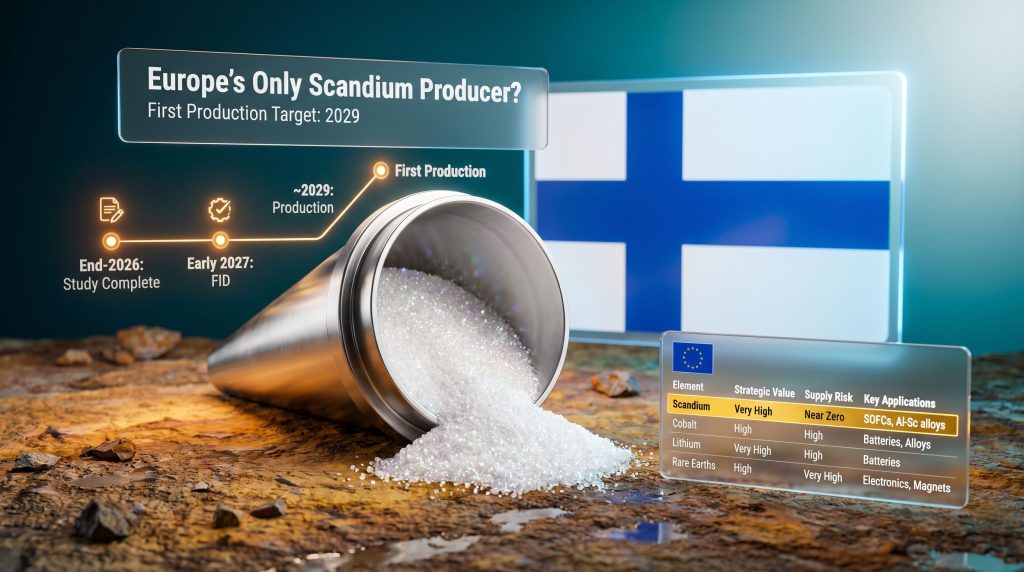
The EU's designation of scandium as a critical raw material reflects this reality precisely. The classification framework combines economic importance with supply risk, assessed against import dependency, geopolitical concentration, and substitutability. Scandium scores adversely on both axes, which is what drives the urgency around European critical raw materials supply.
| Mineral | EU Supply Risk | Domestic Production | Key Application |
|---|---|---|---|
| Scandium | Very High | Near Zero | SOFCs, Al-Sc alloys |
| Cobalt | High | Minimal | Battery cathodes |
| Lithium | High | Growing | Battery anodes |
| Rare Earths | Very High | Limited | Magnets, electronics |
Unlike lithium or cobalt, where European exploration and development activity has accelerated meaningfully over the past decade, scandium has attracted almost no domestic project development. Any credible production pathway on European soil therefore carries disproportionate strategic weight relative to its small market size.
The Terrafame Scandium Recovery Study: What Is Actually Being Assessed
Sotkamo as a Multi-Mineral Platform
Terrafame's Sotkamo operation in the Kainuu region of northern Finland is not a conventional mine in the traditional single-commodity sense. The facility operates one of the world's largest bioheap leaching systems, in which naturally occurring bacteria are used to oxidise sulphide ores and release target metals into an acidic leach solution. The ore body, originally developed for nickel and zinc extraction, contains a range of co-occurring metals in concentrations that make multi-product recovery increasingly attractive as processing infrastructure matures.
The company expanded its recovery scope to include cobalt and, more recently, uranium. Uranium recovery commenced at Sotkamo in 2024, marking a significant step in demonstrating that the operation could add new critical mineral streams to an existing processing platform without constructing entirely new facilities from the ground up. That precedent is directly relevant to the Terrafame scandium recovery study now underway.
What the Pre-Feasibility Study Covers
Terrafame has engaged global engineering firm Worley to lead the pre-feasibility study, targeting completion by end-2026. The study is examining whether scandium can be commercially recovered from an existing side stream connected to the uranium recovery plant at Sotkamo. A final investment decision is anticipated in early 2027, with first scandium production projected approximately two years thereafter, around 2029, subject to a positive outcome.
The specific focus on a side stream, rather than a new processing circuit, is technically and financially significant. Side stream recovery involves intercepting a mineral-bearing process flow at a point where the target element is already naturally concentrated. This approach leverages existing infrastructure, reducing both capital expenditure and construction timeline risk.
Capital Efficiency: The Core Investor Argument
The financial logic of side stream recovery becomes clear when compared against alternative development pathways:
| Project Type | Typical Capital Intensity | Development Timeline | Supply Risk |
|---|---|---|---|
| Greenfield scandium mine | Very High | 8-12+ years | High |
| By-product from existing base metal operation | Low to Moderate | 3-5 years | Low to Moderate |
| Side stream recovery from existing processing plant | Very Low to Low | 2-4 years | Low |
For project financiers and industrial offtakers evaluating supply security, this comparison is not academic. The gap between a greenfield scandium development and a side stream addition to an operating facility can represent hundreds of millions of dollars in capital and a decade in development time. Furthermore, the ongoing critical minerals demand surge makes capital-efficient recovery pathways even more strategically valuable to industrial buyers.
The Metallurgical Pathway: From Leach Solution to Scandium Oxide
How Scandium Is Recovered in Hydrometallurgical Systems
Understanding the technical viability of Terrafame's approach requires familiarity with how scandium behaves within hydrometallurgical processing environments. The recovery sequence typically follows these steps:
-
Leaching: Scandium is mobilised from the ore matrix into an acidic solution alongside primary metals. In bioheap leaching systems like Sotkamo's, this process occurs continuously as bacteria oxidise sulphide minerals over extended periods.
-
Selective separation: Because scandium co-exists in leach solutions with iron, titanium, zirconium, and other competing ions, separation requires either solvent extraction (SX) using selective organic extractants or ion exchange (IX) using functionalized resins.
-
Stripping and purification: The scandium-loaded phase is stripped and subjected to further purification, often involving multiple washing and re-extraction stages to remove residual impurities.
-
Precipitation and calcination: Purified scandium is precipitated as a hydroxide or oxalate, then calcined to produce scandium oxide (Sc₂O₃), the primary commercial product form. Using established separation technologies, purity levels exceeding 99% Sc₂O₃ are achievable.
Solvent Extraction vs. Ion Exchange: The Technical Trade-offs
| Parameter | Solvent Extraction (SX) | Ion Exchange (IX) |
|---|---|---|
| Selectivity for Sc | High with appropriate extractants | High with selective resins |
| Scalability | Proven at industrial scale | Proven, particularly for dilute feeds |
| Reagent cost | Moderate to High | Moderate |
| Suitability for side streams | Strong | Strong for low-concentration feeds |
| Typical purity achievable | Greater than 99% Sc₂O₃ | Greater than 99% Sc₂O₃ |
One of the less widely appreciated technical challenges in scandium recovery is managing the selectivity problem posed by iron and titanium, both of which are present in significant concentrations in most polymetallic leach solutions. Achieving high recovery efficiency without excessive reagent consumption requires careful process chemistry design, which is one of the core scope items the study would be expected to address.
A further nuance specific to bioheap leaching environments is the relatively dilute nature of the leach solution. Scandium concentrations in such solutions are typically low in absolute terms, which places greater demands on the recovery circuit's ability to selectively concentrate the target element. Ion exchange systems are often favoured in such contexts precisely because of their effectiveness with dilute feed streams. Advances in critical minerals processing technologies more broadly are also improving the economic viability of these recovery approaches.
Positioning and Market Dynamics: A Thin Market With Structural Tension
The Opacity Problem in Scandium Pricing
One of the most important and least discussed characteristics of the scandium market is its structural opacity. Unlike lithium, cobalt, or nickel, there is no established exchange-traded price for scandium. Transactions occur overwhelmingly on a bilateral, negotiated basis between producers and industrial consumers, meaning published price benchmarks are indicative rather than transactional.
Scandium oxide prices have historically ranged between USD 3,000 and USD 5,000 per kilogram, with substantial variation depending on purity specification, supply conditions, and geographic origin. For industrial buyers with stringent supply chain traceability requirements, provenance and ESG compliance are increasingly factored into pricing discussions, which creates a potential premium pathway for European-produced material.
Why European Industrial Buyers Are Paying Attention
Aerospace and defence manufacturers operating within European regulatory frameworks face growing pressure to demonstrate supply chain resilience, not merely cost efficiency. A domestically produced scandium oxide, manufactured within EU jurisdiction and subject to European environmental and social governance standards, offers a form of supply security that price-competitive imports cannot replicate through volume alone.
This dynamic is particularly relevant for SOFC manufacturers participating in European hydrogen infrastructure development programmes, and for aerospace suppliers working within the EU's increasingly stringent supply chain due diligence frameworks. In addition, the strategic importance of critical raw materials for the green transition means that European governments are actively supporting domestic production initiatives.
A European scandium producer aligned with EU regulatory and ESG standards would occupy a structurally differentiated market position relative to volume suppliers from geopolitically exposed regions, a distinction that industrial buyers in the clean energy and aerospace sectors are increasingly willing to pay for.
The By-Product Recovery Model: A Global Trend Reaching Critical Mass
Why Operators and Financiers Are Embracing This Approach
The Terrafame scandium recovery study is not happening in isolation. Across multiple jurisdictions, mining and refining operators are examining their existing processing streams for critical mineral recovery opportunities that were previously uneconomic or technically immature. This shift is driven by three converging forces:
-
Capital discipline: Developing entirely new mining operations for minor metals is rarely justified on a standalone basis. By-product recovery from existing infrastructure fundamentally changes the economics.
-
ESG considerations: Extracting additional value from an ore body already being processed does not incrementally increase land disturbance, water consumption, or community impact in the same way that a new mining operation would. This aligns with the increasing scrutiny that both regulators and investors apply to mining's physical footprint.
-
Critical mineral supply imperatives: Governments and industrial buyers are creating structural incentives for domestic production of materials on critical mineral lists, making the commercial case for marginal recovery projects more compelling than it was a decade ago.
Analogous programmes are underway in Australia, where scandium occurs as a natural co-product in lateritic nickel-cobalt ore bodies, and in European research settings examining recovery from titanium industry by-products and bauxite processing residues. The common thread is the recognition that the world's critical mineral endowment is distributed through the residues and by-product streams of existing industrial processes.
Terrafame's Uranium Precedent
The commencement of uranium recovery at Sotkamo in 2024 is a more than symbolic precedent. It demonstrates that Terrafame has successfully navigated the technical, regulatory, and operational challenges of adding a new critical mineral stream to a complex existing facility. The regulatory pathway for uranium recovery in Finland is considerably more demanding than that for most metals, given the additional licensing requirements associated with radioactive materials.
Having completed that process, the company's institutional capability to manage multi-mineral expansion is established rather than theoretical. The lessons from the uranium recovery ramp-up, including process chemistry integration, product specification development, and regulatory sequencing, are directly applicable to the scandium programme design. This institutional knowledge represents a genuine and often underappreciated competitive advantage.
The next major ASX story will hit our subscribers first
Decision Gates and the Path Forward
The Timeline to First Production
The pre-feasibility study follows a clearly sequenced development pathway:
- End-2026: Pre-feasibility study completion and results publication by Worley
- Early 2027: Final investment decision, contingent on study outcomes, market conditions, and financing
- Approximately 2029: Targeted first scandium production, subject to a positive FID and successful construction execution
Customer Engagement as a De-Risking Mechanism
Terrafame has indicated an intention to engage prospective customers during the study phase itself, before any investment decision is made. This approach, which involves building offtake relationships in parallel with technical development, reflects a sophisticated understanding of how to de-risk the commercial case for a small-volume, high-value critical mineral. For a market as thin and bilaterally negotiated as scandium, securing expressions of interest before committing capital materially improves the risk profile of the final investment decision.
Key Risk Factors Investors and Observers Should Monitor
Despite the structural attractiveness of the side stream recovery model, several risk dimensions warrant careful attention:
-
Technical risk: The specific chemistry of Sotkamo's uranium recovery side stream may present selectivity or concentration challenges that affect achievable recovery rates and product purity at commercial scale.
-
Market risk: Scandium pricing is historically thin, opaque, and subject to demand concentration. A single large buyer reducing offtake can meaningfully affect market pricing given the small volumes involved.
-
Regulatory risk: Expanding the scope of Terrafame's existing processing authorisations to include a new product stream will require engagement with Finnish and potentially EU-level regulatory frameworks.
-
Financing risk: Capital markets for small-volume critical mineral projects can be cyclical, and the construction financing environment in early 2027 will significantly influence whether a positive FID can be efficiently executed.
This article contains forward-looking statements and projections based on publicly available information. Readers should not treat any discussion of future timelines, production targets, or market dynamics as investment advice. All investments involve risk, and outcomes may differ materially from projections.
What the Terrafame Scandium Study Signals for European Critical Mineral Strategy
The broader significance of this study extends beyond a single pre-feasibility examination at a single Finnish facility. It represents a test case for whether Europe can convert its existing industrial infrastructure into a meaningful critical mineral production base, without relying exclusively on the decade-long timelines and capital requirements of greenfield development.
If the study confirms commercial viability and the investment decision proceeds, Terrafame would become Europe's only commercial scandium producer. It would, furthermore, demonstrate that the by-product recovery model is executable within EU regulatory and ESG frameworks, creating a template that other operators across Scandinavia and continental Europe could apply to their own processing operations.
The 2026–2027 study-to-decision window will be closely observed by analysts and industry stakeholders tracking progress on EU critical mineral objectives. The outcome at Sotkamo will not answer the question of European supply chain resilience definitively, but it will provide one of the most instructive data points available.
Want to Stay Ahead of the Next Major Critical Mineral Discovery?
Discovery Alert's proprietary Discovery IQ model delivers real-time alerts on significant ASX mineral discoveries — instantly converting complex data across more than 30 commodities into clear, actionable insights for both short-term traders and long-term investors. Explore historic examples of exceptional mineral discovery returns and begin your 14-day free trial today to secure a market-leading advantage before the broader market catches on.