July 14, 2026
The Battery Mineral Supply Chain Is Being Redrawn, and Brazil Is Picking Up the Pen
For most of the past decade, the global race to secure battery-grade nickel has been dominated by a single narrative: Indonesia's rapid rise as the world's dominant HPAL processing hub, bankrolled almost entirely by Chinese capital and integrated into Chinese battery supply chains. Western battery manufacturers and automakers watched this consolidation with growing unease, knowing that dependence on a single geography for a critical cathode input represented a structural vulnerability they could not ignore indefinitely.
The policy response has been building gradually, but the financing response has been slower. Development finance institutions, export credit agencies, and sovereign wealth funds have circled Latin America's laterite nickel endowment for years, recognising that countries like Brazil hold the geological raw material for an alternative supply chain. What has been missing is a credible, fully capitalised project with the right technical pedigree, ESG profile, and institutional backing to attract the scale of capital required.
The Piauí Nickel Project, developed by Brazilian Nickel, is positioning itself as precisely that vehicle. The recent Brazilian Nickel BNDES financial support announcement, covering an initial equipment loan of R$100 million (approximately US$18 million), has attracted attention not because of its size, but because of what it signals about the trajectory of Brazil's industrial and minerals policy, and about the broader architecture of Western-aligned battery mineral finance.
When big ASX news breaks, our subscribers know first
Understanding the Piauí Project: Scale, Output, and Strategic Fit
Located in Piauí State in Brazil's northeast, the project targets one of the country's most significant laterite nickel deposits. Laterite nickel resources differ fundamentally from the sulphide nickel deposits that dominated global production for much of the twentieth century. Laterite ores are found close to the surface, making open-cut extraction relatively straightforward, but their processing is technically demanding.
The ore body at Piauí contains both saprolite zones, which are higher in nickel and historically processed via pyrometallurgical methods like rotary kiln-electric furnace (RKEF) technology, and limonite zones, which are lower-grade but amenable to hydrometallurgical processing. Brazilian Nickel's strategy focuses on hydrometallurgical processing to produce Mixed Hydroxide Precipitate (MHP), targeting the battery cathode supply chain rather than the stainless steel sector that historically consumed most of the world's nickel.
This distinction matters enormously from a market positioning standpoint. MHP is a nickel-cobalt intermediate product that battery cathode manufacturers can refine into precursor cathode active material (pCAM) for use in NMC (nickel-manganese-cobalt) and NCA (nickel-cobalt-aluminium) battery chemistries. These are the dominant high-energy-density battery formats used in electric vehicles. Furthermore, unlike Class 1 refined nickel, MHP avoids the need for full pyrometallurgical refining and aligns with the chemical processing preferences of battery manufacturers — a consideration that is increasingly shaping the battery raw materials market.
| Project Parameter | Detail |
|---|---|
| Total Capital Cost | US$1.4 billion |
| Primary Output | Mixed Hydroxide Precipitate (MHP) |
| End-Use Application | Lithium-ion battery cathode supply chain |
| Target Production Start | 2028 |
| Project Location | Piauí State, Brazil |
| Lead Developer | Brazilian Nickel |
A lesser-known technical advantage of the Piauí deposit is the ore's composition profile. Laterite deposits in the Piauí region contain elevated cobalt-to-nickel ratios within the limonite horizon compared with many comparable Indonesian deposits. Since cobalt is an economically significant co-product in MHP production, this characteristic can meaningfully improve project economics on a co-product credit basis, particularly when cobalt markets recover from current oversupply conditions originating primarily from Democratic Republic of Congo production. Investors tracking global cobalt production will recognise how this dynamic is reshaping project valuations across the sector.
What the BNDES Equipment Loan Actually Represents
Discussions about the Brazilian Nickel BNDES financial support package require a precise understanding of what has been approved versus what remains aspirational. The confirmed instrument is a R$100 million equipment loan, structured through a joint BNDES-Finep initiative specifically targeting Brazil's strategic minerals sector. This facility is designated for equipment procurement related to the MHP processing plant construction, not for broader project development or working capital.
It is important to understand that this approved facility represents roughly 1.3% of the project's total US$1.4 billion capital requirement. Its significance is institutional and symbolic as much as it is financial. When Brazil's primary development bank formally approves financing for a project, it functions as a sovereign credit signal to the private capital markets and multilateral institutions that follow Brazil's industrial policy direction.
Separately, discussions are reportedly ongoing around a substantially larger BNDES facility, with figures cited as high as R$1 billion (approximately US$500 million). This would represent a transformative component of the financing stack, but no formal approval has been announced, and it remains at the negotiation stage.
BNDES's potential involvement extends beyond debt. The institution manages a Critical Minerals Fund (FIP) with a total investment capacity of R$1 billion, of which BNDES itself contributes R$250 million. This fund targets nickel, cobalt, and other battery-relevant strategic minerals. If Brazilian Nickel secures participation through the FIP structure, BNDES would transition from a creditor to an equity co-investor, which would fundamentally alter the risk distribution of the project and its attractiveness to other equity investors.
The Capital Stack: Assembling a Blended Finance Architecture
Financing a greenfield HPAL-adjacent project at this scale in an emerging market requires a sophisticated, layered approach to capital assembly. No single institution or investor class can or will shoulder the full US$1.4 billion requirement alone. Brazilian Nickel's financing strategy reflects an understanding of this reality, pursuing a blended model that combines sovereign development bank debt, export credit agency facilities, and strategic equity from sovereign wealth funds and private capital vehicles.
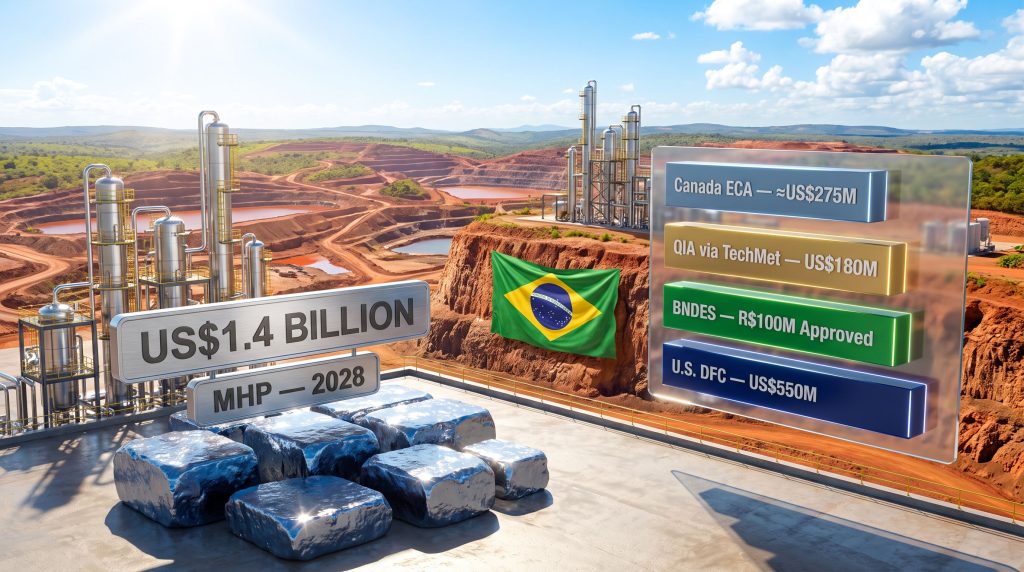
| Financing Source | Instrument | Estimated Quantum | Status |
|---|---|---|---|
| BNDES (Brazil) | Equipment Loan | R$100M (≈US$18M) | Approved |
| BNDES (Brazil) | Potential Larger Debt/Equity | Up to R$1B (≈US$500M) | Under Negotiation |
| U.S. DFC | Letter of Interest | US$550 million (~40% of total) | Letter of Interest Issued |
| Canada Export Credit Agency | Debt Facility | ~US$275 million | Pursuit Stage |
| Qatar Investment Authority (via TechMet) | Equity | US$180 million | Secured |
| European Commission / Other | Anchor Equity | TBD | Sought |
The role of TechMet Ltd deserves particular attention. As the largest shareholder in Brazilian Nickel, TechMet is a specialist critical minerals investment vehicle with its own institutional backing that includes the U.S. International Development Finance Corporation (DFC). This relationship means that U.S. strategic capital has an indirect presence in the project even before the DFC's direct US$550 million letter of interest is considered. The US$180 million equity commitment secured from the Qatar Investment Authority (QIA) through TechMet further broadens the sovereign wealth dimension of the investor base, signalling that Gulf sovereign capital is increasingly active in battery mineral supply chain positioning.
The Anchor Equity Problem: The Financing Gap That Matters Most
The most consequential unresolved issue in the Piauí project's financing trajectory is the absence of a confirmed cornerstone equity investor. In structured project finance, particularly for large-scale greenfield mining, debt providers will not fully activate their commitments until a credible equity anchor is in place. The logic is straightforward: development finance institutions and export credit agencies treat confirmed equity as a first-loss buffer that protects their senior debt positions.
Without this anchor, the DFC's letter of interest remains a non-binding expression of intent rather than a committed facility, and the Canadian export credit discussions cannot progress to formal documentation. The candidates most frequently discussed for this equity anchor role include BNDES through its FIP structure, a direct DFC equity commitment, and potential European Commission instruments linked to the European Critical Raw Materials Act framework.
Until anchor equity is formally confirmed, the project's 2028 commercial production target faces meaningful execution risk from financing timeline slippage, regardless of the strength of the individual debt commitments in the pipeline.
Brazil vs. Indonesia: The ESG Arbitrage That Western Capital Is Pricing In
One of the less publicly discussed dimensions of the Piauí project's investment thesis is the growing premium that Western battery supply chain participants are placing on ESG differentiation. The Indonesian nickel industry faces persistent criticism for its reliance on coal-heavy grid power, community displacement in production areas, and integration into Chinese corporate structures that create geopolitical complexity for European and North American battery manufacturers.
| Factor | Brazil (Piauí) | Indonesia (HPAL Projects) |
|---|---|---|
| Processing Route | Hydrometallurgical / MHP | HPAL / MHP |
| ESG Profile | Higher (lower carbon grid, stronger governance) | Variable (coal-intensive energy) |
| Sovereign Risk | Moderate | Moderate-High |
| Development Finance Access | BNDES, DFC, ECAs | Chinese state banks, domestic |
| Proximity to Western Battery Supply Chains | Strategically advantageous | Geopolitically contested |
Brazil's electricity grid is among the cleanest of any major economy, with hydropower and renewables accounting for a substantial share of generation. For a hydrometallurgical processing operation that is electricity-intensive, the carbon footprint of Piauí's MHP output could be materially lower than Indonesian equivalents. This increasingly matters for automotive OEMs managing Scope 3 emissions disclosures and European battery passport requirements under the EU Battery Regulation.
The geopolitical angle reinforces this differentiation. The U.S. Inflation Reduction Act creates strong commercial incentives for battery manufacturers supplying the North American market to source minerals from countries with Free Trade Agreements or from DFC-engaged supply chains. Brazil's DFC engagement positions Piauí-sourced MHP as potentially aligned with these requirements, though formal IRA compliance determination depends on specific supply chain tracing and processing criteria that have not yet been fully adjudicated for this project.
Nova Indústria Brasil and the Policy Architecture Behind the Project
The Brazilian Nickel BNDES financial support decision does not exist in a policy vacuum. It reflects the operational priorities of Nova Indústria Brasil, the federal government's industrial reindustrialisation strategy launched to reposition Brazil up the value chain in sectors including critical minerals processing. Under this framework, nickel, cobalt, and lithium are classified as strategic minerals, and BNDES is explicitly mandated to deploy concessional capital to catalyse their development.
This is not unprecedented for BNDES. The institution played a foundational role in financing Brazil's deepwater oil and gas industry through the pre-salt development era, and it was central to the financing architecture of Brazil's renewable energy expansion through competitive auctions. The critical minerals sector represents a logical extension of this institutional role into the energy transition economy.
What is less commonly understood is how the Piauí project's financing template, if successfully executed, could become a replicable model for other Brazilian battery mineral developments. Brazil holds significant resources not only in nickel and cobalt but also in lithium, graphite, and manganese. Innovations such as direct lithium extraction technology, for instance, could further enhance the country's position in this space. A demonstrated blended-finance architecture combining BNDES debt, DFC participation, and sovereign wealth equity could attract similar institutional interest to those projects, potentially accelerating Brazil's ambition to become a vertically integrated battery mineral supplier.
The next major ASX story will hit our subscribers first
Key Risks That Investors and Observers Should Track
A rigorous assessment of the Piauí project's outlook requires honest engagement with its risk profile, which is substantial even accounting for its strong institutional support framework.
- Capital cost overrun risk: Large-scale greenfield HPAL-adjacent projects globally have historically experienced cost escalation of 20 to 40 percent above initial estimates. At a US$1.4 billion baseline, even a 20 percent overrun would add approximately US$280 million to the financing requirement.
- Nickel price trajectory: MHP pricing is benchmarked to LME nickel, which has experienced significant downward pressure since its 2022 peak. Sustained low nickel prices compress project economics and can delay investment decisions by offtake counterparties.
- Cobalt market overhang: The co-product cobalt revenue assumption embedded in MHP project economics has been under pressure from persistent oversupply originating in the DRC, where artisanal and industrial production has consistently exceeded demand growth projections.
- Financing closure timeline: The 2028 production start is only achievable if financial close occurs within approximately 12 to 18 months from the current point. Each month of delay in resolving the anchor equity question compresses the construction window.
- Regulatory and environmental permitting: Brazil's federal and state environmental licensing processes for large-scale mining and hydrometallurgical operations involve multiple agencies and community consultation requirements. Piauí State's regulatory environment, while broadly supportive of investment, has the procedural complexity characteristic of major Brazilian infrastructure permitting.
Disclaimer: This article contains forward-looking information, market analysis, and financial projections sourced from publicly available information. It does not constitute investment advice. Readers should conduct their own due diligence before making any investment decisions.
What the Broader Market Should Take From This Development
The significance of the Brazilian Nickel BNDES financial support announcement extends well beyond a single project's financing update. It represents a data point in a larger structural transition: the deliberate construction of a Western-aligned battery mineral supply chain that is geographically diversified away from Chinese-controlled Indonesian processing and resourced through blended sovereign and private capital. Consequently, those monitoring the battery metals investment landscape will find this development particularly instructive.
For investors, the key variables to monitor are the resolution of the anchor equity position, the progression of BNDES's larger facility negotiations, and the formal confirmation of DFC and Canadian export credit commitments. Each of these milestones will function as a signal about whether the project's ambitious 2028 timeline is tracking to plan or beginning to slip. The London Metal Exchange nickel price remains an additional variable worth watching closely, given its direct bearing on MHP project economics.
For the broader battery mineral sector, Piauí's financing journey illustrates both the opportunity and the complexity of building alternatives to the dominant Indonesian supply chain. The geological endowment, the policy support framework, and the institutional interest are all present. The test now is whether the capital assembly mechanics can be completed at the pace the project's timeline demands.
Want to Position Yourself Ahead of the Next Major Battery Mineral Discovery?
Discovery Alert's proprietary Discovery IQ model delivers real-time alerts on significant ASX mineral discoveries — including battery minerals like nickel and cobalt — instantly transforming complex geological data into actionable investment insights for both short-term traders and long-term investors. Explore historic examples of major mineral discoveries and their extraordinary returns, then begin your 14-day free trial to ensure you're never late to the next significant market-moving announcement.