
July 14, 2026
Africa's Largest Oil Producer Faces Its Defining Moment
When an oil-producing nation spends the better part of a decade watching its output collapse while global demand continues to evolve, the eventual recovery carries weight that goes far beyond a single monthly data point. Nigeria's upstream sector has lived through exactly that kind of prolonged deterioration, and the figures emerging from June 2026 represent something more significant than a headline number. They reflect the early results of a years-long effort to dismantle the structural barriers that had been quietly strangling one of Africa's most resource-endowed economies.
Understanding what drove Nigeria oil output six-year high requires looking beneath the production statistics to examine the regulatory architecture, security landscape, and capital commitment decisions that either constrain or enable output growth at scale.
When big ASX news breaks, our subscribers know first
Key Production Metrics: What the June 2026 Numbers Actually Show
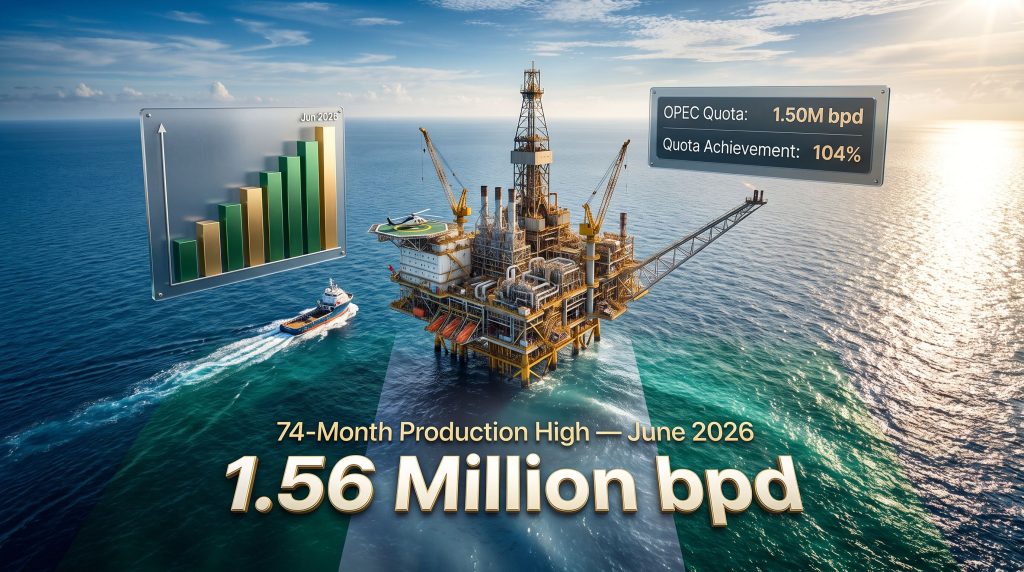
Nigeria's crude oil production reached 1.56 million barrels per day (bpd) in June 2026, its highest monthly figure since April 2020. That single metric represents a 74-month production peak for Africa's largest oil producer, and its significance is amplified by the context surrounding it.
| Metric | Figure | Context |
|---|---|---|
| Crude oil output (June 2026) | 1.56 million bpd | 74-month high |
| Total liquids (crude + condensates) | 1.735 million bpd | Includes ~0.18 million bpd condensates |
| OPEC quota | 1.50 million bpd | Nigeria exceeded quota by ~4% |
| Quota achievement rate | 104% | First sustained over-quota performance in years |
| Month-on-month growth | +2.2% | Fourth consecutive monthly increase (Feb–Jun 2026) |
| February 2026 baseline | 1.483 million bpd | Starting point of the current growth sequence |
| Previous production trough (2022) | ~960,000 bpd | Driven by theft, sabotage, underinvestment |
What makes these figures particularly notable is the sustained trajectory rather than any single spike. Production growth across four consecutive months from February through June 2026 signals a degree of operational consistency that Nigeria's upstream sector has struggled to maintain for the better part of a decade. According to Reuters, the regulator confirmed this milestone represents the highest output level since 2020.
Four consecutive months of production growth, combined with zero major pipeline disruptions recorded during June 2026, points toward a structural shift rather than a temporary fluctuation driven by seasonal or one-off factors.
The Collapse That Preceded the Recovery: A Decade of Structural Damage
To fully appreciate the significance of Nigeria's current trajectory, it is necessary to understand the depth of the deterioration that preceded it. The country's production trough of approximately 960,000 bpd in 2022 was not simply the result of a difficult global environment. It was the cumulative outcome of several reinforcing failures operating simultaneously.
The primary drivers of Nigeria's production collapse included:
- Widespread pipeline vandalism and organised crude theft networks operating across the Niger Delta, which suppressed both production volumes and export reliability
- Repeated attacks on upstream infrastructure and export terminals that forced operators into extended shutdown periods
- Persistent production outages across onshore and shallow-water fields, many of which suffered from years of deferred maintenance
- Chronic underinvestment driven by regulatory uncertainty and an investor-unfriendly operating environment
- The strategic withdrawal of multiple international oil companies from onshore Nigerian assets, which created both technical capacity gaps and reduced capital deployment in legacy fields
The exit of international operators from onshore blocks was a particularly consequential development that receives less attention than it deserves. When major international companies divest onshore assets and transition them to indigenous operators, the receiving companies frequently lack the technical depth and capital reserves needed to sustain production at inherited levels. This creates a production gap that can persist for years while new ownership structures bed in and secure financing.
Furthermore, Nigeria's pattern of failing to meet its OPEC production ceiling across 2020 to 2025 was not a policy choice but a reflection of genuine operational incapacity. The quota existed largely as an aspirational ceiling rather than a binding constraint, which is precisely what makes the June 2026 figure of 104% quota compliance so significant as a directional indicator. The broader OPEC market influence on member state production targets has made this compliance milestone particularly meaningful for Nigeria's standing within the organisation.
Regulatory Reform as a Production Catalyst
The Petroleum Industry Act: From Framework to Function
The Petroleum Industry Act (PIA), signed into law in 2021, created a new regulatory architecture for Nigeria's upstream sector. However, legislation alone does not move production curves. The pace and quality of implementation determines whether a regulatory reform translates into operational improvement.
Under President Bola Tinubu's administration from 2023 onward, PIA implementation has accelerated meaningfully. The establishment of a dedicated presidential energy office signalled institutional commitment to the reform agenda and provided a coordination mechanism for cross-departmental regulatory improvements.
The NUPRC's Operational Transformation
The Nigerian Upstream Petroleum Regulatory Commission (NUPRC) has been central to translating legislative reform into practical efficiency gains. Several operational changes stand out:
- From March 2026, certain well reactivation permits can be issued within hours of application, dramatically compressing timelines that previously stretched across weeks or months
- The regulator has adopted a policy of revoking licences from non-performing operators, creating a direct accountability mechanism that incentivises active asset development
- Streamlined administrative procedures have reduced the bureaucratic friction that historically deterred smaller operators from pursuing reactivation projects on marginal but viable wells
These changes matter disproportionately for idle well reactivation, where the economics are highly sensitive to time-to-production. A permit issued in hours rather than weeks can transform the financial viability of a reactivation project.
The 2026 Licensing Round: A Structural Signal
Nigeria has scheduled a new upstream licensing round for Q3 2026, the first since the 2007 process. This represents an almost two-decade gap in competitive block allocation, which itself reflects the depth of the regulatory dysfunction that characterised the intervening period.
The structural changes embedded in the upcoming round are designed to address the specific friction points that discouraged competitive participation in previous cycles:
- Reduced signature bonuses to lower the capital barrier to entry for smaller operators
- Simplified administrative procedures to compress award timelines and reduce uncertainty
- Tightened technical requirements to ensure that awarded blocks are actively developed rather than held speculatively
Security as a Production Variable: The Niger Delta Equation
One of the most underappreciated dimensions of Nigeria's production recovery is the direct relationship between infrastructure security and output volume. In Nigeria's onshore and shallow-water operating environment, pipeline integrity is not a background assumption but an active production variable that can shift daily output figures by tens of thousands of barrels.
The June 2026 reporting period stands out because no major pipeline disruptions were recorded across Nigeria's main export infrastructure during the month. For a country with Nigeria's security history, that operational clean sheet represents a genuine achievement.
The government's intensified security operations have involved several parallel workstreams:
- Expanded naval surveillance capabilities along Nigeria's export corridors
- Maritime interdiction operations targeting organised crude theft networks operating offshore
- Intensified anti-theft operations across the Niger Delta pipeline network itself
- Improved intelligence-sharing between security agencies and upstream operators
Offshore production assets carry a structural security advantage over onshore operations because they are inherently less accessible to the theft networks that have historically targeted Nigeria's export infrastructure. Consequently, the ongoing shift in Nigeria's production mix toward deepwater and offshore assets has provided a secondary security dividend beyond the direct effects of improved enforcement operations.
The Investment Pipeline: $8 Billion and What It Represents
Production recovery and investment attraction are related but distinct achievements. Nigeria's current output milestone primarily reflects improved security and regulatory efficiency applied to existing assets. The more consequential question for long-term production sustainability concerns whether new capital is flowing into the ground.
The answer, at least in terms of announced commitments, is encouraging.
| Project | Investment Value | Expected Output Addition |
|---|---|---|
| Bonga North (offshore deepwater) | Part of $8bn+ offshore package | Up to +110,000 bpd at peak |
| Ubeta Gas Project | $500 million | TotalEnergies + NNPC partnership |
| Total offshore commitments (under 12 months) | $8 billion+ | Multiple deepwater projects |
The concentration of investment in offshore and deepwater assets reflects rational risk-adjusted decision-making by international operators. Offshore projects carry structurally lower security risk than onshore blocks, offer larger reserve targets, and benefit from the improved regulatory environment created by the PIA. However, it is worth noting how crude oil price trends in the global market significantly influence the timing and scale of these investment commitments.
A detail worth emphasising: in 2024, Nigeria captured three of the four final investment decisions announced across the entire African continent's upstream oil sector. That concentration of continental FID activity is not coincidental. It reflects both the scale of Nigeria's resource base and the improving perception of its investment environment among major operators.
The critical distinction for capital allocation purposes is the difference between recovering previously lost production and developing genuinely new productive capacity. The former restores a baseline; only the latter builds a sustainable growth trajectory.
The next major ASX story will hit our subscribers first
Scenario Analysis: Three Pathways for Nigeria's Production Trajectory
Scenario 1: Sustained Recovery (Base Case)
Under this pathway, continued pipeline security, a successful 2026 licensing round, and timely development of FID-approved projects combine to push production toward and potentially beyond the 1.7 million bpd range within the next three to four years. The Bonga North development's projected contribution of up to 110,000 bpd at peak capacity would be a significant component of this trajectory. NUPRC's licence revocation policy maintains operator accountability and prevents asset hoarding.
Scenario 2: Partial Consolidation (Moderate Case)
Production stabilises in the 1.4 to 1.5 million bpd range as partial reversal of security gains, slower-than-anticipated FID project development timelines, or global oil price deterioration constrains new upstream investment. This scenario represents a meaningful improvement over the 2022 trough but falls short of the structural transformation the current reform trajectory suggests is possible. The oil price shock experienced by energy-producing economies in previous downturns demonstrates precisely how quickly such consolidation scenarios can materialise.
Scenario 3: Reversal Risk (Downside Case)
The structural vulnerabilities that could unwind recent gains remain present. Political instability affecting regulatory continuity, resurgence of organised crude theft if security operations are scaled back due to budget pressure, or failure of the 2026 licensing round to attract competitive international participation could return production to sub-1.3 million bpd levels. In addition, oil trading sanctions applied to competing producers could indirectly affect Nigeria's market positioning depending on how global supply dynamics shift.
Nigeria vs. African Peers: A Continental Production Comparison
| Country | Approximate Output (2025-2026) | OPEC Status | Key Challenges |
|---|---|---|---|
| Nigeria | 1.56 million bpd (June 2026) | OPEC member | Infrastructure security, reserve depletion |
| Algeria | ~900,000-1.0 million bpd | OPEC member | Mature field decline, limited new discoveries |
| Libya | ~1.0-1.2 million bpd (volatile) | OPEC member | Political instability, force majeure risk |
| Congo (Republic) | ~250,000-270,000 bpd | OPEC member | Small reserve base, infrastructure gaps |
Nigeria's position as Africa's largest crude oil producer by volume is not seriously challenged by any continental peer. However, the comparison with Libya is instructive: both countries have experienced severe production volatility driven by non-geological factors, and both demonstrate that the resource base alone does not determine output levels. Governance, security, and regulatory quality are the decisive variables.
Frequently Asked Questions: Nigeria's Oil Output Recovery
What caused Nigeria's oil production to hit a six-year high in June 2026?
Nigeria's Nigeria oil output six-year high of 1.56 million bpd in June 2026 resulted from a combination of improved pipeline security across the Niger Delta, accelerated implementation of the Petroleum Industry Act, operational improvements at the NUPRC including faster permitting processes, and the absence of major infrastructure disruptions during the month. These factors operated together rather than any single cause driving the result.
How does Nigeria's June 2026 output compare to its OPEC quota?
Nigeria produced approximately 1.56 million bpd of crude, exceeding its OPEC ceiling of 1.5 million bpd by roughly 4%. This represented the fourth consecutive month of production growth and the first sustained period of over-quota performance Nigeria had achieved in years. Bloomberg's reporting on this milestone confirmed the figures from Nigeria's upstream regulator.
What is Bonga North and why does it matter for Nigeria's production outlook?
Bonga North is an offshore deepwater development expected to contribute up to 110,000 bpd at peak production capacity. It forms part of the broader $8 billion-plus offshore investment package announced for Nigeria within a 12-month window and represents exactly the kind of new productive capacity the country needs to sustain its current output levels beyond the medium term.
What risks could reverse Nigeria's oil production recovery?
The three primary risk categories are infrastructure security, regulatory continuity across successive administrations, and upstream investment pipeline execution. Furthermore, the trade war oil impact on global demand and pricing could also compress investment appetite for new Nigerian upstream projects. Any significant deterioration in any of these areas could compress production volumes within a relatively short timeframe.
When is Nigeria's next oil licensing round?
Nigeria has scheduled a new upstream licensing round for Q3 2026, the first such process since 2007, featuring reduced signature bonuses, simplified administrative procedures, and tightened technical requirements designed to encourage faster development of awarded acreage.
The Long-Term Test: Structural Transformation vs. Cyclical Recovery
What Durable Production Growth Actually Requires
Production records attract attention, but they do not independently generate the conditions required to sustain themselves. Nigeria's June 2026 milestone, which cemented a genuine Nigeria oil output six-year high, is better understood as a proof-of-concept for the reform agenda rather than confirmation that the underlying structural transformation is complete.
Sustaining and building on current output levels requires progress across multiple simultaneous dimensions:
- Continuous infrastructure security investment that can maintain the operational clean-sheet conditions demonstrated in June 2026
- Regulatory framework stability that persists across political transitions rather than reverting when administration priorities change
- Conversion of announced FIDs into producing assets on the timelines that underpinned the investment decisions
- Active exploration activity to replenish reserves being drawn down by current production, preventing today's recovery from becoming tomorrow's depletion problem
The Investor Confidence Equation
Sophisticated upstream investors evaluate Nigeria not primarily on monthly production statistics but on the durability of the conditions that enable production. Regulatory predictability and security track record carry at least as much weight in long-term capital allocation decisions as current output volumes.
The 2026 to 2028 window is critical in this context. If Nigeria can demonstrate that its improved operating environment persists across the licensing round, through the initial development phases of FID-approved projects, and without significant security setbacks, investor confidence will consolidate in ways that generate self-reinforcing capital flows. If the improvements prove episodic, however, the next contraction cycle could be as damaging as the last.
Nigeria's Fiscal Dependency: The Macroeconomic Stakes
Petroleum revenues remain central to Nigeria's government budget funding and foreign exchange generation. Sustained production growth at current levels carries significant macroeconomic multiplier effects across the broader economy, affecting everything from government spending capacity to naira stability and the country's ability to fund infrastructure development in non-oil sectors.
The stakes of getting the production sustainability question right extend well beyond the upstream sector itself. For Nigeria, oil output is not simply an industrial metric. It remains the primary variable in the country's fiscal equation.
For ongoing coverage of Nigeria's energy sector and broader African economic developments, Ecofin Agency provides regular reporting across African energy, finance, and industry sectors at ecofinagency.com.
This article contains forward-looking analysis and scenario projections based on current available data. Production forecasts and investment timelines are subject to change based on evolving security, regulatory, and market conditions. This content does not constitute financial or investment advice.
Want to Stay Ahead of the Next Major Resource Discovery?
While Nigeria's oil recovery highlights the transformative power of regulatory reform and renewed investment, Discovery Alert's proprietary Discovery IQ model delivers real-time alerts on significant ASX mineral discoveries — instantly converting complex resource data into actionable opportunities for investors at every level. Explore historic discoveries and the exceptional returns they generated, then begin your 14-day free trial to position yourself ahead of the broader market.