July 14, 2026
The Hidden Vulnerability Inside America's Defence Supply Chain
Few strategic materials illustrate the fragility of modern industrial supply chains quite like vanadium. While lithium and rare earth elements dominate the critical minerals demand surge conversation, vanadium quietly underpins some of the most demanding applications in defence manufacturing, including the titanium alloys that form the structural backbone of military aircraft, naval vessels, and space systems. Yet for years, the United States has consumed far more vanadium than it produces domestically, creating a structural dependency that sits uncomfortably alongside an era of intensifying geopolitical rivalry.
The US Vanadium Defence Logistics Agency contract, formalised in June 2026, represents one of the most significant federal procurement decisions in the critical minerals space in recent memory. It signals not just a purchasing decision, but a deliberate policy shift toward anchoring defence-critical mineral processing capacity within US borders.
When big ASX news breaks, our subscribers know first
America's Vanadium Supply Gap: More Serious Than Most Realise
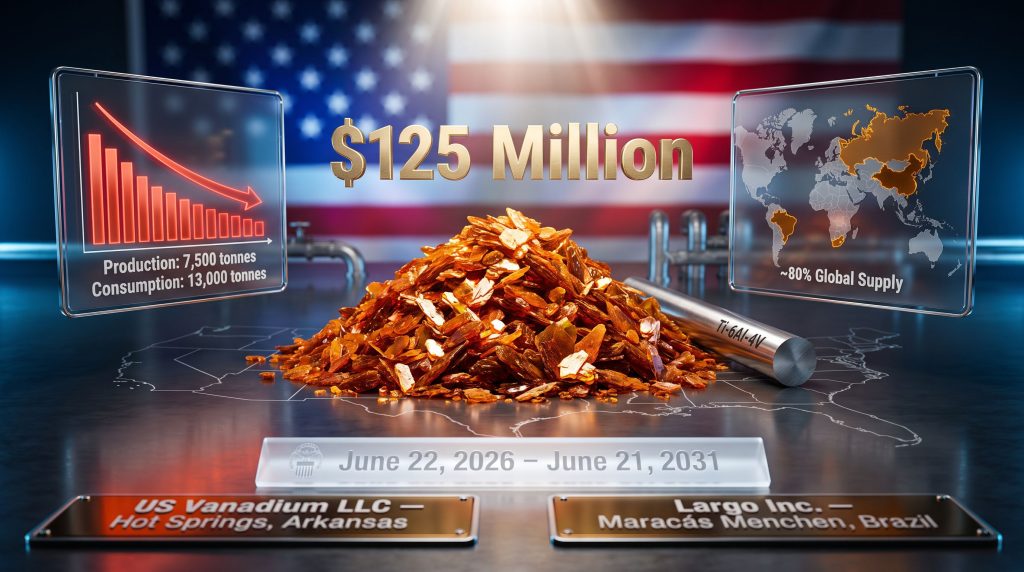
Understanding why the Defence Logistics Agency moved to secure domestic vanadium supply requires appreciating the scale of the imbalance that has developed over time. In 2025, US domestic vanadium production reached approximately 7,500 tonnes, against national consumption of roughly 13,000 tonnes. That means domestic output covers less than 58% of what the country actually uses, with the remainder sourced from foreign suppliers carrying varying degrees of geopolitical risk.
What makes this gap particularly acute is where the shortfall is filled. The US imports vanadium pentoxide primarily from Brazil and South Africa, while ferrovanadium, a processed alloy form of the metal used in steel strengthening, is sourced significantly from Russia and China. Those last two relationships represent the most dangerous exposure in the supply chain.
| Import Source | Product Type | Geopolitical Risk Level |
|---|---|---|
| Brazil | Vanadium pentoxide (V₂O₅) | Moderate |
| South Africa | Vanadium pentoxide (V₂O₅) | Moderate to High |
| Russia | Ferrovanadium | Very High |
| China | Ferrovanadium | Very High |
China, Russia, and South Africa collectively account for approximately 80% of global vanadium production. For Washington's defence planners, that concentration is not an abstract concern. Both China and Russia have demonstrated, through various commodity disputes and export restriction mechanisms in other minerals, a clear willingness to leverage resource dominance as a foreign policy instrument. Furthermore, a disruption to ferrovanadium imports from either country, whether through sanctions escalation or deliberate export restriction, could create near-term bottlenecks in defence manufacturing that would be difficult to route around quickly.
The vanadium supply gap places the United States in a comparable strategic position to its dependencies in rare earth elements and lithium, with one critical difference: the specific product form required for defence applications, high-purity vanadium pentoxide, has an immediate and non-substitutable end use in aerospace-grade titanium alloy production.
What the DLA Contract Actually Involves
The Defence Logistics Agency's strategic materials division awarded a five-year indefinite delivery, indefinite quantity (IDIQ) contract for high-purity vanadium pentoxide in June 2026, with a combined ceiling value of up to $125 million shared across two selected suppliers. The contract was authorised under 10 U.S.C. §3204, the legislative provision governing limited competition procurement on national security grounds.
Contract Structure at a Glance
| Contract Attribute | Detail |
|---|---|
| Total Contract Ceiling | Up to $125 million (shared) |
| Contract Type | IDIQ (Indefinite Delivery, Indefinite Quantity) |
| Duration | 5 years (June 22, 2026 to June 21, 2031) |
| Product | High-purity vanadium pentoxide (V₂O₅) |
| End Use | US National Defense Stockpile |
| Military Beneficiaries | Army, Marine Corps, Navy, Air Force, Space Force |
| Legal Authority | 10 U.S.C. §3204 (limited competition, national security) |
The two recipients of the award were US Vanadium LLC, a subsidiary of TechMet USA operating processing facilities in Arkansas, and Largo Inc. through its Largo Resources USA Inc. entity, which sources production from the Maracás Menchen operation in Brazil. Largo received an initial firm-fixed-price delivery order valued at $60.1 million, while US Vanadium's component covers up to 2,876 metric tonnes of high-purity vanadium pentoxide over the contract term, with a 10% annual price escalation clause built into the pricing structure.
The IDIQ structure is an important technical distinction for anyone assessing the contract's financial implications. Only initial delivery orders represent firm purchasing commitments. Volumes beyond Largo's opening order are not guaranteed and will depend on the DLA's ongoing assessment of stockpile requirements and available appropriations. The $125 million ceiling is a maximum exposure figure, not a committed expenditure.
Why Two Suppliers Rather Than One
The decision to split the award between two producers reflects a procurement philosophy centred on supply chain resilience. Rather than concentrating dependency with a single source, the DLA introduced structural redundancy at the procurement level itself, ensuring that a disruption affecting one supplier does not halt stockpile replenishment entirely.
This dual-supplier model also sends a broader market signal: the US government is willing to support multiple domestic or domestically-aligned production pathways rather than picking a single national champion. For an industry that has historically struggled to attract long-term capital commitments, that signal carries considerable weight.
US Vanadium: The Only Domestic High-Purity Producer
US Vanadium occupies an unusual and strategically important position in the global vanadium market. The company is currently the only US-based producer of high-purity vanadium pentoxide flake at the specification required for aerospace-grade titanium alloy manufacturing. That distinction is not simply a commercial advantage; it represents a genuine gap in the national industrial base that the US Vanadium Defence Logistics Agency contract is explicitly designed to preserve and expand.
A Secondary Recovery Model Built on Industrial Waste
What makes US Vanadium's production methodology particularly noteworthy is its feedstock source. Rather than mining vanadium from primary ore deposits, the company recovers vanadium from spent catalysts generated by petroleum refining operations and other post-industrial waste streams. Its two Arkansas facilities then process these materials into some of the highest purity vanadium oxides produced anywhere in the world.
This secondary recovery approach carries several strategic advantages that are not immediately obvious:
- It eliminates the permitting, capital expenditure, and timeline risks associated with developing a new primary mine
- It positions vanadium production within a circular economy framework, converting industrial by-products into defence-critical outputs
- It allows production to scale in response to refinery catalyst availability rather than ore grade variability
- It makes the operation inherently less susceptible to the geological risk factors that affect conventional mining projects
The feedstock model also explains why US Vanadium was able to launch commercial-scale production of high-purity vanadium pentoxide flake in 2025 relatively quickly after receiving research and development funding from the DLA. Greenfield mine development timelines typically span a decade or more; a processing facility working from existing industrial waste streams can reach commercial output far more rapidly.
What Aerospace-Grade Purity Actually Means
Not all vanadium pentoxide is interchangeable. The purity threshold required for producing titanium-aluminium-vanadium alloy, specifically the Ti-6Al-4V grade that dominates aerospace and defence applications, is substantially higher than what is acceptable for vanadium redox flow battery electrolyte or steel alloying purposes. Trace contaminants that are commercially tolerable in lower-grade applications can cause structural defects in titanium alloys used in load-bearing aerospace components.
Ti-6Al-4V is the most widely used titanium alloy in military and aerospace manufacturing globally. It appears in:
- Airframe structural components for military and commercial aircraft
- Rotorcraft dynamic components including rotor hubs and blade retention systems
- Naval vessel hull fittings and submarine components
- Rocket motor casings and satellite structures for Space Force applications
- Armoured vehicle components requiring high strength-to-weight performance
The fact that US Vanadium's output meets this purity specification, and that it is currently the only US producer doing so at commercial scale, makes the US Vanadium Defence Logistics Agency contract a direct expression of industrial base preservation policy rather than simple commodity procurement.
The National Defense Stockpile: Strategic Logic and Procurement Context
The National Defense Stockpile is a federally managed reserve of materials whose domestic supply could be disrupted during a national emergency or armed conflict. Administered by the DLA's strategic materials division, the stockpile is maintained against formal war-reserve requirements that are periodically assessed and updated.
Vanadium's inclusion in active stockpile procurement reflects a formal determination that current reserves fall below the threshold needed to sustain military-industrial output through a period of supply disruption. That determination carries significant institutional weight because it triggers procurement authority, appropriations justification, and long-term supply contracting powers that routine commodity purchasing does not. This approach is broadly consistent with wider defence critical materials strategies being developed across allied nations.
The 10% annual price escalation clause embedded in US Vanadium's contract terms is particularly revealing. It indicates that the DLA anticipates domestic processing costs to rise over the contract term and has chosen to accept that cost trajectory rather than risk supply interruption. For critical mineral investors and industry analysts, this clause signals government willingness to pay a premium for domestic supply security over the lowest available market price, a posture that has direct implications for the economics of building domestic processing capacity in other critical minerals.
Congressional Dimension and Political Durability
Legislative representatives from Arkansas, at both the Senate and House levels, have actively supported the domestic vanadium production programme, according to reporting by Mining Weekly. This political engagement matters for assessing the long-term durability of the procurement programme for several reasons:
- Bipartisan state-level support creates advocacy infrastructure that can survive changes in federal administration
- Congressional backing provides a channel for future appropriations requests and contract renewal arguments
- It demonstrates that domestic critical mineral processing generates both national security value and local economic constituencies, a combination that historically sustains programmes through budget cycles
Why the IDIQ Contract Model Matters for the Critical Minerals Industry
The structural design of this contract deserves attention beyond the vanadium sector specifically. The IDIQ model, combined with multi-supplier awards, built-in price escalation, and national security procurement authority, may represent an emerging template for how the US federal government approaches critical mineral supply security more broadly. Indeed, this approach aligns with the broader US critical minerals strategy that has gained considerable momentum in recent years.
Key features worth tracking for their potential replication across other minerals:
- Price escalation protection reduces the risk that domestic producers are undercut by subsidised foreign competitors during the contract term
- Multi-supplier design prevents the government from becoming captive to a single producer while still providing enough revenue certainty to justify production investment
- IDIQ flexibility allows procurement volumes to be adjusted as stockpile assessments evolve without requiring new competitive tender processes
- National security authority (10 U.S.C. §3204) permits limited competition, meaning the government is not obligated to accept the cheapest available foreign supply when domestic security considerations apply
For the broader critical minerals investment community, the DLA vanadium contract demonstrates that federal offtake, structured under national security procurement frameworks, can serve as a viable demand anchor for domestic processing facilities. This is particularly relevant given ongoing discussions about wartime powers for minerals and the extent to which policymakers will go to secure supply chains. Furthermore, the evolving US critical minerals tariffs landscape adds additional urgency to establishing reliable domestic production capacity.
Disclaimer: This article contains forward-looking assessments and analysis based on publicly available information. It does not constitute financial or investment advice. Readers should conduct their own due diligence before making investment decisions related to any companies or sectors mentioned.
The next major ASX story will hit our subscribers first
Frequently Asked Questions
What is the total value of the DLA vanadium pentoxide contract?
The contract carries a combined ceiling of up to $125 million shared across both suppliers over five years. This represents a maximum potential spend, not a guaranteed purchase commitment. Actual expenditure will depend on delivery orders issued over the contract term.
Who are the two companies awarded the contract?
The award was split between US Vanadium LLC (a TechMet USA subsidiary producing in Arkansas) and Largo Inc. through its US entity, sourcing material from the Maracás Menchen mine in Brazil.
Why does high-purity vanadium pentoxide matter specifically for defence?
It is a critical precursor for producing Ti-6Al-4V titanium alloy, the dominant titanium grade in military aerospace manufacturing. The purity requirements for this application are significantly stricter than for industrial or energy storage uses of vanadium.
What makes US Vanadium's production model different from conventional vanadium mining?
The company recovers vanadium from spent petroleum refining catalysts and other post-industrial waste streams, rather than extracting it from primary ore deposits. This secondary recovery approach enables faster production ramp-up and eliminates the geological and permitting risks associated with mine development.
What military branches benefit from the National Defense Stockpile programme?
The vanadium pentoxide procured under this contract supports the US Army, Marine Corps, Navy, Air Force, and Space Force.
Is the 10% annual price escalation clause unusual?
It is relatively uncommon in commodity procurement contracts and signals the government's expectation that domestic processing costs will rise and its willingness to absorb that increase to maintain supply security. This provision has important precedent value for structuring future critical mineral offtake agreements with domestic producers.
Want to Stay Ahead of Critical Mineral Discoveries Before the Broader Market Notices?
Discovery Alert's proprietary Discovery IQ model delivers real-time alerts on significant ASX mineral discoveries — including critical minerals like vanadium — instantly translating complex data into actionable investment insights for both short-term traders and long-term investors. Explore historic examples of major mineral discoveries and their returns, then begin your 14-day free trial at Discovery Alert to position yourself ahead of the market.