July 14, 2026
Development Banks and the New Architecture of Critical Minerals Finance
The global race to secure battery-grade mineral supply chains has fundamentally altered the role of state-backed development finance institutions. Across South America, Southeast Asia, and Sub-Saharan Africa, sovereign lenders are no longer passive infrastructure funders waiting for private capital to lead. They are increasingly acting as first-movers, deliberately deploying balance sheets to crowd in institutional co-investors and unlock projects that commercial banks alone cannot finance at scale. This structural shift is nowhere more visible than in Brazil, where the Banco Nacional de Desenvolvimento Econômico e Social, universally known as BNDES, has moved aggressively into critical minerals project finance at a moment when global nickel supply chains face mounting pressure.
Understanding how Brazilian Nickel BNDES funding dynamics are reshaping the country's nickel development pipeline requires examining both the mechanics of development bank finance and the specific geological and economic characteristics that make Brazil's laterite nickel deposits strategically significant. Furthermore, the critical minerals demand surge globally has accelerated the urgency of establishing resilient, diversified supply chains beyond existing dominant producers.
When big ASX news breaks, our subscribers know first
What Makes Brazil's Nickel Endowment Distinct From the Global Pack
Brazil's nickel resources are predominantly hosted in laterite deposits, a geological formation produced by the deep weathering of ultramafic rocks over millions of years in tropical environments. Unlike sulphide nickel deposits, which typically deliver higher grades but require energy-intensive smelting, laterite deposits can be processed using hydrometallurgical methods such as High Pressure Acid Leach, commonly referred to as HPAL. This process can produce mixed hydroxide precipitate or nickel sulphate, both of which feed directly into battery precursor manufacturing.
Brazil's laterite belt, concentrated across states including Goiás, Pará, and Piauí, holds substantial tonnages of nickel at grades typically ranging from 0.8% to 1.4% nickel, comparable to Indonesian laterite deposits that now dominate global Class 1 nickel supply. What differentiates Brazil is its relatively undeveloped processing infrastructure, its improving but still complex permitting environment, and its access to development finance instruments that Indonesian projects rarely enjoy. For context on how Indonesia navigated similar structural challenges, the Indonesia nickel growth challenges provide a useful comparative lens.
The Piauí Nickel Project: Scale, Capital, and Strategic Positioning
The Piauí Nickel Project, operated by Brazilian Nickel (ASX: BRN), represents one of the largest laterite nickel development efforts currently active in South America. The project's total estimated capital expenditure sits at approximately US$1.4 billion, placing it firmly in the category of megaprojects that cannot realistically be financed through equity raises or commercial debt alone.
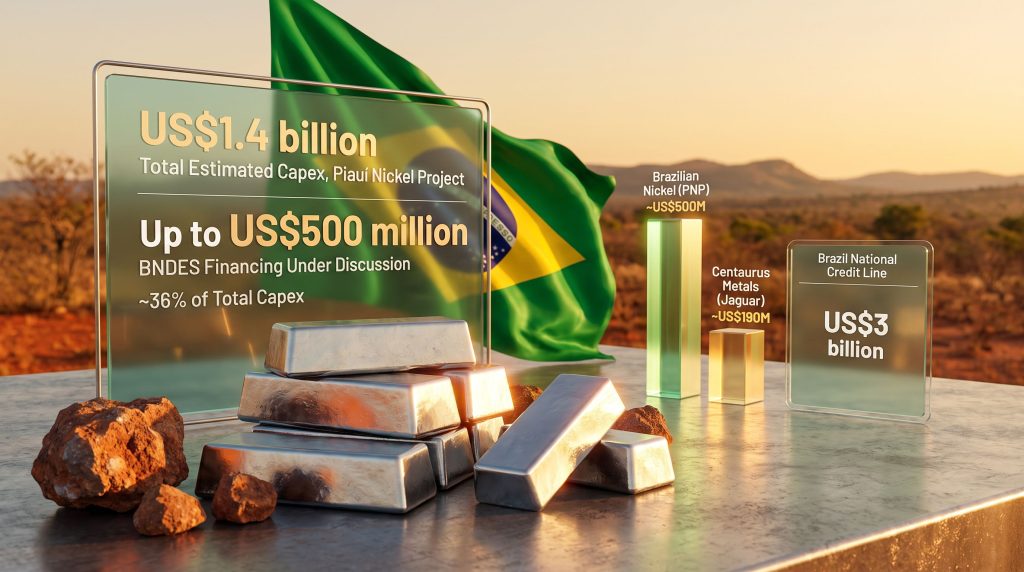
In July 2026, Brazilian Nickel confirmed it had secured an initial financing tranche from BNDES valued at R$100 million, equivalent to approximately US$20 million, directed specifically toward equipment procurement and services. This tranche represents the first concrete disbursement milestone in a broader financing conversation that has been actively developing between the company and BNDES, with discussions centred on a total BNDES contribution of up to US$500 million, representing approximately 36% of the project's total capital requirement.
Key Project Metrics at a Glance
| Metric | Detail |
|---|---|
| Total Estimated Capex | US$1.4 billion |
| BNDES Financing Under Discussion | Up to US$500 million (~R$1 billion) |
| BNDES Funding as % of Total Capex | ~36% |
| Project Location | Piauí State, Brazil |
| Current Status | Advanced financing negotiations; construction pending |
| Recent Equipment and Services Tranche | R$100 million (~US$20 million) |
The distinction between the equipment tranche and the broader financing package is important for investors to understand. The R$100 million facility is a near-term, operational deployment of capital aimed at mobilising procurement activities. The larger US$500 million financing discussion remains subject to due diligence completion, final project approvals, and BNDES internal credit processes. These are separate instruments at different stages of maturity.
How BNDES Structures Critical Minerals Project Finance
BNDES deploys capital through several instruments, the most relevant to large infrastructure and mining projects being the FINEM program, a long-term project finance facility designed for investments above a minimum threshold. FINEM financing typically carries below-market interest rates calibrated to Brazil's Long-Term Interest Rate, known as the TLP, making it materially cheaper than commercial bank debt in the Brazilian context.
For critical minerals projects specifically, BNDES has adopted a staged engagement model:
- Initial screening against strategic mineral criteria and alignment with national industrial policy objectives.
- Non-binding Letter of Intent (LOI) issuance, which signals conditional financing support without creating a legally binding disbursement obligation.
- Technical and environmental due diligence, including assessment of permitting status, community engagement, and ESG compliance frameworks.
- Credit approval and term sheet negotiation, leading toward binding financing agreements.
- Disbursement tranches tied to construction milestones and compliance conditions.
A BNDES Letter of Intent carries significant practical weight in project finance markets even though it creates no binding legal obligation. It functions as a credibility signal that enables developers to approach international co-investors, multilateral lenders, and offtake partners with a demonstrable anchor commitment from a sovereign institution, materially reducing the perceived risk profile of the project.
This staged structure means that the R$100 million equipment tranche secured by Brazilian Nickel represents a concrete execution milestone, distinct from but consistent with the progression toward the larger financing package.
BNDES's Broader Critical Minerals War Chest
The engagement with Brazilian Nickel does not occur in isolation. BNDES has assembled a substantial capital allocation framework directed at critical minerals development across Brazil, reflecting both domestic industrial policy ambitions and Brazil's positioning within Western-aligned battery supply chain initiatives. Notably, BNDES and Finep launched a USD $815 million fund for strategic minerals projects, underscoring the scale of institutional commitment behind this initiative.
BNDES Critical Minerals Capital Deployment Summary
| Program / Initiative | Funding Quantum | Target Minerals | Stage |
|---|---|---|---|
| BNDES-Finep Joint Screening Fund | R$5 billion (~US$815-900M) | Nickel, lithium, REEs, graphite | Development and innovation |
| Brazil National Credit Line (BNDES) | US$3 billion | Broad critical minerals | Project finance |
| FINEM Project Finance (Nickel) | R$1 billion (~US$190M) per LOI | Nickel | Construction-ready projects |
BNDES has reportedly screened more than 50 critical mineral development candidates as part of its structured evaluation process, with nickel sitting near the top of the priority hierarchy given its centrality to lithium-ion battery cathode chemistry, particularly nickel-manganese-cobalt formulations used in high-energy-density EV applications. Critically, BNDES has signalled a preference for projects that move beyond raw ore extraction toward downstream processing, with mixed hydroxide precipitate or battery-grade nickel sulphate production representing the value-add threshold the institution is seeking to support.
Brazilian Nickel vs. Centaurus Metals: Two BNDES Nickel Bets Compared
Brazilian Nickel's Piauí project is not the only nickel development seeking BNDES support. Centaurus Metals, developer of the Jaguar Nickel Sulphide Project in Minas Gerais and Pará, has already received a formal BNDES LOI under the FINEM framework, providing a useful comparator for understanding how BNDES scales its engagement relative to project size and readiness.
Comparative Project Finance Snapshot
| Factor | Brazilian Nickel (PNP) | Centaurus Metals (Jaguar) |
|---|---|---|
| BNDES Financing Sought | ~US$500 million | ~US$190 million |
| BNDES Instrument | Under negotiation | LOI issued (FINEM) |
| Total Project Capex | US$1.4 billion | US$380 million |
| BNDES as % of Capex | ~36% | ~50% |
| Construction Timeline | Pending financing close | Q3 2026 target |
| Project Location | Piauí State | Minas Gerais / Pará |
The Jaguar project's smaller scale and LOI issuance suggest it may reach a formal financing close and construction commencement ahead of Piauí. This creates an instructive dynamic: smaller projects may generate earlier proof-of-concept for BNDES's critical minerals financing model, potentially smoothing the path for larger, more capital-intensive projects like the Piauí Nickel Project at a later stage. Investors tracking Brazil's nickel development trajectory should monitor both projects as leading indicators of BNDES's execution capability and disbursement velocity.
The next major ASX story will hit our subscribers first
The Role of International Co-Financiers: DFC, European Instruments, and Multilateral Stacking
One of the less-discussed dynamics in Brazilian critical minerals finance is the deliberate stacking of sovereign and multilateral financing instruments to reduce the residual risk premium demanded by commercial lenders. The US International Development Finance Corporation (DFC) has publicly stated interest in Brazilian critical minerals projects as part of the broader Western effort to reduce reliance on Chinese-controlled mineral processing capacity.
Similarly, the European Commission's financing instruments, channelled partly through the European Investment Bank and the Critical Raw Materials Act framework, have created pathways for European capital to participate in upstream mineral projects in allied jurisdictions including Brazil. When BNDES anchors a project, it effectively signals eligibility for this multilateral stacking architecture, which is precisely why sovereign LOIs and initial tranches carry disproportionate signalling value relative to their nominal capital amounts. This also intersects directly with broader questions of critical minerals and energy security, which are increasingly shaping how Western governments and institutions deploy financing.
Western development finance institutions are increasingly using project-specific capital commitments as geopolitical instruments, deliberately structuring co-investment frameworks that price Chinese-affiliated capital out of strategic mineral supply chains. Brazil's alignment with this framework, without formally joining any exclusive alliance, represents a nuanced but commercially significant positioning.
Key Risks That Could Derail BNDES Financing Commitments
No analysis of Brazilian Nickel BNDES funding dynamics would be complete without an honest assessment of the risk landscape. Several categories of risk warrant close attention.
Sovereign and Policy Risk
BNDES's investment mandate is ultimately calibrated to Brazil's prevailing political economy. Shifts in government priorities, changes in the institution's leadership, or fiscal pressures on the federal budget could affect disbursement timelines or conditions attached to approved financing. Brazil's current Neoindustrialização policy framework explicitly supports domestic mineral value-add, which is currently supportive. However, policy frameworks can evolve.
Project-Level Permitting and Community Licensing
Piauí State presents specific environmental permitting complexities given its semi-arid ecology and the water-intensive nature of HPAL processing. Community licensing, often described in Brazilian mining practice as the informal social licence to operate, requires sustained engagement with local municipalities and indigenous land management authorities. These are not insurmountable challenges, but they represent genuine schedule risk for construction timelines.
Currency Exposure
With project capital denominated partly in Brazilian reais and revenue denominated in US dollars at international nickel prices, the project carries structural BRL/USD currency exposure. Financing structures that blend BNDES reais-denominated debt with US dollar-denominated international co-financing add complexity to hedging requirements.
Commodity Price Sensitivity
Nickel prices have experienced significant volatility, with the London Metal Exchange price declining sharply from the 2022 spike highs toward the US$15,000–17,000 per tonne range through 2024 and into 2025, pressured by Indonesian supply growth. The project's economic viability under different price scenarios warrants careful consideration. The evolving battery metals investment landscape provides useful context on how broader commodity dynamics are influencing capital flows into projects of this type.
Scenario Analysis: Nickel Price Thresholds and Project Viability
| Nickel Price (USD/t) | Project IRR Implication | BNDES Risk Appetite |
|---|---|---|
| Below US$14,000 | Marginal economics; financing at risk | Likely conditional hold |
| US$14,000–US$18,000 | Base case; financing viable | Active engagement |
| Above US$18,000 | Strong returns; accelerated disbursement | High confidence |
Disclaimer: The above scenario analysis is illustrative and does not constitute financial advice. Nickel price forecasts involve significant uncertainty, and investors should conduct independent due diligence before making investment decisions based on commodity price assumptions.
Brazil's Industrial Policy Dimension: Neoindustrialização and Mineral Sovereignty
The concept of mineral sovereignty has gained significant traction within Brazil's economic policy debate over the past several years. The Lula administration's Neoindustrialização agenda explicitly frames critical mineral processing capacity as a strategic national asset, analogous to the logic that drove Brazil's development of its oil and gas sector through Petrobras in earlier decades.
This policy orientation creates a structural alignment between BNDES's lending mandate and the broader objectives of projects like the Piauí Nickel Project, particularly where downstream processing commitments are embedded in the project design. BNDES has consistently signalled a preference for financing projects that deliver nickel in processed intermediate or final form rather than laterite ore, which incentivises developers to incorporate HPAL or other advanced extraction technologies into their project scope and capital plans.
ESG compliance requirements are integrated into BNDES disbursement conditions as standard practice. Projects seeking BNDES support must demonstrate alignment with Brazilian environmental licensing requirements, maintain credible community consultation records, and in some cases provide independent social and environmental impact assessments aligned with Equator Principles standards.
Global Supply Chain Implications: Brazil as a Non-Indonesian Nickel Source
The strategic importance of developing Brazilian nickel production capacity extends well beyond Brazil's borders. Indonesia currently accounts for more than 50% of global nickel mine output, a concentration that creates meaningful supply chain vulnerability for battery manufacturers and EV producers seeking to diversify away from single-country dependencies. The Philippines represents a secondary laterite supply source, but processing infrastructure remains limited.
Canada's nickel sulphide resources in the Sudbury basin offer high-grade ore but face cost structures that are substantially higher than tropical laterite operations. Brazil's combination of large laterite tonnages, improving processing technology economics, and sovereign financing support through BNDES positions it as one of the most credible candidates to emerge as a meaningful non-Indonesian Class 1 nickel supplier through the latter half of this decade. Furthermore, Brazil has already selected critical mineral projects for US$900 million in funding under the BNDES-Finep push, signalling the breadth of this national commitment.
Brazil vs. Key Nickel Jurisdictions: Comparative Development Profile
| Factor | Brazil | Indonesia | Philippines | Canada |
|---|---|---|---|---|
| Deposit Type | Laterite | Laterite | Laterite | Sulphide |
| Processing Pathway | HPAL | HPAL / NPI | Export ore | Smelting |
| Development Finance | BNDES active | State-bank backed | Limited | Commercial/private |
| Battery-Grade Output Potential | High | High | Low-Medium | High |
| Western Supply Chain Alignment | Strong | Limited | Moderate | Strong |
If Brazilian nickel projects reach commercial production at scale, they could contribute materially to the Class 1 nickel supply balance, particularly the mixed hydroxide precipitate segment that feeds battery precursor cathode active material production. This would, consequently, benefit cathode manufacturers in Europe, Japan, South Korea, and the United States seeking supply chain diversification.
Frequently Asked Questions: Brazilian Nickel and BNDES Financing
What is BNDES and why is it involved in nickel project financing?
BNDES is Brazil's federal development bank, established to finance long-term economic development projects that align with national strategic priorities. Its involvement in nickel project financing reflects Brazil's policy commitment to capturing downstream value from its critical mineral endowment rather than simply exporting raw ore.
How much has Brazilian Nickel secured from BNDES so far?
Brazilian Nickel has confirmed receipt of an R$100 million (~US$20 million) facility directed toward equipment and services for the Piauí Nickel Project, as reported in July 2026. Broader discussions regarding a financing package of up to US$500 million remain ongoing and have not yet reached binding agreement stage.
What is the difference between the R$100 million equipment tranche and the broader US$500 million financing discussion?
The R$100 million tranche is an executed, near-term financing instrument for procurement activities. The US$500 million represents the total BNDES contribution being discussed for full project construction finance. They are, however, at different stages of progression within the overall financing process.
What happens to the project if BNDES does not commit to the full financing package?
If BNDES does not commit to the full package, the company would need to source replacement capital from international co-investors, multilateral lenders, or equity markets. The initial equipment tranche provides operational momentum regardless of the broader financing outcome.
What Investors and Offtake Partners Should Monitor
For investors and battery supply chain participants tracking Brazilian nickel development, the following indicators will be most informative over the next 12 to 18 months:
- Formal BNDES LOI or credit approval for the Piauí Nickel Project beyond the equipment tranche, signalling progression toward full project financing.
- Centaurus Metals Jaguar construction commencement as a proof-of-concept for BNDES's ability to execute on its stated critical minerals financing ambitions.
- Nickel price recovery above US$18,000 per tonne, which would materially strengthen project economics and accelerate BNDES engagement across its screening pipeline.
- International co-financier commitments, particularly from DFC or European instruments, which would validate the multilateral stacking thesis.
- Environmental licensing milestones in Piauí State, which represent the critical path for construction readiness.
The structural lesson from Brazil's critical minerals financing evolution is that development banks are no longer just lenders of last resort. They are becoming the architectural backbone of an entirely new project finance model, one designed explicitly to compete with China's decade-long head start in vertically integrated mineral supply chains.
The Piauí Nickel Project's financing journey is both a company-specific story and a case study in how sovereign capital, industrial policy, and global supply chain strategy are converging in ways that are reshaping the economics of critical minerals development worldwide. Whether Brazilian Nickel BNDES funding progresses to full construction finance will be watched not just in Piauí, but in battery factories across Europe, Japan, and the United States.
Further Exploration: Readers seeking additional context on Brazil's critical minerals financing landscape and BNDES's evolving development mandate may find value in reviewing publicly available reporting from Mining Magazine at miningmagazine.com, which covers related developments across the Americas mining sector.
Want to Stay Ahead of ASX Mineral Discoveries as Critical Minerals Finance Evolves?
Discovery Alert's proprietary Discovery IQ model delivers real-time alerts the moment significant mineral discoveries hit the ASX, instantly translating complex geological and commodity data into actionable investment insights — ideal for investors tracking the critical minerals sector as development finance reshapes global supply chains. Start your 14-day free trial today and explore how historic discoveries have generated extraordinary returns for investors who moved early.