July 14, 2026
The Quiet Shift Reshaping Global Pipeline Supply Chains
For decades, the geography of large-diameter pipe manufacturing was largely fixed. European mills dominated offshore project supply, American producers controlled domestic infrastructure demand, and Asian manufacturers competed primarily on cost. That configuration is now fracturing under the weight of energy security priorities, surging offshore project pipelines across the Gulf, and a structural reassessment of where critical infrastructure components are sourced.
India has emerged as an unexpected fulcrum in this realignment. Its combination of engineering depth, competitive manufacturing economics, and growing technical certification capability has made it an increasingly credible source of high-specification pipeline products for the world's most demanding energy projects. Welspun Corp oil and gas export pipe orders accumulated over the past 12 months illustrate just how dramatically this shift has accelerated. Furthermore, commodity price impacts on input costs and project economics continue to shape the competitive landscape for all participants in this sector.
When big ASX news breaks, our subscribers know first
Breaking Down the July 2026 Order Win and What It Adds to the Backlog
In July 2026, Welspun Corp announced the securing of fresh export pipe orders valued at approximately ₹1,400 crore, designated for oil and gas projects and scheduled for execution from its Indian manufacturing facility. These orders are slated for delivery across FY27 and FY28, anchoring a meaningful slice of near-term production capacity.
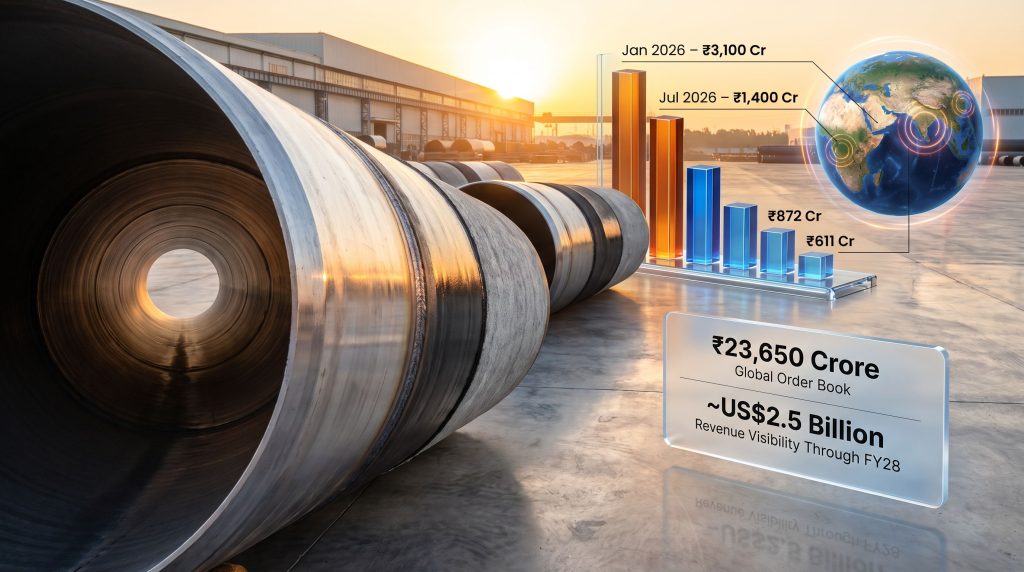
The more significant number, however, is what this win does to the cumulative picture. Since mid-2025, Welspun Corp's India facility has accumulated approximately ₹1,600 crore in international wins. Stacked against earlier contract announcements, the consolidated global order book has climbed to ₹23,650 crore, equivalent to roughly US$2.5 billion, spread across geographies and product categories.
To understand the scale of this accumulation, consider the recent order history across a compressed timeframe:
| Order Event | Approximate Value | Region | Product Type | Execution Window |
|---|---|---|---|---|
| July 2026 Export Win | ₹1,400 crore | Oil and Gas Export Markets | Line Pipes | FY27-FY28 |
| January 2026 Export Win | ₹3,100 crore | Americas | Large-Diameter Coated Line Pipes | FY26-FY27 |
| Earlier FY25 Win | ₹872 crore | Middle East (Sour Service) | Specialty Line Pipes | FY26 |
| Earlier FY25 Win | ₹611 crore | Latin America | Export Pipes | FY26 |
Across roughly a 12-month window, Welspun Corp has secured well over ₹5,000 crore in international pipe contracts. This is not a single opportunistic win capitalising on a temporary demand spike. It reflects a company that has systematically built the technical credentials, manufacturing capacity, and customer relationships required to compete for large-scale international energy infrastructure awards.
Why Welspun Corp Wins High-Specification Export Contracts
Technical Differentiation in a Commoditised Sector
Line pipe manufacturing, at its most basic level, is a commoditised business. Steel is formed, welded, and coated. Margins compress when buyers can substitute between suppliers freely. The way manufacturers escape commoditisation is through technical specialisation, and Welspun Corp has invested heavily in the capabilities that command premium contract values.
Its core export product strength centres on large-diameter Longitudinal Submerged Arc Welded (LSAW) line pipes. The LSAW process uses steel plate rather than coil, enabling the production of pipes with thicker walls and larger diameters suited to high-pressure transmission pipelines and offshore applications. This is technically distinct from HSAW (helical seam) or ERW (electric resistance welded) pipe production and requires different capital equipment and quality control systems.
Beyond the pipe itself, Welspun Corp's coating capabilities are a critical differentiator for offshore project supply. Two coating systems are particularly relevant:
- Anti-corrosion coatings protect against the aggressive electrochemical environment of subsea installations, where uncoated steel would degrade rapidly under sustained saltwater exposure
- Concrete Weight Coating (CWC) adds negative buoyancy to submarine pipelines, ensuring they remain stable on the seabed without requiring additional anchoring. CWC is a non-negotiable specification for most subsea pipeline projects and requires specialised application facilities
The company's capability to supply bends and fittings alongside mainline pipe sections is also meaningful. Energy companies prefer consolidated supply arrangements that reduce interface risk between component suppliers. A manufacturer that can deliver a complete pipeline system package commands stronger positioning in tender evaluations.
A recent Middle East offshore project illustrates the scale these capabilities unlock: the contract involved approximately 50 kilometres of pipeline and roughly 61,000 metric tonnes of bare pipes and bends, a volume that strains the capacity of most pipe mills globally.
The Anjar Facility as an Export Engine
Welspun Corp's Anjar plant in Gujarat serves as the primary production base for international export orders destined for the Middle East and other global markets. The facility's geographic location offers practical logistics advantages for Middle East project supply, with proximity to major Indian ports reducing transit times and freight costs relative to European or East Asian alternatives.
Critically, the company's United States manufacturing operations serve North American demand independently. This dual-geography model means that a surge in Americas pipeline demand does not cannibalise Anjar's capacity, and vice versa. Simultaneous execution of large contracts across multiple geographies becomes operationally feasible without one region crowding out another.
Anatomy of a US$2.5 Billion Global Order Book
What the Backlog Composition Reveals
A consolidated order book of ₹23,650 crore commands attention not simply for its size but for its composition. The backlog draws from multiple demand segments, reducing the earnings sensitivity any single sector downturn might create:
| Demand Segment | Geographic Focus |
|---|---|
| Oil and Gas Export Pipelines | Middle East, Americas |
| City Gas Distribution (CGD) | India |
| LNG Terminal Infrastructure | International |
| Water Pipeline Projects | India and Export Markets |
This diversification across end-use categories is strategically valuable. An oil price correction that causes upstream operators to defer capital expenditure would affect the oil and gas pipeline segment but leave CGD and water infrastructure demand largely intact. The company is not a pure-play bet on a single commodity cycle. In addition, the the global steel outlook for 2025 and beyond will influence input cost dynamics across all these segments.
Revenue Visibility Numbers That Matter to Investors
An order book providing multiple years of forward revenue coverage is not merely a financial metric. It fundamentally changes a manufacturer's operational posture, enabling long-term raw material procurement commitments, workforce planning, and capital allocation decisions with substantially reduced earnings uncertainty.
The specific visibility metrics are notable:
- US operations: approximately 8 quarters of forward revenue coverage from the current order book, with greater than 30% market share in the domestic line-pipe segment
- India operations: more than 4 quarters of forward revenue visibility from existing backlog, with execution extending through FY28
For investors, these figures reduce the analytical burden of modelling near-term revenue uncertainty. The core earnings trajectory through FY28 is substantially de-risked by committed orders rather than speculative demand forecasts.
Structural Forces Driving Sustained Global Demand for Export Pipes
The Offshore Investment Supercycle
GCC nations, particularly Saudi Arabia, the UAE, and Qatar, have entered an extended phase of upstream oil and gas infrastructure investment. This encompasses both new field development and the replacement of ageing offshore infrastructure. Subsea pipelines installed in the 1980s and 1990s are approaching end-of-design-life, creating replacement demand independent of any expansion in production capacity.
What makes this demand cycle particularly durable is that it is not exclusively dependent on high oil prices. National oil companies in the Gulf have long-term production mandates that persist across oil price cycles. Even during periods of lower prices, infrastructure investment continues at reduced but still substantial levels to maintain production capacity and meet domestic energy consumption requirements.
Americas LNG and the Pipeline Multiplier Effect
North American LNG export expansion has a multiplier effect on pipeline demand that is frequently underestimated. Each LNG export terminal requires not just the liquefaction facility itself but an entire upstream gathering and transmission network to deliver sufficient gas volumes. The LNG supply outlook for 2025 points to successive waves of terminal approval and construction activity, each generating associated pipeline build-out requirements.
Welspun Corp's ₹3,100 crore Americas order announced in January 2026 and its dominant US market position directly reflect this infrastructure multiplier dynamic. Consequently, Welspun Corp oil and gas export pipe orders to the Americas region are closely tied to the pace of LNG terminal commissioning.
The Energy Transition Paradox and Hydrocarbon Infrastructure Investment
A widely misunderstood dynamic in the current energy landscape is that the transition toward renewable energy has not reduced hydrocarbon infrastructure investment in the near to medium term. In many respects, it has intensified it. Nations pursuing energy security through domestic LNG reserves, or seeking to monetise existing hydrocarbon resources before long-term demand declines, are accelerating rather than deferring pipeline construction.
This creates a constructive demand backdrop for large-diameter pipe manufacturers that may extend well into the late 2020s, even as renewable capacity additions continue globally.
Risk Factors That Investors and Analysts Should Monitor
Concentration and Execution Risk
Despite the strength of the order book, several risk factors warrant careful monitoring:
- Single-facility concentration risk: Routing international export orders through the Anjar plant creates operational vulnerability. A regulatory issue, labour disruption, or natural event affecting that facility could disrupt delivery timelines on multiple contracts simultaneously
- Steel input volatility: Large-diameter pipe production is steel-intensive, and the company's profitability on fixed-price contracts is sensitive to movement in hot-rolled plate prices. Extended periods of steel price inflation can compress margins on contracted work. The China steel market, in particular, has historically influenced global steel plate pricing dynamics
- Technical compliance complexity: Offshore-grade pipe must satisfy demanding third-party certification requirements from international standards bodies. Any deviation from specification triggers rejection and rework costs that can materially affect project economics
Macroeconomic and Currency Exposure
Export contracts denominated in foreign currencies expose Welspun Corp to INR/USD exchange rate fluctuation. A strengthening rupee compresses the realised rupee value of dollar-denominated revenues. While the company likely employs hedging strategies, residual currency exposure remains a factor in margin analysis.
Oil price volatility also influences future order flow, even if it has limited impact on orders already in the backlog. A sustained decline in crude prices can cause energy majors and national oil companies to defer or cancel planned pipeline projects, reducing the pipeline of new awards available for competitive tender.
Competitive Intensity in Global Line-Pipe Markets
Chinese pipe manufacturers, backed by integrated steel production and significant scale, remain formidable competitors in price-sensitive international tenders. US-China trade tensions have, however, introduced additional complexity into global supply chain decision-making, sometimes redirecting procurement away from Chinese sources. European mills retain technical prestige in ultra-high-specification applications. Welspun Corp's competitive advantage lies in occupying the intersection of technical capability and cost competitiveness, a position that requires constant reinforcement through quality performance and manufacturing investment.
The next major ASX story will hit our subscribers first
Three Structural Themes Defining the Path Through FY28
Synthesising the order book data, technical capabilities, and demand drivers, three themes emerge as central to understanding Welspun Corp's strategic positioning:
- Export maturity: The company has demonstrably moved beyond reliance on India's domestic pipeline programme as its primary revenue driver. International orders now constitute a substantial and growing share of total backlog, reflecting genuine global competitiveness rather than home-market dependence
- Product sophistication as a margin moat: Offshore-grade coated pipes, sour-service specialty products, and complete pipeline system supply capability reduce the price comparability that compresses margins in commodity line-pipe markets
- Dual-geography manufacturing as a structural advantage: Operating independent production hubs in India and the United States allows simultaneous pursuit of global and domestic American demand without creating internal capacity conflicts that constrain growth
Forward indicators worth tracking include additional Middle East or Americas export contract announcements in the second half of FY27, the pace of order book conversion against the existing ₹23,650 crore backlog, and any capital allocation decisions relating to US facility expansion or Anjar capacity augmentation.
The accumulation of Welspun Corp oil and gas export pipe orders across multiple geographies, product categories, and execution periods reflects a structurally deepening competitive position in global energy infrastructure supply chains, not merely a favourable moment in the oil and gas investment cycle.
Disclaimer: This article is intended for informational purposes only and does not constitute financial advice or an investment recommendation. Readers should conduct independent research and consult qualified financial advisers before making investment decisions. Forward-looking statements regarding order execution, revenue visibility, and market positioning involve assumptions and uncertainties that could cause actual outcomes to differ materially from projections.
Want to Spot the Next Major Resource Discovery Before the Broader Market Does?
Discovery Alert's proprietary Discovery IQ model delivers real-time alerts on significant ASX mineral discoveries, instantly translating complex resource data into actionable investment insights for both short-term traders and long-term investors — explore historic examples of exceptional discovery returns and begin your 14-day free trial at Discovery Alert to position yourself ahead of the market.