July 14, 2026
The Structural Forces That Make Aluminium Price Corrections Misleading
Commodity price corrections rarely tell a single story. When metal prices fall sharply over a matter of weeks, the instinctive investor response is to interpret the move as a fundamental signal — a warning that demand is softening, that supply is overwhelming the market, or that a broader economic deterioration is underway. However, aluminium markets in mid-2026 offer a compelling counter-example, and the Vedanta NALCO or Hindalco aluminium stocks buying opportunity debate is at the centre of it. The correction that rattled Indian aluminium stocks was driven by the unwinding of a geopolitical risk premium, not by any measurable deterioration in the underlying demand picture.
Understanding why prices moved the way they did, and what the structural supply-demand balance actually looks like beneath the noise, is the essential starting point for any disciplined analysis of these three companies.
When big ASX news breaks, our subscribers know first
How the LME Aluminium Price Cycle Unfolded in H1 2026
Between January and June 2026, LME aluminium prices surged by approximately 25%, a move that had relatively little to do with a sudden acceleration in global consumption. The dominant driver was geopolitical anxiety centred on the Strait of Hormuz, the critical maritime chokepoint through which a significant portion of global commodity shipping flows. When shipping disruption risk rises in that corridor, markets price in supply-chain uncertainty across multiple raw materials simultaneously, and aluminium was no exception.
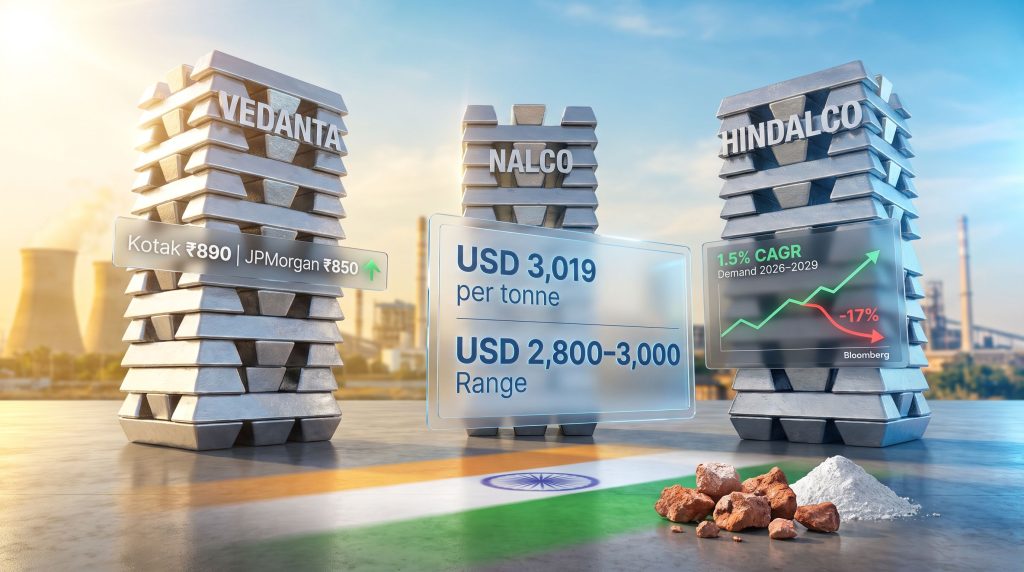
When West Asian tensions temporarily eased, that risk premium evaporated quickly. Prices pulled back by more than 17%, settling at approximately USD 3,019 per tonne. The speed of the reversal reflected how much of the preceding rally had been sentiment-driven rather than physically underpinned. Indian equity markets responded in kind:
- NALCO shares declined by over 19% from early June 2026 highs, the sharpest correction among the three major producers
- Hindalco fell by more than 15% over the same period
- Vedanta's specific correction magnitude was not uniformly disclosed across broker research at the time of writing, though the stock also experienced meaningful selling pressure
According to recent reporting on aluminium stock volatility, rising Chinese supply added further downward pressure on prices during this period, compounding the geopolitical unwinding effect.
"The critical insight for investors is that a price correction driven by geopolitical risk premium deflation is structurally different from one driven by demand destruction. The former creates valuation dislocations; the latter signals genuine earnings risk."
Why Geopolitical Price Swings Are Not Demand Signals
The distinction between geopolitical volatility and genuine demand weakness is one of the most consistently misread dynamics in commodity investing. Strait of Hormuz disruption risk inflates prices rapidly because traders and physical market participants price in worst-case logistics scenarios. However, the underlying consumption of aluminium in electric vehicle manufacturing, power grid infrastructure, and renewable energy installations does not pause because shipping routes become temporarily uncertain.
Analysts from JPMorgan, ING, and Kotak Securities maintained their forecast of a global aluminium deficit in 2026 even as prices were falling. Kotak Securities projected demand growth of 1.5% CAGR between 2026 and 2029, marginally ahead of a projected 1.3% supply growth rate over the same period. That narrow but persistent demand-supply imbalance is the structural underpinning that the short-term price volatility was obscuring. Furthermore, the aluminum and alumina markets have demonstrated similar patterns of geopolitical sensitivity in prior cycles, reinforcing the importance of distinguishing noise from signal.
What Global Supply Constraints Actually Mean for Prices
Indonesia's Ambition Gap: Capacity Targets vs. Operational Reality
Indonesia has positioned itself as a future aluminium production powerhouse, with stated plans to expand smelting capacity to 14.9 million tonnes by 2030. On paper, this represents a formidable addition to global supply. In practice, however, the gap between ambition and deliverable output is substantial.
The core constraint is power generation. Aluminium smelting is one of the most electricity-intensive industrial processes in existence, requiring approximately 13 to 15 megawatt-hours of electricity per tonne of primary aluminium produced. Indonesia's domestic power infrastructure is not currently scaled to support smelting operations anywhere near the stated capacity target. Analysts at Axis Direct estimated that realistic aluminium output from Indonesia by the end of the decade would reach only 3.4 to 3.5 million tonnes, a fraction of the headline figure.
| Metric | Indonesia Target (2030) | Analyst Realistic Estimate |
|---|---|---|
| Stated Smelting Capacity | 14.9 million tonnes | N/A |
| Projected Achievable Output | N/A | 3.4 to 3.5 million tonnes |
| Implied Execution Gap | Approximately 11.4 to 11.5 million tonnes |
Source: Axis Direct research estimates
This is a consequential divergence. If markets have partially priced in Indonesian supply additions based on headline capacity announcements rather than realistic output projections, the actual tightness of the global aluminium market could be meaningfully greater than consensus models suggest.
China's Structural Production Ceiling
China produces more primary aluminium than any other country and has been the dominant swing factor in global supply dynamics for more than two decades. But Chinese capacity expansion is now encountering a regulatory ceiling of approximately 45 million tonnes, imposed by environmental and energy policy constraints. As China industrial demand dynamics continue to evolve under policy constraints, the incremental supply additions that once regularly reshaped global market balances are no longer available as a pressure-release valve.
The combination of China's constrained ceiling and Indonesia's execution limitations creates a supply environment where the market's ability to absorb demand growth is more limited than the headline production numbers suggest. Hitesh Jain, Lead Analyst at Yes Securities, assessed that aluminium prices would likely trade in the USD 2,800 to 3,000 per tonne range over the medium term, with the structural deficit providing a sustained price floor.
The Hidden Cost Structure of Aluminium Production
One aspect of the aluminium supply picture that receives insufficient attention is the relationship between energy costs and the marginal cost of production. Unlike many metals where ore grade is the primary cost determinant, aluminium smelting economics are dominated by electricity tariffs. Producers with access to captive power generation, particularly coal or hydropower, operate at a structurally lower cost position than those dependent on grid electricity at market rates. This is precisely why Vedanta's vertically integrated model, which spans coal and power generation through to primary metal production, provides a meaningful competitive moat during periods of energy price volatility.
Are Indian Aluminium Stocks Attractively Valued After the Correction?
Sector Valuation in Context
The price correction compressed Indian aluminium producer valuations to levels that multiple analysts described as broadly fair to modestly attractive. Vinod Nair, Head of Research at Geojit Investments, noted that aluminium companies were trading close to their five-year average EV/EBITDA multiples, a normalisation from the premium valuations reached during the H1 2026 price surge.
Equally notable is the persistent valuation discount at which aluminium stocks trade relative to steel companies, despite aluminium's superior demand growth trajectory across key end markets. The commodity price impact on producer valuations is well-documented, and this discount has historically reflected aluminium's greater commodity price sensitivity and more capital-intensive production economics. It also, however, represents a potential re-rating opportunity if structural demand growth materialises as forecast.
Additional macro tailwinds supporting the valuation recovery thesis include:
- A weakening US dollar index, which typically provides a supportive backdrop for USD-denominated commodity prices
- Easing Federal Reserve rate trajectory concerns, reducing the cost-of-capital pressure on commodity equities
- Lower input costs for bauxite mining and coal procurement benefiting producer margins directly
| Company | Valuation Status | Key Competitive Advantage | Analyst Consensus |
|---|---|---|---|
| Vedanta | Near 5-year average EV/EBITDA | Vertically integrated, captive power | Buy: Kotak (₹890), JPMorgan (₹850) |
| NALCO | Near 5-year average EV/EBITDA | Debt-free, maximum price leverage | Buy/Strong Buy: Axis, IIFL, Emkay |
| Hindalco | Near 5-year average EV/EBITDA | Diversified, Novelis recovery optionality | Divided: Buy vs. Reduce |
Vedanta, NALCO, or Hindalco: Dissecting Each Investment Case
Vedanta: Integrated Operations as a Moat Against Volatility
Vedanta's aluminium business benefits from one of the most complete vertical integration structures among publicly listed Indian producers. The company controls the value chain from bauxite extraction and alumina refining through coal supply, captive power generation, and primary aluminium casting. This structure insulates margins more effectively during periods of input cost inflation or commodity price softness than a pure-play smelting operation dependent on third-party power and raw material supply.
Key investment thesis components:
- Ongoing capacity expansion programmes across multiple stages of the value chain
- Improving earnings visibility as expansion projects reach operational maturity
- Disciplined capital allocation and a stated commitment to balance sheet deleveraging
- Kotak Securities price target of ₹890, representing approximately 32% upside from mid-2026 levels
- JPMorgan upgraded the stock to Buy with a ₹850 price target, implying approximately 22% upside
- Rated as a top pick by Kotak, ICICI Securities, CLSA, and JPMorgan simultaneously — an unusually broad convergence of tier-one brokerage consensus
"The breadth of institutional buy-side alignment on Vedanta is notable. When multiple major brokerages with different analytical methodologies arrive at materially similar conclusions, it reduces the idiosyncratic risk of acting on any single analyst's recommendation."
NALCO: Pure-Play Leverage With Balance Sheet Resilience
National Aluminium Company offers investors the cleanest single-variable exposure to aluminium price recovery among the three listed producers. As a predominantly integrated bauxite-to-aluminium operation with a debt-free balance sheet, NALCO's earnings are highly sensitive to aluminium price movements in both directions, making the question of whether this is a Vedanta NALCO or Hindalco aluminium stocks buying opportunity particularly relevant here.
What makes NALCO structurally distinct:
- Zero net debt, providing resilience through cyclical downturns without the refinancing risk that pressures leveraged producers
- Maximum earnings leverage to an aluminium price recovery among the three companies, meaning every USD per tonne improvement in LME prices flows more directly to NALCO's bottom line
- Expanding alumina production capacity adds a growing revenue stream that benefits from both aluminium price strength and alumina market dynamics independently
- Currency depreciation tailwinds, as a portion of NALCO's revenues are realised in or benchmarked to USD while a significant share of costs are denominated in Indian rupees
- Long-term strategic optionality through rare-earth recovery projects being developed from bauxite residue, a developing area of value not yet reflected in mainstream valuation models
The 19% correction from early June 2026 highs positioned NALCO as offering the most compressed valuation entry point for pure-play aluminium exposure. Axis Direct, IIFL Securities, and Emkay all maintained Buy or Strong Buy ratings on the stock through the correction. Metal stocks expert commentary has similarly framed recent weakness as a potential accumulation opportunity for patient investors.
Hindalco: The Most Nuanced and Contested Investment Case
Hindalco presents a genuinely divided analytical community, which itself communicates something important about the stock's risk-reward profile. The company's business model extends beyond primary aluminium to include copper operations and, through its majority-owned Novelis subsidiary, a significant upstream aluminium recycling and rolling business with global operations.
The bull case rests on:
- Stable aluminium price support combined with falling input costs from lower bauxite mining and coal expenses
- New alumina refinery contributions incrementally improving margin structure
- Copper business providing earnings diversification and reducing reliance on aluminium price outcomes alone
- Novelis recovery trajectory, with the recycled aluminium and downstream rolling division positioned to benefit from rising global demand for low-carbon aluminium in automotive and packaging applications
The bear case is equally substantive:
- Kotak Securities, Emkay, and InCred Equities all carried Reduce ratings on Hindalco as of mid-2026
- InCred Equities issued price targets implying 25 to 37% downside from June 2026 levels, one of the more bearish stances among rated Indian industrial stocks
- The concern is that aluminium price tailwinds and Novelis recovery expectations may already be reflected in the stock's valuation, limiting incremental upside relative to the risk carried
"Hindalco is the only company among the three where major institutional brokerages are actively divided between accumulation and reduction. For investors considering a position, position sizing discipline and entry point management are more important here than with either Vedanta or NALCO."
In addition, the broader conversation around green metals pricing is increasingly relevant to Hindalco's Novelis division, as downstream buyers of low-carbon aluminium products become more willing to pay a premium for verified green content.
Key Risks That Could Undermine the Recovery Thesis
Risk Matrix for Indian Aluminium Producers
| Risk Factor | Nature of Impact | Probability Assessment |
|---|---|---|
| Renewed West Asian conflict escalation | Short-term price spike followed by mean-reversion | Moderate |
| Faster-than-expected global supply additions | Downward LME price pressure | Low to Moderate |
| US Federal Reserve rate trajectory hawkishness | USD strength suppresses commodity pricing | Moderate |
| Weaker global economic growth | Industrial demand compression | Low to Moderate |
| Chinese demand slowdown | Structural reduction in primary aluminium consumption | Low |
| Indonesian smelting capacity overperforming projections | Unexpected supply additions above 3.5 million tonnes | Low |
The EV/EBITDA Limitation as a Valuation Tool
One aspect of sector valuation analysis that sophisticated investors should recognise is that EV/EBITDA multiples, while useful for cross-sectional comparison, can be misleading in commodity industries where EBITDA is highly sensitive to spot commodity prices. A company trading at its five-year average EV/EBITDA multiple at the bottom of a price cycle may still be statistically cheap relative to mid-cycle earnings power. Consequently, contextualising the multiple against the prevailing aluminium price level is essential rather than treating it as a standalone signal.
The next major ASX story will hit our subscribers first
A Structured Framework for Approaching Aluminium Stock Entry Points
Given the persistence of macro and geopolitical uncertainty, a staggered accumulation approach was broadly recommended by analysts covering the sector. The practical application of this framework can be broken into four sequential steps:
-
Establish your aluminium price view. If you believe LME aluminium stabilises above USD 2,800 per tonne, producer margins at current cost structures remain healthy. Monitor LME weekly closing prices as the primary leading indicator.
-
Match stock selection to your risk tolerance. Conservative capital preservation focus suggests NALCO, given the debt-free balance sheet and direct price leverage. Growth-oriented investors may find Vedanta's broad analyst consensus and integrated cost structure more compelling. Diversification-oriented investors should weigh Hindalco's multi-commodity structure against the valuation division among analysts.
-
Define accumulation tranches and schedule. A staggered entry across three to four tranches over eight to twelve weeks reduces timing risk and allows averaging into positions across multiple price points rather than concentrating exposure at a single entry level.
-
Monitor the leading indicator set consistently:
- LME aluminium spot and three-month forward prices
- US dollar index directional trend
- Chinese monthly primary aluminium production data
- Indonesian smelting capacity commissioning updates and power infrastructure developments
- Indian producer quarterly earnings, particularly margin evolution relative to input cost trends
Furthermore, investors tracking the broader sector should note that top aluminium companies globally are facing broadly similar structural supply constraints, reinforcing the thesis that Indian producers are not uniquely exposed to these dynamics.
FAQ: Key Questions on Vedanta, NALCO, and Hindalco as a Buying Opportunity
Which stock carries the highest analyst price target upside among the three?
Vedanta holds the highest stated upside targets from tier-one brokerages, with Kotak Securities projecting ₹890 and JPMorgan setting an ₹850 target, implying approximately 32% and 22% upside respectively from mid-2026 trading levels.
Does NALCO offer better leverage to an aluminium price recovery than Hindalco?
Yes, for pure-play price leverage. NALCO's focused business model and debt-free balance sheet mean earnings respond more directly to aluminium price movements. Hindalco's broader diversification moderates both the upside sensitivity and the downside risk.
Why did Indian aluminium stocks fall so sharply in June 2026?
The correction was principally driven by the easing of Strait of Hormuz geopolitical tensions, which deflated a risk premium that had been built into LME aluminium prices over the preceding months. The price retreat of more than 17% flowed through directly into equity valuations, with NALCO falling over 19% and Hindalco declining more than 15% from their early June peaks.
What is the medium-term aluminium price range analysts are working with?
Yes Securities projected aluminium to trade within the USD 2,800 to 3,000 per tonne range over the medium term. JPMorgan, ING, and Kotak Securities all forecast a global aluminium market deficit persisting through 2026, with demand growing at 1.5% CAGR against 1.3% supply growth through 2029.
What is the single biggest risk to the aluminium sector outlook in H2 2026?
Analysts broadly identified geopolitical re-escalation in West Asia as the primary near-term risk, capable of triggering sharp aluminium price swings in either direction. Secondary risks include faster-than-expected supply additions and any hawkish shift in Federal Reserve policy that strengthens the US dollar.
Summary: What the Mid-2026 Correction Reveals About Indian Aluminium Stocks
Whether the Vedanta NALCO or Hindalco aluminium stocks buying opportunity is genuine ultimately comes down to the structural story beneath the volatility. The key takeaways are as follows:
- The H1 2026 aluminium price surge and subsequent correction reflected geopolitical risk premium dynamics, not a change in structural demand fundamentals
- Global supply constraints remain genuine: China's regulatory production ceiling and Indonesia's power infrastructure limitations both limit the market's ability to absorb demand growth
- Indian aluminium producers have reset to near five-year average EV/EBITDA multiples, offering a more rational entry point than the elevated valuations reached in mid-H1 2026
- Vedanta commands the broadest institutional buy-side consensus with the highest stated price targets; NALCO provides the cleanest pure-play exposure with zero net debt; Hindalco presents the most analytically contested case with genuinely divided brokerage opinion
- A staggered, disciplined accumulation strategy — rather than concentrated lump-sum entry — is the framework that best manages the residual macro uncertainty in the current environment
Disclaimer: This article is intended for informational and educational purposes only. It does not constitute financial advice or a recommendation to buy or sell any security. Commodity prices, analyst forecasts, and equity valuations are subject to rapid change. Readers should conduct their own due diligence and consult a licensed financial adviser before making investment decisions. Past performance and analyst price targets are not guarantees of future returns.
For ongoing coverage of LME aluminium price dynamics, Indian producer updates, and broader aluminium value chain analysis, AL Circle provides continuous sector reporting at alcircle.com.
Want to Know When the Next Major Mineral Discovery Hits the ASX?
Discovery Alert's proprietary Discovery IQ model scans ASX announcements in real time, instantly identifying significant mineral discoveries and turning complex data into actionable investment insights — giving subscribers a decisive edge before the broader market reacts. Start your 14-day free trial today, or explore Discovery Alert's discoveries page to understand how historic ASX mineral discoveries have generated substantial returns for early movers.