
August 4, 2026
The Hidden Value Unlock in Bulk-Tonnage Gold: Why Resource Confidence Matters More Than Size
In the world of ASX-listed gold development, raw resource tonnage attracts headlines, but it is the proportion of high-confidence ounces that genuinely moves the needle for institutional investors and project financiers. A deposit can hold tens of millions of tonnes of mineralised material, yet remain essentially stranded at the exploration stage if the bulk of those ounces sit in the Inferred category. The mechanics of how resource confidence translates into project economics, feasibility inputs, and ultimately reserve declarations is one of the most underappreciated dynamics in junior gold investing, and it sits at the heart of understanding the significance of the Brightstar Sandstone resource upgrade.
When big ASX news breaks, our subscribers know first
Sandstone in Context: A Murchison District Asset With Regional Pedigree
Western Australia's Murchison region carries a gold exploration and production history stretching back over a century. The district's geological architecture, dominated by Archean greenstone belts intruded by granitoid bodies, creates the structural setting that hosts orogenic gold systems across a broad geographic footprint. These systems are characterised by gold mineralisation concentrated along shear zones, fault corridors, and lithological contacts, producing the kind of laterally continuous, predictable grade distributions that bulk-tonnage open-pit mining economics depend upon.
Brightstar Resources (ASX: BTR) controls a substantial tenement package within this corridor through its Sandstone Gold Project. The asset benefits from proximity to regional infrastructure that reduces the capital intensity of a development pathway, a critical consideration for any junior developer navigating the gap between resource estimate and first gold pour. Within Brightstar's consolidated portfolio, Sandstone functions as the anchor asset, and the most recent resource update has materially reinforced that position.
What the Brightstar Sandstone Resource Upgrade Actually Delivers
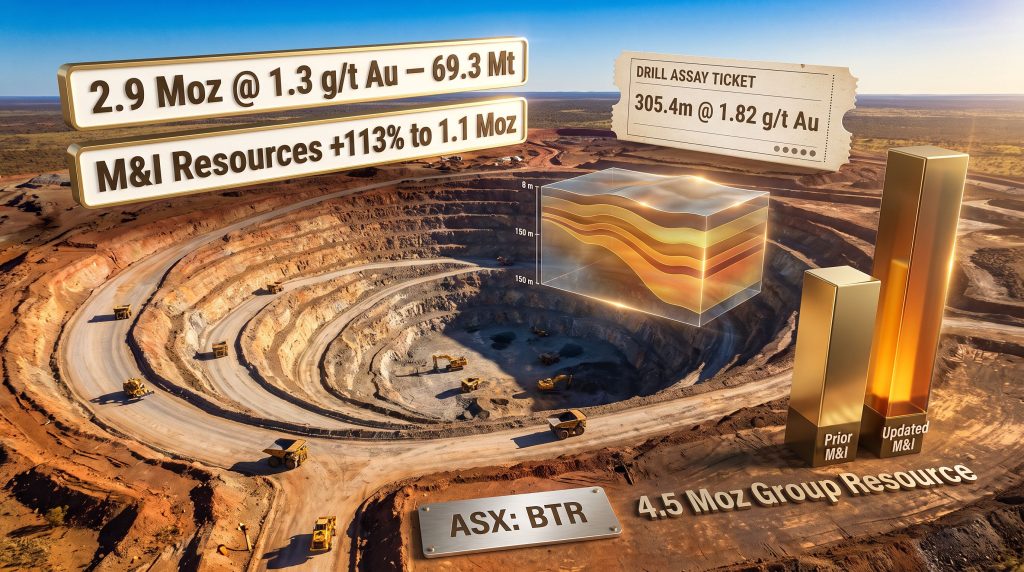
The updated Mineral Resource Estimate for the Sandstone Gold Project now stands at 69.3 million tonnes at 1.3 grams per tonne (g/t) gold, containing 2.9 million ounces (Moz). When viewed alongside Brightstar's group-wide consolidated resource base of 4.5 Moz, the scale of what has been achieved at the project level becomes clear.
The headline figures, however, only partially capture the significance of this update. The deeper story lies in the category-level breakdown:
| Resource Category | Tonnage | Grade (g/t Au) | Contained Gold |
|---|---|---|---|
| Total Sandstone Resource | 69.3 Mt | 1.3 g/t | 2.9 Moz |
| Measured + Indicated | Subset of above | 1.5 g/t | 1.1 Moz |
| Group Consolidated Total | Multi-asset | Blended | 4.5 Moz |
The Measured and Indicated component, which represents the highest-confidence resource classifications under the JORC Code 2012 framework, surged by 113% to reach 1.1 Moz at 1.5 g/t gold. The total resource grew by approximately 18%, but it is the M&I uplift that carries the most weight from a development pathway perspective.
A 113% increase in Measured and Indicated resources is not merely a volumetric achievement. It reflects a fundamental shift in the asset's technical maturity, moving from exploration-stage estimation toward the confidence thresholds required for mine planning, reserve declaration, and project financing.
Understanding Why M&I Classification Is the Critical Metric
The JORC Code 2012, administered under Australian securities regulations, establishes a classification hierarchy for mineral resources based on geological confidence:
- Inferred Resources are estimated with low geological confidence, typically based on wide drill spacing and limited sampling density.
- Indicated Resources require closer drill spacing and greater data density, providing moderate confidence in continuity and grade estimation.
- Measured Resources represent the highest confidence tier, supported by detailed drill patterns and thorough sampling, sufficient for detailed mine planning.
Crucially, Ore Reserves can only be derived from Measured and Indicated resources, never from Inferred material. This means that until a project converts sufficient ounces into M&I categories, it cannot declare an Ore Reserve, and without an Ore Reserve, it cannot support a bankable feasibility study or access project-level debt financing from major lending institutions.
The Brightstar Sandstone resource upgrade's M&I growth therefore represents far more than a confidence reclassification exercise. It is the enabling step for the entire development pathway downstream. Furthermore, understanding cut-off grade economics is essential when evaluating how much of this material can realistically be brought into an economic mine plan.
Drilling Results That Underpin the Numbers
The resource upgrade is supported by a substantial infill and extensional drilling program executed across the Sandstone tenement package. The standout result reported alongside the update, 305.4 metres at 1.82 g/t gold, warrants careful interpretation beyond the raw numbers. Interpreting gold drill results of this nature requires a clear understanding of what the intersection geometry tells us about deposit continuity.
An intersection of this length at this grade demonstrates two things simultaneously: the vertical and lateral continuity of the mineralised system, and the grade consistency required for bulk-tonnage economics. Short, high-grade intersections in orogenic systems can reflect localised bonanza zones that do not necessarily extrapolate across a deposit at scale. A 305-metre intersection, by contrast, speaks to a system with dimensions amenable to large-scale open-pit extraction.
The drill program design also reflects deliberate strategic thinking. Infill programs, which tighten the spacing between existing drill holes, are the mechanism by which Inferred resources convert to Indicated and Measured classifications. Step-out programs simultaneously test whether known mineralised zones extend beyond their current boundaries. Running both concurrently is resource-efficient but requires confident geological modelling to guide collar placement effectively.
Why Shallow Depth Is a Commercial Differentiator
A critical and frequently underappreciated aspect of the Sandstone resource is the depth profile. With a significant proportion of mineralisation sitting within the top 150 metres from surface, the deposit sits in a sweet spot for open-pit mining methodology.
Depth matters enormously in open-pit economics for a straightforward reason: the strip ratio, defined as the volume of waste rock that must be moved per tonne of ore extracted, increases as mining progresses deeper into a pit. Shallow orebodies allow lower strip ratios in the early years of production, which directly reduces operating costs per ounce and improves the economics of the critical early cash flow period that services development capital.
For a project of Sandstone's grade-tonnage profile, the combination of shallow depth and consistent grade distribution creates a compelling technical case for conventional open-pit mining feeding a carbon-in-leach (CIL) processing circuit, the dominant processing technology for oxide and transitional gold ores in the Western Australian goldfields environment.
Grade-Tonnage Profile: Where Sandstone Sits in the Competitive Landscape
Understanding where the Sandstone deposit sits within the broader universe of gold development projects helps contextualise its economic potential. Brightstar's Sandstone hub strategy, moreover, adds further strategic weight to these numbers:
| Project Type | Typical Grade Range | Typical Tonnage | Mining Method |
|---|---|---|---|
| High-grade underground | 3.0–8.0 g/t | Less than 10 Mt | Underground |
| Low-grade bulk open-pit | 0.5–1.0 g/t | Greater than 100 Mt | Open pit / heap leach |
| Medium-grade bulk open-pit | 1.0–2.0 g/t | 30–100 Mt | Open pit / CIL |
| Sandstone (BTR) | 1.3 g/t | 69.3 Mt | Open pit / CIL |
At 1.3 g/t across 69.3 Mt, Sandstone occupies the medium-grade bulk open-pit category, a profile that has historically supported economically robust operations across the Western Australian goldfields. This grade range sits comfortably above the economics threshold for CIL processing, while the tonnage scale provides the production volume needed to justify processing infrastructure capital expenditure.
Projects in the 1.0 to 2.0 g/t grade range with resources exceeding 50 million tonnes represent some of the most actively sought development targets by mid-tier gold producers seeking organic production growth without acquiring operating underground mines.
The Development Pathway: From Resource to Reserve to Production Decision
The Brightstar Sandstone resource upgrade positions the project at a specific inflection point in the standard development sequence for Australian gold projects. Understanding the remaining milestones helps frame both the opportunity and the timeline risk:
- Pre-Feasibility Study (PFS): The 1.1 Moz M&I resource provides the geological confidence base to underpin meaningful mine scheduling and economic modelling. A PFS converts resource data into preliminary mine designs, processing flowsheets, and capital cost estimates.
- Ore Reserve Declaration: Derived from Measured and Indicated resources, an Ore Reserve declaration under JORC Code 2012 represents the project's first formally audited economic asset. This milestone frequently triggers institutional re-rating events for ASX junior developers.
- Definitive Feasibility Study (DFS): The definitive feasibility study builds on the PFS with greater engineering detail, firmer capital cost estimates, and confirmed process design, sufficient to support project financing discussions with lenders and strategic partners.
- Metallurgical Testwork: Confirmatory testwork to establish gold recovery rates for the specific ore types present at Sandstone will be critical to validating processing assumptions within feasibility documents.
- Environmental and Heritage Approvals: Western Australia's regulatory framework requires environmental impact assessment and heritage surveys prior to mine development, a process with defined timelines but inherent uncertainty.
- Capital Markets Execution: Development capital for a project of this scale will require a well-structured financing strategy, potentially combining equity, debt, and strategic partnerships.
Earlier company disclosures had flagged a further Sandstone resource upgrade as a target for mid-2026, and the interim estimate released represents material progress against that objective.
The next major ASX story will hit our subscribers first
Portfolio-Level Significance: What 4.5 Moz Means for Brightstar
Brightstar's consolidated group mineral resource of 4.5 Moz positions the company within a comparatively rare cohort of ASX-listed gold developers holding multi-million-ounce portfolios without yet being in production. This scale matters for several reasons beyond simple headline metrics:
- Institutional investor thresholds: Many institutional mandates require a minimum resource scale before an asset qualifies for consideration, with 2 Moz frequently cited as a meaningful threshold at the project level.
- Strategic partnership optionality: Projects exceeding 2 Moz at the asset level attract attention from mid-tier and major gold producers seeking to add resources to their development pipelines through joint ventures, earn-in agreements, or outright acquisition.
- Portfolio risk diversification: A multi-asset resource base reduces the binary risk inherent in single-project exposure, providing development optionality across different geological and regulatory timelines.
Sandstone's 2.9 Moz contribution at the project level means the asset alone clears the institutional significance threshold, independent of Brightstar's other portfolio holdings.
Key Investment Considerations and Risk Factors
The technical picture presented by the Brightstar Sandstone resource upgrade is genuinely substantive, but investors should assess this milestone within a clear-eyed risk framework. Consequently, the following considerations warrant careful attention:
- Resource estimates are not Ore Reserves. The 2.9 Moz figure represents a geological estimate of in-ground material, not a statement of economic viability. Conversion to reserves requires demonstrating the material can be mined profitably under stated assumptions.
- Feasibility study outcomes are uncertain. Capital cost estimates, operating cost projections, and recovery rate assumptions in feasibility studies carry ranges of uncertainty that can materially affect project economics.
- Gold price sensitivity: At 1.3 g/t, Sandstone's economics will be meaningfully sensitive to the prevailing gold price at the time of production decision. The current gold price outlook for miners improves the economic case but cannot be assumed to persist indefinitely.
- Permitting timelines in WA: While Western Australia maintains a comparatively efficient approvals environment relative to many global jurisdictions, heritage surveys, environmental impact assessments, and Native Title processes introduce timeline variables that are difficult to predict with precision.
- Capital markets execution risk: Financing a development project of this scale requires favourable equity market conditions, investor appetite, and potentially strategic partner engagement, none of which can be guaranteed.
This article is intended for informational purposes only and does not constitute financial advice. Readers should conduct their own due diligence and consult a licensed financial adviser before making investment decisions.
Frequently Asked Questions: Brightstar Sandstone Resource Upgrade
What is the total resource size at Brightstar's Sandstone Gold Project?
The Sandstone Gold Project now hosts a mineral resource of 69.3 million tonnes at 1.3 g/t gold for 2.9 million ounces, following the most recent interim resource upgrade.
By how much did the Sandstone resource increase?
The total resource increased by approximately 18%, while Measured and Indicated resources rose by 113% to reach 1.1 Moz at 1.5 g/t gold.
What is Brightstar Resources' total group resource?
Following the Sandstone update, Brightstar's consolidated group mineral resource stands at 4.5 million ounces of gold.
Why does the shallow depth profile of the Sandstone resource matter?
A significant proportion of the resource sits within the top 150 metres from surface, which supports open-pit mining methodology, lowers strip ratios in early production years, reduces pre-production capital requirements, and decreases technical development risk compared to deeper underground scenarios.
What does the resource upgrade mean for the Pre-Feasibility Study?
The increase in Measured and Indicated resources provides the geological confidence level typically required to support robust mine scheduling and economic modelling within a PFS framework. In addition, it creates the foundational input needed for a maiden Ore Reserve declaration under the JORC Code 2012. Thorough drill result interpretation at each stage of this process remains essential for validating those assumptions.
What was the key drill intercept reported alongside the upgrade?
A drill result of 305.4 metres at 1.82 g/t gold was reported, demonstrating strong mineralisation continuity and grade consistency across the Sandstone system, attributes that are particularly important for validating bulk-tonnage open-pit assumptions.
How does Sandstone's grade-tonnage profile compare to peer projects?
At 1.3 g/t across 69.3 Mt, Sandstone occupies the medium-grade bulk open-pit category, above the economics threshold for conventional CIL processing and consistent with the profile of several operating Western Australian goldfield mines. This positions it favourably relative to lower-grade heap leach candidates while avoiding the higher capital and operational complexity of underground development.
Ready to Identify the Next Major ASX Gold Discovery Before the Market Moves?
Discovery Alert's proprietary Discovery IQ model scans ASX announcements in real time, instantly alerting subscribers to significant mineral discoveries — the kind of resource confidence upgrades and development milestones that can reshape a junior gold developer's trajectory overnight. Explore historic examples of major discovery returns and begin your 14-day free trial today to position yourself ahead of the broader market.