Brightstar Resources Ltd
- ASX Code: BTR
- Market Cap: $532,699,797
Brightstar Strikes Gold at Depth: 53 Visible Gold Occurrences Confirm New Discovery Zone at Two Mile Hill
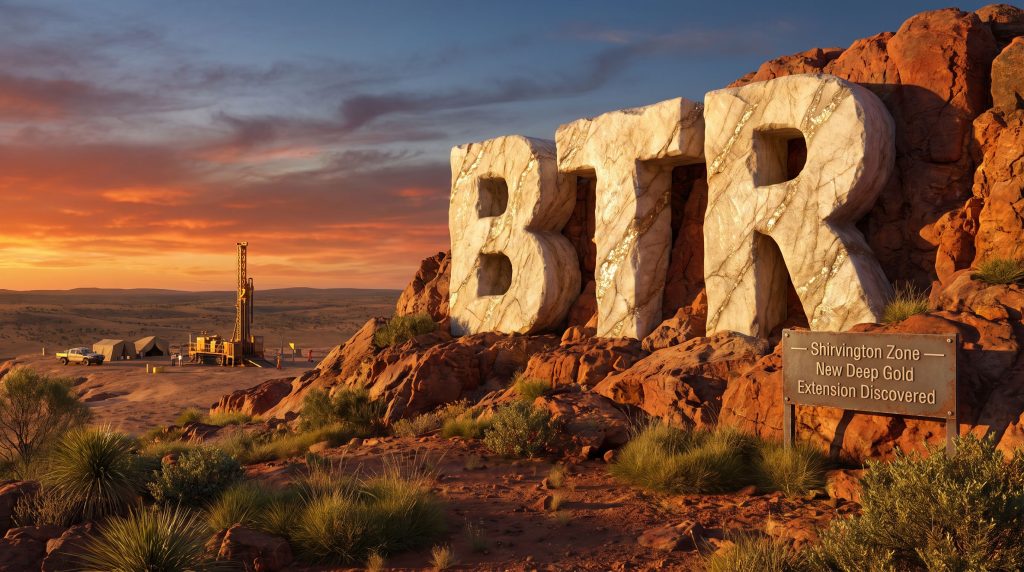
The Brightstar Resources Two Mile Hill visible gold discovery at Shirvington Zone marks a significant development for the company's exploration portfolio. Brightstar Resources (ASX: BTR) has reported widespread visible gold throughout deep diamond drilling at its Two Mile Hill deposit, part of the 2.9 million ounce Sandstone Gold Project in Western Australia. According to the announcement, 53 individual visible gold occurrences were logged across two completed drill holes, with both holes ending in mineralised rock well beyond their planned depths.
The newly identified zone, named the Shirvington Zone, sits approximately 700 metres below surface and represents a depth extension not previously captured in the existing resource model. Two further holes remain in the current approximately 3,400 metre diamond drilling program, with assay results anticipated in late September 2026.
When big ASX news breaks, our subscribers know first
What Was Drilled and What Was Found
The current program is designed to test the depth extension of the tonalite intrusion that hosts the Two Mile Hill gold deposit. Two holes have been completed, TMHDD26003 at 1,039.2 metres and TMHDD26004 at 888.3 metres, with TMHDD26003 recorded as Brightstar's first drill hole to exceed 1,000 metres in depth.
Both holes were extended beyond their originally planned depths after continuing to intersect mineralised tonalite without reaching the lower contact of the unit. According to the company, this is a notable geological observation, as the drill bits never exited the ore-hosting rock.
| Drill Hole | Type | Depth (m) | Visible Gold Occurrences | Status |
|---|---|---|---|---|
| TMHDD26003 | Diamond | 1,039.2 | 27 | Completed |
| TMHDD26004 | Diamond | 888.3 | 26 | Completed |
| TMHDD26005 | Diamond | TBD | Pending | Pending |
| TMHDD26006 | Diamond | TBD | Pending | Pending |
| Program Total | ~3,400 | 53 confirmed so far | 2 holes remaining |
Visible gold was observed throughout both holes, typically associated with galena and pyrite within quartz veins. In one instance, at 651.75 metres in TMHDD26004, gold was recorded within the tonalite rock itself, outside of any vein structure.
The company noted this vein-external occurrence may point to a more widespread, disseminated gold component within the mineralising system, in addition to gold controlled by vein structures.
A Closer Look: Visible Gold From Surface to Nearly 1,000 Metres
The distribution of visible gold occurrences across both holes was described as continuous rather than clustered in a narrow zone. Gold was observed repeatedly from approximately 500 metres depth to beyond 900 metres, indicating mineralisation throughout a thick sequence of tonalite.
TMHDD26003 Selected Visible Gold Occurrences
| Depth From (m) | Depth To (m) | Vein Type | Associated Minerals |
|---|---|---|---|
| 502.65 | 502.70 | Thin quartz vein | Gold, pyrite |
| 565.90 | 566.00 | Set of thin quartz veins | Gold, pyrite, galena |
| 639.48 | 639.56 | ~10cm quartz vein | Gold, galena, pyrite |
| 665.12 | 666.30 | ~1.2m quartz vein | Gold, galena, pyrite |
| 770.35 | 770.40 | Thin quartz vein | Gold, galena, pyrite |
| 904.89 | 907.85 | Set of thin quartz veins | Gold, galena, pyrite |
TMHDD26004 Selected Visible Gold Occurrences
| Depth From (m) | Depth To (m) | Vein Type | Associated Minerals |
|---|---|---|---|
| 516.00 | 517.00 | Set of thin quartz veins | Gold, galena, pyrite |
| 626.82 | 627.23 | 40cm quartz vein | Gold, galena, pyrite |
| 651.75 | 651.80 | Tonalite (no vein) | Gold, pyrite |
| 757.50 | 757.60 | Set of thin quartz veins | Gold, pyrite |
| 872.50 | 872.70 | ~20cm quartz vein | Gold, pyrite |
| 886.95 | 887.10 | ~10cm quartz vein | Gold, pyrite, galena |
The full table of 53 visible gold occurrences detailed in the announcement spans depths from approximately 500 metres to 908 metres in TMHDD26003, and 516 metres to 887 metres in TMHDD26004.
Important Note
Visible gold observations are geological indicators and should not be treated as a substitute for laboratory assay results. Assay samples have been dispatched, with results expected in late September 2026, at which point grade data will be reportable.
Understanding Tonalite-Hosted Gold Deposits
A tonalite is a type of coarse-grained igneous rock, formed when magma rises through surrounding rock and solidifies underground. At Two Mile Hill, this tonalite body acts as the primary host for gold mineralisation. Gold-bearing fluids have historically moved through the tonalite along fractures, depositing gold within quartz veins and, in some instances, directly within the surrounding rock.
A key concept for investors to understand is resource geometry. Mineral resource estimates are bounded by a defined geological envelope, essentially the interpreted edges of the ore-hosting rock body. If drilling confirms the host rock, and the gold it carries, extends materially beyond the current envelope, this can translate into direct upside to the stated resource figure.
Prior to recent drilling, the tonalite at Two Mile Hill was interpreted to extend to approximately 180 metres horizontal width. The latest two holes intersected tonalite widths of 400 to 500 metres downhole, and geological modelling now suggests the unit is greater than 300 metres wide horizontally at depth, with both holes ending inside the mineralised unit.
The Shirvington Zone is the name given to this newly confirmed depth extension of the tonalite. It sits below and beyond the current resource envelope and was not captured in the existing 731,000 ounce at 1.6 g/t gold resource estimate for the combined Two Mile Hill-Shillington deposit.
Building on an Earlier High-Grade Result
This drilling program follows an announcement on 3 August 2026, which reported one of the broadest and highest-grade intercepts in the company's history at Two Mile Hill.
TMHRCD26020 Key Intercepts (Previously Reported)
| Intercept | From (m) | Width (m) | Grade (g/t Au) |
|---|---|---|---|
| Broad intercept | 351.9 | 305.4 | 1.82 |
| High-grade sub-interval 1 | 351.9 | 17.5 | 9.68 |
| High-grade sub-interval 2 | 531.0 | 13.4 | 8.59 |
| High-grade sub-interval 3 | 586.7 | 34.6 | 4.11 |
That result prompted the four-hole extensional program now underway. The two completed holes were designed to follow the tonalite at depth and delineate the eastern and western contacts of the intrusion, a task that has proven more expansive than anticipated given neither hole has exited the mineralised unit.
Assay results from a separate, earlier infill drilling program conducted for the pre-feasibility study are also expected to be reported shortly, according to the company.
Managing Director's Perspective
Alex Rovira, Managing Director, Brightstar Resources
"The intersection of more visible gold and significant thickness of the mineralised tonalite is extremely exciting for Two Mile Hill. We're seeing notably thicker tonalite, with downhole widths of 400-500m in both completed holes, and gold-bearing quartz veins logged throughout the tonalite unit. This new extension to the tonalite at depth, the 'Shirvington Zone', presents material upside to the interpreted dimensions of the host unit and the current Mineral Resource envelope.""Excitingly, Brightstar's ongoing exploration success at our Two Mile Hill and Bull Oak deposits has drastically improved our understanding of the significance of these felsic intrusive units in Sandstone. There remain up to ten geophysical analogues in the central Sandstone area, proximal to Two Mile Hill, that remain undrilled and represent opportunities for multiple mineralised felsic intrusives throughout the Sandstone Greenstone Belt."
The Broader Sandstone Picture
Two Mile Hill sits within the Sandstone Gold Project, which hosts a total Mineral Resource of 2.9 million ounces at 1.3 g/t gold across multiple deposits. The portfolio spans a range of deposit styles and sizes, with the Two Mile Hill-Shillington system among the highest-grade contributors at 1.6 g/t gold.
Key Sandstone Deposits Resource Summary
| Deposit | Total Tonnes (kt) | Grade (g/t Au) | Total Ounces (koz) |
|---|---|---|---|
| Two Mile Hill / Shillington | 14,574 | 1.6 | 731 |
| Lord Nelson | 6,199 | 1.4 | 279 |
| Vanguard Camp | 3,809 | 1.7 | 205 |
| Indomitable Camp | 10,871 | 1.0 | 366 |
| Montague-Evermore | 4,805 | 1.6 | 241 |
| Whistler | 1,823 | 1.8 | 105 |
| Bull Oak | 10,537 | 1.0 | 322 |
| Total Sandstone | 69,337 | 1.3 | 2,868 |
Two Mile Hill is already the largest individual deposit within the Sandstone project by contained ounces. Furthermore, the company has indicated the Shirvington Zone has potential to add to this figure once assays are received and resource models are updated.
Ten Undrilled Targets Point to Further Exploration
The results at Two Mile Hill, together with the separately reported Bull Oak granodiorite deposit, have led Brightstar's geologists to identify felsic intrusive bodies, such as tonalites and granodiorites, as dominant controls on the largest gold deposits in the Sandstone Greenstone Belt.
Geophysical surveys have, consequently, identified up to ten additional felsic intrusive units in the central Sandstone area, proximal to Two Mile Hill, that have not been systematically drilled. Given that the Bull Oak granodiorite and Two Mile Hill tonalite represent two of the largest individual deposits in the belt, the company has flagged the presence of similarly unexplored bodies in the same corridor as a future exploration opportunity.
Upcoming Catalysts and Timeline
| Catalyst | Expected Timing |
|---|---|
| Assays from TMHDD26003 and TMHDD26004 | Late September 2026 |
| Assays from infill drilling (PFS-oriented program) | Shortly, per announcement |
| Results from remaining two holes of the program | Following drilling completion |
| Updated geological models incorporating Shirvington Zone | Post-assay |
| Future Mineral Resource updates | Following updated modelling |
| PFS workstreams | Ongoing |
| Exploration of undrilled felsic targets | Planning stage |
Investment Considerations
Brightstar is pursuing two parallel value streams: near-term gold production at its Goldfields Hub, and continued exploration at Sandstone. This announcement advances the latter.
Key takeaways from the announcement include:
-
Resource upside at depth is now geologically indicated. The Shirvington Zone sits outside the current resource envelope and would require an updated resource model to be captured. The existing 731,000 ounce at 1.6 g/t Two Mile Hill-Shillington figure does not include this zone.
-
Both holes ended in mineralised rock. The system remains open at depth, meaning further drilling will be required to define the full extent of the Shirvington Zone.
-
53 visible gold occurrences across 400 to 500 metres of tonalite width in two holes points to a mineralising system of scale, according to the company.
-
A 2.9 million ounce project with ten undrilled geophysical analogues offers additional discovery potential not yet reflected in current resource estimates.
-
Near-term production at Goldfields provides financial context. Brightstar is targeting first gold production at its Goldfields Hub in June 2027, supported by a feasibility study outlining more than 75,000 ounces per annum over six years, with approximately $1 billion in life-of-mine cashflows, a $606 million net present value and a 74% internal rate of return, as previously reported by the company.
The next major ASX story will hit our subscribers first
Glossary of Key Terms
Tonalite: A coarse-grained igneous rock that forms when magma solidifies underground. At Two Mile Hill, tonalite acts as the host rock for gold mineralisation.
Diamond Drilling (DD): A drilling method that extracts a continuous cylinder of rock, known as core, from underground. It provides detailed geological and structural information and is typically more expensive than reverse circulation drilling but is used for deep targets.
Visible Gold: Gold that can be observed with the naked eye in drill core. While not a substitute for laboratory assay, it is considered a strong qualitative indicator of mineralisation.
Mineral Resource Estimate (MRE): A formal, JORC-compliant estimate of the quantity and grade of mineral material considered to have reasonable prospects for eventual economic extraction, subdivided into Inferred, Indicated and Measured categories.
Shirvington Zone: The name given to the newly identified depth extension of the Two Mile Hill tonalite intrusion, confirmed at approximately 700 metres depth and interpreted to be greater than 300 metres wide horizontally.
Galena: A grey metallic mineral, lead sulphide, that commonly occurs alongside gold in quartz vein systems and is used as an indicator mineral for gold mineralisation.
JORC Code: The Australasian Code for Reporting of Exploration Results, Mineral Resources and Ore Reserves, the standard framework governing how ASX-listed companies report geological data.
Felsic Intrusive: A category of igneous rock, including tonalite and granodiorite, that is relatively light coloured and silica rich. At Sandstone, these intrusive bodies are considered key controls on the largest gold deposits identified to date.
Key Takeaway
The Brightstar Resources Two Mile Hill visible gold discovery at Shirvington Zone confirms a substantial depth extension that sits outside the current 731,000 ounce resource envelope. With 53 visible gold occurrences across 400 to 500 metres of mineralised tonalite in two drill holes, assays pending for late September, two more holes still to complete, and ten undrilled geophysical targets identified in the broader Sandstone belt, the exploration outlook for BTR carries multiple potential catalysts. Investors may wish to monitor upcoming assay results in the coming weeks for further confirmation of grade and continuity.
Want to Know More About Brightstar Resources and the Sandstone Gold Project?
With 53 visible gold occurrences confirmed at depth, a newly identified Shirvington Zone sitting outside the current resource envelope, and multiple upcoming catalysts — including assay results expected in late September 2026 — Brightstar Resources (ASX: BTR) is worth keeping a close eye on. Head to the official Brightstar Resources website to explore the full scope of the Sandstone Gold Project, the company's near-term production ambitions at its Goldfields Hub, and what the discovery at Two Mile Hill could mean for the investment case.