
July 10, 2026
The Quiet Revolution Reshaping West African Gold Mining
Across the Sahel, a structural realignment is underway that has little to do with commodity prices or exploration breakthroughs. The forces reshaping West African gold mining are political, ideological, and increasingly operational. For decades, the region's gold wealth flowed primarily through multinational private operators, with host governments collecting royalties and taxes while retaining limited direct stakes. That model is being systematically dismantled, and the Burkina Faso Bouboulou gold project permit awarded to state-owned miner SOPAMIB represents one of the clearest examples yet of this transition moving from policy paper to physical mine development.
Understanding what this means for investors, operators, and the broader West African gold sector requires more than reading a permit announcement. It demands a close look at the geological foundations, the economic logic, the policy machinery, and the unresolved questions that could determine whether this project becomes a blueprint or a cautionary tale. Furthermore, mining geopolitical risk across the Sahel has become an increasingly critical factor shaping how capital is allocated in the region.
When big ASX news breaks, our subscribers know first
SOPAMIB: From Dormant Entity to Operational Mining Vehicle
The Revival No One Predicted
SOPAMIB, the Société de Pensée et de Maintenance des Industries Minières, was created in 2014 during a period of democratic governance in Burkina Faso. For nearly a decade, it existed in name only, an institutional placeholder with no operational mandate and no active projects. Its revival under 2024 mining code reforms was not accidental. The revised code expanded the legal basis for direct state ownership of strategic mineral deposits, creating a pathway that had not previously existed in enforceable form.
The establishment of SOPAMIB Bouboulou as a dedicated project subsidiary mirrors a governance structure increasingly common across the Sahel. State-backed gold consolidation is reshaping how governments engage with their mineral endowments, moving away from passive equity participation toward full operational responsibility. This is a meaningful distinction, as direct development places the state in the role of operator, exposing it to both the upside and the execution risks that come with running a mine.
How SOPAMIB Fits Into the Regional State Miner Landscape
The table below contextualises SOPAMIB within the broader pattern of Sahel state mining entities, each of which shares a similar trajectory of creation during democratic periods followed by operational empowerment under military-led administrations.
| State Miner | Country | Established | Primary Role |
|---|---|---|---|
| SOPAMIB | Burkina Faso | 2014 (revived 2024) | Direct mine development |
| SOGUIPAMI | Guinea | 2011 | Mineral rights management |
| AGEM | Mali | 2023 | Strategic mine acquisitions |
| MIMCO | Niger | Restructured 2023 | Uranium and gold oversight |
"The activation pattern across these entities is strikingly consistent: created under civilian governments as institutional frameworks, then converted into operational instruments under administrations prioritising resource sovereignty over foreign investment attraction."
The Bouboulou Gold Project: Geological Fundamentals
Location and Structural Setting
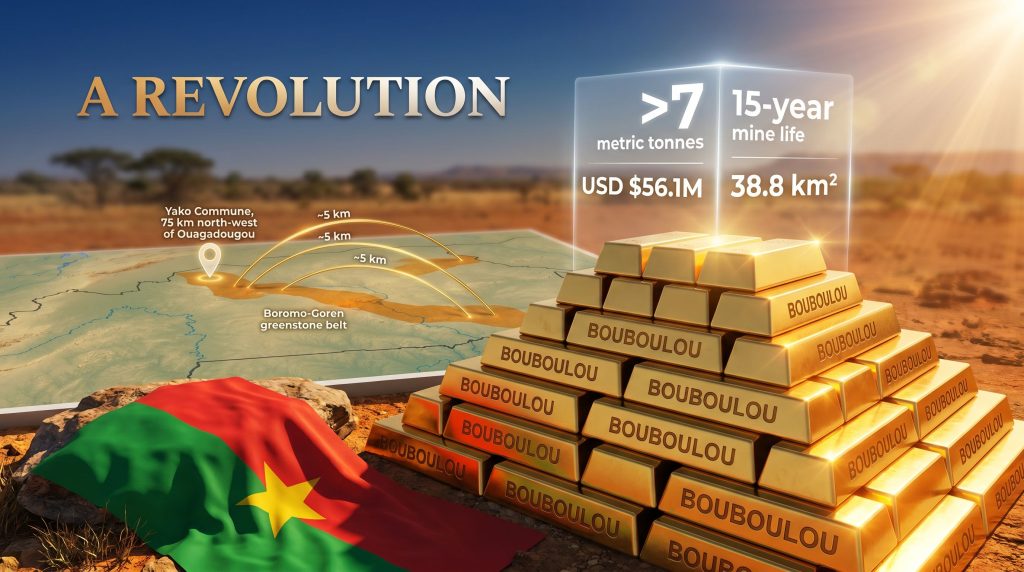
The Bouboulou project occupies 38.8 km² within the Yako commune of north-central Burkina Faso, positioned approximately 75 km north-west of Ouagadougou. Its location on the Boromo-Goren greenstone belt is geologically significant in ways that extend beyond the project boundary.
Greenstone belts are among the most productive geological settings for orogenic gold deposits globally. These ancient volcanic and sedimentary sequences, deformed and metamorphosed over billions of years, create the structural traps where gold-bearing hydrothermal fluids accumulate. The Boromo-Goren belt is considered one of West Africa's higher-priority gold-bearing terranes, sitting within a broader Birimian-age geological province that has generated some of the continent's most significant gold discoveries over the past three decades.
What makes the Birimian terranes of West Africa particularly attractive from an exploration standpoint is the combination of structural complexity and relatively shallow weathering profiles. The lateritic cap that covers much of the region preserves geochemical signals at surface, making anomaly detection through soil sampling and airborne geophysics comparatively efficient. This is a key reason why surface geochemical results carry meaningful predictive weight in this geological environment.
What the Historical Data Actually Tells Us
Historical exploration across the Bouboulou permit area identified three distinct gold-anomalous trends, each extending approximately 5 km in length. Geochemical sampling returned values exceeding 1 gram per tonne gold across these trends, a threshold that exploration geologists typically treat as the lower boundary for economically significant surface mineralisation in this style of deposit.
It is worth noting what this data does and does not confirm. Surface geochemical anomalies at this scale are strong indicators of bedrock mineralisation but do not constitute a mineral resource estimate under any internationally recognised reporting standard. The transition from anomaly to resource requires systematic drilling, assaying, and geostatistical modelling. Furthermore, interpreting gold drill results from airborne geophysics and historical drilling campaigns provides the foundational dataset, but the project remains at an early-to-intermediate development stage from a resource definition perspective.
Comparable producing operations on adjacent belt segments, including projects operated by Endeavour Mining, IAMGOLD, West African Resources, and Nordgold, provide geological analogues that support the prospectivity of the Boromo-Goren corridor. Structural positioning relative to these operations suggests Bouboulou sits within a productive mineralised trend rather than at its margins.
Project Economics: Parsing the Numbers
Key Metrics at a Glance
The Burkina Faso government's announcement included the following headline figures for the Bouboulou project:
| Metric | Stated Value |
|---|---|
| Required Capital Investment | More than 32 billion CFA francs (~USD $56.1 million) |
| Projected Mine Life | More than 15 years |
| Estimated Gold Production | More than 7 metric tonnes over mine life |
| Projected Direct Revenue | More than 39 billion CFA francs (excluding dividends) |
| Employment Creation | Approximately 1,200 direct and indirect jobs |
What the Revenue-to-Capex Ratio Suggests
A capital requirement of approximately USD $56.1 million positions Bouboulou as a mid-scale development within the West African context. The region's major privately funded operations typically require capital in excess of USD $300 million to USD $500 million for large-scale open-pit construction, meaning Bouboulou is sized more comparably to a junior or mid-tier developer's project than a major mining company's flagship operation.
The projected revenue figure of more than 39 billion CFA francs against a capital base of 32 billion CFA francs implies a revenue-to-capex ratio that looks attractive on paper. However, this figure excludes operating costs, sustaining capital, and the cost of debt or equity financing, none of which have been publicly disclosed. Without a full cost model, the net return profile cannot be independently assessed.
"Investors and analysts evaluating the project should treat the headline economics as directionally informative rather than definitive. The absence of disclosed financing arrangements introduces material uncertainty around whether the project can reach production on the stated timeline."
The Employment Dimension
The projection of approximately 1,200 direct and indirect jobs carries particular weight in north-central Burkina Faso, a region experiencing compounding economic pressure from prolonged security instability. For context, artisanal and small-scale mining already employs an estimated one million people across Burkina Faso according to the country's Ministry of Mines, making formal employment creation through large-scale projects a politically sensitive and practically important objective for the government.
Burkina Faso's 2024 Mining Code: The Regulatory Architecture
What Changed and Why It Matters
The 2024 mining code reforms introduced several provisions that collectively shifted the balance of power between the state and private operators. Key changes included expanded mandatory state equity participation thresholds, strengthened provisions for state acquisition of strategic deposits, and the legal framework that enabled SOPAMIB's operational revival. Bouboulou is now the fourth state-owned gold mine in an emerging portfolio that had no operational precedent before 2024.
The prior development model, in which private operators held exploration and exploitation licences while the state collected royalties and a minority equity stake, generated consistent revenue but left the government exposed to transfer pricing risks, revenue recognition disputes, and limited control over production scheduling. The new model trades these structural vulnerabilities for direct execution risk and financing responsibility. Consequently, mining consolidation trends across the region are now increasingly driven by state actors rather than private M&A activity.
The Nexus Gold Transition
Nexus Gold Corp. previously held a three-year renewable exploration work permit over the Bouboulou concession, awarded in 2024. The transition of industrial exploitation rights from a private exploration-stage holder to SOPAMIB illustrates precisely how the 2024 code's provisions operate in practice. The mechanics are not unique to Burkina Faso. Mali's AGEM has pursued comparable acquisitions, and Guinea has renegotiated several legacy agreements under similar legislative frameworks since 2021.
For private explorers active in the region, the Bouboulou case is an instructive data point. Exploration permits granted under the revised code do not carry the same expectation of progression to exploitation that they once did. The regulatory environment now explicitly reserves the right to redirect strategically significant discoveries toward state-led development pathways.
Resource Nationalism Across the Sahel: Pattern Recognition
A Regional Trend, Not an Isolated Policy
Mali, Niger, Guinea, and Burkina Faso have each enacted substantive resource sovereignty measures since 2020. The following characteristics define the regional pattern:
- Revised mining codes increasing mandatory state equity to between 15% and 35% across different jurisdictions
- Creation or reactivation of state mining entities with direct development mandates
- Renegotiation or cancellation of legacy agreements with private operators deemed unfavourable
- Reduced reliance on international arbitration mechanisms in favour of domestic dispute resolution
- Explicit framing of mineral wealth as a national strategic asset requiring direct state management
Implications for Private Capital Deployment
Existing operators including Endeavour Mining, IAMGOLD, West African Resources, and Nordgold continue to operate under their current permit frameworks, and there is no evidence that the Burkina Faso Bouboulou gold project permit directly threatens existing licences held by private companies. However, the regulatory direction creates a meaningful deterrent for new private capital entering the exploration and development pipeline.
The critical distinction for institutional investors is between operating risk and regulatory risk. In the current Sahel environment, these two risk categories are increasingly difficult to disaggregate. Security conditions affect logistics, workforce availability, and insurance premiums. Regulatory changes affect permit security, fiscal terms, and exit mechanisms. Together, they create a risk profile that requires recalibration of return expectations rather than simple avoidance. In addition, current gold exploration trends suggest that private capital is increasingly being redirected toward more stable jurisdictions as a result.
The next major ASX story will hit our subscribers first
Production Outlook and Timeline Uncertainties
Where Bouboulou Fits in Burkina Faso's Gold Sector
Burkina Faso ranks among Africa's top five gold producers. Annual national gold output has historically ranged between 50 and 70 tonnes, driven predominantly by large-scale privately operated mines. The Bouboulou project's projected lifetime production of more than 7 metric tonnes spread across a minimum 15-year operational life represents an average annual contribution of less than 0.5 tonnes per year at face value, an incremental rather than transformational addition to national output.
The more significant implication is structural. If the state successfully develops Bouboulou and applies the SOPAMIB model to additional concessions, the cumulative effect on the national production mix could be meaningful within a five-to-ten-year horizon. The immediate production contribution is modest; however, the precedent value is considerably larger.
Realistic Timeline Assessment
No official production commencement date has been disclosed. Based on comparable state-led mine developments across the Sahel, the timeline from permit award to first production has typically ranged from 24 to 48 months, subject to the following variables:
- Confirmation of financing structure and funding source
- Completion of feasibility-level engineering and procurement
- Construction of site infrastructure including power, water, and access roads
- Recruitment and training of operational workforce
- Security conditions in north-central Burkina Faso, which have deteriorated significantly since 2021
The absence of a disclosed financing plan is the most material near-term constraint. State-led mine development in resource-sovereign jurisdictions has frequently been delayed not by geological factors but by the practical difficulty of securing project finance on commercially viable terms when the sovereign credit rating and geopolitical environment discourage conventional lenders.
Frequently Asked Questions
What is the Bouboulou gold project?
The Bouboulou gold project is a state-owned gold mining development located in the Yako commune of north-central Burkina Faso, covering 38.8 km² on the Boromo-Goren greenstone belt approximately 75 km north-west of Ouagadougou. The industrial mining permit has been awarded to SOPAMIB Bouboulou, a subsidiary of Burkina Faso's state mining company. The official project details published by Nexus Gold provide useful background context on the concession's exploration history.
How much will the Bouboulou project cost to develop?
The project requires an investment exceeding 32 billion CFA francs (approximately USD $56.1 million). The Burkina Faso government has not publicly disclosed the financing structure or the source of project capital.
How much gold will Bouboulou produce?
The project is expected to produce more than 7 metric tonnes of gold over a mine life exceeding 15 years, generating more than 39 billion CFA francs in direct revenue excluding dividends.
What role did Nexus Gold Corp. play in the project's history?
Nexus Gold Corp. previously held an exploration work permit for the Bouboulou concession, valid for three years and renewable twice. Industrial exploitation rights have since been transferred to SOPAMIB under Burkina Faso's 2024 mining code framework.
What does the Bouboulou permit signal for the broader West African gold sector?
The permit demonstrates that Burkina Faso's resource sovereignty agenda is advancing from legislative reform to operational execution. It introduces elevated regulatory uncertainty for private capital seeking new exploration and development exposure in the region, while establishing a replicable state-led development model that could be applied to additional concessions.
Key Takeaways for Investors and Industry Observers
The Burkina Faso Bouboulou gold project permit is simultaneously a project-level milestone and a policy-level signal. Several conclusions emerge from a careful analysis of the available information:
- The project's headline economics, particularly the revenue-to-capex ratio, are directionally attractive but cannot be fully evaluated without a disclosed cost structure and financing plan
- SOPAMIB's activation as a direct mine developer rather than a passive equity participant marks a genuine structural shift in how the Burkina Faso state engages with its mineral endowment
- The Boromo-Goren greenstone belt's geological credentials are well-supported by regional analogues, but Bouboulou's resource base has not been publicly defined to international reporting standards
- The 24-to-48-month production timeline benchmark from comparable projects suggests first production is unlikely before 2027 at the earliest, and potentially later given unresolved financing questions
- For the broader West African gold sector, Bouboulou is a data point in a regional pattern that is accelerating rather than plateauing
This article contains forward-looking statements and projections based on publicly available information as of the date of publication. Project economics, production timelines, and regulatory outcomes are subject to material uncertainty. Nothing in this article constitutes financial or investment advice. Readers should conduct their own due diligence before making any investment decisions related to companies or projects operating in West Africa's mining sector.
Want to Track the Next Major ASX Mineral Discovery Before the Market Moves?
Discovery Alert's proprietary Discovery IQ model delivers real-time alerts on significant ASX mineral discoveries, transforming complex geological and market data into clear, actionable insights for both short-term traders and long-term investors. Explore Discovery Alert's dedicated discoveries page to see how historic discoveries have generated substantial returns, and begin your 14-day free trial today to position yourself ahead of the broader market.