
July 11, 2026
The Quiet Shift Reshaping West Africa's Gold Industry
Across the Sahel region, a structural transformation has been underway for several years, one that most international investors have either underestimated or misread entirely. The assumption that West Africa's gold wealth would continue to be extracted predominantly by internationally listed mining companies, with host governments collecting royalties and taxes at arm's length, is being methodically dismantled. What is replacing it is not simply a policy adjustment but a fundamental rethinking of who owns, operates, and benefits from mineral development at a national level.
This shift did not begin with a single announcement. It has been building through a series of legislative reforms, military-led governance changes, and institutional reconfigurations across Burkina Faso, Mali, and Niger that collectively signal something more durable than short-term nationalism. The granting of the industrial mining permit for the Burkina Faso Bouboulou gold project on July 9, 2026 is the clearest operational expression of this transformation yet. Furthermore, understanding this shift requires examining both its institutional roots and its practical implications for the broader geopolitical mining landscape across West Africa.
When big ASX news breaks, our subscribers know first
SOPAMIB's Decade-Long Journey From Paper Entity to Mine Operator
Understanding what the Bouboulou permit represents requires stepping back to examine the institutional history of SOPAMIB, Burkina Faso's state-owned mining company. Founded in 2014 during a period of relative political stability, SOPAMIB existed primarily as a legal and administrative structure for nearly a decade. It held no producing assets, deployed no capital, and generated no revenue. Its creation was more symbolic than operational, reflecting an aspiration toward state participation in mining rather than a concrete industrial strategy.
That changed decisively in 2024, when a series of structural and legislative reforms repositioned SOPAMIB as an active development vehicle. The reforms were not simply administrative. They reflected a deliberate political choice by Burkina Faso's military administration to move beyond the role of passive revenue collector and into direct mine ownership and operation.
How SOPAMIB's Subsidiary Model Works
The creation of project-specific subsidiaries, such as SOPAMIB Bouboulou S.A., is a particularly telling structural detail. Rather than channelling all activity through a single monolithic state enterprise, Burkina Faso has adopted a modular holding company model, where each mine is incorporated as a distinct legal entity under SOPAMIB's umbrella. This approach mirrors structures used by more mature state mining enterprises in other resource-rich nations and suggests a degree of institutional sophistication.
A useful regional comparison can be drawn with Guinea's state mining vehicles, which have employed similar subsidiary structures to manage separate commodity streams, and with Mali's increasingly assertive role in renegotiating mining terms with international operators. Niger has pursued a comparably nationalist trajectory, particularly following the restructuring of uranium agreements with French interests. Consequently, mining industry consolidation across the Sahel is increasingly being driven by state actors rather than private capital.
What the Bouboulou Gold Project Actually Involves
The Burkina Faso Bouboulou gold project is located in the Yako commune of north-central Burkina Faso, a region that sits within one of West Africa's historically productive gold-bearing geological corridors. The Birimian greenstone belt, which stretches across much of the region, has been the source of the majority of West Africa's hard rock gold discoveries and remains geologically prospective across wide areas that have not yet been fully explored or developed.
The permit approval by the Council of Ministers on July 9, 2026 represents a formal regulatory milestone, moving the project from the exploration and pre-development phase into the industrial mining classification under Burkina Faso's mining code. This distinction matters: industrial permits carry substantively different obligations around capital deployment, environmental compliance, and production commencement timelines compared to earlier-stage exploration licences.
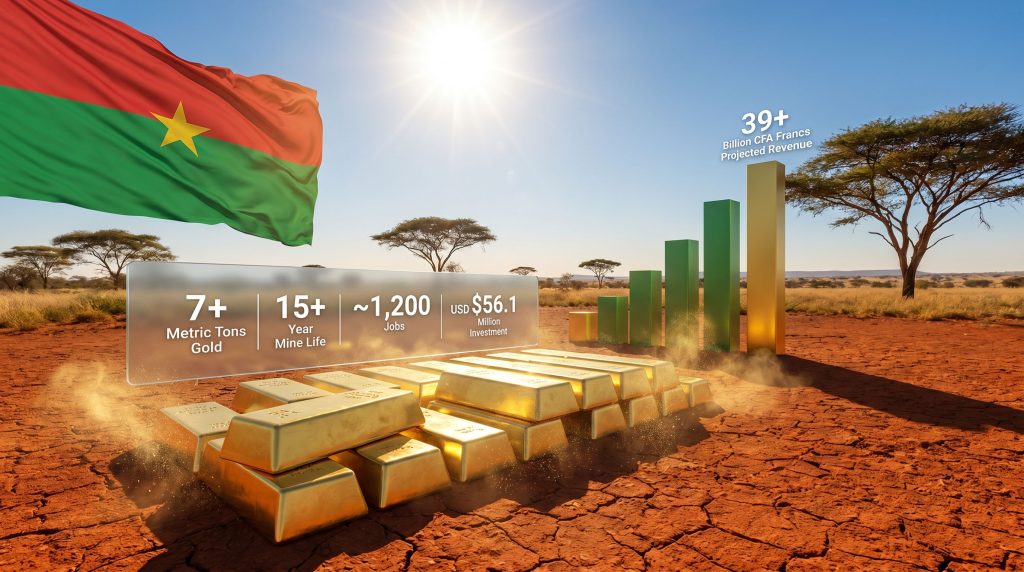
The project's core economics, as disclosed by the government, are summarised below:
| Metric | Detail |
|---|---|
| Permit Approved | July 9, 2026 |
| Operating Entity | SOPAMIB Bouboulou S.A. |
| Location | Yako Commune, North-Central Burkina Faso |
| Projected Gold Output | More than 7 metric tons over mine life |
| Mine Life | More than 15 years |
| Capital Requirement | More than 32 billion CFA francs (~USD $56.1 million) |
| Projected Direct Revenue | More than 39 billion CFA francs (excluding dividends) |
| Employment | Approximately 1,200 direct and indirect jobs |
| Historical Classification | First state-operated industrial gold mine in Burkina Faso |
One figure in the above table warrants particular attention: the exclusion of dividends from the 39 billion CFA franc revenue projection. In a state-owned mine context, dividends would flow back to the government as shareholder rather than to external investors. The fact that the stated revenue figure excludes this component suggests the actual fiscal benefit to the Burkinabe state is likely to be materially higher than the headline number implies, assuming the mine reaches projected production levels and the gold price outlook remains supportive.
The Bouboulou permit marks a concrete operational milestone: Burkina Faso's first industrial gold mine to be directly operated by the state, rather than licensed to a private or foreign operator. This is not simply a policy statement but a structural precedent.
State Mining vs. Private Operator Models: A Structural Comparison
For context, Burkina Faso's existing gold mining landscape is dominated by internationally listed private operators. Major companies including Endeavour Mining, IAMGOLD, West African Resources, and Nordgold have operated in the country across varying periods and project scales. These operators collectively represent a much larger near-term production base than Bouboulou's projected 7-tonne output over 15 years, which places the state project in realistic perspective.
However, the significance of Bouboulou is not primarily about production scale at this stage. It is about what model it establishes and whether that model replicates across additional state-controlled assets. In addition, the broader trend of gold M&A activity globally suggests that state participation models are reshaping how ownership and value are distributed across the sector.
| Dimension | Private Operator Model | SOPAMIB State Model |
|---|---|---|
| Capital Source | Foreign direct investment and equity markets | State-directed capital allocation |
| Profit Distribution | Dividends, royalties, and taxes to government | Direct retention of revenue by the state |
| Operational Risk | Borne by private shareholders | Borne by the Burkinabe state |
| Production Timeline | Market-driven and capital-access dependent | Politically influenced |
| Community Obligations | Contractual and CSR-based | State-mandated social obligations |
| Technical Capacity | Access to global mining expertise | Reliant on state capacity or partnerships |
The private operator model has historically delivered Burkina Faso a fiscal return through a combination of corporate income taxes, royalties calculated on production value, and in some cases, carried state equity interests. The state mining model, by contrast, retains the full operating margin but simultaneously absorbs the full capital risk and operational responsibility.
Whether this trade-off is economically advantageous for Burkina Faso depends heavily on two variables: the long-term gold price environment, and the government's ability to execute technically complex mine development without the institutional infrastructure that private operators typically bring.
The Financing Question: The Elephant in the Room
Among the details disclosed in connection with the Bouboulou permit, one critical piece of information was conspicuously absent: how Burkina Faso intends to fund the more than 32 billion CFA franc capital requirement.
The government's failure to disclose a financing structure for a project of this scale is not a minor administrative gap. It is the single most important unresolved question for the project's development timeline.
Potential funding pathways include:
- Sovereign balance sheet allocation from Burkina Faso's national budget
- Development finance institution lending from African or multilateral development banks
- Bilateral agreements with state-backed financial institutions from partner nations
- Revenue-sharing arrangements with equipment or technology providers structured as project finance
The absence of clarity here is consistent with a broader pattern observed across state mining initiatives in Sahelian countries, where announcements of intent have often preceded concrete financing arrangements by months or years. Investors and analysts tracking the resource nationalism trend in West Africa would be wise to treat project timelines as provisional until financing structures are confirmed and independently verified.
Bouboulou Within the Five-Project State Transfer Program
The Burkina Faso Bouboulou gold project does not exist in isolation. It represents the fourth mine brought under SOPAMIB's operational umbrella as part of a broader government initiative to transfer five gold mining projects to state control. This framing is important because it transforms Bouboulou from a standalone event into a data point within a systematic policy programme.
The sequential activation of these state assets raises several questions that carry implications for the broader mining investment environment in Burkina Faso:
- Whether the five projects targeted for state transfer include previously licensed private concessions or exclusively greenfield assets with no prior private-sector investment
- How production timelines across the five projects will be staggered, given shared constraints on state capital and technical capacity
- What the fifth and final project in the programme represents in terms of scale, geology, and strategic positioning
- Whether the programme's success with Bouboulou will accelerate state claims over additional concessions beyond the initial five
These are not hypothetical concerns. The trajectory of resource nationalism in Mali, where the government has moved progressively from renegotiation of terms to direct equity seizures in some mining arrangements, offers a cautionary precedent for how initial state participation programmes can expand in scope over time.
The next major ASX story will hit our subscribers first
Economic and Employment Dimensions
Can State Mining Deliver Real Community Benefit?
Beyond the headline production and revenue figures, the Bouboulou project carries meaningful implications for local economic development in the Yako commune region. The projection of approximately 1,200 direct and indirect jobs over the mine's operational life represents a significant employment base for a north-central region of Burkina Faso that has limited alternative industrial employment options.
State-operated mines in the African context frequently carry formal obligations around local hiring, supplier preference, and community infrastructure investment that may exceed what private operators would voluntarily commit to under standard CSR frameworks. Whether these obligations translate into durable economic benefits for surrounding communities, or remain aspirational targets, will depend substantially on the governance capacity of SOPAMIB Bouboulou S.A. as an operating entity.
Infrastructure co-benefits, including improved road access, expanded power supply, and water infrastructure investments associated with mine development, can also generate positive spillover effects for the Yako commune region that extend beyond direct employment numbers.
What This Means for International Mining Operators in Burkina Faso
For internationally listed gold mining stocks and producers active in Burkina Faso, the Bouboulou permit sends a clear directional signal, even if it does not immediately alter existing concession terms. The government's stated ambition to expand state control over mineral development, combined with the institutional activation of SOPAMIB across multiple projects, creates an environment in which private operators should anticipate:
- Increased pressure toward mandatory state equity participation in new project approvals
- More stringent local content requirements tied to workforce and procurement
- Potential renegotiation of royalty and tax structures as existing agreements approach renewal periods
- Greater scrutiny of profit repatriation and transfer pricing arrangements
None of these outcomes are certainties, and Burkina Faso continues to require the capital, technical expertise, and operational track record that major international mining companies bring. However, the policy direction established by the Bouboulou project permit makes it significantly more difficult for operators to assume that the pre-2024 regulatory environment will remain stable over medium-term investment horizons.
The Sahel-wide pattern of resource nationalism is not a temporary anomaly driven purely by military governance. It reflects deeper structural pressures around revenue adequacy, economic sovereignty, and public legitimacy that are likely to persist regardless of how the political landscape in the region eventually evolves.
This article is intended for informational purposes only and does not constitute financial or investment advice. Projections, timelines, and financial figures cited reflect publicly available government statements and are subject to change. Readers should conduct independent due diligence before making any investment decisions related to mining assets or companies operating in Burkina Faso or the broader Sahel region.
Want to Stay Ahead of Significant Mineral Discoveries Before the Broader Market?
Discovery Alert's proprietary Discovery IQ model delivers real-time alerts on significant ASX mineral discoveries, transforming complex mineral data into actionable insights for both short-term traders and long-term investors — explore historic examples of major discovery returns and begin your 14-day free trial today to secure a market-leading advantage.